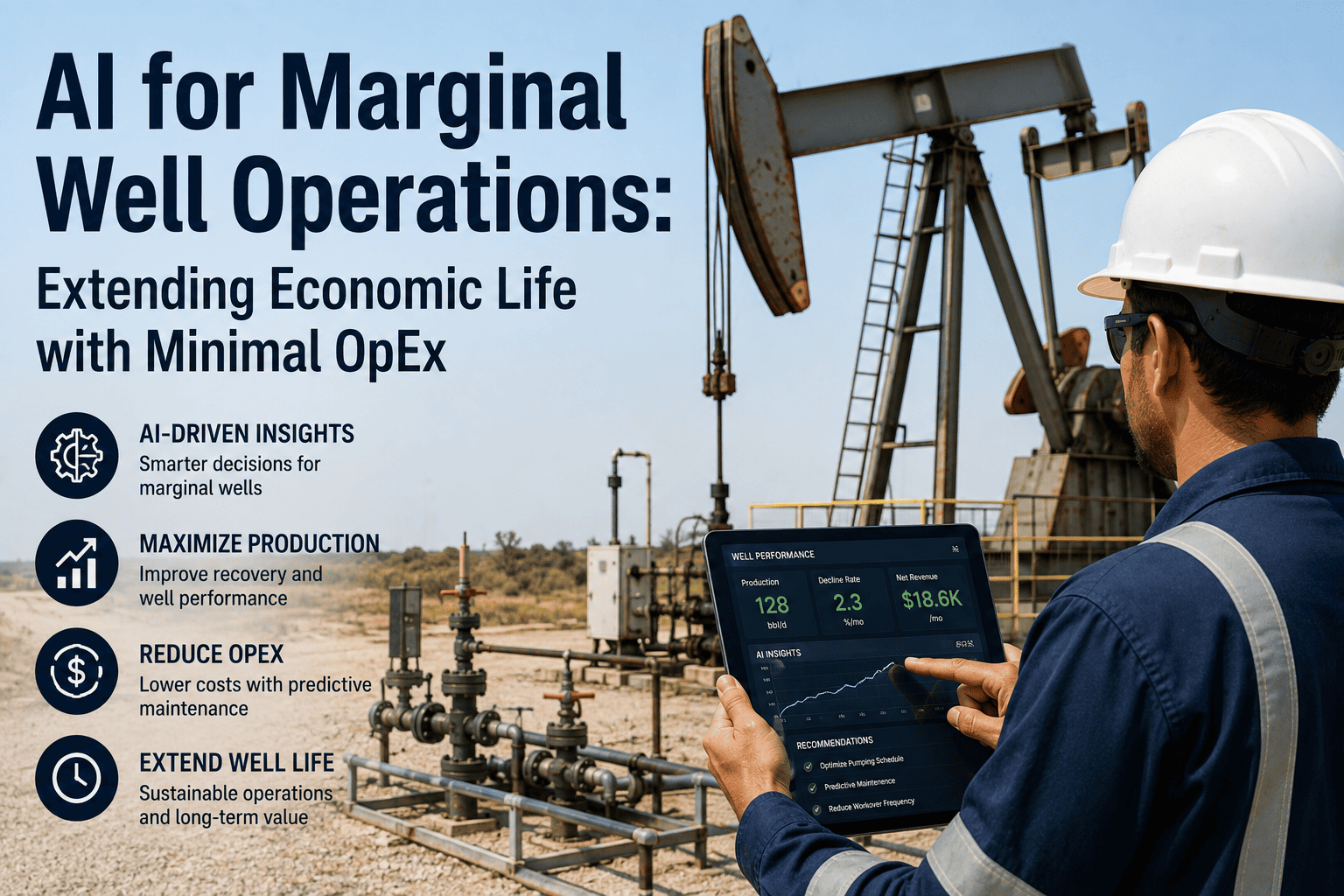
Most AI platforms built for oil and gas are priced and engineered for the wells that can absorb the cost. That leaves out the largest population of wells in the country. Roughly three out of every four producing wells in the United States pump 15 barrels of oil equivalent a day or less, and together this marginal well population still accounts for a meaningful share of domestic output. Monitoring these wells has traditionally meant either an expensive SCADA build-out that never pencils out, or a pumper driving a truck route and hoping nothing failed since the last visit. Talk to support about what low-cost, per-well AI monitoring actually looks like on a marginal well portfolio.
700,000+ Marginal Wells Produce Roughly a Tenth of U.S. Oil. Most of Them Still Run on Guesswork.
A marginal well only stays economic if operating cost stays low, which is exactly why most operators have never been able to justify enterprise monitoring on this part of their portfolio. iFactory brings AI-driven lift, chemical, and failure monitoring down to a per-well cost that actually fits marginal well economics, so wells that would otherwise get plugged early keep producing instead.
Why the Economics Here Are Different From Every Other Segment of the Portfolio
A marginal well is not a small version of a high-rate well, it is a fundamentally different economic object. The IRS defines a stripper oil well as one producing 15 barrels a day or less over a twelve-month period, and by that measure the majority of wells in the country now fall into this category. Individually, each well contributes little. In aggregate, this population still supplies a real share of domestic oil, and every barrel that goes offline early because of a preventable lift failure, an untreated corrosion problem, or a chemical treatment that ran dry is a barrel that had to come from somewhere else, usually at higher cost.
The margin on a well like this is thin by design, which means the cost of monitoring it has to be thin too. A platform built around a $2,000 to $5,000 per well setup, or a monthly fee calculated for a high-rate horizontal well, simply does not clear the hurdle on a well producing a handful of barrels a day. That mismatch is the actual reason so many marginal wells still run on a pumper's route schedule and a paper log instead of any form of continuous monitoring, not a lack of available technology.
There is also a demographic reality behind these numbers that matters for how operators plan around this segment. Marginal wells tend to concentrate in older, mature basins that have been producing for decades, often operated by small and mid-sized independents rather than the majors, and often with a single field superintendent responsible for hundreds of wellheads spread across a wide geographic area. That combination, thin per-well margin plus wide physical dispersion, is precisely what makes low-cost, remote monitoring valuable here even though it would be almost unnecessary on a tightly clustered, high-rate pad where a pumper drives past every well daily anyway.
Why Enterprise SCADA Was Never Built for This Segment of the Portfolio
Traditional SCADA and enterprise IoT platforms were priced around high-rate assets where a single well's revenue can absorb thousands of dollars in monitoring infrastructure without changing the economics. Marginal wells cannot absorb that cost structure, and pushing the same pricing model down to a fifteen-barrel-a-day well guarantees the project gets shelved. Low-cost AI monitoring built specifically for this segment inverts the cost model instead of scaling down an enterprise one.
| Cost Factor | Traditional Enterprise SCADA | Low-Cost AI Monitoring for Marginal Wells |
|---|---|---|
| Per-well hardware cost | Often $2,000 to $5,000+ installed | Designed around minimal sensor footprint and shared infrastructure |
| Ongoing monitoring cost | Priced for high-rate well economics | Roughly $50 to $100 per well per month |
| Deployment model | Well-by-well engineered installation | Standardized, batch deployment across a field or route |
| Data prioritization | Continuous full-resolution telemetry | Event and trend-focused, tuned to what actually changes an operating decision |
| Break-even threshold | Requires higher-rate production to justify | Pays for itself by preventing a single avoidable failure or truck roll |
The difference is not just price, it is design intent. A platform built for marginal wells has to answer one question well: is this well trending toward a problem that will cost more to fix later than it costs to catch now. Everything else is secondary to keeping the per-well cost low enough that monitoring hundreds or thousands of low-rate wells is still a net financial gain, not a rounding error that gets cut in the next budget cycle.
Monitoring That Actually Fits a $50-a-Day Well's Economics
iFactory's marginal well monitoring is priced and engineered for this segment specifically, not scaled down from an enterprise SCADA build. See what it costs to cover your marginal well count before you decide which wells to plug next.
Four Places Marginal Wells Lose Economic Life Before They Have To
A marginal well rarely fails all at once. It loses economic life gradually, through a series of small inefficiencies that individually look minor but compound over months into the difference between a well that stays profitable for another few years and one that gets marked for plugging earlier than necessary. AI monitoring earns its cost back by catching these leaks while they are still cheap to fix.
Each of these leaks is small on any single well. Multiplied across a portfolio of several hundred marginal wells, they add up to a meaningful share of the field's total operating margin, which is exactly the margin AI monitoring is designed to protect rather than replace.
Turning a Judgment Call Into a Data-Backed Economic Decision
Every marginal well eventually reaches a point where the decision to keep producing or plug and abandon has to be made, and that decision has historically leaned on operator experience and rough field averages more than well-specific data. AI monitoring changes the inputs available for that decision by tracking the actual trend, not the assumed one.
Neither list is a formula that decides the outcome automatically, but both turn a decision that used to rely on a field superintendent's memory of how the well has been acting into one backed by an actual trend line. Operators managing hundreds of marginal wells use this kind of portfolio-wide view to prioritize which wells get an optimization pass, which get a workover budget, and which get scheduled for plugging, instead of reviewing wells reactively one at a time.
This matters more now than it did a decade ago, because plugging liability itself has become a bigger line item on the balance sheet. State bonding requirements and orphan well cleanup programs have tightened in many basins, which means a well plugged prematurely still carries a sunk cost, and a well left unplugged long after it stopped being economic keeps accumulating regulatory and environmental exposure the longer that decision gets deferred. A data-backed keep-or-plug process reduces the number of wells sitting in that ambiguous middle zone, where nobody has affirmatively decided to keep producing or to plug, because nobody had the data to make the call with confidence.
Rolling Out Monitoring Across a Marginal Well Portfolio Without Breaking the Budget
Deploying AI monitoring across hundreds or thousands of low-rate wells only works if the rollout itself stays cheap, which means the approach looks different from a single-asset high-rate deployment. The phases below reflect how a portfolio-scale rollout is typically sequenced.
Where Marginal Well Monitoring Programs Fail to Pay for Themselves
Most marginal well monitoring initiatives that get cut are not cut because the technology failed, they are cut because the program was designed around the wrong assumptions from the start. A few patterns show up repeatedly.
Common Questions on AI Monitoring for Marginal Wells
What actually counts as a marginal or stripper well?
The most common definition, used for tax purposes and widely adopted across the industry, classifies a stripper oil well as one producing 15 barrels or less per day averaged over a twelve-month period, with a similar volume-based threshold applied to gas wells. Marginal well is a closely related but slightly different term that refers more broadly to economic viability rather than a fixed production number, since a well can be marginal at one oil price and profitable at another. In practice, most operators use the two terms interchangeably when describing the low-rate tail of their portfolio. Contact support to review how your well count breaks down against this threshold.
How is $50 to $100 per well per month even possible for continuous monitoring?
The cost stays low because the deployment model is standardized rather than custom-engineered per well, hardware is selected specifically for a minimal, low-power footprint instead of enterprise-grade sensor packages, and the data model prioritizes the trends and events that actually change an operating decision rather than continuous full-resolution telemetry that a marginal well does not need. This is a deliberate design choice built around marginal well economics from the start, not a scaled-down version of a system priced for high-rate assets. Book a demo to see the actual cost breakdown for your well count.
Does AI monitoring help decide when to plug a well, or only how to run it better?
Both, and the plugging decision is often where the larger financial impact sits, since a well plugged too early forfeits remaining economic production while a well kept producing too long past economic viability continues to accumulate operating and eventual plugging liability cost. Tracking lift efficiency, chemical cost per barrel, and failure frequency over time gives operators a trend-based view of where a well sits on that curve, rather than relying on a periodic field assessment that may already be several months out of date. Contact support to discuss portfolio-wide keep-or-plug reporting.
Can this be deployed across hundreds of wells at once, or does it need to start smaller?
Most operators start with a pilot batch, typically one pumper route or one field, so the cost savings and lift or chemical optimization results can be benchmarked against actual prior operating cost before committing budget to the full portfolio. Because the deployment model is standardized rather than engineered per well, scaling from a pilot batch to a full field or portfolio rollout does not require redesigning the approach, it just extends the same instrumentation and optimization process to more wells. Book a demo to plan a pilot batch sized to your operation.
Is this only useful for oil wells, or does it apply to marginal gas wells as well?
The same low-cost monitoring principles apply to marginal gas wells, which are classified under a similar low-volume threshold and face comparable economic pressure from fixed operating costs against declining production. Plunger lift performance, liquid loading trends, and compressor or wellhead equipment condition are the gas-well equivalents of the lift and chemical signals tracked on marginal oil wells, and both can be monitored through the same standardized, low-cost deployment model. Contact support to discuss monitoring across a mixed oil and gas marginal well portfolio.
Every Marginal Well You Plug Early Is Revenue You Didn't Have to Give Up
iFactory's low-cost AI monitoring is built specifically for the economics of marginal and stripper wells, turning lift, chemical, and failure data into decisions that extend economic life instead of ending it early. See what it looks like across your own well count.