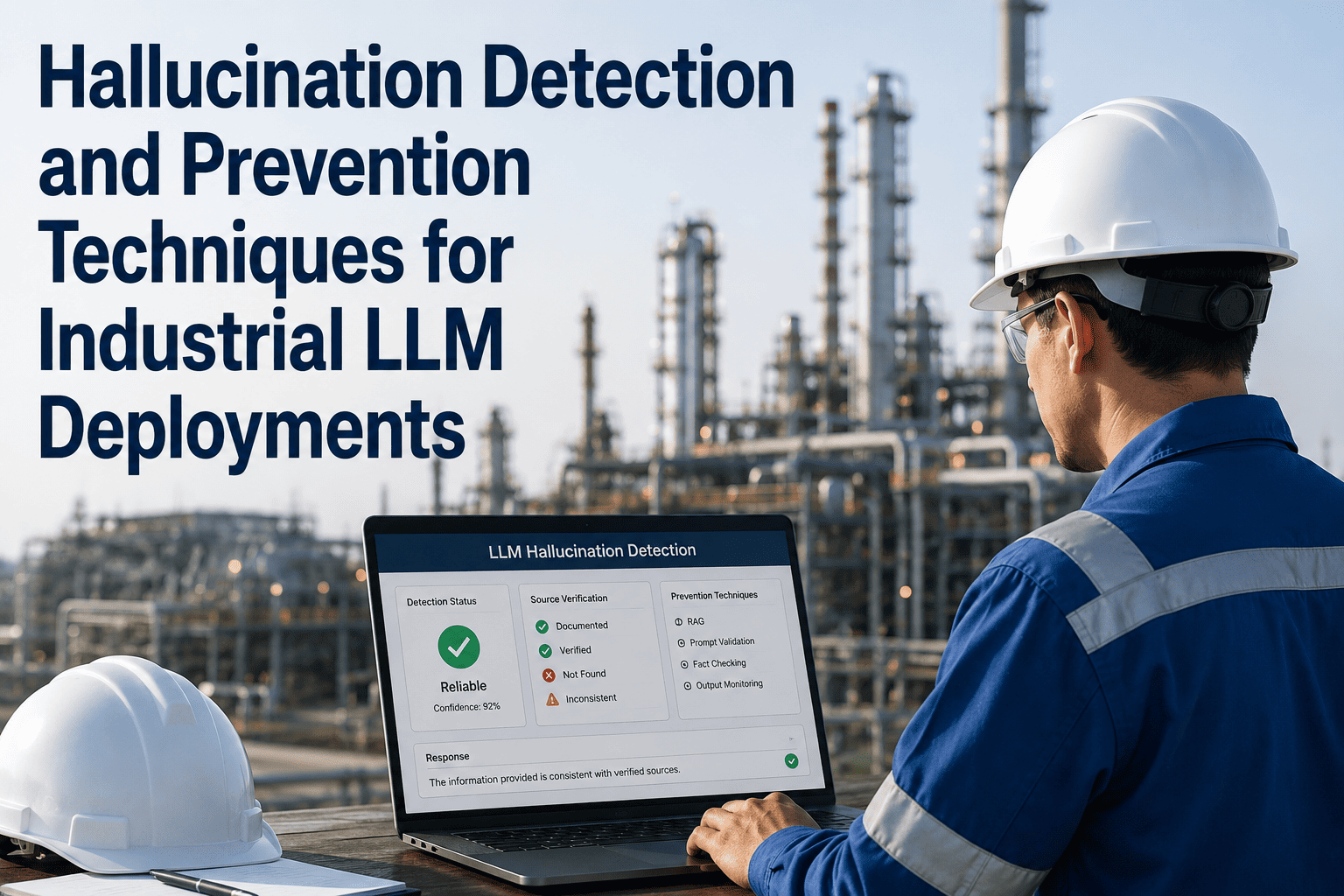
Ask a general-purpose LLM to explain the isolation sequence for a specific exchanger on a specific unit, and it will answer confidently — using patterns learned from millions of documents that have nothing to do with your plant. Enterprise benchmarks put commercial model hallucination rates between 15% and 52%, and that number climbs sharply the moment a question depends on facility-specific detail no public training data ever contained. Retrieval-augmented generation solves a different problem than a bigger model does: instead of asking the LLM to remember your P&IDs, SOPs, and permit history, RAG hands it the actual document at query time and instructs it to answer from that text alone, with a citation the reader can check in seconds. If you want to see what a grounded assistant looks like against your own plant documents, book a demo with our team.
A Model That Guesses Is a Liability. A Model That Cites Its Source Is a Tool.
Every plant runs on documents — P&IDs, SOPs, isolation procedures, incident reports, permit histories, equipment manuals. iFactory's RAG layer indexes all of it and forces every AI answer to trace back to a verified passage, so operators get a citation instead of a confident guess, and safety teams get an audit trail instead of a black box.
Why Grounding Is Not Optional in Process Operations
A hallucinated product recommendation is an annoyance. A hallucinated isolation step, a fabricated permit condition, or a misquoted alarm setpoint is a process safety event waiting to happen. The gap between a chatbot that sounds right and a system that is verifiably right is exactly the gap retrieval architecture is designed to close, and the industry data on both sides of that gap is stark. Most enterprise pilots that stall out at the proof-of-concept stage do so for this exact reason — the demo answered general questions convincingly, and then failed the moment someone asked it something only the plant's own documents could answer correctly.
Prompt engineering alone caps out at roughly a 15 percentage-point reduction in hallucination rate, because it never changes what the model is actually generating from. Retrieval changes the input itself — the model is answering from a retrieved passage of your SOP rather than from a statistical pattern learned across the open internet, which is why enterprise document Q&A treats RAG as the baseline architecture, not an optional add-on. The workforce numbers make the case even more directly: the same institutional knowledge that a retiring operator carries in their head is exactly the knowledge a retrieval index can capture and keep answerable long after that person has left the site.
What an Ungrounded Model Gets Wrong on a Live Plant
These are not hypothetical failure modes. They are the specific ways a general-purpose LLM, however capable, produces a confident and wrong answer when the question depends on facility-specific documentation it was never trained on and has no way to check. Each pattern below has the same signature: the answer reads fluently, uses the right vocabulary, and would pass a casual glance — which is exactly what makes it dangerous in a control room rather than harmless in a chat window.
Blended Procedure Versions
Asked for an isolation procedure, the model merges phrasing from a generic industry template with fragments of your actual SOP, producing a sequence that sounds plant-specific but was never approved by anyone on your site.
Outdated Revision Recall
The model answers from whatever version of a manual or standard it happened to see during training, with no awareness that your SOP was revised twice since, and no way to flag that the answer might be stale or superseded.
Fabricated Equipment Tags
Asked about a specific vessel or line, the model generates a plausible-looking tag number and spec that matches the pattern of your naming convention but does not correspond to anything on your actual P&ID or equipment register.
Confident Unit Conversion Errors
Pressure, flow, and temperature figures get restated with subtly wrong units or rounding, delivered with the same confident tone as a correct answer, because the model has no retrieved source document to check the number against before responding.
Invented Regulatory Citations
Asked to justify an answer against a standard or permit condition, the model cites a section number that sounds authoritative but does not exist in the actual regulation or the site's own permit documentation.
No Way to Verify the Answer
Even when the model happens to be right, there is no citation back to a source document, so an operator has no fast way to confirm the answer before acting on it, and no principled reason to trust it any more than an educated guess from a colleague.
Every one of these failures shares the same root cause: the model is generating from patterns in its training weights, not from a document it can point to. RAG does not make the underlying model smarter — it changes what the model is allowed to answer from, and that change alone accounts for most of the accuracy gap between a general chatbot and a system built for operational use.
How Retrieval-Augmented Generation Actually Works
RAG is a pipeline, not a single feature. Each stage exists to make sure the final answer is traceable back to a real passage in a real document, rather than a plausible-sounding synthesis the model produced on its own. Skipping any one stage reintroduces the same risk the whole architecture is built to remove.
Document Ingestion Across Every Source
P&IDs, SOPs, isolation and permit-to-work procedures, equipment manuals, incident investigations, and maintenance records are ingested and parsed into a structured index, including scanned and drawing-format documents that a standard text search would miss entirely, and legacy binders that have never existed in digital form before.
Chunking and Embedding for Retrieval
Each document is broken into meaningful passages and converted into vector embeddings that capture semantic meaning, so a question phrased differently from the source text still retrieves the right passage instead of relying on exact keyword matches that break the moment terminology varies slightly across documents.
Retrieval Against the Live Query
When an operator asks a question, the system retrieves the most relevant passages from the indexed documents in real time, ranked by relevance, and filters for the current approved revision so a superseded SOP version is never surfaced by mistake, even if it is still sitting somewhere in the archive.
Generation Constrained to Retrieved Text
The LLM is instructed to answer using only the retrieved passages as its source material, rather than drawing on its own training data, which is the mechanism that produces the 75 to 90 percent hallucination reduction seen in retrieval-grounded systems compared with prompting alone. If the retrieved passages do not actually answer the question, the model is instructed to say so rather than filling the gap with a plausible guess.
Citation Returned With Every Answer
The final response includes a direct reference to the source document and section it was drawn from, so an operator or engineer can verify the answer in seconds rather than trusting it on faith, and every query is logged for audit, giving safety and compliance teams a complete record of what was asked and what document supported each answer.
None of these five stages is exotic in isolation — vector search, document parsing, and prompt constraints are all established techniques on their own. What makes the pipeline effective is running all five together end to end, so a gap in any single stage never turns into an unverifiable answer reaching an operator on the floor.
See Your Own P&IDs and SOPs Grounding an AI Assistant
The difference between a demo built on generic documents and one built on your actual plant library is immediate. A 30-minute walkthrough shows exactly how retrieval, citation, and revision control work against documents you already have.
Standalone LLM Versus RAG-Grounded LLM
The two systems can use the exact same underlying model. What changes is where the answer comes from, and that single difference determines whether the output is something an operator can act on or something that needs independent verification before it can be trusted. The table below lays out the practical difference across the questions a safety or compliance reviewer would actually ask.
| Behavior | Standalone LLM | RAG-Grounded LLM |
|---|---|---|
| Source of the answer | Statistical patterns from training data | Retrieved passage from your own documents |
| Handles facility-specific detail | Guesses or fabricates plausible detail | Answers only from indexed plant documents |
| Citation with the answer | None — no way to verify quickly | Direct reference to source document and section |
| Reflects the current SOP revision | Frozen at training cutoff, unaware of updates | Retrieves the current approved revision automatically |
| Answer when no source exists | Still generates a confident-sounding response | Reports that no matching document was found |
| Auditability of every query | No structured log tying answer to a source | Full query and citation log for compliance review |
The last row matters as much as the first. A RAG system that cannot find a supporting passage is designed to say so rather than fill the gap with a guess, which is the behavior that makes it safe to put in front of operators making real decisions. That single design choice — refusing to answer past the edge of the retrieved evidence — is the practical difference between a tool a safety committee can approve and one it cannot.
What Gets Indexed on a Typical Refinery or Upstream Site
RAG is only as useful as the document library behind it. On an active oil and gas site, that library is large, mixed-format, and constantly revised — exactly the conditions that make manual document search slow and make retrieval architecture valuable. Most sites already have every one of these document types somewhere; the work is connecting them into a single index an assistant can actually query.
Piping and Instrumentation Diagrams
Vector and scanned P&IDs indexed so equipment tags, line specs, and instrument loops can be queried directly instead of manually traced across drawing sheets during a time-pressured troubleshooting call.
Standard Operating Procedures
Start-up, shutdown, and routine operating SOPs indexed with revision control, so a query always retrieves the currently approved version rather than an archived one an operator happened to save locally.
Isolation and Permit-to-Work Procedures
Lockout-tagout sequences and permit conditions indexed with their approval history, so an operator gets the exact required steps for that specific equipment rather than a generalized industry template.
Incident and Near-Miss Investigations
Past investigation reports indexed so root-cause patterns and corrective actions from similar events surface automatically when a related question comes up, instead of relying on someone remembering the incident happened.
Equipment and Vendor Manuals
OEM manuals and maintenance documentation indexed alongside internal procedures, so troubleshooting guidance reflects the specific equipment model and revision actually installed on site, not a generic product line.
Regulatory and Permit Documentation
Environmental permits and applicable regulatory text indexed together, so compliance questions are answered against the site's actual permit conditions rather than a generic summary of the underlying rule.
These document types rarely live in one system today — P&IDs sit in an engineering document management tool, SOPs in a quality system, incident reports in a separate EHS platform. Retrieval architecture does not require consolidating them into one repository first; it indexes across the systems you already use.
What This Means for Teams Evaluating AI on Process Operations
None of this requires a different, smarter model. It requires a different architecture around the model — one that treats your documents as the source of truth rather than a reference the model might loosely recall. The three takeaways below are the ones that come up most often once a site starts evaluating AI for anything beyond a chat interface.
Bigger Models Do Not Solve Facility-Specific Accuracy
No amount of general training data teaches a model your plant's tag numbering, your latest SOP revision, or your permit history. Only retrieval against your own documents can ground an answer in that reality, which is why teams that keep evaluating larger foundation models in search of better plant-specific accuracy tend to see the same failure modes repeat regardless of which model they test.
Citations Turn Trust Into Verification
An operator should never have to take an AI answer on faith. A citation back to the exact SOP paragraph or P&ID reference converts a confident-sounding claim into something checkable in seconds, which is the same standard already applied to any other safety-critical reference material used on a live unit.
Grounding Is How Institutional Knowledge Survives Retirement
With roughly half the experienced workforce approaching retirement, indexing SOPs, manuals, and investigation history into a retrievable system is what keeps that knowledge answerable instead of walking out the door with the people who wrote it, and it gives new hires a way to query the same judgment calls a veteran operator would have made from memory.
Frequently Asked Questions
Does RAG completely eliminate hallucinations?
No system eliminates hallucination entirely, but retrieval grounding is by far the most effective mitigation available, with reported reductions of 75 to 90 percent compared with prompting alone on enterprise document tasks. The remaining risk is managed through citation — every answer includes a reference back to its source passage, so even in the rare case where the model misreads a retrieved document, the operator has a fast way to check it rather than having to trust the answer blind. Systems can also be configured to decline to answer entirely when retrieval confidence is low, rather than filling the gap with a best guess, which further narrows the window where an unverified answer could reach an operator. To see the citation behavior demonstrated against real documents, book a demo with our team.
What document formats can actually be indexed for retrieval?
The ingestion pipeline handles native text documents, scanned PDFs requiring OCR, and drawing-format files such as P&IDs where equipment tags and line data need to be extracted from a technical drawing rather than plain text. Mixed-format libraries are the norm on an active plant, and the indexing process is built specifically to handle that mix rather than assuming everything arrives as clean text, including handwritten annotations on older drawings and multi-generation revisions of the same document that were never formally reconciled. Our support team can review a sample of your document library and confirm handling for any unusual formats — reach out to support here.
How does the system know it is using the current SOP revision and not an outdated one?
Revision control is built into the indexing layer, not left to the retrieval model to figure out. When a document management system marks a new revision as approved, the index updates and the prior version is flagged as superseded, so retrieval always surfaces the current approved text by default. Superseded versions remain searchable for audit and investigation purposes but are clearly labeled as historical, which prevents the exact failure mode where a general-purpose LLM answers from a frozen training snapshot with no awareness that anything has changed since. This is also what lets a site trust the assistant during an active revision cycle, when several document versions may exist in the system at once.
Can this be deployed without exposing sensitive plant data outside the organization?
Yes — the retrieval index and document store are deployed within the customer's own environment or a dedicated private instance, and the underlying model only ever sees the specific passages retrieved for a given query rather than the full document library at once. This keeps sensitive P&ID, permit, and incident data inside the site's existing security boundary, and access controls can be layered on top of the index so different roles retrieve only the document sets they are authorized to see. Our team can walk through the specific deployment architecture and data-handling controls on a scoping call — contact support to discuss your setup.
How long does it take to get a document library indexed and queryable?
A pilot scope covering a single unit's P&IDs, SOPs, and isolation procedures typically goes from document handoff to a queryable, citation-backed assistant within two to four weeks. Full-site libraries with mixed scanned and drawing-format documents take longer to ingest, since each document type needs its own extraction handling before it can be indexed reliably, and larger sites often phase the rollout unit by unit so the highest-value document sets go live first. Our team can scope a realistic timeline once we see a representative sample of your document set — book a demo to get started.
Stop Letting Your AI Guess About Your Own Plant
Every confident wrong answer starts the same way — a model with no document to check itself against. Let us show you what a grounded, citation-backed assistant looks like running on your own P&IDs, SOPs, and procedures.