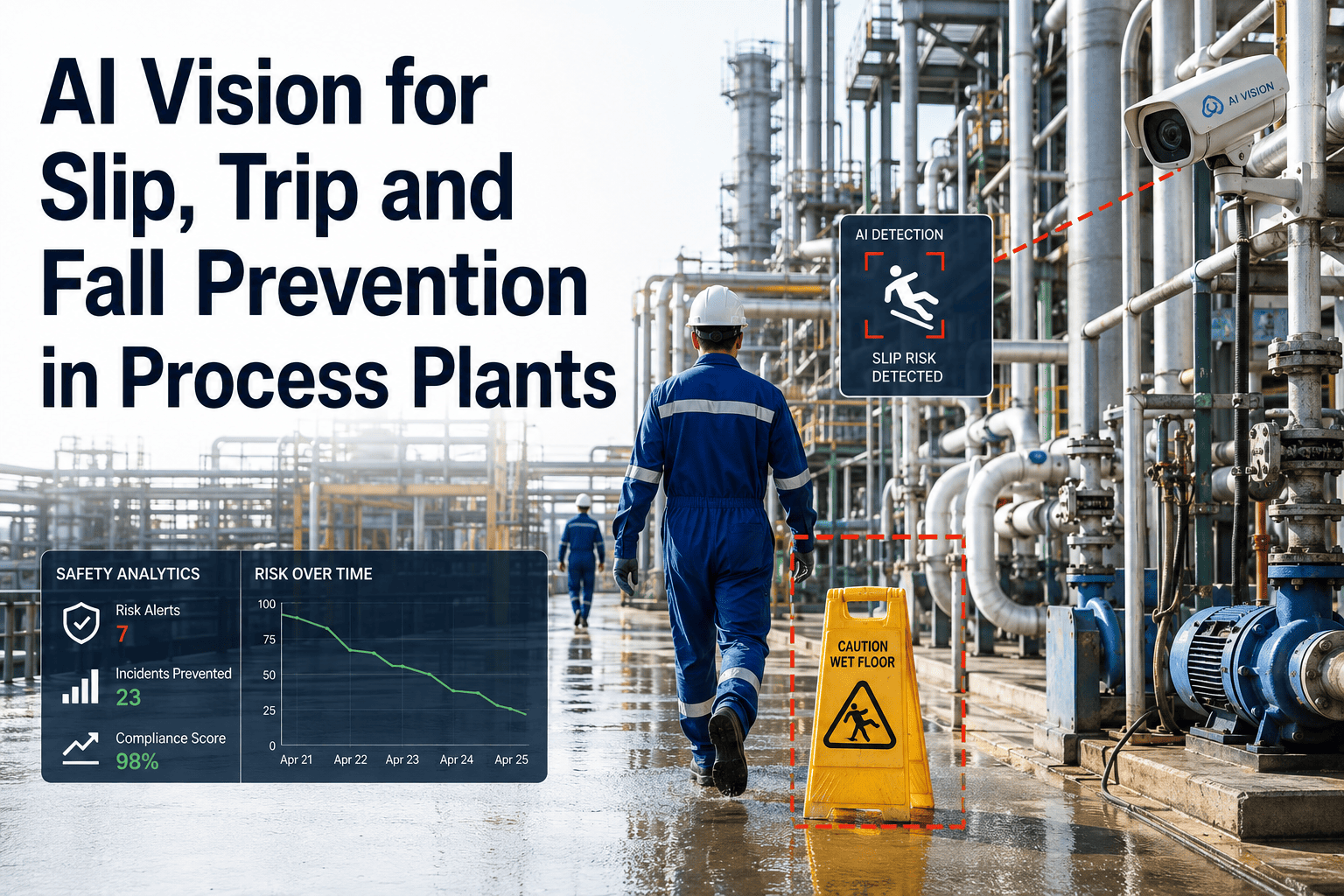
Slips, trips, and falls remain the single largest source of workplace injury incidents in process plants, and the ones that lead to the most days-away-from-work claims across oil and gas, refining, chemical processing, and heavy manufacturing. The frustrating part for safety leaders is that almost every STF incident traces back to a hazard that existed in plain sight before the incident occurred — a wet floor no one flagged, a hose stretched across a walkway, a worker on an elevated platform without fall protection engaged. AI vision catches those hazards while they are still hazards, before they become incidents, which is a fundamentally different safety model than investigating them after the fact — iFactory's deployment engineering team walks safety leaders through what continuous hazard detection actually looks like on a live process plant.
AI Vision for Slip, Trip and Fall Prevention in Process Plants
Wet floors. Obstructed walkways. Missing handrails. Workers at height without fall protection. The hazards that cause slip, trip, and fall incidents are the same across every process plant — and every one of them is visible to a camera before it becomes an incident. That's the shift AI vision brings to industrial safety: from investigation to prevention.
Why STF Incidents Dominate Process Plant Safety Statistics
Every process plant safety leader can recite the pattern from experience. Chemical exposure incidents are rare and dramatic. Fire and explosion incidents are catastrophic when they occur but infrequent thanks to decades of process safety investment. Slip, trip, and fall incidents are none of those — they are constant, low-drama, and cumulatively they cause more injuries, more lost work days, and more workers' compensation cost than any other category on the plant's incident log. The frequency is what makes them expensive; individually each incident is a bruise, a sprain, or a broken bone, but multiplied across a workforce and a year they add up to the largest safety expense category on the P&L.
The pattern is remarkably consistent across process industries. Refineries see workers slipping on hydrocarbon spills near pumps and sample points. Chemical plants see falls from elevated platforms during valve operations. Food and beverage plants see trips over wash-down hoses and slips on wet floors from cleaning operations. Steel and cement plants see falls on stairs contaminated with process dust. The specific hazards differ, but the underlying safety failure is the same — a hazard existed and was not addressed before someone encountered it.
Traditional safety programs address STF hazards through inspection rounds, housekeeping audits, and behavior-based observation programs. All of these work when they happen, but they share a fundamental limitation: they observe a snapshot of the plant at the moment the observer walks through. Between rounds, the plant reverts to whatever state it happens to be in, and the hazards that cause incidents are usually the ones that developed between rounds rather than the ones the last round captured. Continuous camera-based hazard detection eliminates the between-rounds gap, which is where most STF incidents actually happen.
There's a second dynamic worth naming: the plants that already have mature safety cultures tend to underestimate how much residual risk lives in the between-rounds gap because their inspection rounds are thorough and their behavior-based programs are well-run. Continuous detection often surprises those plants first — not because their safety practices were weak, but because their existing measurement systems could never capture hazards that emerged and were resolved between observation moments. The near-miss data that shows up in the first quarter of continuous monitoring is almost always a shock, even to plants that considered themselves ahead of the safety curve.
The Six Hazard Classes AI Vision Actually Detects
Understanding what AI vision catches and how it catches it starts with breaking STF hazards into their observable categories. Each of the six below is a hazard type a trained camera model can recognize reliably in a process plant environment, and each maps to a specific incident pattern the plant's OSHA log almost certainly contains.
Stop Investigating STF Incidents. Start Preventing Them.
iFactory's AI vision platform monitors walkways, platforms, and access routes continuously — alerting on wet floors, obstructions, missing handrails, and fall protection non-compliance as they develop, not after an incident forces the investigation.
The High-Risk Zones That Justify Coverage First
A process plant cannot install a camera on every square meter, and it doesn't need to. The zones where STF incidents concentrate are well-known from incident data, and starting camera coverage in those zones delivers the majority of the safety value at a fraction of a whole-plant deployment cost. The typical layout below reflects the pattern most plants converge on when they scope initial coverage against incident history.
The prioritization above reflects a consistent finding from process industry incident data: fall-from-height incidents concentrate around elevated platforms and access ladders, slip incidents concentrate around pump rows where hydrocarbon or process fluid leaks are most common, and stair-related incidents concentrate at cross-over structures where workers change elevation while carrying tools or samples. Camera coverage that starts with these four zones typically captures the majority of the plant's historical STF incident population before extending to secondary zones.
The Seconds Between Detection and Resolution
Safety response time is what separates a caught hazard from an incident. Traditional inspection rounds have response times measured in hours or days — the round happens, the hazard is documented, the work order is written, the correction is scheduled. AI vision compresses that timeline into seconds and minutes, which is often the difference between a hazard being addressed and a hazard being encountered by a worker.
Compare that timeline against the traditional model: the hazard exists at time zero, the next scheduled inspection round happens hours later, the hazard is documented, a work order is written, correction is scheduled for the next available shift, and in the meantime workers continue to encounter the hazard. The compression from hours-to-days into seconds-to-minutes is not incremental — it is the difference between a hazard causing an incident and a hazard being addressed before it does.
How Different Process Industries Deploy STF Prevention
The core hazards are consistent across process industries but the deployment patterns vary based on plant layout, work density, and regulatory framework. The four patterns below capture how STF prevention actually gets configured on real plants and where the technology delivers the largest measured safety improvement per camera installed.
| Industry | Primary STF Hazards | Priority Camera Zones | Highest-Value Detection |
|---|---|---|---|
| Oil & Gas Upstream | Elevated derricks, rig floor slips, wellhead access | Rig floor, catwalks, monkey board | Fall protection compliance at height |
| Refining | Hydrocarbon slips near pumps, tank farm access | Pump rows, sample points, tank stairs | Wet floor and spill detection |
| Chemical Processing | Reactor platform access, hose obstructions | Reactor platforms, transfer areas | Fall protection + walkway obstruction |
| Food & Beverage | Wash-down water on floors, hose trips | Processing floors, wash areas, cold storage | Wet floor detection across all shifts |
| Steel & Metals | Dust-contaminated stairs, elevated crane access | Crane access stairs, mill floor | Handrail integrity + stair compliance |
| Cement & Aggregates | Elevated silo access, kiln platform work | Silo tops, kiln platforms, conveyor bridges | Fall protection at height |
| Pharmaceutical Manufacturing | Cleanroom slips, sterile-area egress | Wash-down zones, cleanroom transitions | Wet floor + gowning compliance |
The pattern that shows up across every industry is that camera zones follow incident history rather than plant geography. The plants that scope deployment against their own OSHA log deliver measurable incident reduction inside the first year; the plants that scope against plant size and try to cover everything at once often produce weaker safety outcomes because their attention is spread too thin across zones that were never contributing much to the incident population.
Deploy Camera Coverage Where Your Incidents Actually Happen
iFactory's deployment team maps camera zones against your plant's own incident data, not against a generic template. That's why coverage starts producing measurable STF reduction inside the first year rather than becoming a whole-plant project that never quite finishes.
How AI Vision Fits Alongside What You Already Have
Every process plant has an existing safety system — inspection rounds, behavior-based observation programs, permit-to-work systems, incident reporting databases, and safety information management platforms. AI vision does not replace any of those; it feeds them. The value only materializes when detected hazards flow into the systems that already govern how the plant tracks and responds to safety events, rather than sitting in a separate camera-alerts dashboard no one in the safety organization is trained to monitor.
The uncomfortable truth about slip, trip, and fall incidents in process plants is that almost every one of them was preventable, and almost every one of them was preventable because the hazard was visible before the incident happened. I've sat through more STF incident investigations than I can count, and the pattern is the same nearly every time — the spill was there, the hose was there, the handrail was missing, the worker wasn't tied off — and none of it was addressed because no one saw it in the window between when it developed and when someone encountered it. Continuous camera-based hazard detection changes the fundamental math on this. It doesn't replace the safety culture, the training, or the inspection rounds; it eliminates the gap where hazards used to live undetected until they caused injuries. The plants I've watched deploy it well see the leading indicators — near-miss detections, compliance trends by area, response times — become visible in a way they never were before, and the lagging indicator, the injury count, follows within a year.
Frequently Asked Questions
See STF Prevention Deployed on a Live Process Plant Environment
Slip, trip, and fall incidents remain the largest category of preventable workplace injury in process industries — and the one where continuous camera-based hazard detection produces the largest measured safety improvement per dollar invested. iFactory's platform is designed for the specific hazard classes and plant environments where STF risk actually concentrates.