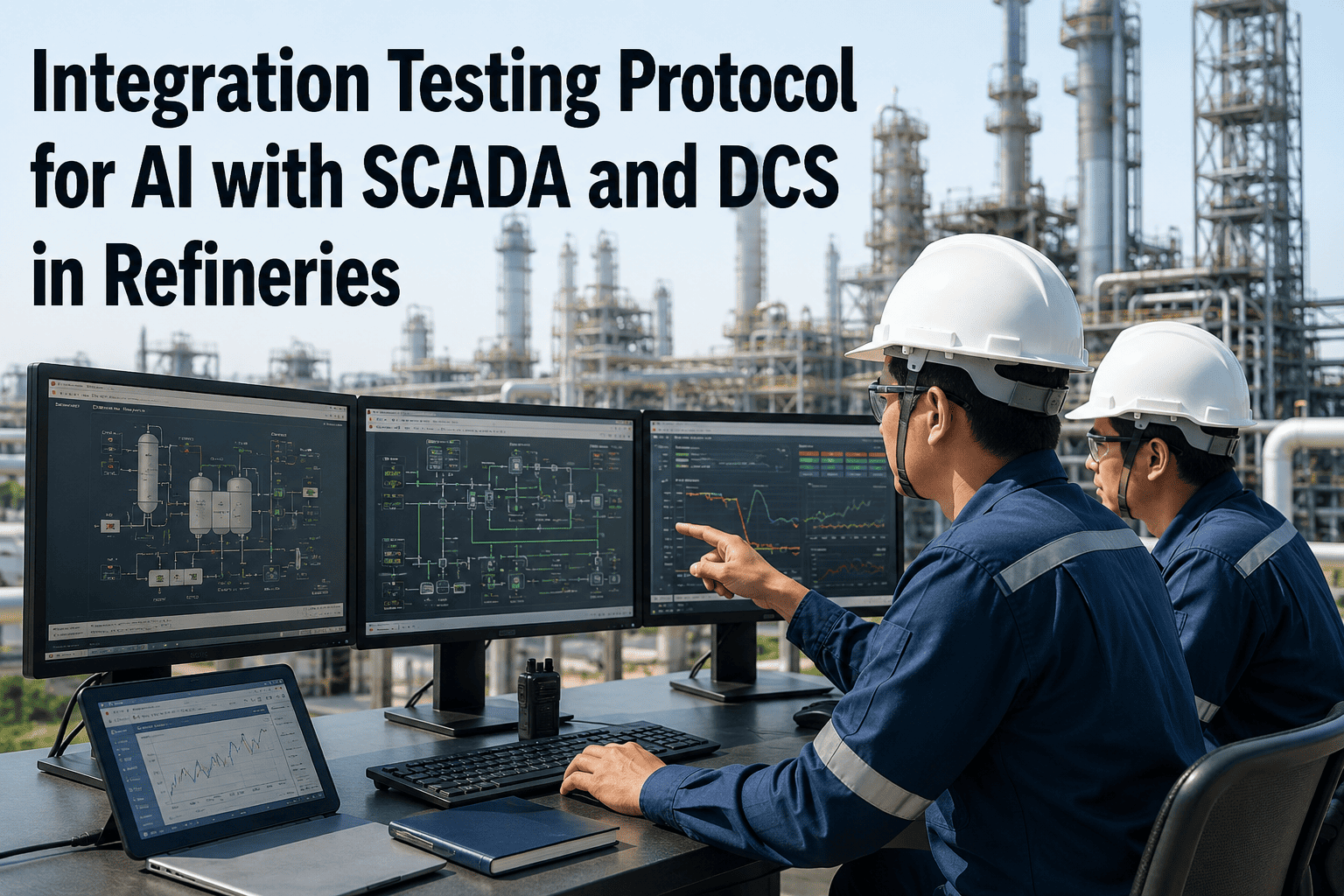
A refinery's DCS has been running the same crude unit for fifteen years without a single unplanned trip caused by its own logic. An AI layer that reads tags from that DCS for the first time has no such track record, and the two systems are about to share a network, a tag database, and in some cases a failover path. Most AI vendors demo well in a conference room and then discover, weeks into a live rollout, that their polling rate collides with the historian's own scan cycle or that a tag rename during a DCS patch silently broke a model input. Reliability and automation teams are usually the ones left explaining the gap between a clean pilot and a messy production rollout, even though the root cause sits in a testing step that was skipped rather than in the AI model itself. A formal integration testing protocol exists to catch exactly that class of failure before it reaches a live unit, and a walkthrough of how iFactory structures that protocol is available for teams planning a rollout.
Most AI-SCADA Integration Failures Are Never Caught in the Demo. They Surface Three Weeks Into Production
A structured test protocol validates data latency, tag mapping, failover behavior, and cybersecurity posture before an AI system ever touches a live SCADA or DCS network, turning integration risk into a documented pass or fail rather than a live-unit surprise.
An AI Layer Is Not Just Another HMI Client. It Changes How the Control Network Behaves
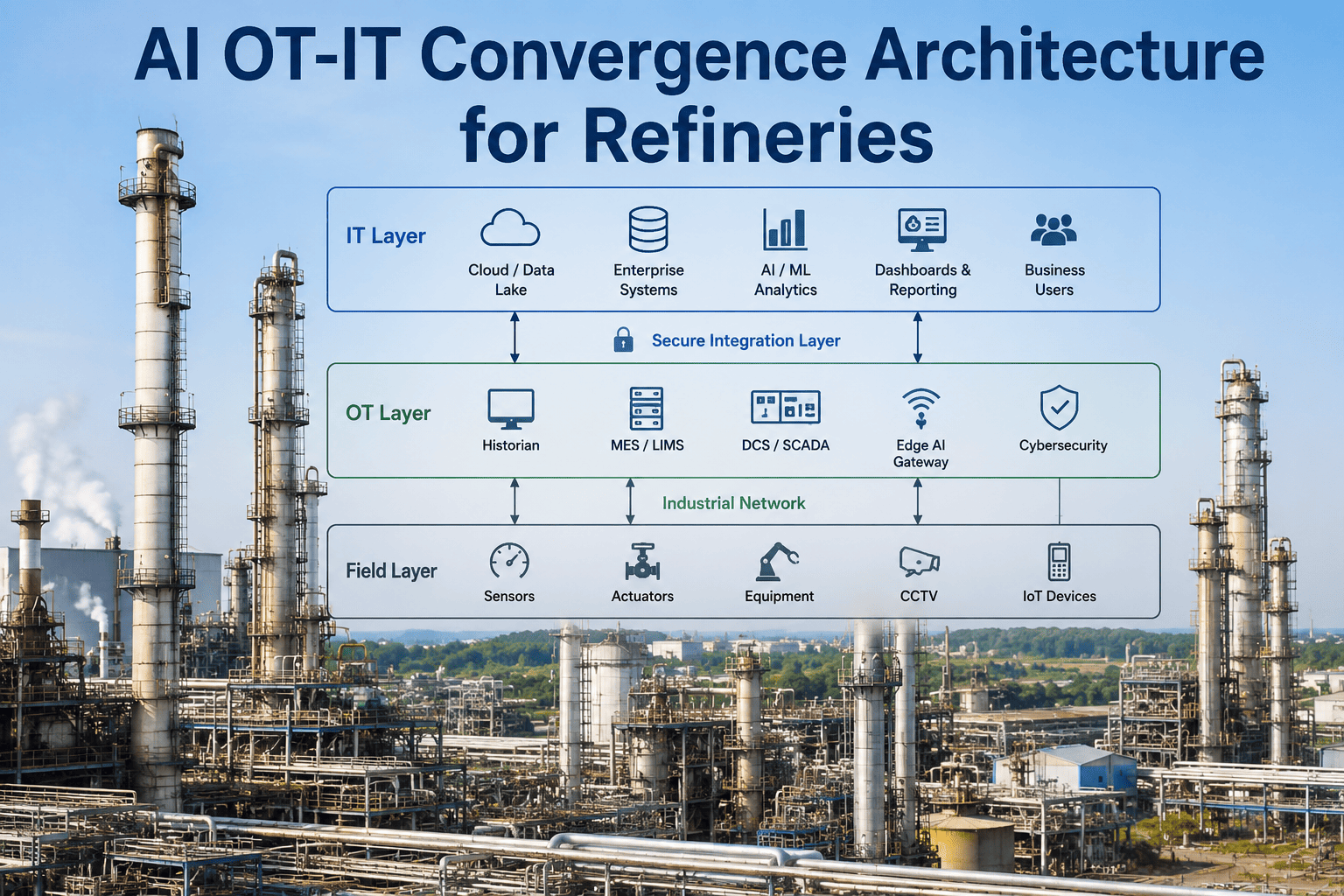
A dashboard that reads a handful of tags for a screen refresh is a passive observer. An AI system that continuously ingests hundreds or thousands of tags, correlates them against maintenance history, and pushes alerts back into an operator workflow is an active participant on the same network that runs your process control. DCS platforms are engineered around hierarchical, modular control specifically to keep local control tasks isolated from higher-level supervision, which is precisely the boundary an AI integration has to respect rather than blur, and a DCS coordinating and optimizing the overall process while individual PLCs handle local control is exactly the layered architecture a badly tested AI connection can undermine if it is allowed to poll too aggressively or write back where it should only read.
Skipping a formal test protocol does not mean the AI system fails safely. It means the failure mode is undocumented, discovered by an operator instead of a test engineer, and diagnosed under production pressure instead of in a staging environment. Vendors who deploy the same integration pattern across dozens of plants often assume their standard connector is proven, but a connector that worked cleanly on one DCS vendor's historian can behave very differently against a different platform's tag database, polling limits, or redundancy scheme. The four risk categories below are where refineries most often find that gap, and each one is invisible from a conference-room demo because a demo environment never has the tag volume, patch history, or failover complexity of a real operating unit.
Data Latency Drift
An AI model trained on near-real-time tag values silently degrades when polling cycles slip, producing recommendations based on stale process data without any alarm indicating the delay.
Tag Mapping Errors
A single mismapped or renamed tag, especially after a DCS patch or point database change, feeds the wrong value into a model and produces a confident, wrong recommendation.
Failover Ambiguity
When the primary SCADA server switches to standby, an untested AI integration may keep reading from the dead path, double-count events, or drop data for the switchover window entirely.
Cybersecurity Exposure
Every new connection into an OT network is a new attack surface, and an AI integration that has not been validated against ISA/IEC 62443 zone and conduit requirements widens that surface without anyone signing off on it.
A Five-Stage Test Protocol for Validating AI Against SCADA and DCS Before Go-Live
Each stage below produces a documented pass or fail against a defined threshold, not a subjective "it seemed to work" sign-off. The sequence matters: connectivity and mapping have to be proven correct before latency and failover tests mean anything, since a latency measurement against a mismapped tag is measuring the wrong thing entirely, and cybersecurity validation runs last because it has to account for every connection surfaced by the previous four stages. Treat the five stages as gates rather than a checklist to run in parallel. A team under schedule pressure is often tempted to run latency and failover testing simultaneously with mapping verification to save time, but that shortcut is exactly how an unmapped tag ends up buried inside a failover report where nobody thinks to look for it.
Connectivity and Protocol Verification
Confirm the AI layer establishes a stable read connection over the plant's actual protocol, whether that is OPC UA, Modbus, or a historian API, using the same network path, firewall rules, and authentication that production will use. This stage also confirms the connection survives a normal SCADA server restart without requiring manual reconnection.
Tag Mapping Verification
Every tag the AI model consumes is checked point by point against the DCS or SCADA point database: correct engineering units, correct scaling, correct source, and correct behavior when a tag is renamed, deleted, or re-pointed during a routine configuration change. Unmapped or ambiguous tags are logged as findings, not silently ignored.
Data Latency Measurement
Latency is measured end to end, from the timestamp a value changes at the source to the timestamp the AI layer registers it, under normal load and again under simulated network congestion. The result is compared against the latency budget the model actually needs, not a generic industry figure.
Failover Behavior Testing
The primary SCADA or DCS path is deliberately failed over to standby while the AI integration is actively reading data, and the team records whether data continuity holds, whether duplicate events appear, and how long recovery takes. This is repeated for controller-level, communication-path, and server-level failure scenarios separately, since each behaves differently.
Cybersecurity Validation
The completed integration is assessed against the plant's ISA/IEC 62443 zone and conduit model, confirming the AI connection sits in the correct security zone, uses least-privilege credentials, and does not create an unmonitored path between IT and OT. Findings here can require rework of earlier stages before final sign-off.
A Test Protocol Only Works If Someone Has Run It Before
iFactory's integration team has staged and validated AI connections against SCADA and DCS platforms across refinery, cement, and power plant environments. Book a review and walk through the protocol against your own point database.
What "Fast Enough" Actually Means for Different Types of AI Use Cases
Latency requirements are not uniform across an AI deployment. A predictive maintenance model comparing vibration trends against a maintenance history can tolerate a data delay measured in seconds. A model correlating an alarm flood with a process upset in near real time cannot. Testing against a single blanket latency target is one of the most common reasons a protocol misses a real problem, because it passes the easy use case and hides the failure on the demanding one. SCADA best-practice guidance recommends specifying operator interaction and process-data latency separately from screen refresh rate, precisely because a fast redraw can hide a stale underlying value, and the same principle applies directly to an AI layer: a dashboard that appears to update smoothly can still be reasoning over data that is minutes old if the source feed itself has drifted.
The table below is a starting point, not a fixed standard. Every plant should define its own latency budget per use case based on process dynamics and risk assessment, then test the AI integration against that specific number rather than a generic figure pulled from a vendor's marketing material.
| Use Case | Target Latency | Test Method | Failure Impact if Missed |
|---|---|---|---|
| Predictive maintenance trending | Under 30 sec | Timestamp comparison, source to model | Low, trend still valid over hours |
| Process anomaly correlation | Under 5 sec | Simulated upset injection | Moderate, delayed operator alert |
| Alarm flood analysis | Under 2 sec | Burst-load stress test | High, root cause misattributed |
| Safety-adjacent monitoring | Under 1 sec | Failover-concurrent latency test | Severe, requires independent SIS review |
The last row is worth calling out directly: any AI use case that touches safety-adjacent monitoring should be tested alongside, not as a substitute for, the plant's independent safety instrumented system. Integration testing validates the AI layer's behavior, it does not certify the AI as a safety function under IEC 61511, and a protocol that blurs that line is a finding in itself.
The Checks Most Teams Skip Because They Look Redundant Until One Fails
Tag mapping verification and failover testing both feel like formalities the first time a team runs them, because everything usually works on the first pass. The value shows up on the second pass, after a routine DCS patch or a scheduled server failover, when the checks that were passed the first time need to be repeated to confirm nothing quietly broke. DCS platforms with unified tag databases are specifically designed so controller changes propagate automatically throughout the system, which is a genuine engineering advantage, but it also means a single point database edit can ripple into every downstream consumer of that tag, including an AI layer that has no way of knowing the change happened unless it is explicitly tested against it.
Bumpless failover is a standard expectation for redundant DCS architecture, meaning the control system itself continues operating without a process upset during a switchover. The open question this protocol answers is whether the AI integration reading alongside that control system holds up to the same standard, or whether it quietly loses a data window that operators never notice because their own HMI recovered cleanly.
Point-by-Point Tag Audit
Every consumed tag verified against engineering units, scaling factors, and source system, with discrepancies logged as findings rather than corrected silently mid-test.
Rename and Re-Point Simulation
A subset of tags deliberately renamed or re-pointed in a staging environment to confirm the AI layer flags the break instead of silently reading a stale or wrong value.
Controller-Level Failover
Redundant controller switchover tested with the AI integration active, confirming bumpless transfer holds for the AI's read path the same way it holds for the operator HMI.
Communication-Path Failover
Primary network path deliberately dropped to confirm the AI layer reconnects over the redundant path within the plant's defined recovery window, without manual intervention.
Server-Level Failover
Primary SCADA server taken offline entirely to confirm the AI layer follows the same server switchover the operator workstations follow, with no duplicate or missing data.
Recovery Time Logging
Every failover scenario timed from disruption to full data continuity, with the result compared against the plant's own operational recovery requirement, not a vendor default.
Every New Connection Into an OT Network Is a New Line Item on Your Threat Model
Refineries have spent years building defense-in-depth around SCADA and DCS networks using zone and conduit segmentation, and an AI integration that is not deliberately fitted into that model becomes the exception nobody accounted for. This is not a reason to avoid AI, it is a reason to test the connection with the same rigor applied to any other new system entering the OT environment, guided by ISA/IEC 62443 and, where the plant falls under it, NERC CIP.
Cybersecurity validation is deliberately run last in the protocol because it has to account for every pathway the previous four stages created, including any temporary test connections, staging credentials, or diagnostic access that should be closed out before go-live rather than left open as a convenience. It is common for a connectivity test in stage one to open a diagnostic port that gets forgotten by the time failover testing wraps up in stage four, and running the security review as the final gate is what catches that kind of leftover access before it becomes a permanent, unmonitored hole in the network.
Zone and Conduit Placement
Confirms the AI connection lands in the correct security zone relative to the SCADA and DCS layers it reads from, with no conduit that bypasses an existing segmentation boundary.
Least-Privilege Credentials
Verifies the AI system's service account can read only the tags it needs and cannot write back into control logic unless that capability was explicitly scoped and approved.
IT/OT Boundary Review
Checks whether the integration creates any path, direct or indirect, between the corporate IT network and the OT control network that was not already accounted for in the security architecture.
Test Access Closeout
Confirms every temporary credential, diagnostic port, or staging connection used during the previous four testing stages is disabled or removed before the system goes live.
Logging and Monitoring Coverage
Verifies the AI connection's traffic is visible to existing OT network monitoring, so an anomaly on that connection is caught by the same detection your security team already relies on.
Patch and Update Path Review
Reviews how the AI system itself receives updates or patches, since an update mechanism that bypasses the plant's change management process is its own security finding.
What Refineries Report After Running a Formal Protocol Before Go-Live
These figures reflect outcomes reported by refinery and process plant teams that moved from an informal or vendor-led acceptance check to a documented, stage-gated integration test protocol before an AI system went into production use. The pattern across those teams is consistent even when the AI use case differs: the plants that treat integration testing as a formality tend to spend their first few months of production chasing intermittent, hard-to-reproduce issues, while the plants that run the full five-stage protocol spend that same window fine-tuning model outputs instead of debugging the pipeline underneath them.
The documentation produced during testing has a second life beyond go-live. When a future DCS upgrade, patch, or point database migration happens, the original test results become the baseline for a much faster re-validation instead of a from-scratch investigation, which is often the difference between a same-day fix and a multi-week outage of the AI system while the cause is tracked down.
Questions Automation and Reliability Teams Ask About AI-SCADA Integration Testing
Validate the Integration Before It Ever Touches a Live Unit
iFactory runs the full five-stage protocol against your actual SCADA or DCS point database in a staged environment, with a documented findings report at every stage. Book a demo to see the process against your own tag list.