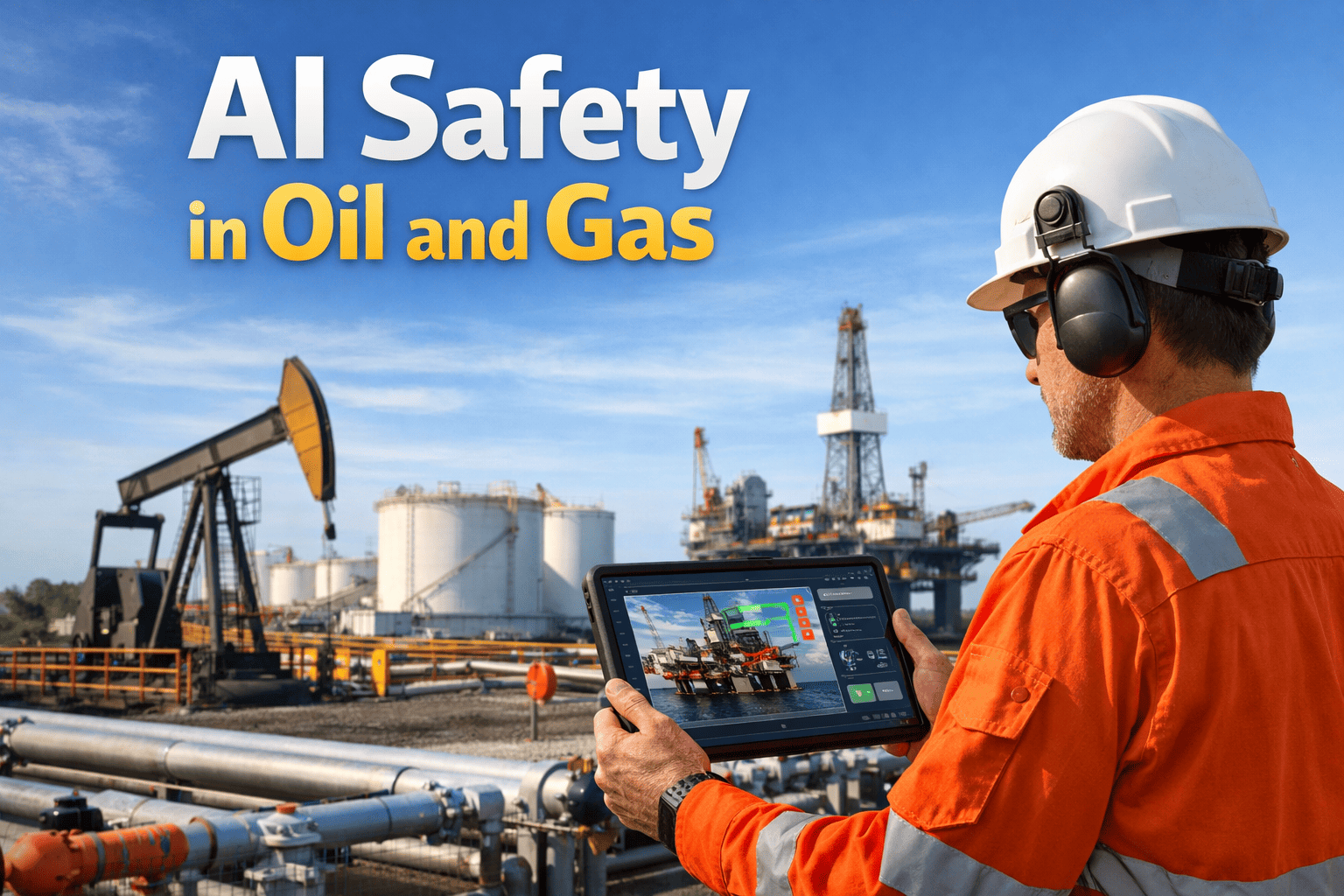
A large language model does not know it is wrong. It will recommend a relief valve setting, a chemical dosage, or a maximum operating pressure with exactly the same fluent confidence whether the number came from a validated source or from a statistical guess dressed up as an answer. In an office workflow that confidence gap is an inconvenience. In an oil and gas facility where a wrong number can mean an overpressure event, a chemical incompatibility, or a bypassed interlock, it is a hazard that most operators have not yet built a technical control around. The organisations moving fastest with generative AI in the field are not the ones deploying the biggest models — they are the ones that built the guardrail layer first. If your team is evaluating where generative AI touches safety-critical decisions, book a session with the iFactory AI governance team to review a guardrail architecture built for process safety environments.
LLM Safety · Process Safety Governance
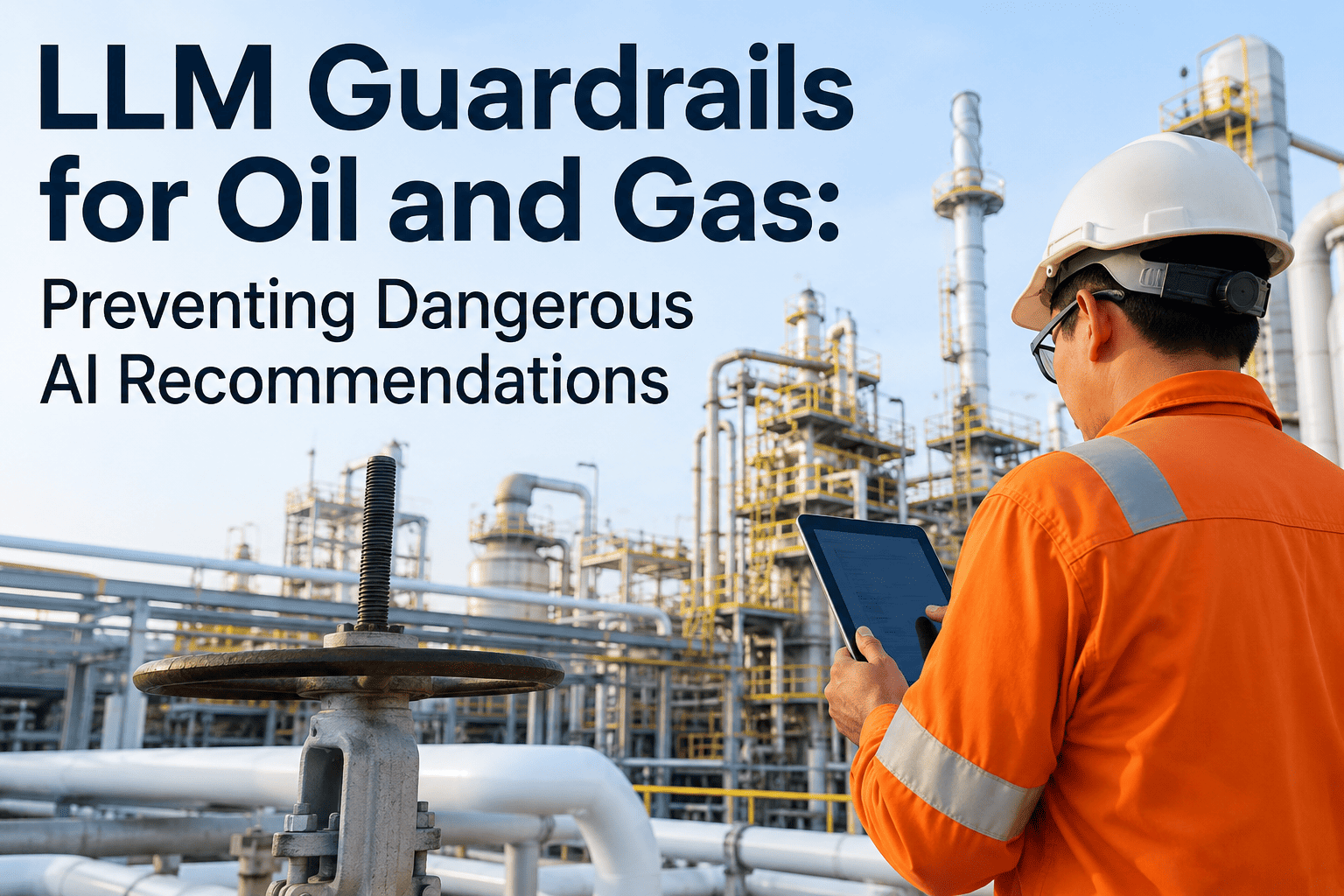
LLM Guardrails for Oil and Gas: Preventing Dangerous AI Recommendations Before They Reach an Operator
A practical framework for output validation, safety-limit enforcement, and mandatory source citation on every AI-generated technical response in refinery, midstream, and upstream operations.
The Governance Gap Is Already Measured
Industry surveys on enterprise AI agent deployment consistently find a wide gap between how much organisations rely on AI-generated output and how much control they have placed around it. Most facilities did not choose to leave that gap open — governance simply lagged deployment, and in a process safety environment that lag carries a different weight than it does in a marketing department.
80%of organisations report their AI agents have already taken actions beyond their intended scope
44%have implemented any formal policy governing what an AI agent is permitted to do
20ximprovement in output accuracy reported when a validation layer wraps raw model output
Where the Risk Actually Lives
An LLM Does Not Fail Loudly — It Fails Fluently, and That Is the Problem
A control system alarm fails loudly: a light flashes, a horn sounds, a value goes red. An unguarded LLM fails quietly, in the same calm sentence structure it uses when it is correct. Ask it for the maximum allowable working pressure of a vessel, the correct chemical dosage for a corrosion inhibitor, or the isolation sequence for a piece of rotating equipment, and a model with no output validation will answer in the same tone whether it retrieved the number from your P&ID database or synthesised something plausible-sounding from general training data. The operator reading that answer has no visual signal that distinguishes a grounded response from a fabricated one — the fabricated one often reads more confidently because it is unconstrained by the messiness of real data. This is the specific failure mode that output guardrails exist to close: not making the model smarter, but making it impossible for an ungrounded, out-of-limit, or unverifiable answer to reach a person making a safety decision.
The Four-Layer Guardrail Stack
What Sits Between Your Model and Your Operator
A production-grade guardrail architecture for industrial AI is not one filter — it is a stack of independent checks, each catching a different failure mode, running before a recommendation is ever displayed to a person on the floor.
Layer 1
Safety-Limit Enforcement
Every numeric recommendation touching pressure, temperature, flow, chemical concentration, or torque is checked against a hard-coded table of engineering limits pulled from your process safety information — not from the model's training data. A recommendation that falls outside the approved operating envelope is blocked at the output layer, not flagged for optional review.
Layer 2
Groundedness and Citation Checking
Every technical claim in a response must trace back to a retrieved document, sensor reading, or approved procedure. If the model cannot produce a source for a statement, the statement is stripped from the response or the response is withheld entirely rather than delivered with a fabricated or missing citation.
Layer 3
Format and Schema Validation
Structured outputs — a work order, a permit field, a maintenance recommendation — are validated against a strict schema before they are allowed to populate a downstream system. Malformed, incomplete, or logically inconsistent output is rejected and reprocessed rather than passed through.
Layer 4
Escalation and Human Authority Routing
Any recommendation touching a defined safety-critical category — energy isolation, confined space entry, hot work near flammable atmosphere — is automatically routed for human sign-off regardless of how confident the model's output appears. The system is designed to widen the human review net exactly where consequence is highest.
The Practical Difference
Ungoverned LLM Output vs Guardrailed LLM Output in a Process Safety Context
| Decision Point | Ungoverned Output | Guardrailed Output |
|---|
| Chemical dosage recommendation | Generated from general pattern matching, no facility-specific limit check | Checked against your approved dosage range before display |
| Source of technical claim | Often unstated or fabricated when asked to justify itself | Every claim links to a retrieved document or sensor tag |
| Out-of-envelope pressure value | Delivered with the same tone as an in-range value | Blocked automatically; flagged for engineering review |
| Audit trail of the recommendation | Rarely reconstructable after the fact | Full input, retrieval, and validation log retained |
| Safety-critical task handling | Answered directly with no escalation logic | Automatically routed to a named human authority |
See the Guardrail Stack Applied to Your Workflows
iFactory Reviews Your Highest-Risk AI Use Cases and Maps the Guardrails Needed Before Rollout
Rather than retrofitting governance after an incident, the review starts with the three or four AI-assisted workflows carrying the most consequence in your operation — dosage recommendations, isolation guidance, and permit conditions are the common starting point — and maps a guardrail stack against each before it goes live.
Routing Logic
What Happens When a Guardrail Actually Fires
A guardrail is only useful if it does something when triggered. The routing table below shows how a blocked or flagged recommendation moves through the system rather than simply disappearing or silently degrading.
Recommendation exceeds a hard safety limit
Response blocked before display to the requesting operator
Process safety engineer notified with the full model input and rejected output
Incident logged in the guardrail audit trail with a timestamp
Model cannot produce a source citation
Unsourced claim stripped or full response withheld, depending on severity
Requesting user shown a message that the answer could not be verified
Query logged for retrieval-index improvement review
Query touches a defined safety-critical category
Recommendation routed to a named human authority for sign-off
Model output shown as a draft suggestion, not a final answer
Sign-off decision recorded against the original AI-generated draft
Rollout Sequence
A Three-Phase Path to a Governed Deployment
Phase 1 · Weeks 1–3
Inventory and Risk-Rank Every AI Use Case
Catalogue every place generative AI currently touches a decision in your operation, from shift report summarisation to dosage recommendations, and rank each by the consequence of a wrong answer. This inventory is almost always the first time a facility has seen its full AI exposure in one place.
Phase 2 · Weeks 4–7
Deploy Guardrails on the Highest-Risk Use Cases First
Build and validate the safety-limit, citation, schema, and escalation layers for the top-ranked use cases before touching lower-risk workflows. This concentrates governance effort where a failure would matter most.
Phase 3 · Weeks 8–12
Extend Coverage and Formalise the Policy Layer
Roll the same guardrail architecture out to remaining use cases and formalise the governance policy — who owns escalations, how the audit log is reviewed, and how often the safety-limit tables are revalidated against updated process safety information.
Measuring Governance
The Metrics That Show a Guardrail Programme Is Actually Working
Citation Coverage Rate
Target: 100%
Percentage of technical claims in AI-generated responses that carry a verifiable source. Should reach and hold at 100% once groundedness checking is fully deployed — any drop signals a retrieval index gap that needs attention.
Safety-Limit Block Rate
Tracked, not zeroed
Number of recommendations blocked for exceeding a hard engineering limit. This number is expected to be non-zero — a healthy guardrail catches real out-of-envelope suggestions rather than never firing.
Escalation Response Time
Target: under 15 minutes
Time between a safety-critical query being routed to a human authority and that authority reviewing it. A long delay here defeats the purpose of routing the decision to a person in the first place.
Audit Retrieval Time
Target: under 15 minutes
Time to reconstruct the full input, retrieval, validation, and human decision trail for any single AI-assisted recommendation, requested during an internal review or regulatory inquiry.
The question I hear most from operations leaders evaluating generative AI is whether the model is accurate enough to trust. That is the wrong question. The right question is what happens the one time out of a thousand that it is wrong. A model that is 99.9% accurate on dosage recommendations is still going to be wrong roughly once for every thousand queries a busy control room generates in a year, and the entire value of a guardrail programme is what happens in that one case — not the other 999. If the wrong answer is caught, logged, and routed to a person before it reaches an operator, the accuracy of the underlying model almost stops mattering as a safety question, because the consequence of the rare miss has already been contained by the system around it, not by the model itself.
Marcus Thibodeaux
Director of Process Safety Digitalisation · Certified Process Safety Professional · 21 years in refining and midstream operations · Former PSM Program Manager across a five-refinery portfolio · Focus on AI governance and safety-critical automation
Operations and IT Questions
LLM Guardrails for Oil and Gas — Frequently Asked
Does adding a guardrail layer slow down the AI response enough to hurt adoption?
A properly designed guardrail stack adds measurable but small latency — typically a few hundred milliseconds for lightweight checks like schema validation, and slightly more for a full citation and safety-limit pass. For the majority of industrial use cases, where a response is being read and acted on by a person rather than powering a millisecond-sensitive control loop, this delay is not perceptible as friction. The larger adoption risk actually runs the other way: operators who receive one confidently wrong answer from an ungoverned system tend to stop trusting the tool entirely, which does far more damage to adoption than a sub-second guardrail check ever would. For a discussion of latency budgets specific to your workflows,
book a session with our team.
Can guardrails be applied to a model we are already using, or does this require switching platforms?
Guardrails are architecturally a layer that sits around a model, not a property of the model itself, so they can generally be applied to whatever underlying model your organisation is already using without requiring a platform switch. The safety-limit tables, citation requirements, schema validators, and escalation rules are built against your process safety information and your workflows, then wrapped around the existing model's input and output. This is one of the more practical aspects of a guardrail programme — it does not force a vendor decision before governance can begin.
Reach out to our support team for a technical review of your current AI stack.
How do we decide which AI use cases need the strictest guardrails versus lighter oversight?
The ranking criterion that matters most is consequence of a wrong answer, not frequency of use. A high-volume use case like summarising a shift log carries low consequence if occasionally imperfect, and can run with lighter validation. A low-volume use case like recommending an isolation sequence carries severe consequence if wrong even once, and needs the full four-layer stack regardless of how rarely it is invoked. The inventory-and-risk-rank exercise in Phase 1 of a rollout is specifically designed to surface this distinction before any guardrail is built, so effort is not spent uniformly across use cases that do not carry uniform risk.
What regulatory or audit expectations apply specifically to AI-generated technical recommendations?
While AI-specific regulation in process safety is still developing, the underlying expectation from existing frameworks like OSHA Process Safety Management and API recommended practices is unchanged by the introduction of AI: any recommendation that informs a safety-critical decision needs a documented, reconstructable basis. A guardrail architecture that enforces citation and retains a full audit trail is built specifically to satisfy that existing expectation, positioning AI-assisted recommendations to be treated the same way a human-generated technical memo would be treated during an audit or incident investigation.
Book a compliance-focused review session to map this against your specific regulatory obligations.
Who should own the guardrail policy inside our organisation — IT, process safety, or operations?
The most durable ownership model splits the responsibility rather than assigning it to a single function: process safety or engineering owns the content of the safety-limit tables and the escalation criteria, since that is domain expertise no AI or IT team should be defining independently, while IT or a digital team owns the technical implementation, uptime, and audit log infrastructure that enforces those rules. Operations leadership typically owns the escalation response — making sure a flagged recommendation actually gets reviewed within the target window rather than sitting unopened. Facilities that assign the entire programme to one function tend to end up with either technically sound guardrails that do not reflect real engineering limits, or well-defined limits that never get properly enforced in the system.
Confident and Correct Are Not the Same Thing
Map the Guardrails Your Highest-Risk AI Workflows Need — Before the Next Recommendation Goes Out
iFactory works with process safety and digital teams to inventory AI touchpoints, build the safety-limit and citation layers around your existing model, and stand up an audit trail that holds up to internal and regulatory review.