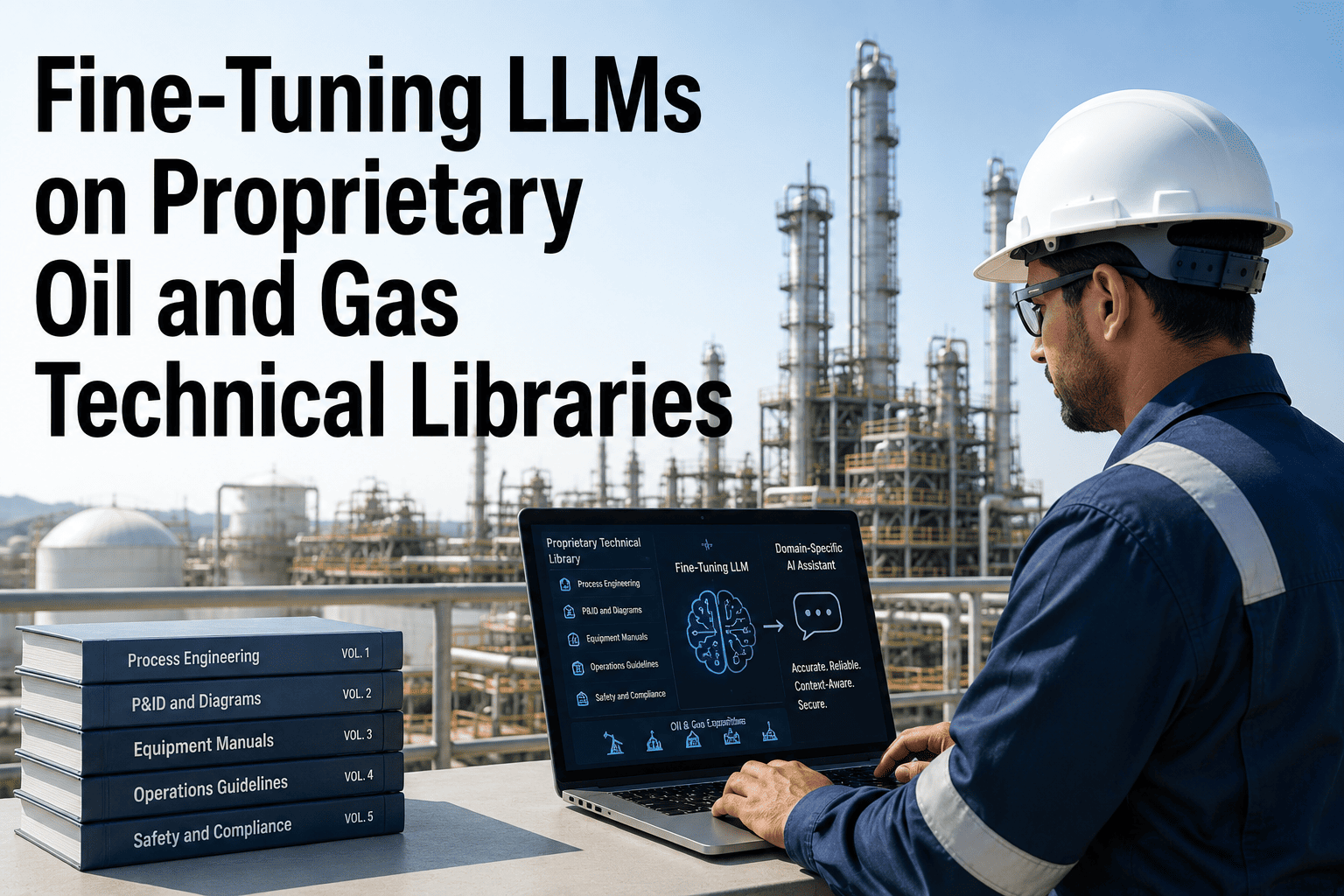
Ask a general-purpose AI model a question about your specific relief valve setpoint calculation or your company's exact permit-to-work sequence, and it will answer confidently, fluently, and sometimes wrong. Generic models are trained on the public internet, not on your SOPs, your engineering standards, or the specific way your organization has documented a process for the last twenty years. Closing that gap is what fine-tuning is for, and the difference in reliability between a generic model and one trained on your own technical library is not subtle, it's the difference between a tool engineers trust and one they have to double-check every time, and Book a Demo to see what that gap looks like closed.
Turn Your Technical Library Into a Model That Actually Knows Your Operation
iFactory fine-tunes base language models on your company's SOPs, engineering standards, and calculation methods, moving hallucination rates on domain-specific queries from the 15-20% range down to under 3%.
Why a Generic Model Struggles With Your Technical Library
A base language model's confidence is not calibrated to your operation. It has read millions of pages about pressure vessels in general and almost nothing about the specific relief system design your plant actually uses, yet it will answer a question about either one with the same fluent tone. That mismatch between confidence and correctness is where hallucinations live, and it gets worse, not better, the more specific and technical the question becomes.
No Exposure to Your Internal Standards
Your company's specific SOPs, engineering calculation methods, and equipment-specific procedures were never part of any base model's training data, so it fills the gap with generic industry knowledge that may not match your practice.
Engineering Precision Requires Exact Values
A wrong answer about a historical event is embarrassing. A wrong answer about a flow coefficient or a setpoint calculation can lead to a real engineering error, and generic models were never optimized for that level of precision.
Terminology and Units Drift
Your organization may use a specific abbreviation, unit convention, or internal document naming scheme consistently across thousands of pages. A generic model has no reason to know that convention exists.
Three Ways to Adapt a Model to Your Domain — And Why They Are Not Interchangeable
Prompting, retrieval-augmented generation, and fine-tuning all show up in conversations about domain adaptation, and they are often discussed as if any one of them solves the same problem. They don't. Each one changes a different part of how the model behaves, and the right answer for a technical library usually involves more than one working together.
Prompt Engineering
Adjusts model behavior through carefully written instructions at query time, without changing the model itself. Fast to iterate, but limited when the base model simply does not contain the underlying domain knowledge.
Retrieval-Augmented Generation
Retrieves relevant passages from your document library at query time and inserts them into the prompt. Strong for surfacing specific facts, but the model's underlying reasoning and terminology handling stay generic.
Fine-Tuning
Continues training the model on your own documents, embedding your terminology, calculation patterns, and procedural logic directly into the model's parameters rather than supplying it fresh at every query.
In practice, the strongest deployments combine fine-tuning with retrieval rather than choosing one exclusively. Fine-tuning teaches the model to think and speak like your organization; retrieval keeps it grounded in the specific, current document when the answer needs to cite an exact source rather than rely on what it learned during training.
What Goes Into the Fine-Tuning Corpus
Standard Operating Procedures
Step-by-step procedures across permit-to-work, lockout-tagout, startup and shutdown sequences, and equipment-specific operating instructions.
Engineering Standards and Specifications
Internal engineering standards, design basis documents, and the specific editions of external codes and standards your organization has adopted.
Engineering Calculation Methods
Worked calculation examples showing the exact method, assumptions, and unit conventions your engineers use for sizing, relief, and performance calculations.
Historical Incident and Investigation Reports
Root cause analyses and lessons-learned documentation that teach the model the specific failure patterns and terminology your organization has actually encountered.
The Fine-Tuning Pipeline, Step by Step
Corpus Curation and Cleaning
Technical documents are parsed, de-duplicated, and structured into training examples, with special handling for tables, calculation steps, and figures that plain text extraction tends to mangle.
Base Model Selection
A base model is selected based on the balance of reasoning capability, deployment constraints, and whether it needs to run on-premise for data security reasons common in industrial environments.
Parameter-Efficient Fine-Tuning
Techniques such as LoRA and QLoRA adapt the model's behavior at a fraction of the compute cost of full retraining, producing a lightweight adapter that can be updated as your document library grows.
Preference Alignment
A preference tuning pass, using methods like direct preference optimization, teaches the model to favor the response format and level of technical caution your subject matter experts actually want.
SME-Reviewed Validation
A held-out set of real technical questions, answered independently by subject matter experts, becomes the benchmark the fine-tuned model is scored against before it goes anywhere near a production workflow.
See What Your Own Technical Library Could Teach a Model
iFactory builds fine-tuned models from your SOPs, standards, and calculation methods, validated against your own subject matter experts before deployment.
Hallucination Rate by Query Type: Generic vs. Fine-Tuned
| Query Type | Generic Base Model | Fine-Tuned on Technical Library |
|---|---|---|
| General Industry Concepts | Low Hallucination Rate | Low Hallucination Rate |
| Company-Specific SOP Steps | High Hallucination Rate | Very Low Hallucination Rate |
| Engineering Calculation Values | High Hallucination Rate | Very Low Hallucination Rate |
| Internal Terminology and Abbreviations | Moderate to High Hallucination Rate | Very Low Hallucination Rate |
| Standard and Code References | Moderate Hallucination Rate | Low Hallucination Rate |
Fine-Tuning Alone Is Not a Safety Strategy
Reducing hallucination rate is not the same as eliminating risk, and a fine-tuned model deployed without additional guardrails still needs the same operational discipline any AI system in an industrial environment requires. The teams that get this right treat fine-tuning as one layer in a broader safety architecture, not the whole architecture.
Ground High-Stakes Answers in Retrieval
For safety-critical queries, pair the fine-tuned model's fluency with a retrieval step that cites the exact source document, so an engineer can verify the answer against the original page.
Keep a Held-Out Evaluation Set Current
As your document library grows, periodically refresh the SME-reviewed validation set so the model's performance is measured against current procedures, not the ones that existed at initial training.
Flag Low-Confidence Responses Explicitly
A well-calibrated fine-tuned model should be able to signal uncertainty rather than answer every question with the same confident tone, especially on edge cases outside its training corpus.
Keep a Human in the Loop for Judgment Calls
Fine-tuning improves factual accuracy on known patterns, but it does not replace engineering judgment on novel situations the training corpus never covered.
Common Mistakes in a Fine-Tuning Project
Training on an Incomplete Corpus
Fine-tuning on last year's SOP library while the current revision sits in a document management system nobody exported from produces a model that is confidently out of date.
Skipping the SME Validation Step
A model that scores well on generic benchmarks can still fail on the specific technical questions your engineers actually ask, which only a subject matter expert review will catch.
Overfitting to a Narrow Document Set
Training too heavily on a small number of documents can make the model rigid, reproducing phrasing rather than reasoning through a question it has not seen phrased that exact way before.
Treating Fine-Tuning as a One-Time Project
Technical libraries change as procedures are revised and standards are updated. A fine-tuned model needs a refresh cadence, not a single training run treated as permanently finished.
Our engineers stopped treating the assistant as a search box and started treating it as a colleague who had actually read our procedures. That shift only happened once hallucination rates dropped low enough that people trusted the answer without checking the source document every time.
Frequently Asked Questions
Do we need retrieval-augmented generation if we already fine-tuned a model?
Fine-tuning and retrieval solve different problems, so most production deployments use both. Fine-tuning teaches the model your terminology, reasoning patterns, and calculation methods, while retrieval keeps it grounded in the exact, current version of a specific document at query time. For safety-critical or regulatory questions where citing the precise source matters, retrieval remains essential even on a well fine-tuned model. Book a Demo to see how the two work together in practice.
How much technical documentation do we need before fine-tuning makes sense?
There is no strict minimum, but meaningful improvement generally requires a corpus large and consistent enough to represent your organization's actual terminology and procedural patterns repeatedly rather than once. Most industrial technical libraries, once SOPs, standards, and calculation records are consolidated, comfortably clear that bar. Smaller or highly specialized document sets can still benefit, though the model may generalize less confidently outside the specific topics well represented in the corpus.
Does fine-tuning require sending our proprietary documents to a third party?
It does not have to. On-premise and private-cloud fine-tuning options exist specifically for organizations that cannot send proprietary engineering documents to an external service, which is a common requirement in industrial and regulated environments. The right deployment model depends on your data governance policies and existing infrastructure, and this is usually one of the first questions worth resolving before a fine-tuning project starts.
How do you measure hallucination rate in a way that is actually meaningful?
The most reliable method is a held-out set of real technical questions, answered independently by your own subject matter experts, then compared against the model's answers on the same questions without the model having seen them during training. Generic public benchmarks are useful for comparing base models, but they say very little about how a model performs on your specific SOPs and calculation methods, which is why an internal SME-reviewed benchmark matters more than any published leaderboard score.
How often does a fine-tuned model need to be retrained?
This depends on how frequently your underlying documentation changes, but a quarterly or semi-annual refresh cycle is common for organizations with active document revision processes. Major standard updates, significant SOP rewrites, or the addition of a new facility's documentation are all natural triggers for an earlier refresh outside the regular cadence. Our support team can help define a refresh cadence that matches your document management workflow.
Give Your Engineers a Model That Actually Knows Your Operation
iFactory fine-tunes language models on your proprietary technical library, validated against your own subject matter experts before it ever touches a production workflow.