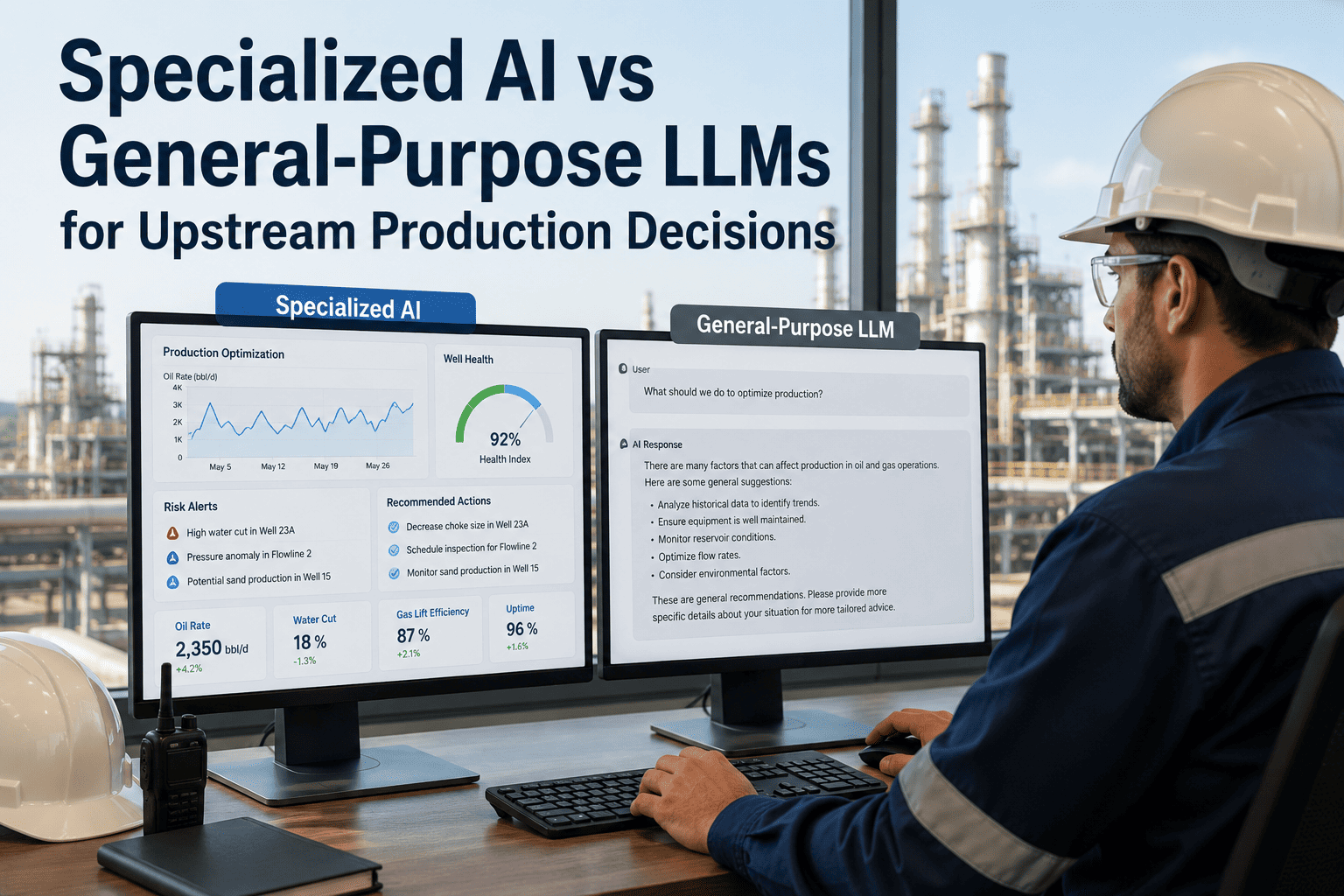
Ask a general-purpose chatbot how much a well will produce next quarter and it will answer with confidence, in fluent prose, with a number that sounds entirely plausible. It will also be wrong in ways that are almost impossible to catch from the output alone, because the model has no idea what a decline curve actually is beneath the words it just generated. Independent 2026 benchmarking of frontier language models still puts hallucination rates in the mid-single digits even on best-case general tasks, and far higher on complex structured analysis, which is exactly the category a production forecast falls into. For a reservoir engineer deciding where to allocate a workover budget, that gap between fluent and correct is the whole risk. See how iFactory's upstream specialists scope specialized models against the well data you already have.
Upstream AI Risk Comparison
A General-Purpose LLM Doesn't Know What a Decline Curve Is. Your Well Data Does.
Specialized AI trained on your production history, completion design, and reservoir characteristics returns forecasts grounded in physics and precedent. A general-purpose model returns the statistically most likely sentence. In production decision-making, those are not the same thing.
Why This Question Matters More in Upstream Than Almost Anywhere Else
Every industry is experimenting with large language models right now, but few industries convert a wrong answer into a seven-figure decision as fast as upstream oil and gas does. A forecast that overstates remaining reserves changes a divestment price. A forecast that understates decline changes a workover schedule and leaves barrels in the ground unbudgeted. A misread on artificial lift performance changes a capital allocation across an entire field. Upstream already leads AI adoption across the oil and gas value chain, capturing the largest share of sector-wide AI investment as operators push analytics into exploration, drilling, and production decisions. That adoption curve is exactly why the specialized-versus-general question can no longer be an afterthought: the tool doing the reasoning matters as much as the decision it informs.
4.6%–6.1%
Baseline hallucination rate on 2026 frontier general-purpose models, even on straightforward tasks
15%–52%
Reported hallucination range on structured analysis tasks, the category a production forecast falls into
51%–61%
Share of total oil and gas AI investment currently going into upstream exploration and production
$400K–$500K
Estimated cost per hour of unplanned downtime on an oil and gas production site
What "Specialized" Actually Means, Beyond the Marketing Language
"Trained on your data" gets used loosely enough that it has almost stopped meaning anything. A genuinely specialized production AI system is built differently at every stage, not just fine-tuned at the end of a general pipeline. The distinction is structural, and it shows up in what the model can and cannot be asked to reason about.
Physics-Constrained, Not Pattern-Matched
A specialized model incorporates decline curve equations, material balance, and reservoir engineering constraints directly into its architecture, so its output cannot violate the physics of how a well actually produces. A general LLM has no such constraint; it produces a number because the tokens around it were statistically likely, not because a reservoir behaves that way.
Trained on Well-Specific Time Series
It learns from your field's actual production history, completion parameters, and offset well behavior, not from generic internet text that happens to mention oil and gas. The training data is the operational record, not a scrape of public articles about the industry.
Bounded Output With Confidence Ranges
A well-built specialized system reports a forecast band and a confidence level tied to data quality, and flags when it is extrapolating beyond what the well history supports. A general LLM reports a single confident-sounding number with no calibrated sense of its own uncertainty.
Validated Against Known Outcomes
Specialized models are backtested against wells whose actual production is already known, so their error rate on your basin is measurable before you rely on them. A general LLM's accuracy on your specific reservoir has never been tested by anyone, because it was never built to be tested that way.
Where the Two Approaches Actually Diverge
The failure mode with a general-purpose model is rarely an obviously wrong answer. It is a plausible-sounding answer delivered with the same fluent confidence as a correct one, which is precisely what makes it dangerous in a decision-support context. The table below reflects how the two approaches behave across the tasks that make up day-to-day upstream production management.
Specialized Production AI vs. General-Purpose LLM
See the Difference on Your Own Wells
Run Your Field's Data Through a Model Built for It
Bring a production history from one well or one pad. We'll show you what a specialized forecast looks like against it, side by side with what a general-purpose tool would have said.
Five Places a General-Purpose Model Quietly Gets Upstream Wrong
These are not edge cases. They are the ordinary, everyday questions a production team asks, and they are exactly where a model with no domain grounding produces an answer that reads as authoritative but has no connection to how the well or the equipment actually behaves.
01
Confusing Normal Decline With an Emerging Problem
A general model asked to interpret a production drop has no baseline for what normal Arps-curve decline looks like on your well type, so it can just as easily under-flag a real mechanical issue as over-flag routine decline.
02
Treating Type Curves as Universal
It will apply a generic decline pattern learned from public text rather than the specific behavior of your formation, completion design, and offset wells, producing a forecast that looks reasonable and is not actually calibrated to your rock.
03
Missing Artificial Lift Failure Signatures
Fluid pound, gas interference, and worn valve signatures each have a distinct dynamometer card shape. A general model has no training on those shapes and cannot reliably tell an experienced pumper's judgment call from a coincidence in the numbers.
04
Stating Reserve Estimates With False Precision
Asked for an EUR, a general model will produce a specific-looking figure without disclosing that it is extrapolating far past the actual production history, which is the single most consequential kind of overconfidence in a reserves-based decision.
05
No Memory of What It Got Wrong Last Time
A general-purpose chat session has no persistent record of its own past forecast errors on your wells, so there is no feedback loop improving its accuracy on your specific field over time the way a purpose-built model's does.
The Cost Curve Behind This Question
The reason this distinction is worth engineering time rather than treating as a philosophical debate is the size of the numbers sitting behind a wrong call. Unplanned downtime on an oil and gas production site is now estimated at roughly $400,000 to $500,000 per hour, more than double what it was estimated at only a few years earlier, and offshore operators report an average of around 27 days of unplanned downtime a year. A forecasting or diagnostic error that delays a correct response by even a few hours compounds quickly against numbers that size. A specialized model is not just more accurate in the abstract; it is more accurate on the exact decisions where inaccuracy is most expensive.
Caught by a specialized model
Anomaly flagged against a known equipment baseline within the operating shift, workover scheduled before failure, downtime avoided entirely
Missed by a general-purpose model
No baseline to compare against, deviation reads as normal variation, condition worsens until it becomes an unplanned shutdown
Cost at that point
Hundreds of thousands of dollars per hour of lost production, plus emergency intervention and expedited parts costs on top of the base loss
Market Momentum Is Already Moving Toward Specialized Tools
The wider oil and gas AI market is projected to grow at a compound annual rate in the low-to-high teens through the early 2030s across most independent forecasts, and upstream consistently captures more than half of that spending because exploration and production workflows are the most data-rich part of the value chain. That growth is not being driven by generic chatbot adoption. Major oilfield service providers have been expanding joint industry-specific model development with cloud partners specifically because a horizontal, general-purpose model does not hold up against the accuracy bar this industry needs for capital decisions. The market is voting with its investment dollars for domain-specific systems over general-purpose ones, and the accuracy data explains why.
Questions to Ask Before You Trust Any AI Output on a Well
Whether you are evaluating a specialized platform or wondering if a general chatbot is good enough for a quick check, these questions separate a tool you can build a decision on from one that only sounds like it belongs in the conversation.
1. What data was this specific answer grounded in?
If the model cannot point to your production history, completion record, or offset well data behind a specific forecast, it is generating a plausible-sounding pattern rather than reasoning from your well's actual behavior.
2. Does it report a confidence range or a single number?
A single precise-looking figure with no stated uncertainty is a warning sign in production forecasting, where even a well-calibrated model should widen its range as it extrapolates further from known history.
3. Has its accuracy been validated on wells like yours?
A specialized model backtested against known outcomes on comparable formations gives you a measurable error rate before you rely on it. A general-purpose model's accuracy on your specific basin has typically never been tested by anyone.
4. Can the reasoning be reproduced and audited later?
If a reserves estimate or workover recommendation ever needs to be defended to a partner, lender, or regulator, you need a traceable chain from input data to output, not a chat transcript that cannot be re-run the same way twice.
Put a Real Number Behind This
Get a Backtested Accuracy Comparison on Your Own Field
We'll validate a specialized forecast against wells you already know the outcome for, so the accuracy gap isn't a claim, it's a number you can see.
Frequently Asked Questions
Isn't a general-purpose model good enough for a quick sanity check, even if not for the final decision?
It can be useful for summarizing a report or drafting an email, but a quick sanity check on production numbers is exactly where the risk hides, because a plausible-sounding wrong number can anchor a team's thinking before anyone runs the real analysis. If that quick check ends up shaping a workover priority or a budget conversation even informally, the lack of grounding in your actual well data matters just as much as it would in a formal forecast. The safer pattern is to keep general-purpose tools for administrative and communication tasks and route anything touching production numbers through a system that can show its data source. You can see how
iFactory scopes that separation for teams that use both types of tools.
How much well history does a specialized model actually need before it's reliable?
There is no universal threshold, because it depends on well type, completion complexity, and how much offset data exists in the same formation, but a specialized model will tell you explicitly when it is operating outside a confident data range rather than guessing silently. Wells with only a few months of production history will naturally carry wider forecast bands than wells with years of established decline behavior, and a properly built system surfaces that distinction instead of hiding it. This is one of the clearest structural advantages over a general-purpose model, which has no concept of "not enough data yet" built into how it answers. A specialist can walk through what your specific field's data maturity supports on a call.
Do we have to replace our existing production software to bring in a specialized AI layer?
No, in most deployments the specialized model sits alongside your existing SCADA, production accounting, and reservoir software, reading from the data you already collect rather than requiring a system replacement. That keeps the rollout timeline measured in weeks rather than the much longer cycle a full software migration would require, and it means your existing workflows and reporting structures stay intact. The integration typically starts on one or two wells or a single pad so the accuracy can be validated before wider rollout.
Book a scoping call to see how this maps to your current stack.
What happens when the specialized model itself is uncertain or wrong?
A well-built specialized system is designed to surface its own uncertainty rather than mask it, flagging low-confidence forecasts and widening its range instead of presenting a single number with false precision. When it is wrong, the traceable data path means engineers can identify what input or assumption drove the miss and correct it, which feeds back into improving accuracy on that specific field over time. That feedback loop is structurally absent from a general-purpose chatbot, where there is no persistent memory of a past forecast error to learn from. It is a meaningful difference between a tool that improves with use and one that repeats the same blind spots indefinitely.
Is this level of accuracy overkill for a smaller independent operator with fewer wells?
Smaller operators often have less margin to absorb a wrong capital decision, not more, since a single mispriced divestment or misallocated workover budget carries proportionally more weight against a smaller balance sheet. The specialized approach also scales down reasonably well, since a model can be scoped to a handful of wells or a single field rather than requiring an enterprise-wide rollout to be useful. The relevant question isn't company size, it's whether a production or reserves number is about to inform a real financial decision.
Talk to our team about what a right-sized deployment looks like for a smaller operation.
Ground Your Forecasts in Your Own Well Data.
See What a Specialized Model Says About Your Field
Bring your production history to the call. We'll show you the accuracy gap between a specialized forecast and a general-purpose answer on wells you already know the outcome for.