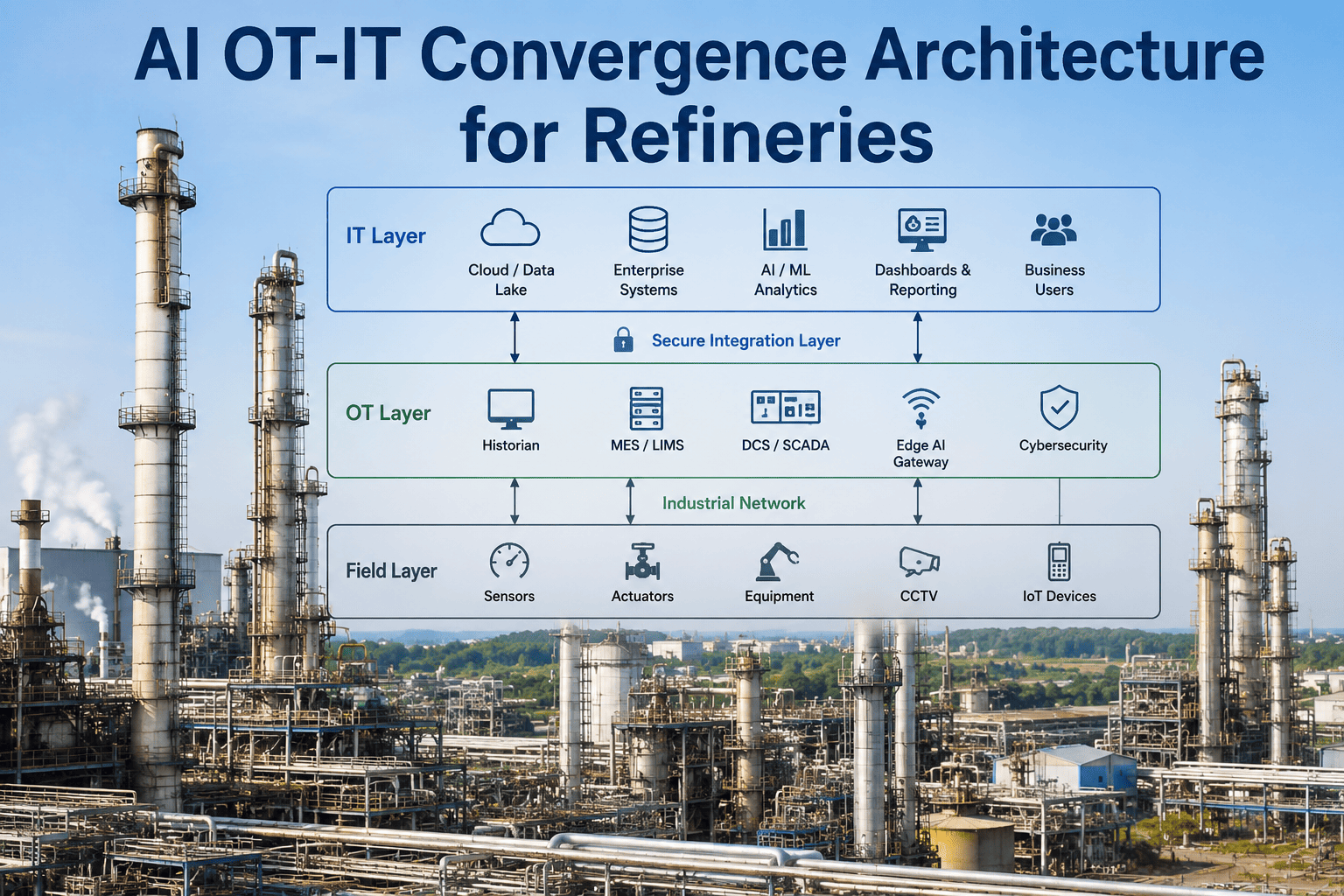
One manufacturer spent $315,000 migrating forty AI workflows after its platform vendor collapsed. Refineries face the same risk at a larger scale, since a DCS is typically a 25 to 30 year commitment, and a proprietary AI module bolted onto it can quietly become just as permanent. Avoiding it comes down to which standards you insist on before signing. iFactory's integration team works through this evaluation with refinery operators before any contract gets signed.
Your DCS Outlasts Every AI Vendor You'll Ever Evaluate
A refinery control system runs for decades. The AI platform you bolt onto it should be swappable in months, not welded in for the life of the plant. Here's how to keep it that way, and what to check before you sign anything.
Two Ways an AI Vendor Gets Welded to Your DCS
Lock-in rarely happens in one dramatic decision. It accumulates through a series of individually reasonable-sounding choices that only become expensive in aggregate, usually well after the contract is signed and the models are trained on years of your process data.
- AI module ships embedded inside the DCS vendor's own control software, with no documented external API
- Historical process data lives in a vendor-specific database format that only their tools can query
- Model logic and tuning parameters are a black box, inaccessible even to your own engineers
- Switching means re-engineering the integration layer from scratch, not just swapping a module
- AI platform connects through OPC UA or MQTT, protocols any vendor's tools can read
- Process data is exposed through standardized, documented data models your team can query directly
- Model outputs and integration logic are visible and portable, not locked inside one vendor's runtime
- Switching means re-pointing the same standard connection at a new platform, not rebuilding it
What Lock-In Actually Costs When It Comes Due
The bill for vendor lock-in rarely arrives during the honeymoon period of a new AI deployment. It arrives two or three years in, when the vendor raises prices, gets acquired, deprioritizes your use case, or simply cannot keep pace with what your refinery needs next. By then, the cost of leaving has usually grown far larger than the cost of staying, which is precisely the trap.
Find Out How Locked In Your Current Setup Already Is
Bring your current DCS vendor, historian, and any AI or advanced process control modules already deployed. We'll walk through what's portable today and what isn't.
The Standards That Actually Buy You Independence
Not every "open" label means the same thing. Three standards do most of the real work in keeping a refinery's AI layer separable from its DCS, and each solves a slightly different piece of the portability problem.
Five Questions to Ask Before You Sign
Every one of these questions has a specific, checkable answer. If a vendor can't answer clearly, or the answer is "our proprietary format," that's the lock-in risk showing up before the contract is even signed.
Not sure how your current contract answers these five questions? Send us the integration section and we'll flag what to renegotiate before renewal.
Integrated DCS vs. Best-of-Breed: The Trade-Off You're Actually Making
Refineries evaluating AI integration are really choosing between two philosophies, and it helps to name the trade-off honestly rather than pretend one side has no downside. A single-vendor DCS ecosystem gives you one point of contact and a proven, unified architecture, at the cost of being tied to that vendor's pace of innovation and pricing decisions. A best-of-breed approach, where the AI layer connects through open standards regardless of which DCS you run, gives you the freedom to pick the best tool for each job, at the cost of owning more of the integration yourself. Open standards are what make that second path viable without turning every integration decision into a custom engineering project.
| Consideration | Proprietary DCS-Native AI | Open Standards AI Layer |
|---|---|---|
| Switching AI vendors | Full integration rebuild | Re-point the same standard connection |
| Historical data access | Locked in vendor's proprietary format | Exportable in standard, queryable formats |
| Multi-vendor plants | Separate integration per DCS vendor | One integration pattern across all units |
| Pricing leverage | Limited, tied to single vendor roadmap | Retained, can evaluate alternatives anytime |
| Brownfield legacy DCS | Often requires vendor-specific gateway | Edge gateways bridge via OPC UA regardless of age |
Why This Matters More in Refining Than Almost Anywhere Else
Most industries can tolerate a rip-and-replace integration project if a vendor relationship sours. Refineries generally cannot. A DCS is typically a 25 to 30 year commitment, and most refinery control system work happening in 2026 is brownfield migration, not new builds, meaning today's AI integration decisions get layered onto systems like TDC3000, CENTUM CS3000, or older PROVOX platforms that were never designed with AI connectivity in mind. That reality cuts two ways. It means an AI vendor selling proprietary lock-in is asking you to bet the next several years of that 25 to 30 year window on their continued existence and goodwill. It also means the open-standards path has to work with genuinely old hardware, not just the newest DCS on the market, which is exactly what edge gateways speaking OPC UA over legacy protocols like Modbus are built to handle. The oil and gas DCS market itself is expected to grow at roughly 4.1% annually through 2030, and a meaningful share of that growth is existing refineries modernizing control systems that have already exceeded their originally intended operational lifecycle, not new refineries being built from scratch.
What Independence Looks Like in Practice
An AI layer built on open standards doesn't mean rejecting your DCS vendor's own AI offerings outright. Honeywell Forge, ABB Ability, and Schneider's EcoStruxure all deliver real value inside their own ecosystems. The difference is architectural: does the AI capability require everything else in your stack to be that same vendor's product, or does it connect through OPC UA, MQTT, and REST regardless of what sits underneath it? A refinery that insists on the second answer keeps every future decision, including whether to keep using that same vendor's AI tools, entirely optional rather than contractually assumed. That optionality is the entire point, and it costs nothing extra to insist on it at the evaluation stage, while it can cost hundreds of thousands of dollars to retrofit after the fact.
There is also a data-ownership dimension that outlasts any individual vendor decision. Years of process history, tuned model parameters, and alarm-response patterns represent genuine institutional knowledge, built up shift after shift, unit after unit. When that history lives exclusively inside a proprietary format, the refinery has effectively handed the vendor ownership of its own operating experience. Rebuilding that history from scratch after a forced migration is not just an engineering cost. It is a knowledge cost, because some of what a well-tuned model learned about a specific unit's quirks over several years of operation cannot be fully recovered from raw historian data alone. Standard, exportable data formats keep that history where it belongs: with the refinery that generated it.
Multi-Vendor Refineries Face This Question Constantly
Very few refineries run a single DCS platform across every unit. Decades of expansions, acquisitions, and unit-specific upgrades typically leave a plant running Honeywell on one train, Yokogawa on another, and a legacy Foxboro or PROVOX system somewhere in the mix. In that environment, a proprietary AI module tied to one DCS vendor doesn't just create a lock-in risk. It creates a coverage gap, because that module simply cannot see or act on data from the other platforms running elsewhere in the same plant. An open-standards integration layer solves both problems in one move: it removes the single-vendor dependency, and it gives operations a single, consistent view across every DCS platform on site, regardless of which vendor built which unit's control system decades apart from the others.
This matters most in exactly the scenarios where refineries are already under the most operational pressure: turnaround planning that spans units on different control platforms, cross-unit optimization that needs a consistent view of feedstock and yield data, and incident investigation that has to reconstruct what happened across a boundary between two different vendors' historians. A proprietary, single-vendor AI layer structurally cannot answer questions that cross that boundary, no matter how sophisticated its model is within its own silo. An open-standards layer treats the boundary as a data-modeling exercise rather than an integration wall, which is usually the difference between an AI initiative that actually informs plant-wide decisions and one that quietly stays confined to a single train.
The Migration You Never Have to Make
The strongest argument for open standards is not a hypothetical. It is the migration project that simply never has to happen. When an AI vendor's roadmap stops matching your refinery's needs, when pricing terms shift after an acquisition, or when a genuinely better platform enters the market, a refinery running on OPC UA, MQTT, and REST evaluates the alternative on its merits and switches on its own timeline. A refinery locked into a proprietary integration evaluates the alternative against the cost of a full rebuild, and in practice, that comparison usually loses even when the new platform is clearly better. Lock-in doesn't just cost money when you leave. It quietly removes leverage every single day you stay, because the vendor knows exactly how expensive it would be for you to walk away, and pricing and support decisions tend to reflect that knowledge over time.
None of this requires a refinery to become an integration specialist overnight. It requires asking the right five questions before a contract is signed, insisting that any AI vendor demonstrate real interoperability rather than claim it, and treating the integration layer as a strategic asset the refinery owns, not a feature the vendor happens to include. That shift in framing, from "what does this vendor's AI do" to "how easily could we leave if we needed to," is usually the single highest-leverage question in the entire evaluation process.
Frequently Asked Questions
Connect Your DCS to AI Without the Lock-In
Bring your current DCS vendor and any AI modules already in place. We'll show you exactly what's portable today, and what an open-standards integration layer looks like for your refinery.