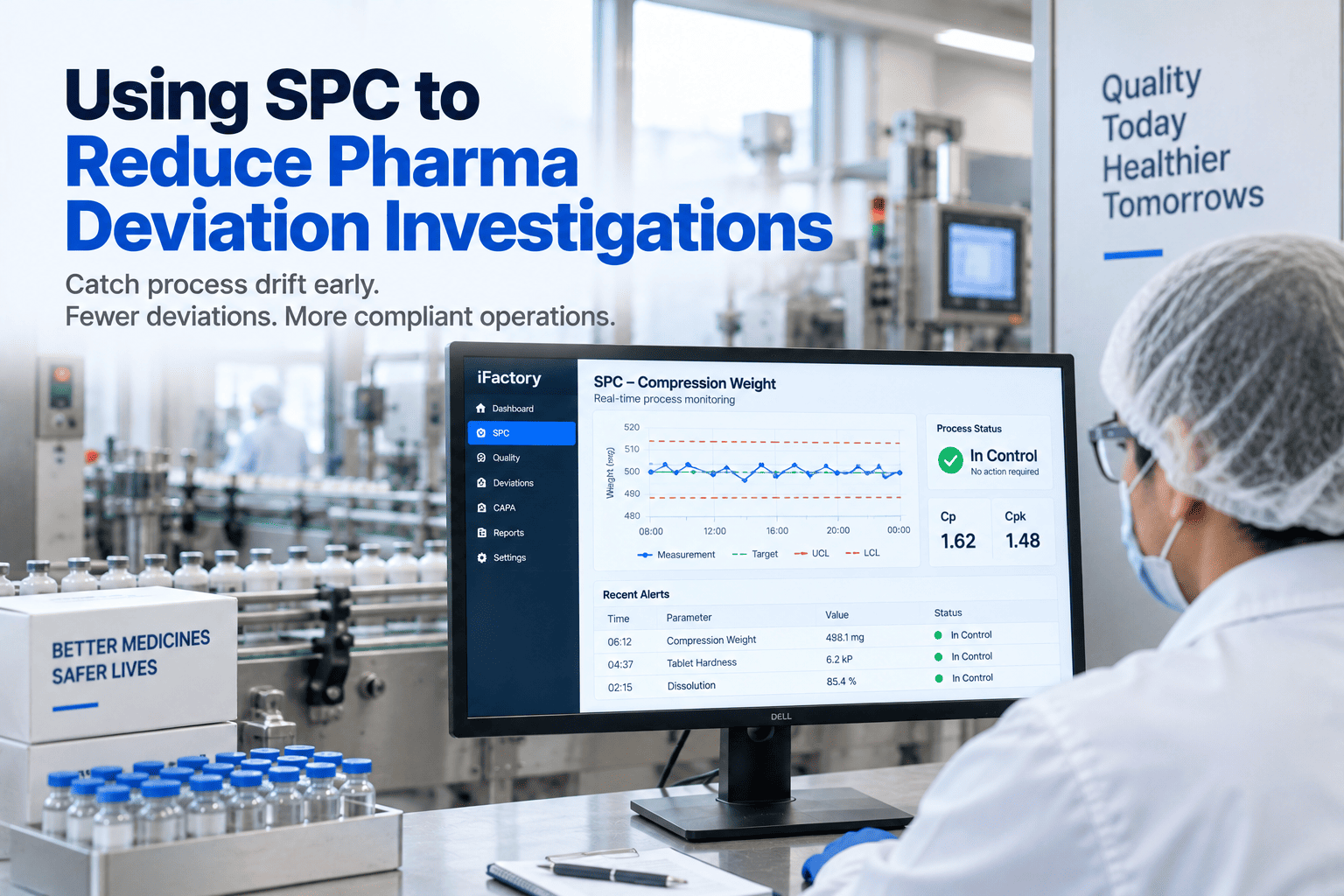
Ask any pharma quality team where their time goes and the answer is deviations — not the events themselves, but the investigations they compel. A single out-of-spec result triggers a formal, regulated inquiry that typically runs 30 to 45 days, pulls analysts and QA off everything else, holds the batch, and leaves a paper trail an FDA investigator reads line by line under 21 CFR 211.192. Here's the part that stings: a large share of those deviations never had to happen. The process was already drifting toward the limit, batch after batch, and nobody saw it until a result finally crossed the line. By some estimates around 30 percent of GMP deviations trace back to process-control gaps — exactly what SPC is built to close. SPC catches the creeping mean before it breaches spec, so the drift becomes an in-control adjustment instead of an investigation. You can book a demo to see it on your process data.
The Cheapest Deviation Investigation Is the One You Never Have to Open
Around 30 percent of GMP deviations come from process-control gaps. SPC catches drift early — while the result is still in spec — turning what would have been a 30-to-45-day investigation into a quiet correction, and slashing the investigation workload at its source.
It's Not the Failed Result — It's the Investigation It Compels
To see why prevention matters so much, be precise about where a deviation's cost actually lands. The failed unit is trivial; the burden is everything the failure sets in motion. A regulated investigation isn't optional or quick, and it consumes exactly the people you can least spare. This is the workload SPC exists to shrink at the source.
An OOS or deviation triggers a documented, scientifically sound investigation under 21 CFR 211.192 — typically a 30-to-45-day effort with a regulatory clock and scrutiny attached. The test that failed took minutes; the inquiry it compels takes weeks.
Each investigation pulls analysts, QA, and process engineers off other priorities to reconstruct what happened. The opportunity cost — the improvement work not done because the team is writing an investigation — often exceeds the direct cost.
While the investigation runs, affected lots sit on hold — finished product that can't ship, working capital frozen, and a delivery commitment at risk, all waiting on a paper process that started with a drift nobody caught.
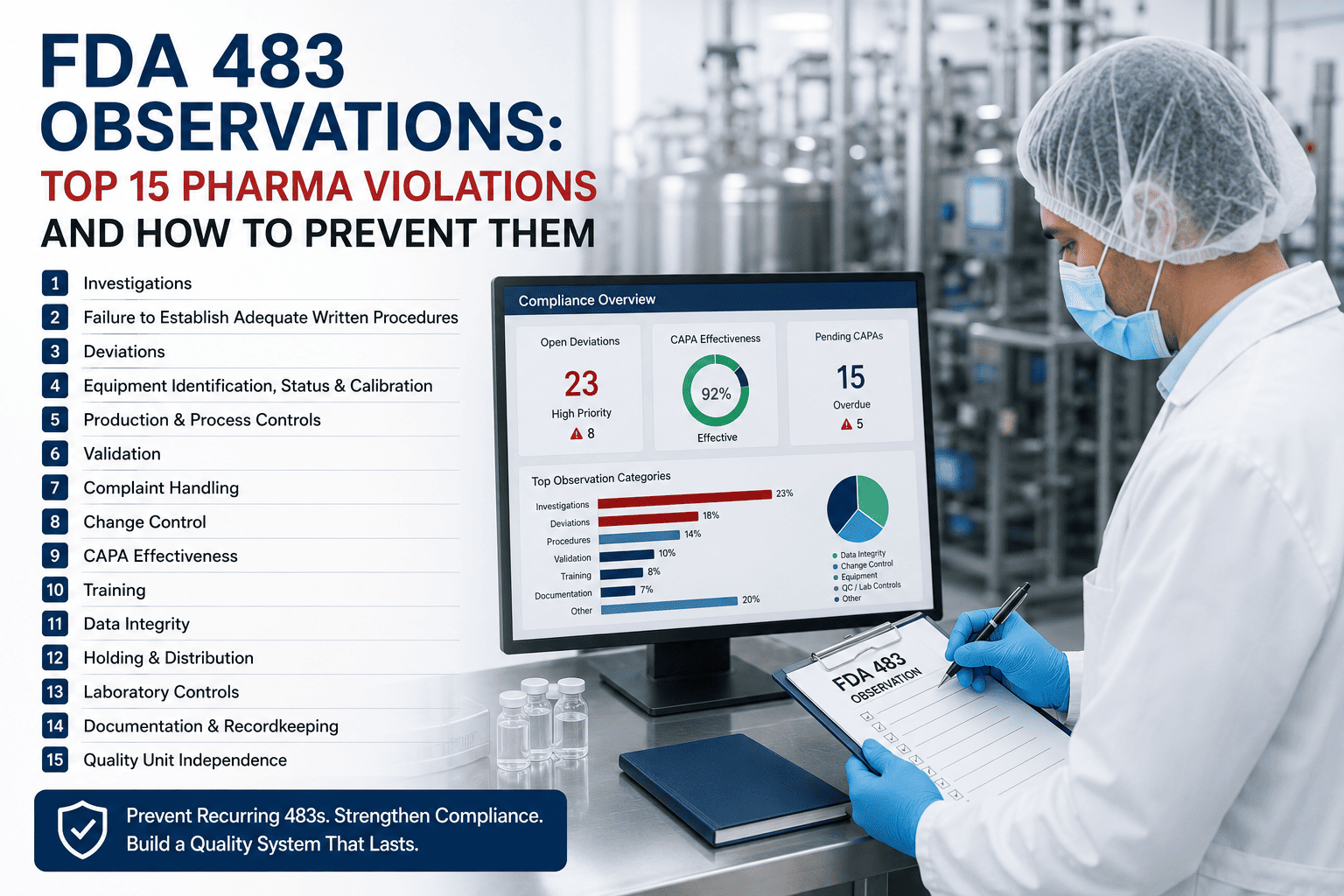
Lab-control failures and mishandled investigations sit among the top FDA citation categories, and inspectors read deviation trends as a direct signal of process discipline. A weak or repeated one can escalate into a 483, a warning letter, or worse.
A Deviation Is Usually a Drift That Nobody Caught in Time
The deviations SPC can prevent share a signature: the process didn't fail suddenly, it drifted. The mean crept toward a specification limit over batches or hours while every individual result still passed — until one didn't, and a deviation had to be raised for something that was visible in the data long before. Understanding that pattern is understanding where the workload comes from.
A process parameter — potency, impurity, fill, dissolution — slowly walks toward its limit. Each result is in spec, so nothing is flagged, but the trend is unmistakable in hindsight. The deviation gets written when the creep finally crosses the line, weeks after it started.
A result inside the control limits feels safe, so teams watch only for the point that finally breaches. But a run of points on one side of the mean, or a steady trend, is a process already out of control — a signal that shows up long before any single result fails.
An out-of-trend signal — a result abnormal relative to history but still in spec — is the early warning. Ignored, it becomes an out-of-spec result and a full investigation. Caught, it's a small adjustment. The same event, handled weeks apart, costs wildly different amounts.
Catch the Drift Before It Becomes a File
iFactory's SPC trends every critical parameter and fires on the drift while results are still in spec — so the creeping mean becomes an adjustment you make, not a deviation you investigate.
The Western Electric Rules Fire Weeks Before a Result Fails
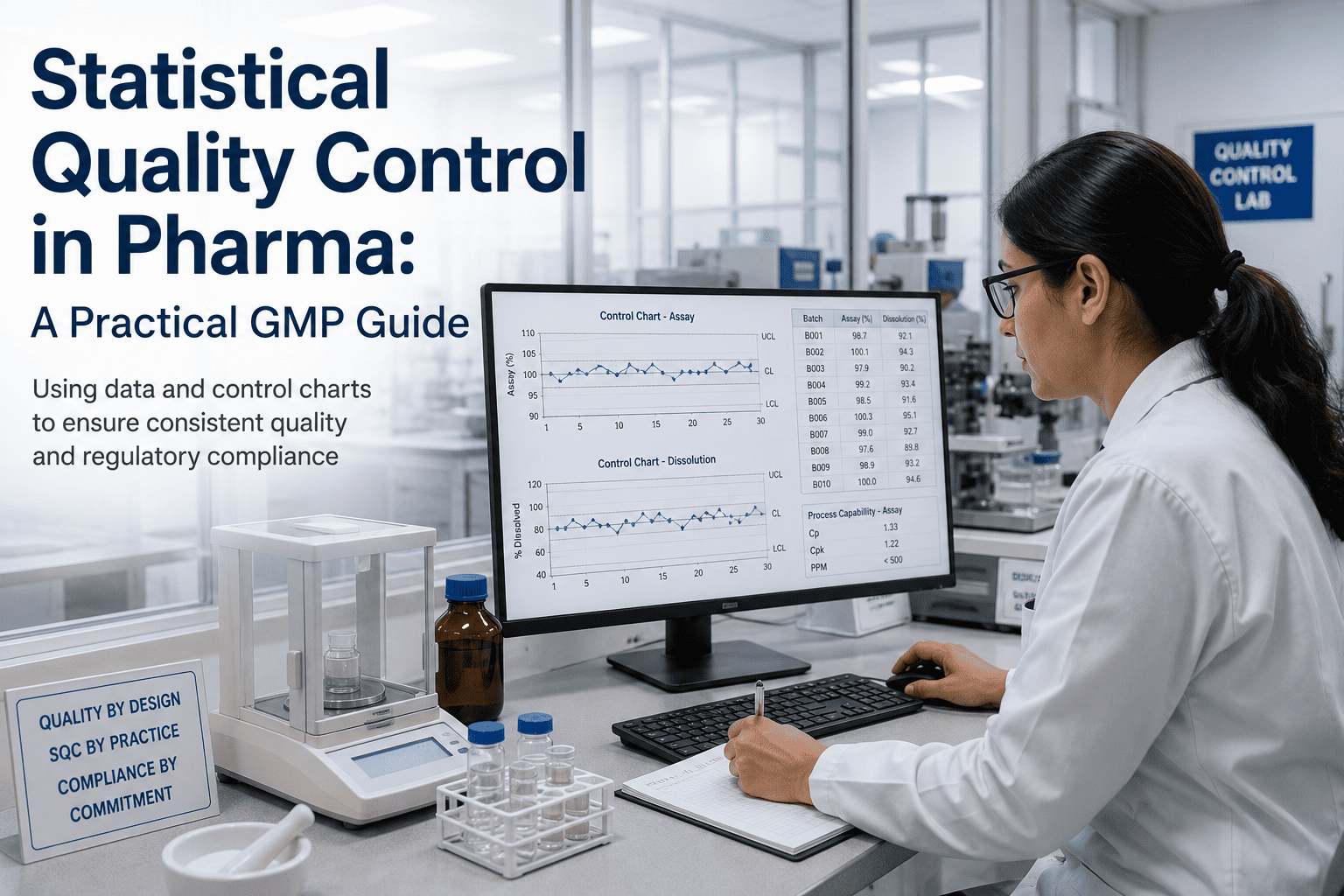
SPC prevents deviations because its rules detect the drift, not just the breach. A point inside the control limits does not mean the process is in control — the eight pattern-based Western Electric rules, in every serious SPC package since 1956, catch special-cause variation long before a point crosses ±3σ. Applied to your critical quality attributes, they turn the invisible creep into an actionable signal. These are the ones that catch a deviation in the making.
Nine consecutive points on the same side of the centerline means the process mean has shifted — a persistent change that's still in spec today but heading somewhere. This fires while you can still investigate a pattern instead of a failure.
Six consecutive points all rising or all falling is the creeping mean made visible — the exact drift that becomes an OOS if left alone. The rule flags it as a trend weeks before it reaches the limit.
Clusters of points drifting into the outer zones signal rising variability before any breach. Increasing spread is an early sign of a process losing control that a simple limit check would miss entirely.
The classic breach still matters — but in a well-run SPC program it's the rare exception, because the pattern rules caught most problems earlier. When it does fire, it's a genuine special cause, not the first anyone knew of a long-running drift.
The Same Event, Handled Weeks Apart, Is a Different Animal
Here's the reframe that matters most: catching a problem with an SPC rule while the result is still in spec doesn't just speed up the investigation — it changes what kind of event it is. It becomes a pattern-flag adjustment, handled on the floor, instead of a formal deviation with a regulatory clock. Teams that ignore the pattern rules end up writing OOS investigations that should have been pattern-flag adjustments weeks earlier.
The drift is invisible until a result breaches, a deviation is opened, the batch goes on hold, a 30-to-45-day investigation runs, RCA and CAPA follow, and the whole file sits in front of an inspector. Weeks of your team's time for a problem the data showed early.
The rule fires on the trend while every result is still in spec, an engineer adjusts the process back to center, and the event closes as a documented in-control correction. No batch hold, no regulatory clock, no investigation — because there was no deviation to raise.
Prevention and Inspection Readiness Come From One System
The SPC that prevents deviations does a second, equally valuable job: it produces the evidence an FDA inspector asks for. Continued Process Verification — Stage 3 of the 2011 Process Validation guidance — expects exactly this trending, and it's the only auditable way to prove a state of control across the lifecycle. The trending that catches drift is the trending the inspector wants to see.
"Show me your Stage 3 trending — can you demonstrate the process was in a state of control?" A live SPC program answers it on the spot with charts, where a spreadsheet reconstructed after the fact invites the follow-up questions that turn a routine inspection into a 483.
Inspectors read deviation trends as a signal of process discipline. SPC that shows deviations declining, and recurring signals caught and closed, demonstrates a system that actively prevents rather than one that only records — the maturity regulators now expect.
Many pharma attributes — impurities, particulates, counts — are non-normal by nature. A credible SPC program transforms the data or uses the right chart type and documents the rationale, because auditors object to assuming normality without verifying it.
For the genuine deviations that remain, an SPC signal auto-routed into the CAPA workflow with its full data context accelerates closure from weeks toward days — so even the investigations you can't prevent cost less.
SPC That Reduces Deviations, Not One That Adds Noise
Done carelessly, SPC can generate a flood of false signals that the team learns to ignore — which would defeat the entire purpose. Reducing the investigation workload depends on the program being disciplined about what it monitors and how it alarms. These are the things that separate deviation-reducing SPC from dashboard noise.
Monitor the critical quality attributes and critical process parameters that actually drive deviations, mapped from the control strategy — not every available tag. Charting what matters keeps the signals meaningful and the response focused.
Applying the appropriate pattern rules per attribute — not all eight everywhere — is what keeps alerts credible. Over-ruling floods the team with false alarms; the right rules on the right charts catch real drift without the noise.
SPC run live on production data catches drift while it's still correctable; SPC run on last month's data in a spreadsheet just documents the deviation you already have. The timing is the entire difference between prevention and record-keeping.
A rule that fires into a report nobody reads prevents nothing. The signal has to reach the person who can adjust the process, in time to act — so the pattern flag becomes a correction, not a missed early warning.
SPC Built to Shrink the Deviation Pile
iFactory runs SPC on your live pharma process to prevent deviations at the source: it trends the critical attributes, fires the right pattern rules while results are still in spec, routes the signal to someone who can act, and produces the Stage 3 evidence an inspector expects — so the investigation workload falls and inspection readiness rises from one system.
What Pharma Operations Teams Ask About SPC and Deviations
Turn Deviation Investigations Into Adjustments You Never Have to File
iFactory's SPC catches the drift weeks before it breaches spec, routes the signal to someone who can correct it, and doubles as your Stage 3 state-of-control evidence — so the deviation pile shrinks at its source and inspections get easier at the same time.