The aeroderivative versus frame gas turbine decision usually gets made at the procurement stage based on output, footprint, and efficiency curves, and the maintenance cost consequences of that choice only become fully visible five or ten years later when the first major overhaul bill arrives. Both turbine families are reliable when maintained correctly, but the maintenance philosophy, cost structure, and availability profile between them are different enough that applying a frame-style maintenance plan to an aeroderivative unit, or the reverse, quietly erodes the economics either design was supposed to deliver. Book a demo to see how iFactory tracks maintenance cost per fired hour across mixed turbine fleets.
Two Turbine Philosophies, Two Very Different Maintenance Bills
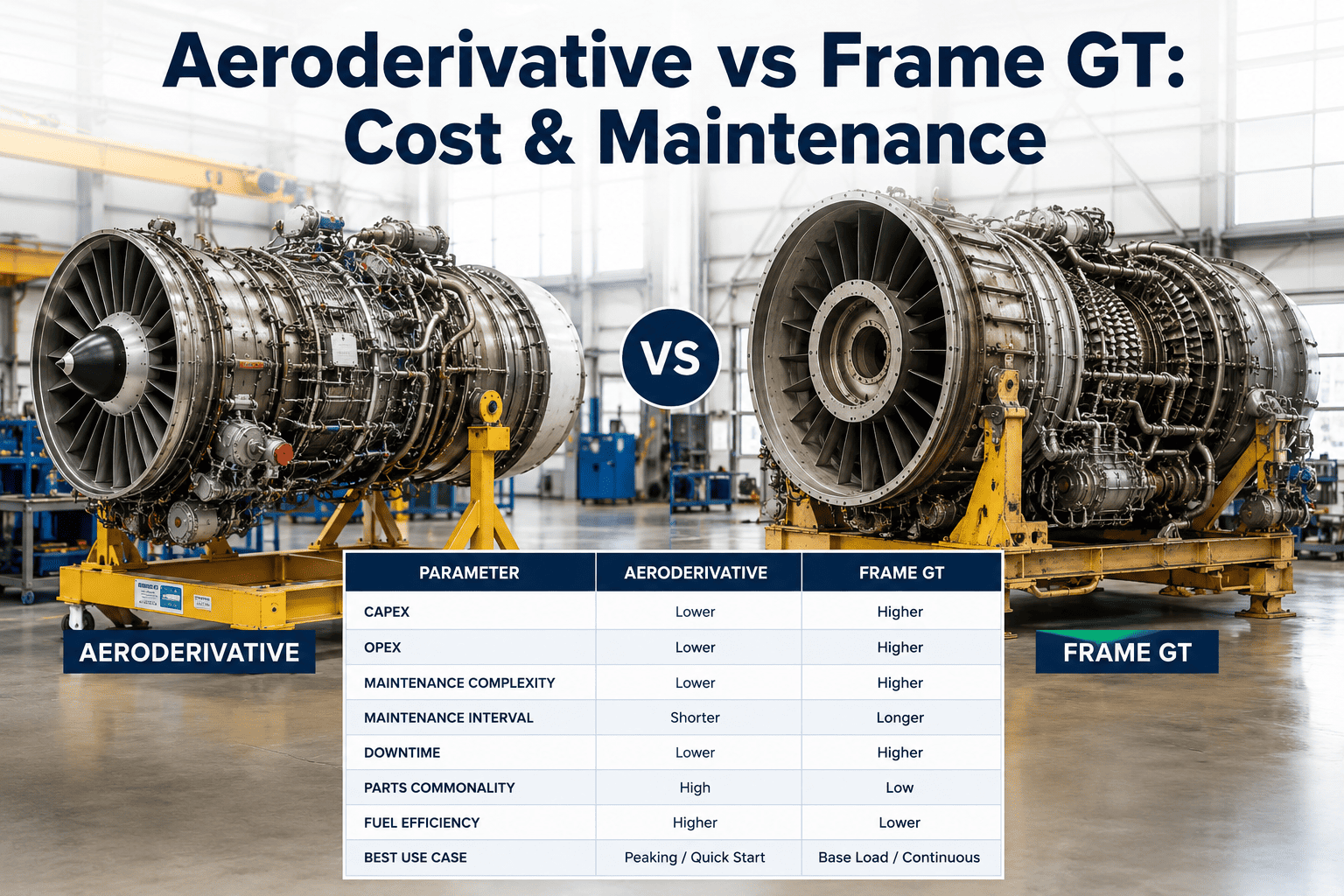
Aeroderivative units are built around fast module swaps and off-site overhaul, trading higher capital cost for shorter outages. Frame turbines are built around in-situ repair and longer intervals between major work, trading longer outages for lower per-hour parts cost. Neither is universally cheaper, the right answer depends on your duty cycle, spare module access, and outage cost profile.
Why These Two Designs Lead to Two Different Maintenance Philosophies
Aeroderivative turbines are derived from jet engine cores, built light, and designed around the same logic commercial aviation uses: when a module degrades, you swap it out as a complete unit and send it to a repair facility, rather than opening the casing on site. That approach was built for airlines that cannot tolerate long ground time, and it carries directly into power generation as short outage windows measured in hours or a few days for a module change.
Frame turbines are built heavier and larger from the outset, without the weight constraints aviation imposes, and their maintenance philosophy assumes the unit stays in place. Hot gas path components are inspected and repaired in-situ during scheduled outages, and the casing itself rarely leaves the foundation. That means longer outage windows, typically weeks rather than days, but often at a lower total parts cost per repair cycle since full module replacement is avoided.
- Module swap outages typically complete in 24-72 hours
- Higher capital and spare module inventory cost
- Repair happens off-site at a specialized facility, not in the plant
- Better fit for peaking and fast-cycling duty profiles
- Lower mass supports faster start-up to full load
- Major inspection outages typically run 2-6 weeks
- Lower relative capital cost per MW installed
- Hot gas path repair performed in-situ by field crews
- Better fit for steady baseload operating profiles
- Higher thermal mass supports longer component life at steady load
Comparing Cost Per Fired Hour Across a Mixed Fleet Is Harder Than It Looks
iFactory normalizes maintenance spend, outage duration, and parts consumption across aeroderivative and frame units on the same fleet dashboard, so the comparison is based on your actual data, not published averages.
Maintenance Cost Per Fired Hour: What the Published Ranges Actually Show
Published maintenance cost figures vary widely by manufacturer, model vintage, and fuel type, so the ranges below should be read as directional rather than a quote for any specific unit. What holds consistently across sources is the relative pattern between the two turbine families, not the absolute numbers.
| Cost Driver | Aeroderivative | Frame |
|---|---|---|
| Parts cost per fired hour | Generally higher | Generally lower |
| Labor cost per outage event | Lower, off-site repair | Higher, extended on-site crew |
| Outage duration, major event | 1-4 days per module | 2-6 weeks |
| Spare inventory carrying cost | Significant, spare modules required | Lower, repair kits rather than full spares |
| Availability impact of a major event | Lower, shorter downtime | Higher, longer downtime |
The pattern that emerges is a tradeoff between availability and total maintenance spend rather than one design being cheaper across the board. A plant that values uptime highly, such as one facing high replacement power costs during an outage, often finds the aeroderivative premium pays for itself through avoided downtime, while a steady baseload plant with lower outage cost exposure often favors the frame turbine's lower per-hour parts cost.
These figures also shift meaningfully with unit age. A frame turbine in its first decade of operation typically sees longer intervals between major inspections and correspondingly lower annualized cost, while a unit well past its original design life often faces shorter effective intervals as OEM-recommended inspection triggers tighten in response to accumulated fatigue. Aeroderivative modules follow a somewhat more predictable pattern since each module has its own defined life limit independent of the rest of the engine, which makes budgeting more straightforward but does not necessarily make it cheaper over the full ownership period.
How OEM Service Agreements Change the Calculation
Long-term service agreements with the original equipment manufacturer shift a meaningful portion of the maintenance cost comparison away from a pure parts-and-labor calculation and into a contractual cost-per-fired-hour structure, which changes how the aeroderivative versus frame comparison should actually be modeled. Under a typical long-term agreement, the OEM assumes much of the maintenance cost risk in exchange for a predictable payment tied to operating hours, which can make the higher aeroderivative parts cost far less consequential to the plant's own budget than the raw parts pricing would suggest.
The tradeoff is that these agreements often come with utilization commitments or availability guarantees that favor whichever turbine design better matches the plant's actual duty profile, so a mismatch between contract terms and real operating pattern can erase much of the intended cost predictability. Reviewing actual fired hours, starts, and outage history against the contract's assumptions on a recurring basis is worth doing well before a renewal negotiation, not after a dispute over invoiced charges has already started.
What Should Actually Drive the Comparison at Your Plant
Most Plants Do Not Actually Choose One or the Other
In practice, many power plants and industrial sites operate a mixed fleet, running frame turbines for steady baseload generation and aeroderivative units for peaking or fast-response capacity, precisely because the two designs serve different roles in the same operation. The maintenance planning challenge in that scenario is less about which turbine type is better and more about tracking cost per fired hour consistently across fundamentally different maintenance models, so budget comparisons and capital planning decisions rest on comparable numbers rather than apples-to-oranges spend categories.
How to Actually Build a Total Cost of Ownership Comparison
A fair comparison between turbine types requires more than lining up published maintenance cost ranges side by side, because those figures rarely capture the outage cost, availability impact, and spare parts carrying cost that make the real difference at a specific site. Building a defensible total cost of ownership model means working through a consistent set of inputs for both turbine types rather than comparing a vendor's aeroderivative brochure against a different vendor's frame turbine case study.
Once these four inputs are assembled on a consistent basis, the total cost of ownership comparison usually looks meaningfully different from a simple published-range comparison, and it is common for the conclusion to flip depending on how heavily a given site weighs outage cost against parts spend. This is also where continuous maintenance data tracking pays off, since a model built on a single historical snapshot goes stale as soon as fuel costs, labor rates, or duty cycle shift.
Common Questions About Aeroderivative and Frame Turbine Maintenance
Is an aeroderivative turbine always more expensive to maintain than a frame turbine of similar output?
Not necessarily, and the answer depends heavily on how cost is measured. Aeroderivative units typically carry higher parts cost per fired hour and require investment in spare modules, which makes the per-hour maintenance line item look more expensive in isolation. When outage cost, lost generation revenue, and availability penalties are factored into a total cost of ownership view, the shorter aeroderivative outage window frequently narrows or reverses that gap, particularly for plants where downtime carries a high financial cost. Book a demo to model total cost of ownership against your specific outage cost profile.
How long does a typical frame turbine major inspection outage actually take compared to a module swap?
A frame turbine major inspection, covering hot gas path components and a full combustion inspection, commonly runs two to six weeks depending on unit size, findings during teardown, and field crew availability, since the work happens in-situ with the casing opened on the foundation. An aeroderivative module swap, by contrast, typically completes in one to four days because the degraded module is pulled as a complete unit and a pre-tested spare is installed in its place, with the actual repair work happening off-site afterward on the removed module.
Does duty cycle really change which turbine type makes more economic sense, or is that overstated?
Duty cycle is one of the more consequential variables in this comparison rather than a secondary factor. Frequent starts and stops impose thermal cycling stress that both designs must tolerate, but aeroderivative units generally handle fast starts and load changes with less cumulative fatigue impact given their aviation-derived design heritage, while frame turbines are generally optimized around sustained steady-state operation. A plant running mostly baseload with infrequent starts will likely see less differentiation from duty cycle alone, while a peaking or fast-cycling profile tends to favor the aeroderivative maintenance model more clearly. Contact support for help evaluating your specific duty cycle data.
What is the biggest hidden cost that plants underestimate when budgeting for aeroderivative maintenance?
Spare module carrying cost is the most commonly underestimated line item. The fast outage window that makes aeroderivative units attractive only materializes if a spare module is available, either owned outright or accessible through a lease or pooling arrangement, and that inventory represents significant capital sitting idle between uses. Plants that skip this investment and instead order a module only after a failure occurs often end up with outage durations that erase the theoretical speed advantage entirely, sometimes running longer than a comparable frame turbine repair. Book a demo to see how spare module planning fits into total maintenance cost tracking.
Can maintenance cost data from one turbine model be used to benchmark a different model in the same family?
Only loosely, and it should be treated as a starting reference point rather than a reliable benchmark. Cost per fired hour varies meaningfully across models within the same aeroderivative or frame family based on vintage, fuel type, ambient operating conditions, and the specific parts and labor market a plant operates in, so cross-model comparisons are useful for sanity-checking a budget but should not replace tracking a specific unit's own maintenance history over time as the primary planning input.
Compare Your Fleet on Real Numbers, Not Published Averages
iFactory tracks maintenance spend, outage duration, and availability across every turbine in your fleet, aeroderivative and frame alike, on one normalized cost-per-hour view.