Most power plants didn't design their alarm system so much as accumulate it, one setpoint and one control system upgrade at a time over twenty or thirty years, until a control room that should present a handful of meaningful alerts per hour instead buries operators under hundreds during a single upset. ANSI/ISA-18.2 exists precisely because alarm systems drift this way by default, and it lays out a structured lifecycle, not a one-time project, for keeping an alarm system honest over the decades it will actually be in service. Understanding where your plant sits on that lifecycle, and what the assessment and improvement stages actually involve, is the starting point for turning an alarm system back into a tool operators trust. See where your plant's alarm system sits on the lifecycle when you book a demo.
Alarm Management Is a Lifecycle, Not a One-Time Fix
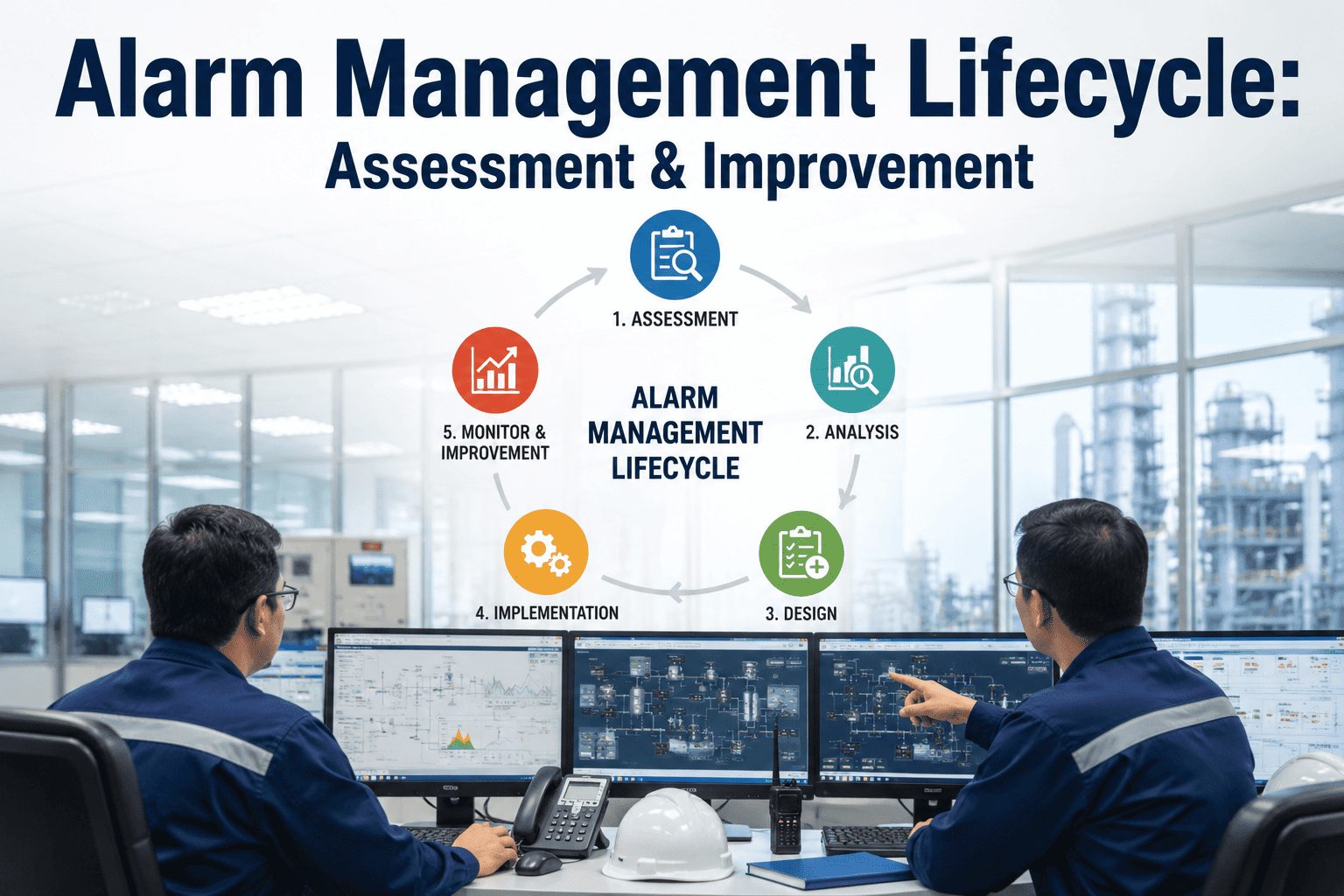
ISA-18.2 defines alarm management as a continuous governance loop spanning philosophy, rationalization, operation, and audit. Skip any stage and the alarm system drifts right back toward overload within a few years.
A Rationalized Alarm System Doesn't Stay Rationalized on Its Own
A successful rationalization project can bring a chronically overloaded alarm system back within a healthy operating range almost overnight, and plant teams understandably treat that as the finish line. But every control logic change, every new sensor, every process modification, and every setpoint tweak made afterward has the potential to reintroduce nuisance alarms if it isn't run back through the same disciplined review process. Without a formal monitoring and management-of-change stage built into daily operations, the same plant tends to drift back toward alarm overload within two to three years of an otherwise successful rationalization effort. This pattern repeats so consistently across the industry that ISA-18.2 was deliberately structured as a closed loop rather than a linear project plan, with the audit and monitoring stages explicitly designed to feed findings back into philosophy, rationalization, and detailed design whenever drift is detected, rather than treating those earlier stages as permanently closed once completed.
From Philosophy Document to Continuous Audit
ISA-18.2 organizes alarm management into ten interconnected stages, and while every plant's specific priorities differ, the stages naturally group into four broader phases that map to how most reliability and operations teams actually think about the work. Understanding these groupings matters because a plant assessing its own maturity rarely needs to treat every stage as an isolated checklist item; instead, most gaps trace back to a weakness in one of these four broader phases, and fixing that phase tends to resolve several individual stage deficiencies at once.
Notice that the loop closes back on itself: findings from the audit and monitoring phase feed directly back into the foundation phase, triggering a revised philosophy document or a fresh identification pass whenever the operating environment has changed enough to warrant it. This is the structural feature that separates a true lifecycle program from a one-time cleanup project, and it's the piece most commonly missing from plants that see their alarm counts creep back upward a few years after an initial improvement effort.
What a Good Alarm Philosophy Document Actually Contains
The philosophy stage produces the single reference document that every later stage measures against, and plants that skip or under-invest in this step tend to see rationalization decisions made inconsistently across different systems and different reviewers, since there is no shared standard to test candidate alarms against. A well-built philosophy document typically defines alarm priority classifications and the response time each priority level implies, the criteria an alarm must meet to be considered valid in the first place, standards for alarm setpoints relative to safe operating limits, guidelines for alarm suppression during startup, shutdown, and maintenance modes, and the roles and responsibilities for maintaining the document itself as the plant evolves. Plants revisiting an old or thin philosophy document as part of a lifecycle assessment often find that simply strengthening this foundation resolves a surprising share of the inconsistency that shows up later in rationalization and detailed design.
Management of Change Is What Keeps Rationalization From Wearing Off
Every plant has a management-of-change process for control logic and equipment modifications, but far fewer extend that same discipline specifically to alarm configuration, treating a new or modified alarm as a minor technical detail rather than a change that deserves the same rationalization scrutiny as the original alarm set. In practice, this means any engineer who adds a new alarm during a project, or adjusts a setpoint to reduce nuisance trips, should be running that change through the same cause-consequence-response criteria defined in the philosophy document, and logging it in the master alarm database just as the original rationalization effort did. Plants that formalize this step, even as a lightweight review rather than a heavyweight committee process, are the ones that hold onto their rationalization gains for years instead of watching them erode within a couple of budget cycles.
Where Does Your Alarm System Sit on the Lifecycle Today?
iFactory benchmarks your current alarm performance against ISA-18.2 targets and identifies exactly which lifecycle stage needs attention first.
The Performance Metrics That Define a Healthy Alarm System
The monitoring and assessment stage is where a lifecycle program earns its keep day to day, and it depends on tracking a small set of well-established metrics rather than trying to review every alarm individually. These metrics give reliability engineers an objective, ongoing read on system health instead of waiting for the next major upset to reveal that the alarm system has drifted.
Why the Rationalization Stage Takes the Most Time and Delivers the Most Value
Rationalization is where every candidate alarm gets tested against a simple but rigorous question: does this alarm genuinely require an operator to take a specific action within a defined time window to avoid a defined consequence? Alarms that fail this test get reclassified, suppressed under specific operating conditions, or removed entirely, and the ones that pass get a documented cause, consequence, and corrective action attached so any future operator understands exactly what the alarm means and what to do about it.
Where Most Plants Actually Sit on the Alarm Management Maturity Curve
The table below reflects the practical difference between plants at different stages of lifecycle maturity, based on the metrics and practices most commonly observed during alarm system assessments across the power generation sector.
| Maturity Level | Alarms per Operator per Hour | Monitoring Practice | Typical Outcome |
|---|---|---|---|
| Reactive | 20 or more during upsets | No formal monitoring in place | Frequent alarm floods, operator desensitization |
| Rationalized Once | 6-10, drifting upward | One-time project, no ongoing review | Gradual return toward overload within years |
| Actively Monitored | Under 6 sustained | Regular metric review, formal change control | Stable performance, fewer nuisance alarms |
| Continuously Improving | Under 6, trending down | Automated monitoring with proactive bad-actor resolution | Sustained low nuisance rate, high operator trust |
What Plant Teams Ask About Alarm Lifecycle Management
Turn Alarm Management From a Compliance Project Into a Living Program
iFactory continuously tracks your alarm performance against ISA-18.2 targets, flags bad actors automatically, and keeps your rationalized alarm system from drifting back toward overload. Book a demo and see your current lifecycle stage assessed.