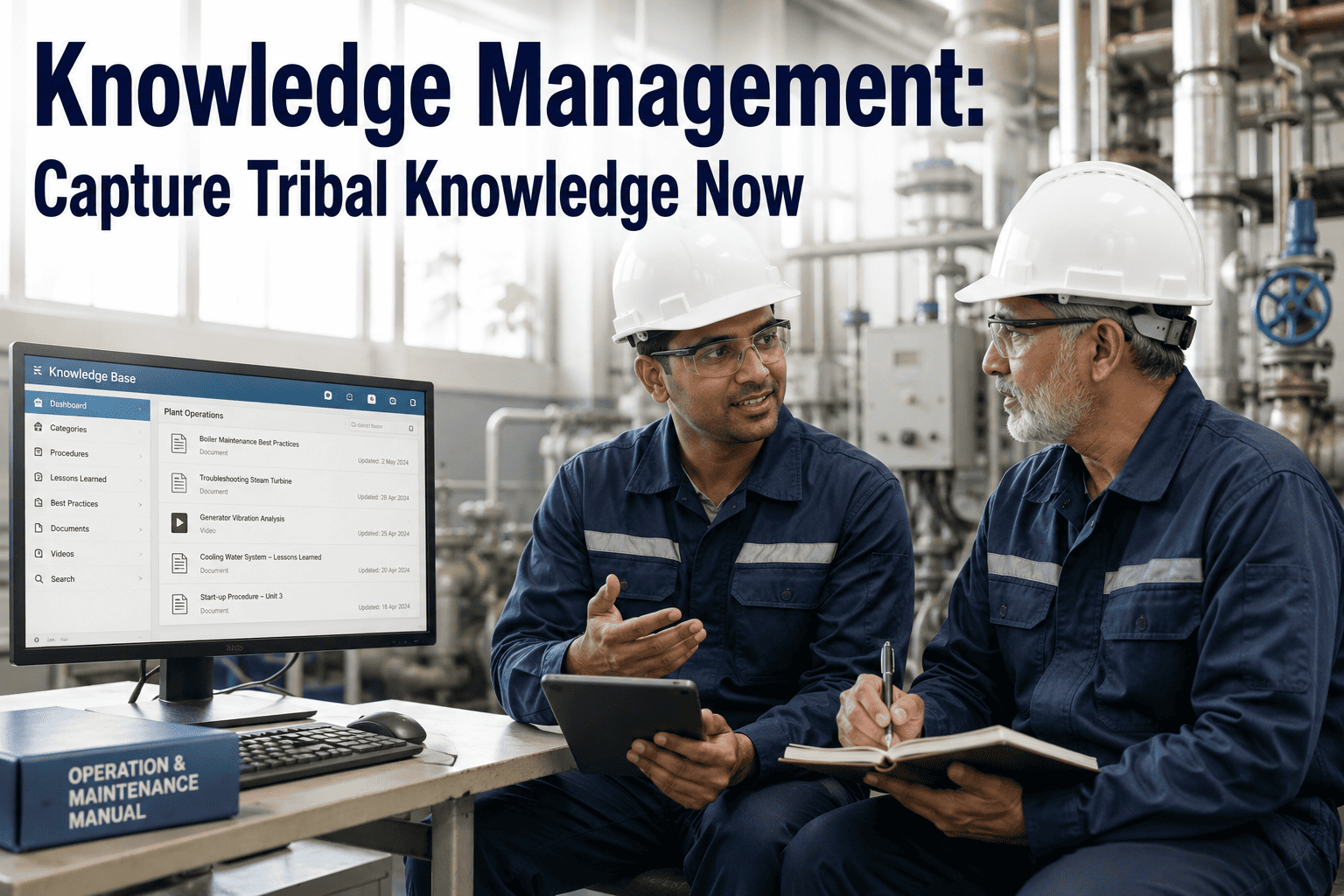
Knowledge Management: Capture Tribal Knowledge Now

By Johnson on July 29, 2026

knowledge-management-system-power-plant-tribal-knowledge

A senior turbine technician who has spent thirty years on a single unit does not hand over a manual when they retire — they hand over nothing written at all, because the knowledge that let them catch a bearing problem by sound, or know which valve always sticks in cold weather, was never captured anywhere except their own memory. Power generation is aging faster than almost any other industrial sector, and every year a wave of that experience walks out the door permanently, taking with it decades of plant-specific troubleshooting knowledge that no procedure manual ever documented. The plants that recover fastest from this transition are the ones that started capturing that knowledge digitally before the retirement happened, not after. iFactory builds the AI-searchable knowledge system that makes that capture possible at scale.

Expert Capture Searchable Knowledge Base Faster Onboarding Retention Protection

Knowledge Management: Capture Your Power Plant's Tribal Knowledge Before It Retires

iFactory turns the troubleshooting instincts of your most experienced operators and engineers into a searchable, AI-organized knowledge base — so the next generation of your workforce inherits what took decades to learn, instead of relearning it from scratch after every retirement.

10,000/day Baby Boomers retiring across the workforce nationally
42% Of maintenance technicians now over age 55
70% Of operational knowledge estimated to be undocumented tribal knowledge
18 Months Average gap between a senior retirement and a replacement reaching full productivity

The Knowledge Loss Timeline: How a Retirement Becomes an Operational Gap

Knowledge loss at a power plant rarely happens the day someone retires — it happens gradually, and by the time the operational impact is visible, the window for an easy fix has already closed. Recognizing where a facility sits on this timeline is the first step in deciding how urgently a capture program needs to start.


Phase 1 — Peak Knowledge
Experienced technicians operate at full capacity, solve problems quickly, and informally mentor younger staff during routine shifts — the plant runs smoothly largely because of what they carry in their heads, not what is written down

Phase 2 — Pre-Retirement Disengagement
One to three years before exit, senior staff begin mentally checking out, take on fewer new challenges, and informal mentoring time shrinks even as the knowledge gap they will leave behind keeps growing

Phase 3 — Departure
The expert leaves, often with little formal handover — exit interviews and knowledge transfer sessions rarely capture more than a fraction of the operational judgment built over a career

Phase 4 — The Visible Gap
Troubleshooting takes longer, previously solved problems get rediscovered from scratch, and new hires lean on trial and error for issues a departed expert could have diagnosed by sound or smell

Phase 5 — Slow Recovery
Operational performance typically takes one to two years to recover after a key retirement without structured knowledge transfer, as the replacement gradually rebuilds — through experience — what already existed and was lost

What a Retiring Expert Actually Takes With Them

Job descriptions and procedure manuals capture the formal part of a role. They rarely capture the part that actually makes an experienced operator valuable — the pattern recognition built from thousands of hours on a specific unit, under specific conditions, with specific equipment quirks that never made it into any document.

Acoustic and Sensory Diagnosis
The ability to identify a developing bearing fault, cavitation issue, or combustion instability by sound, vibration feel, or smell — long before instrumentation thresholds would flag it
Equipment-Specific Quirks
Knowledge that a particular valve always sticks in cold weather, or that a specific pump runs rough for the first ten minutes after a cold start and it is normal, not a fault
Historical Failure Context
Memory of how a similar failure was diagnosed and resolved five or ten years earlier, including the false leads that wasted time and the fix that actually worked
Informal Workaround Procedures
Undocumented adjustments developed over years that keep aging equipment running reliably outside of what the original equipment manual describes
Vendor and Parts Relationships
Knowledge of which supplier's replacement part actually fits despite matching part numbers, and which vendor contact resolves an issue fastest
Cross-System Interaction Effects
Understanding of how a change in one system — a load shift, a fuel switch, a seasonal condition — ripples into behavior on a seemingly unrelated system elsewhere in the plant

The Real Cost of Undocumented Knowledge: A Facility-Level Estimate

The financial impact of tribal knowledge loss is easy to underestimate because it shows up as many small costs spread across departments rather than one large line item. Modeled across a mid-size facility experiencing several senior retirements over a two-year period, the pattern below reflects figures reported across manufacturing and energy operations.

Scroll to compare cost categories
Cost Category Without Structured Knowledge Capture With AI-Assisted Knowledge Capture
New Hire Time to Full Productivity Roughly 18 months of traditional shadowing and trial-and-error learning before a replacement performs at the departed expert's level Commonly reduced to 6–8 months when new hires can search a captured knowledge base for prior diagnoses and equipment-specific context
Repeat Failure Events Previously diagnosed issues get rediscovered from scratch because the original resolution was never written down or made searchable Prior diagnoses and resolutions are retrievable in seconds, cutting redundant troubleshooting and repeat downtime events significantly
Informal Mentoring Load Senior technicians spend hundreds of hours per year on ad hoc, one-on-one mentoring that does not scale beyond the people physically present on shift Mentoring knowledge is captured once and reused indefinitely across every new hire and every shift, independent of who happens to be on site
Extended Troubleshooting Time Without documented procedures, technicians spend materially more time diagnosing familiar problems than a documented equivalent would require Searchable historical context shortens diagnosis time by surfacing similar past events and their resolutions immediately
Start Capturing Your Experts' Knowledge Before the Next Retirement

iFactory's AI knowledge platform listens to the troubleshooting decisions your best operators make every shift and turns them into a searchable knowledge base the next generation can actually use — without adding paperwork to their day.

How AI-Assisted Knowledge Capture Actually Works

The reason most tribal knowledge capture initiatives stall is that they ask experienced staff to stop working and go write documentation — a task most technicians actively avoid and rarely prioritize under production pressure. An AI-assisted approach instead captures knowledge from the work that is already happening, without adding a separate documentation burden.

1
Capture From Existing Workflows
Troubleshooting calls, shift handover notes, work order resolutions, and maintenance conversations are captured as they naturally happen — not through a separate documentation task added to someone's workload
2
Structure and Organize Automatically
AI processes the captured content, extracts the operationally relevant detail, and organizes it by equipment, system, and failure type so it becomes retrievable rather than buried in a transcript
3
Make It Instantly Searchable
A technician facing an unfamiliar symptom on a specific asset can search plain language and surface every relevant prior diagnosis, workaround, and resolution logged for that equipment
4
Refine Continuously With Use
Every new troubleshooting event, whether resolved by a veteran or a new hire using the system, adds to the knowledge base — so the resource keeps improving instead of going stale after the capture project ends

Expert Perspective: What Plants Learn Once Capture Starts

We had three senior turbine technicians retiring within eighteen months of each other, and honestly we did not fully appreciate what that meant until the first one actually left. The exit interview process we had in place was built for HR paperwork, not for capturing thirty years of operational judgment — it produced maybe two pages that barely scratched the surface. What changed things was shifting our approach so that knowledge got captured from the troubleshooting conversations that were already happening on shift, rather than asking someone to sit down and write a manual nobody had time to write. Six months in, we had a searchable base of real diagnosed events, tied to specific equipment, with the reasoning behind each resolution intact. When our newest hire faced a compressor vibration issue that looked unfamiliar to him, he searched the system and found that our retired lead technician had documented the exact same symptom pattern four years earlier, with the root cause and the fix. That single search probably saved him two full days of trial and error, and it was the moment the rest of the team stopped being skeptical about whether this was worth the effort.
— Maintenance Manager, Combined-Cycle Power Facility · 21 Years Power Generation Experience · Managed Workforce Transition Across Two Retirement Waves

Frequently Asked Questions

Q: Do our senior technicians need to change how they work to make knowledge capture happen?
No — the entire premise of an AI-assisted capture approach is that it works from conversations, troubleshooting calls, and work order resolutions that are already part of daily operations, rather than requiring technicians to stop and write separate documentation. Experienced staff who are skeptical of formal documentation processes because of the time burden tend to engage far more naturally with a system that captures what they are already saying and doing. Contact our team to see how capture integrates with your specific shift handover and work order processes.
Q: How is captured knowledge organized so it is actually searchable later?
Captured content is processed by AI models trained to extract the operationally relevant detail — equipment identification, symptom description, diagnostic reasoning, and resolution — and organize it into a structured, searchable knowledge base rather than leaving it as unstructured raw transcripts. A technician can search plain language for a symptom on a specific asset and retrieve every relevant prior event, rather than needing to remember exact terminology or which shift the original event happened on.
Q: What if a retiring expert is uncomfortable with conversations being recorded or captured?
Knowledge capture programs are most successful when experienced staff are engaged as partners in preserving their own legacy rather than treated as a passive data source, and addressing this concern directly and early is critical to adoption. Capture scope, consent, and what specifically gets recorded are configured collaboratively with your team and workforce representatives before deployment, and the goal is framed around preserving expertise for the people they are training, not surveillance. Book a Demo to discuss governance and consent configuration for your facility.
Q: How quickly can we realistically start capturing knowledge before a scheduled retirement?
Deployment for an initial capture program can typically begin within a few weeks, and meaningful knowledge accumulation starts as soon as normal shift activity — troubleshooting calls, handovers, and work order resolutions — begins flowing through the system. For a retirement with a known timeline, starting capture twelve to eighteen months ahead gives the richest result, but even a compressed few-month window before an unexpected departure captures substantially more than no structured process at all.
Q: Does this replace formal training programs and standard operating procedures?
No — a captured knowledge base complements formal SOPs and training programs rather than replacing them. SOPs describe how a process should be performed under normal conditions; captured tribal knowledge fills the much larger space of how experienced staff actually diagnose and resolve the edge cases, quirks, and failures that formal procedures were never written to cover. The two resources work best used together, with the knowledge base becoming the reference for the situations a manual was never designed to anticipate.
Don't Let Decades of Operational Knowledge Walk Out the Door Undocumented

iFactory helps power generation facilities capture the troubleshooting instincts of their most experienced staff into a searchable, AI-organized knowledge base — protecting institutional expertise, shortening new hire ramp-up time, and giving every future technician access to what took a career to learn.
Share This Story, Choose Your Platform!