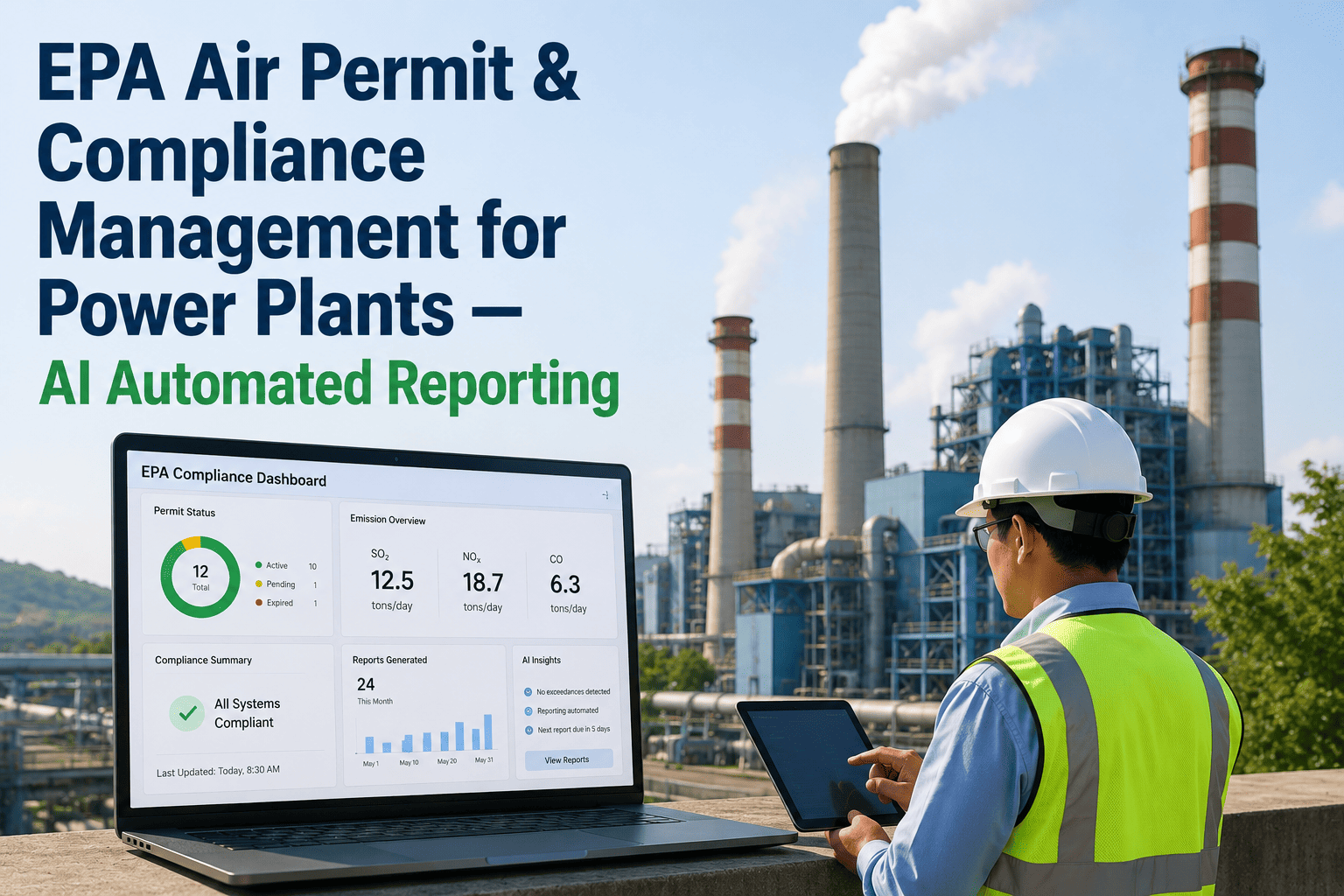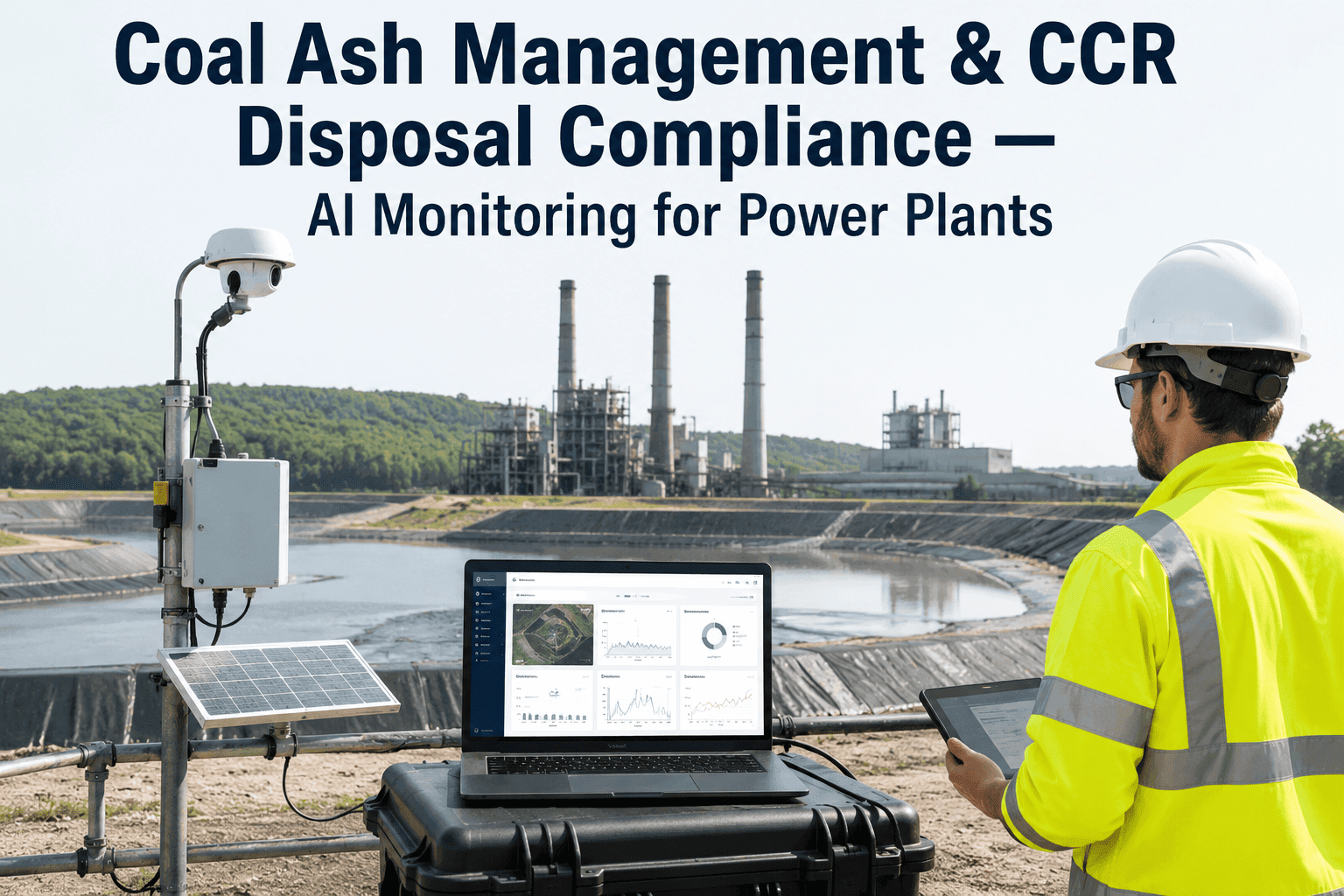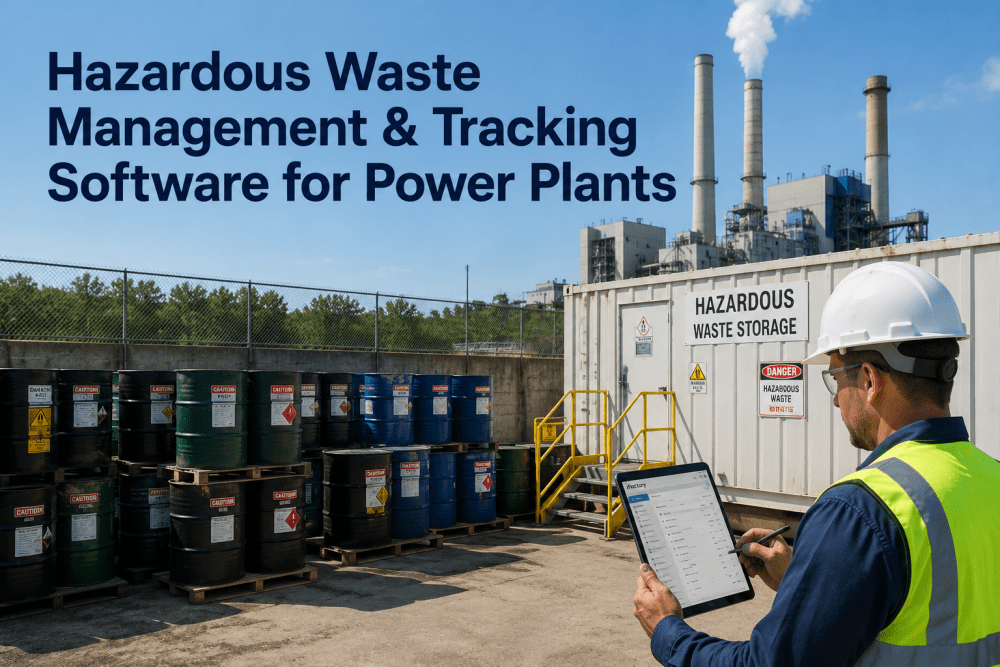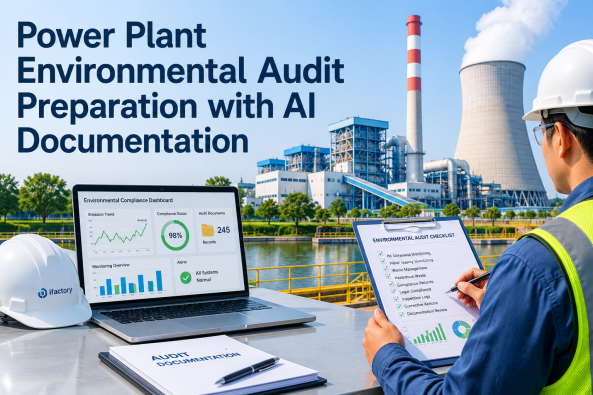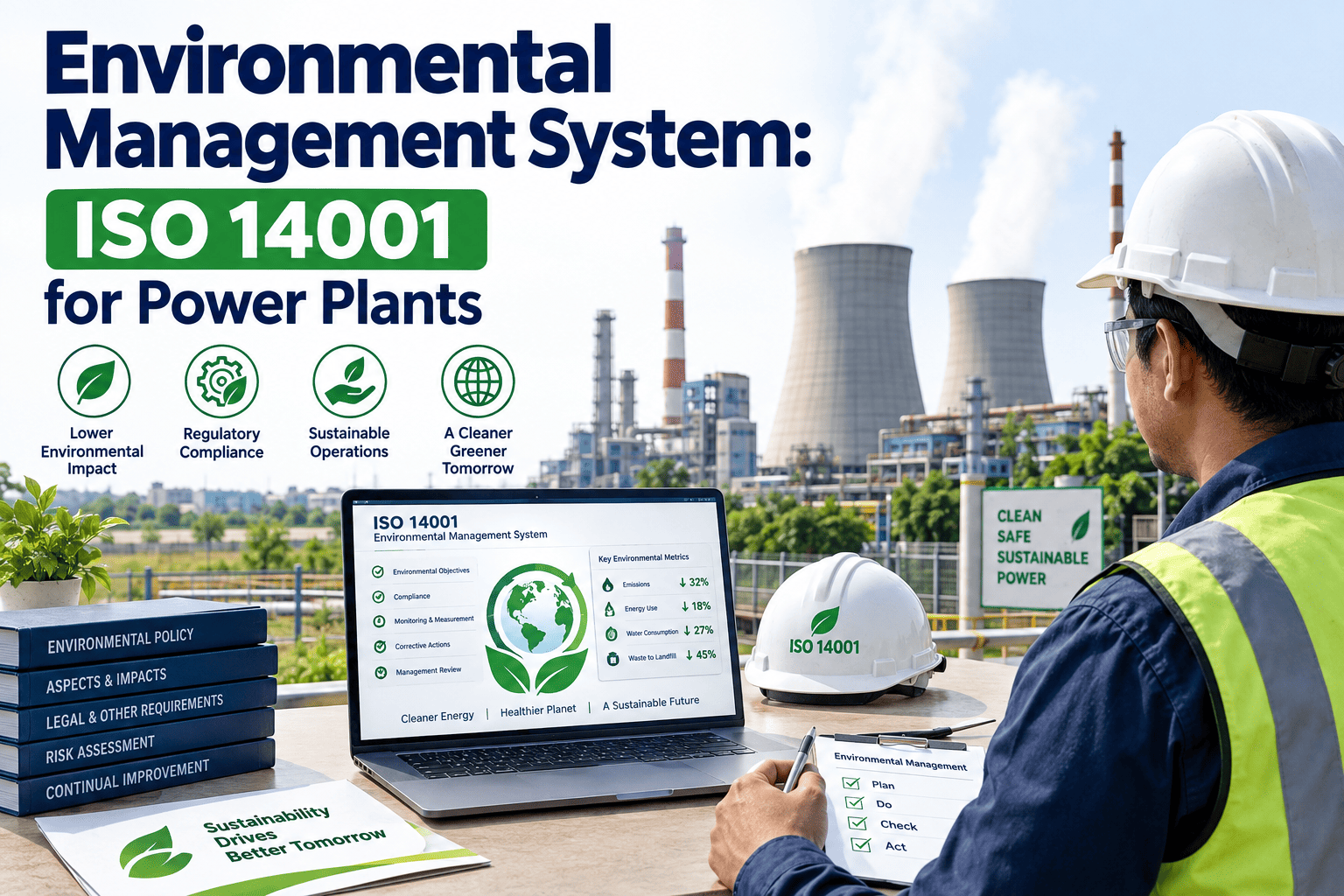
Power plants operate under more environmental permits, monitoring requirements, and reporting obligations than almost any other industrial facility. Air emissions permits with continuous monitoring requirements, wastewater discharge permits with daily sampling schedules, hazardous waste manifests, Tier II chemical inventory reports, spill prevention plans, and greenhouse gas reporting rules all converge on the environmental manager's desk simultaneously. ISO 14001 provides the framework to organize this complexity into a coherent management system — but only if the system is implemented as a living operational tool rather than a documentation exercise for the certification auditor. To see how iFactory turns ISO 14001 from a compliance burden into an operational advantage, book a 30-minute demo.
Environmental Management System: ISO 14001 Implementation for Power Plants
How power generation facilities build, operate, and continually improve an ISO 14001 environmental management system that satisfies auditors, reduces risk, and drives measurable environmental performance improvement.
Why ISO 14001 Is Different From Ordinary Environmental Compliance
Environmental compliance means meeting the specific requirements in your air permit, your water discharge permit, your waste management rules, and your reporting obligations. ISO 14001 goes further — it requires you to have a systematic process for identifying all of those requirements, evaluating your performance against them, finding the gaps before a regulator does, and fixing those gaps in a way that prevents recurrence. The distinction matters because compliance can be achieved reactively — responding to inspection findings, correcting violations after they occur — while ISO 14001 demands a proactive posture where the management system itself catches deficiencies before they become violations. The table below draws the line between what compliance requires and what ISO 14001 adds on top of that baseline.
Permit Conditions Met
Emission limits, discharge limits, and waste handling requirements are satisfied at the point of monitoring. There is no systematic process to verify that all permits have been identified or that monitoring covers all regulated parameters.
Reports Filed on Schedule
TRI reports, Tier II submissions, greenhouse gas reports, and discharge monitoring reports are submitted by their deadlines. There is no systematic verification that all required reports have been identified or that reported data is accurate.
Violations Corrected After Discovery
When an inspector identifies a violation or a monitoring result exceeds a permit limit, a corrective action is taken. There is no requirement to investigate root cause or prevent recurrence beyond the specific instance.
Records Maintained for Retention Period
Monitoring data, permits, and reports are filed and retained for the required period. There is no systematic organization, indexing, or accessibility standard beyond what the regulation specifies.
Complete Compliance Register
A documented register of all applicable legal requirements, updated on a defined schedule, with a process to evaluate compliance against each requirement — not just the ones that have monitoring data, but all of them, including less obvious obligations like spill prevention plan updates and storage tank integrity testing.
Systematic Aspect and Impact Assessment
Every environmental aspect of the plant's activities — not just regulated emissions — is identified, its environmental impact is evaluated using a defined methodology, and the significant aspects are managed through documented objectives, targets, and operational control procedures.
Root Cause Corrective Action
Every nonconformity — whether an actual violation, a near-miss, or an internal audit finding — is investigated for root cause, and corrective actions are implemented and verified for effectiveness. The system prevents recurrence rather than just addressing the symptom.
Documented Knowledge and Continual Improvement
Environmental performance data is analyzed for trends, management reviews evaluate system effectiveness against defined indicators, and improvement opportunities are identified and pursued as formal objectives with tracked progress.
The PDCA Engine: How ISO 14001 Drives Continuous Environmental Improvement
ISO 14001 is built on the Plan-Do-Check-Act cycle, and understanding where each clause of the standard falls within that cycle is the key to building a system that actually functions rather than one that exists only on paper during the certification audit. The four-phase visual below maps every significant ISO 14001 clause to its position in the PDCA cycle and shows how the outputs of each phase feed the inputs of the next — creating a self-reinforcing loop that drives environmental performance improvement with every rotation.
Establish the Framework and Set Direction
Define the environmental context of the organization, establish the environmental policy, identify environmental aspects and their significance, determine compliance obligations, set environmental objectives and targets, and plan the actions needed to achieve them. This phase creates the strategic foundation — without rigorous planning, the remaining phases operate without direction and the system becomes reactive rather than proactive.
Implement Controls and Execute Plans
Provide the resources, competence, awareness, and communication infrastructure needed to execute the plans. Establish operational controls for significant aspects, manage documented information, and implement emergency preparedness and response procedures. This phase converts the planning outputs into operational reality — it is where the environmental management system stops being a document and starts being a set of actions that people perform every day as part of their work.
Monitor, Measure, and Evaluate Performance
Monitor and measure environmental performance against the objectives and targets set in the Plan phase. Evaluate compliance with legal requirements through a systematic audit process. Conduct internal audits of the environmental management system itself. Analyze data for trends and present results to management for review. This phase is where the system reveals whether the plans and controls are actually working — and where they are not, it generates the nonconformities and improvement inputs that feed the Act phase.
Correct Nonconformities and Improve the System
React to nonconformities with root cause analysis and corrective actions. Evaluate opportunities for improvement that arise from monitoring data, audit findings, management review conclusions, and changing external conditions. Update the environmental aspects register, compliance register, and operational controls to reflect changes in operations, regulations, or performance. This phase closes the loop and feeds improvements back into the Plan phase, ensuring that the next rotation of the cycle operates at a higher performance level than the current one.
Environmental Aspect Identification: The Register That Drives Everything
The environmental aspect register is the single most important document in an ISO 14001 system because it determines what the system manages. If an aspect is missing from the register, it is outside the scope of the management system — no objective is set for it, no operational control is established, no monitoring is performed, and no audit evaluates it. In a power plant, the number of potential environmental aspects is enormous, which means the identification and significance evaluation process must be structured, systematic, and documented to a standard that can withstand certification auditor scrutiny. The aspect categories below represent the major groupings that every power plant EMS must address, along with the specific aspects that are most commonly identified as significant in fossil, gas, and biomass generating facilities.
The Highest-Visibility Aspect Category
NOx, SO2, particulate matter, CO, VOCs, mercury, and greenhouse gases from combustion sources. Each emission point — boiler stack, gas turbine exhaust, diesel generator, coal handling dust — is a separate aspect with its own regulatory limits, monitoring requirements, and control technology. The significance evaluation must consider not just permit compliance but also the magnitude of the emission, the sensitivity of the receiving environment, and the public and regulatory attention the emission attracts. In most power plants, the major combustion source emissions are significant by any evaluation methodology, and the EMS must have documented operational controls, monitoring programs, and improvement objectives for each one.
Multiple Discharge Points With Different Permit Conditions
Power plants discharge water from multiple points — cooling tower blowdown, boiler blowdown, FGD wastewater, ash pond overflow, storm water outfalls, and sanitary wastewater — each with its own permit limits, monitoring parameters, and sampling frequency. The aspect register must identify each discharge point separately because the regulatory requirements and environmental sensitivity differ for each one. Cooling tower blowdown with biocide residuals has a different impact profile than FGD wastewater with heavy metals, and the EMS must manage them as distinct aspects with distinct controls and monitoring programs.
Hazardous and Non-Hazardous Waste Streams
Fly ash, bottom ash, FGD gypsum, spent catalyst, waste oil, boiler chemical containers, mercury-containing lamps, asbestos from legacy insulation, and general plant trash. Each waste stream is a separate environmental aspect, and the significance evaluation must consider the hazard classification, the quantity generated, the disposal method, and the regulatory requirements for handling, storage, transportation, and disposal. Hazardous waste streams are almost always significant aspects that require documented operational controls covering container labeling, storage time limits, manifest tracking, and disposal facility verification.
Water Use, Energy Use, and Material Input Efficiency
ISO 14001 requires consideration of environmental aspects related to resource use, not just pollution outputs. For power plants, this includes water withdrawal for cooling and boiler makeup, fuel consumption efficiency, and the environmental impact of fuel sourcing — particularly for biomass plants where feedstock procurement can have significant land-use and transportation impacts. Resource consumption aspects are increasingly identified as significant as plants face water scarcity constraints, carbon pricing mechanisms, and fuel cost volatility that create both environmental and business incentives to improve efficiency.
Often Overlooked Until a Complaint Arrives
Cooling tower fan noise, steam venting, coal handling operations, transformer hum, and truck traffic on access roads all generate noise that can affect neighboring communities. Many power plants do not include noise in their aspect register until a community complaint triggers a regulatory investigation. ISO 14001 requires proactive identification of noise as an environmental aspect, evaluation of its significance based on proximity to receptors and applicable noise ordinances, and operational controls — such as restricted operating hours for high-noise activities — to manage significant noise impacts before they become compliance issues.
Site Contamination and Ecological Impact
Historical contamination from legacy operations — ash disposal areas, former waste oil storage sites, coal pile runoff areas — can create ongoing environmental aspects even after the original activity has ceased. Active impacts include habitat disturbance from plant operations, thermal discharge effects on receiving water bodies, and bird mortality from transmission lines and cooling water intakes. These aspects are increasingly subject to regulatory attention and stakeholder scrutiny, and the EMS must address both historical contamination management and active biodiversity impact mitigation.
Compliance Obligation Register: The Living Document That Prevents Surprises
The compliance obligation register is the document that connects the ISO 14001 system to the actual regulatory requirements that govern the plant's operations. Unlike the aspect register — which is about what the plant does — the compliance register is about what the law requires the plant to do. Every permit condition, every monitoring requirement, every reporting deadline, every record retention obligation, and every procedural mandate from every applicable environmental regulation must be captured, organized, and tracked in this register. The table below shows the structure that a well-built compliance obligation register uses for power plant environmental requirements — and highlights the fields that make the register actionable rather than just a list.
| Requirement Source | Specific Obligation | Frequency | Responsible Role | Evaluation Method |
|---|---|---|---|---|
| Title V Air Permit | NOx emissions below 0.15 lb/MMBtu | Continuous (CEMS) | Environmental Engineer | CEMS data review vs permit limit |
| NPDES Discharge Permit | Submit DMR by 28th of following month | Monthly | Environmental Coordinator | DMR submission log and QA review |
| EPCRA Tier II | Submit chemical inventory by March 1 | Annual | EHS Manager | Submission confirmation from state agency |
| 40 CFR Part 98 | Report GHG emissions by September 30 | Annual | Environmental Engineer | Subpart D calculation verification |
| RCRA hazardous waste | 90-day storage limit for accumulated waste | Continuous | Waste Coordinator | Weekly storage area inspection |
| SPCC Plan | Review and update every 5 years | 5-year cycle | Environmental Manager | Plan review record with PE certification |
| CCR Rule | Submit closure plan for inactive impoundment | Per schedule | Environmental Manager | State agency acceptance letter |
| Noise Ordinance | Sound level below 65 dBA at property boundary | Quarterly survey | Environmental Technician | Noise monitoring survey results |
Internal Audit Program: The Mechanism That Catches Gaps Before the Certification Auditor Does
The internal audit is the self-check mechanism in the ISO 14001 PDCA cycle, and its effectiveness determines whether the system actually improves or merely maintains the status quo between certification audits. An internal audit program that merely confirms that procedures exist and records are filed is not adding value — it must evaluate whether the procedures are being followed, whether the controls are effective, whether the monitoring data shows the expected performance, and whether the compliance register is complete and current. The audit schedule below represents a best-practice approach that distributes audit coverage across the full three-year certification cycle so that every element of the EMS is evaluated at least once per cycle, with high-risk elements audited more frequently.
Compliance Register Verification and Air Emissions Controls
The Q1 audit verifies that the compliance obligation register has been updated to reflect any new or modified permits, regulations, or consent orders that took effect since the last review. It then audits the air emissions control program — CEMS calibration and QA/QC procedures, excess emission reporting, opacity observations, and the operational controls for NOx, SO2, and particulate matter reduction equipment. The audit includes a field verification that CEMS shelter conditions, sample line integrity, and analyzer performance meet the requirements of 40 CFR 75 and the facility's quality assurance plan.
Water Discharge Monitoring and Waste Management Operations
The Q2 audit evaluates the water discharge monitoring program — sampling procedures, laboratory QA/QC, DMR preparation and submission, and the operational controls for wastewater treatment systems including pH adjustment, metals removal, and biological treatment. It then audits the waste management program — hazardous waste identification, container management and labeling, storage time compliance, manifest accuracy, disposal facility verification, and universal waste handling. Field verification includes inspection of the hazardous waste storage area, sampling equipment condition, and waste container labeling against the requirements of the waste management procedures.
Environmental Aspect Register Review and Emergency Preparedness
The Q3 audit verifies that the environmental aspect register has been updated to reflect any changes in operations, new equipment, modified processes, or changed fuel sources that may have introduced new aspects or changed the significance of existing ones. It then audits the emergency preparedness and response program — spill response procedures, spill kit inventory and condition, notification procedures for reportable releases, and the results of any drills or actual incidents that occurred during the audit period. The audit includes a tabletop exercise or drill observation to verify that response procedures are understood by field personnel and that communication chains function as documented.
Management Review Inputs and Continual Improvement Evidence
The Q4 audit evaluates the inputs to management review — are all required elements present including audit results, compliance evaluation status, performance against objectives, and changes in external context? It then audits the corrective action process — are nonconformities being investigated for root cause, are corrective actions implemented on schedule, and is effectiveness verification being performed? The audit also reviews any changes to the environmental management system documentation since the last audit to verify that document control procedures were followed and that the changes are consistent with the system's intent.
Your ISO 14001 System Is Only as Strong as the Data That Feeds It
iFactory connects your environmental aspect register, compliance obligations, monitoring data, audit findings, and corrective actions into a single platform where every element of your EMS is linked, tracked, and always audit-ready. No more scrambling before surveillance audits. No more gaps between what the procedure says and what the records show.
The Five Documentation Burdens That Cause ISO 14001 Programs to Stall
Most power plants that attempt ISO 14001 implementation do not fail because they lack environmental expertise — they fail because the documentation and record-keeping burden overwhelms the resources available to sustain it. The certification audit can be passed with a heroic effort of document preparation, but the annual surveillance audits reveal whether the system is being maintained or whether the documentation has fallen behind. The five burdens below are the ones that most consistently cause EMS programs to degrade between certification audits, and each one is a direct consequence of managing the system through manual documents and spreadsheets rather than through a purpose-built platform.
Compliance Register Drift — New Requirements That Never Get Added
Environmental regulations change constantly — new permit conditions are issued, existing rules are amended, new reporting requirements are added, and court decisions change the interpretation of existing obligations. A compliance register maintained in a spreadsheet or Word document depends on someone noticing the change, finding the document, making the update, and redistributing it. In practice, new requirements are often communicated by email, discussed in a meeting, and then lost in the workflow before they reach the compliance register. By the time the internal auditor or certification auditor asks whether the register reflects the current regulatory landscape, the answer is often no — and the finding goes into the audit report as a nonconformity that could have been prevented by an automated update and notification process.
Aspect Register Staleness — Operations Change But the Register Does Not
Power plants undergo constant operational changes — fuel switches, equipment modifications, process upgrades, and capacity adjustments. Each change has the potential to introduce new environmental aspects or change the significance rating of existing ones. The ISO 14001 standard requires that the aspect register be updated when changes occur, but in a manual system, this update depends on the environmental manager being informed of every operational change and having the time to re-evaluate the affected aspects. When a new scrubber system is installed but the aspect register still lists the old configuration, the EMS is managing a plant that no longer exists — and the gap will be visible to any auditor who compares the register to the actual plant configuration.
Monitoring Data Fragmented Across Systems That Do Not Talk to Each Other
Environmental monitoring data in a power plant comes from multiple sources — CEMS data systems, laboratory information management systems, SCADA systems for water flow and temperature, manual sampling sheets, and contractor reports. In most plants, these data sources are not integrated, and the environmental manager must manually compile performance data from multiple systems to evaluate compliance, prepare reports, and generate the management review inputs that ISO 14001 requires. This manual compilation is time-consuming, error-prone, and almost always results in gaps where data from one source is missed or misaligned with data from another — creating compliance evaluation findings that could have been avoided with automated data aggregation.
Corrective Actions That Close on Paper But Not in Practice
The corrective action process is one of the most scrutinized elements of the ISO 14001 audit because it reveals whether the system actually drives improvement or merely processes paperwork. In manual systems, corrective actions are often documented as closed when the immediate fix is implemented — a valve is repaired, a procedure is revised, a training session is conducted — but the root cause analysis is superficial and the effectiveness verification is not performed. The certification auditor asks for evidence that the corrective action prevented recurrence, and the plant cannot produce it because the system did not require or track that verification step. The result is a recurring nonconformity that appears on audit after audit because the system allows corrective actions to close without proving they worked.
Management Review Becomes a Presentation Instead of an Evaluation
ISO 14001 Clause 9.3 requires management review to evaluate the suitability, adequacy, and effectiveness of the environmental management system using defined inputs that include audit results, compliance status, performance against objectives, and changes in context and requirements. In plants where the EMS data is fragmented and the documentation is not current, management review becomes a slide presentation prepared by the environmental manager that summarizes what the manager remembers happening since the last review — not a data-driven evaluation of system performance against measurable criteria. The certification auditor evaluates whether management review produced conclusions and decisions that drove improvement, and a presentation without supporting data does not satisfy that requirement.
How iFactory Operationalizes Your ISO 14001 Environmental Management System
iFactory addresses every one of the documentation burdens described above by replacing manual documents and fragmented data sources with a single platform where every element of the EMS is linked, automated where possible, and always current. The platform does not replace the environmental management system — it provides the infrastructure that makes the system operable, auditable, and improvable without requiring heroic manual effort from the environmental team. The capability map below shows how iFactory maps to each major ISO 14001 requirement and eliminates the manual processes that cause EMS programs to degrade between audits.
Regulatory Change Monitoring
iFactory monitors federal and state environmental regulatory databases for changes that affect your plant's compliance obligations based on your permit types, fuel types, and operating parameters. When a new rule is proposed or finalized, the system alerts the environmental manager, identifies which compliance obligation register entries are affected, and creates a task to evaluate the impact and update the register before the new requirement takes effect. This eliminates the compliance register drift that is the most common ISO 14001 nonconformity related to Clause 6.1.3.
Living Aspect Register With Change Triggers
The environmental aspect register in iFactory is a live database linked to the plant's equipment and process configuration. When a management-of-change review is initiated for a new installation, a fuel switch, or a process modification, the system automatically identifies which environmental aspects are affected, prompts the environmental team to re-evaluate significance, and updates the register with the new aspect data before the change is implemented. This ensures the register always reflects the current plant configuration — not the configuration that existed at the time of the last manual review.
Compliance Evaluation Calendar and Evidence Capture
Every compliance obligation in the register is linked to an evaluation schedule — daily, weekly, monthly, quarterly, or annual — and iFactory generates evaluation tasks on the defined schedule with the specific evaluation method documented in the register. When the responsible person completes the evaluation, the result and supporting evidence — monitoring data, inspection records, submission confirmations — are captured in the platform and linked to the obligation. The system generates a compliance status dashboard that shows every obligation's current evaluation status and highlights any obligation where the evaluation is overdue or the result indicates noncompliance.
Automated Data Aggregation From Multiple Sources
iFactory integrates with CEMS data systems, LIMS, SCADA, and manual data entry workflows to aggregate environmental monitoring data into a single platform where it can be analyzed against permit limits, trended over time, and formatted for management review and regulatory reporting. The system flags exceedances in real time, generates automated compliance reports for internal review, and maintains a complete audit trail of all data points with timestamps, source identification, and any corrections or qualifiers. This eliminates the manual data compilation that consumes hours of environmental engineer time before every report deadline and management review.
Audit Schedule, Checklists, and Finding Tracking
iFactory manages the internal audit program from schedule through closure. The audit schedule distributes coverage across the three-year certification cycle with automatic assignment of audit tasks to qualified auditors. Audit checklists are generated from the EMS element database, customized for each audit scope. Findings are entered in the field, classified by severity, and linked directly to corrective action workflows that track through root cause analysis, corrective action implementation, and effectiveness verification. The system generates the internal audit report in the format required by the certification body, with all supporting evidence linked and accessible.
Forced-Process Corrective Action That Prevents Premature Closure
Corrective actions in iFactory cannot be closed without completing every required step — nonconformity description, root cause analysis, corrective action plan, implementation evidence, and effectiveness verification. The system enforces the process by preventing status advancement until each step is documented with the required evidence. When an effectiveness verification shows that the corrective action did not prevent recurrence, the system reopens the corrective action and requires a revised root cause analysis. This eliminates the paper-closure problem where corrective actions are marked complete without demonstrating that they actually worked — the most common corrective action nonconformity identified in ISO 14001 surveillance audits.
Want to see your ISO 14001 system's compliance status in a single dashboard? Book a 30-minute platform walkthrough with the iFactory team.
Management Review: Turning Data Into Decisions That the Auditor Can See
ISO 14001 Clause 9.3 requires top management to review the environmental management system at planned intervals to ensure its continuing suitability, adequacy, and effectiveness. The review must cover a defined list of inputs — audit results, compliance evaluation status, performance against objectives, changes in external and internal issues, and opportunities for improvement — and it must produce documented conclusions and decisions regarding any need for changes to the environmental management system. The difference between a management review that satisfies the auditor and one that generates a finding is whether the review is supported by data that is organized, current, and directly traceable to the EMS elements being evaluated. The input matrix below shows what each management review input requires and how iFactory automates its preparation.
| Management Review Input | What the Auditor Expects to See | How iFactory Prepares It |
|---|---|---|
| Audit results | Complete internal audit reports with findings, corrective actions, and closure evidence for the review period | Auto-generated audit summary report with linked findings and CA status |
| Compliance evaluation status | Evidence that every compliance obligation was evaluated on schedule and results documented | Compliance dashboard showing evaluation status for every obligation with evidence links |
| Performance against objectives | Progress data for each environmental objective with trend analysis against the target | Objective tracking dashboard with current performance, trend charts, and gap-to-target |
| External and internal changes | Documentation of regulatory changes, operational changes, and organizational changes that affected the EMS | Change log auto-populated from MOC reviews and regulatory monitoring alerts |
| Corrective action effectiveness | Summary of corrective actions closed during the period with effectiveness verification results | CA closure report with root causes, actions taken, and effectiveness verification evidence |
| Improvement opportunities | Documented opportunities identified from monitoring trends, audits, or external benchmarking | Improvement opportunity log with source, proposed action, and prioritization |
Frequently Asked Questions
How long does it take to implement ISO 14001 in a power plant from scratch?
A typical ISO 14001 implementation in a power plant takes 12 to 18 months from the initial gap analysis to the certification audit, depending on the size of the plant, the maturity of existing environmental management practices, and the resources allocated to the implementation project. The timeline breaks down roughly as follows: gap analysis and planning takes 1 to 2 months, aspect and compliance register development takes 2 to 3 months, documentation and procedure development takes 3 to 4 months, system implementation and training takes 3 to 4 months, internal audit and management review takes 2 months, and certification audit scheduling and preparation takes 1 to 2 months. Plants that already have strong environmental compliance programs can compress this timeline by 3 to 6 months because much of the aspect identification and compliance register content already exists in some form. To discuss a realistic timeline for your facility, book a 30-minute assessment with our team.
Can ISO 14001 certification reduce our environmental insurance premiums?
In many cases, yes. Environmental liability insurers increasingly view ISO 14001 certification as evidence of a systematic approach to environmental risk management, and some insurers offer premium discounts of 5 to 15 percent for certified facilities. The discount depends on the insurer, the type of coverage, and the plant's claims history — ISO 14001 does not guarantee a discount, but it provides a documented basis for negotiating one at renewal. Beyond premium reductions, certification can improve the terms of environmental liability coverage by demonstrating that the plant has proactive processes for identifying and managing environmental risks, which reduces the insurer's assessment of the probability and severity of a covered environmental loss. The business case for certification should include a discussion with your insurance broker about the potential underwriting benefits.
What is the difference between an ISO 14001 internal audit and a regulatory compliance audit?
A regulatory compliance audit focuses on whether the plant is meeting specific permit limits, reporting requirements, and procedural mandates defined by environmental regulations — it evaluates compliance outcomes. An ISO 14001 internal audit evaluates whether the environmental management system itself is functioning as designed — it evaluates the processes that produce those compliance outcomes. The internal audit asks not just whether the NOx emission was below the permit limit, but whether the monitoring procedure was followed, whether the data was reviewed by a competent person, whether the compliance evaluation was documented on schedule, and whether the system would catch and correct a deviation before it became a violation. A regulatory audit can pass while an ISO 14001 audit finds nonconformities because the management system has gaps even though the current compliance status is acceptable. For guidance on structuring your internal audit program, contact the iFactory support team.
How does iFactory handle the transition when our plant changes fuel type or adds new equipment?
When a management-of-change review is initiated in iFactory for a fuel switch, new equipment installation, or process modification, the system automatically triggers an environmental aspect review workflow. The environmental team is prompted to identify any new aspects introduced by the change, re-evaluate the significance of affected existing aspects, update the aspect register, and determine whether any compliance obligation register entries need to be added or modified. The system links the change record to the updated registers so that any auditor can trace from the operational change to the EMS documentation updates in a single click. This eliminates the aspect register staleness problem that occurs when changes are implemented but the environmental documentation is not updated in parallel.
What happens if we fail a surveillance audit — can iFactory help us respond?
If a surveillance audit identifies nonconformities, iFactory provides the corrective action infrastructure to respond within the timeframe specified by the certification body — typically 30 to 90 days depending on severity. Each nonconformity is entered as a corrective action record with the required workflow steps: root cause analysis, corrective action plan, implementation, and effectiveness verification. The system enforces completion of every step and generates the response package that the certification body requires, with all supporting evidence linked and organized. For plants that have experienced audit failures, iFactory also provides a pre-audit readiness assessment that evaluates every EMS element against the audit criteria before the next surveillance visit, giving the environmental team time to close any gaps before the auditor arrives. To set up a pre-audit readiness assessment, schedule a demo and we will walk through the process.
Stop Managing ISO 14001 in Binders and Spreadsheets — Start Operating It
iFactory gives your environmental team a single platform that connects your aspect register, compliance obligations, monitoring data, internal audits, corrective actions, and management review into one audit-ready system. Every clause covered. Every record linked. Every surveillance audit prepared for before it arrives.