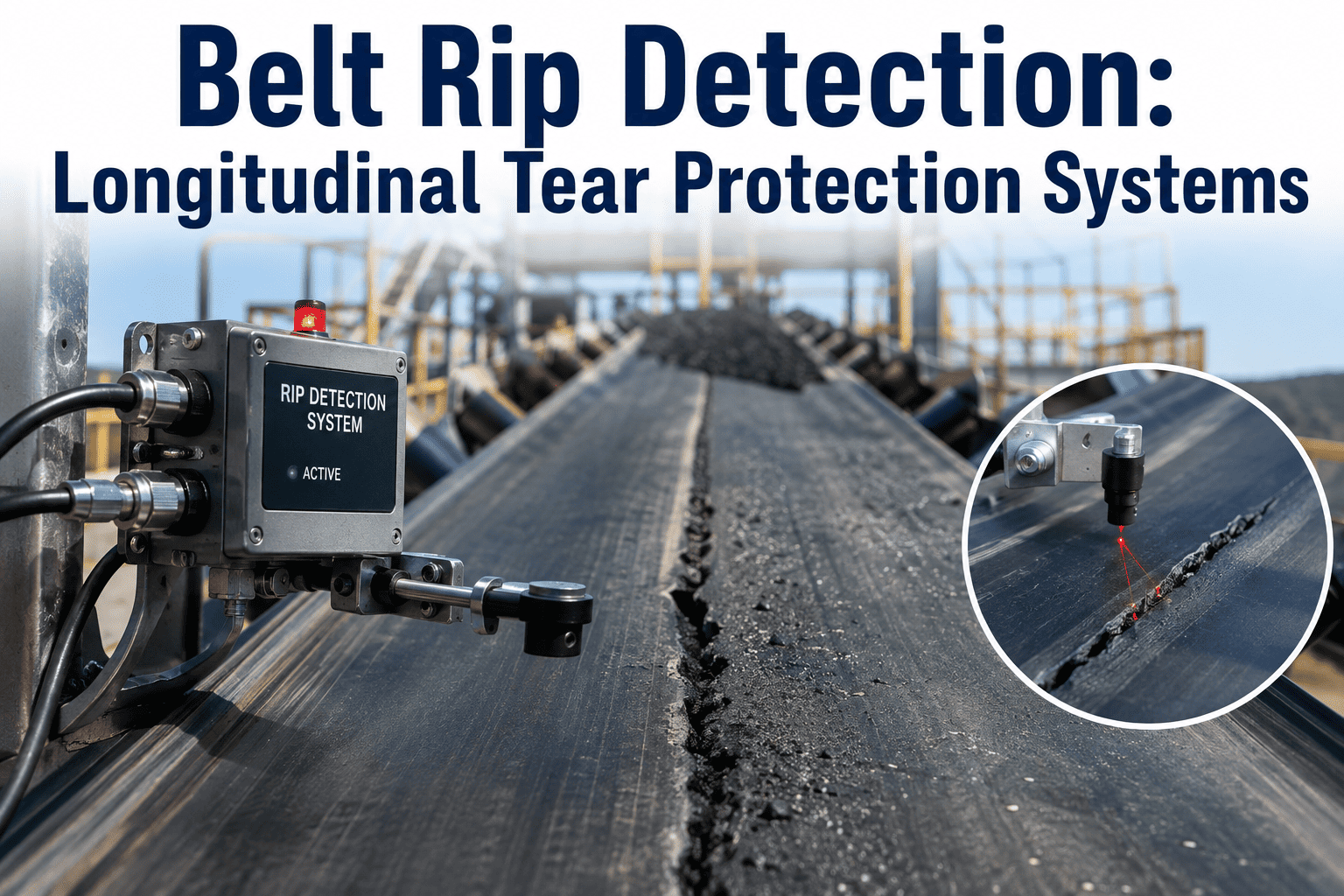
A longitudinal rip doesn't announce itself the way a snapped splice does. It starts as a puncture from a tramp metal fragment or a jammed chute, and then the belt does the rest of the damage on its own — the cut runs with the belt direction, shredding cover rubber, fabric plies, and steel cords for hundreds of feet before anyone on the floor notices. Coal handling systems are more exposed to this failure mode than almost any other bulk material line, because oversized lumps, wet fines, and buried tramp metal are a routine part of the feed, not a rare contamination event. This piece looks at how longitudinal tears actually start and spread, what detection technologies exist to catch them in the first few feet instead of the last few hundred, and how automatic belt-stop systems change the economics of coal conveyor protection. A short walkthrough shows how these detection layers map onto your own conveyor network.
Why Longitudinal Rips Are the Costliest Belt Failure on a Coal Line
Not all belt damage carries the same cost. Surface wear, edge fraying, and minor punctures are maintenance line items — repaired on a schedule, budgeted for, and largely predictable. A longitudinal rip is different in kind. Once a sharp object catches the belt and the tear begins to run, the belt itself becomes the mechanism of its own destruction, and the distance it travels before detection is often the single biggest variable in the final repair bill. A rip caught in the first ten feet is a vulcanized patch and a short delay. The same rip left undetected for a few hundred feet of travel is a full segment replacement, a multi-day shutdown, and in the worst cases a fire risk from friction heat where torn material contacts the structure.
How a Rip Starts and Why It Spreads So Fast
Most longitudinal tears begin the same way: a piece of tramp metal, a jammed lump, or a foreign object embeds itself in the loading zone or a transfer chute and catches the belt as it passes underneath. From that point, belt speed does the damage. A conveyor running at 3.5 to 5.5 meters per second drags the caught object through the belt for as long as it stays lodged, and because the tear runs parallel to the belt's own travel direction, there is nothing structural stopping it from continuing to open until the belt is stopped or the object works free.
The gap between stage one and stage five is measured in seconds, not minutes, on a fast-moving overland conveyor. That is the core argument for automated detection over operator vigilance: a control room operator watching a camera feed, or a mechanic doing a scheduled walk, is simply not positioned to catch a tear inside the window where stopping the belt still means a small patch rather than a segment swap.
Belt Rip Detection Technologies Compared
There is no single correct rip detection technology — the right choice depends on belt construction, budget, and how much of the tear you're willing to let run before intervention. Most coal operations end up combining more than one method, since each catches a different stage of the failure and none of them alone covers every scenario a working conveyor will throw at it.
| Detection Method | How It Works | Typical Rip Length Before Stop |
|---|---|---|
| Embedded loop / conductive loop | Coils embedded in the belt at intervals; a broken loop signals a tear directly to the control unit | Under 10 feet |
| Acoustic / impact sensing | Microphones or piezo sensors detect the distinct sound signature of a rip starting | 10-30 feet |
| Machine vision / line-scan camera | Continuous optical scanning flags a developing tear line as it opens | 15-40 feet |
| Rip cord / pull-wire switch | Mechanical cord that trips a stop switch when physically snagged or displaced | Variable — depends on physical trigger contact |
| Operator visual / walk inspection | Scheduled or incidental human observation of belt condition | Often 100+ feet before reported |
The pattern in that table is consistent across most coal handling operations: methods that embed sensing directly into the belt or monitor it continuously catch a tear dramatically earlier than methods relying on a human noticing something is wrong. That gap compounds — every additional foot of undetected rip adds cover rubber, fabric, and potentially steel cord to what a repair crew now has to cut out and replace.
Embedded Loop Detection: How the System Actually Works
Embedded loop detection remains the gold standard for steel cord and multi-ply fabric belts carrying coal, precisely because it does not depend on the tear being visible, audible, or physically large enough to trip a mechanical switch. The sensing element is built into the belt itself, so it fails the same way the belt fails — which is exactly what makes it reliable.
Dual-loop configurations, where two adjacent detectable elements are monitored per interval, add a layer of confirmation logic — a single broken element can be treated as a possible fault, while both elements breaking together is treated as a confirmed tear, reducing false trips from normal wear or a loop nearing end of life. That distinction matters operationally, because a rip detection system that stops the belt too often on false positives gets bypassed or ignored, which defeats the entire purpose of installing it.
Automatic Belt Stop Systems: Why Response Time Is the Real Variable
Detecting a rip and stopping the belt are two different problems, and the second one is where a lot of otherwise well-specified systems lose their value. A sensor that identifies a tear accurately but routes the alarm through a control room operator who has to manually trigger a shutdown adds seconds of belt travel that a direct, automated stop sequence does not.
The trade-off with a direct automatic stop is that the confirmation logic upstream has to be trustworthy, since an unnecessary emergency stop on a loaded overland conveyor carries its own cost in restart time, belt tension cycling, and potential material spillage at load points. This is where combining detection methods earns its keep — a system that requires agreement between an embedded loop signal and an acoustic or vision confirmation before triggering an automatic stop gets the speed benefit of direct action without the nuisance-trip cost of a single, less selective sensor acting alone.
Common Pitfalls in Rip Detection Deployment
Sizing a Detection Program to Your Belt Network
Not every conveyor in a coal handling plant carries the same rip risk, and treating a short, slow, well-guarded transfer belt the same way as a mile-long overland conveyor running at full speed usually means either overspending on the low-risk belt or underprotecting the high-risk one. A practical sizing approach starts with three variables: belt length, since longer belts give a rip more distance to run before any detection method catches it; belt speed, since faster belts convert the same detection lag into a longer physical tear; and tramp metal history at the loading zones feeding that specific belt, since some feed points are simply dirtier than others regardless of what magnetic separation is already in place upstream.
This tiered approach also shapes capital planning. Embedded loop sensing requires the belt to carry the sensing elements from manufacture, which means the practical entry point is usually the next scheduled belt replacement or rebuild rather than a mid-life retrofit. Acoustic and vision-based systems, by contrast, can be installed as external hardware on an existing belt with a much shorter lead time, which makes them a reasonable interim layer of protection on a high-risk belt that isn't due for replacement for another year or more.
What Rip Detection Data Feeds Into Your Maintenance Program
A rip detection system that only stops the belt is doing half the job. The position, timing, and frequency data it generates is equally valuable for understanding why tears are happening in the first place, and that data is most useful when it flows into the same maintenance and reliability system tracking the rest of the plant's asset history rather than sitting in a standalone alarm log that nobody reviews until after the next incident.
Feeding this data into a CMMS or plant reliability platform also shortens the repair cycle itself. A crew arriving at a flagged loop position with the exact belt location, tear timestamp, and prior detection history at that spot spends less time locating and diagnosing the damage and more time actually repairing it — which, combined with early detection, is what keeps a rip event a short planned stoppage instead of an extended unplanned one.