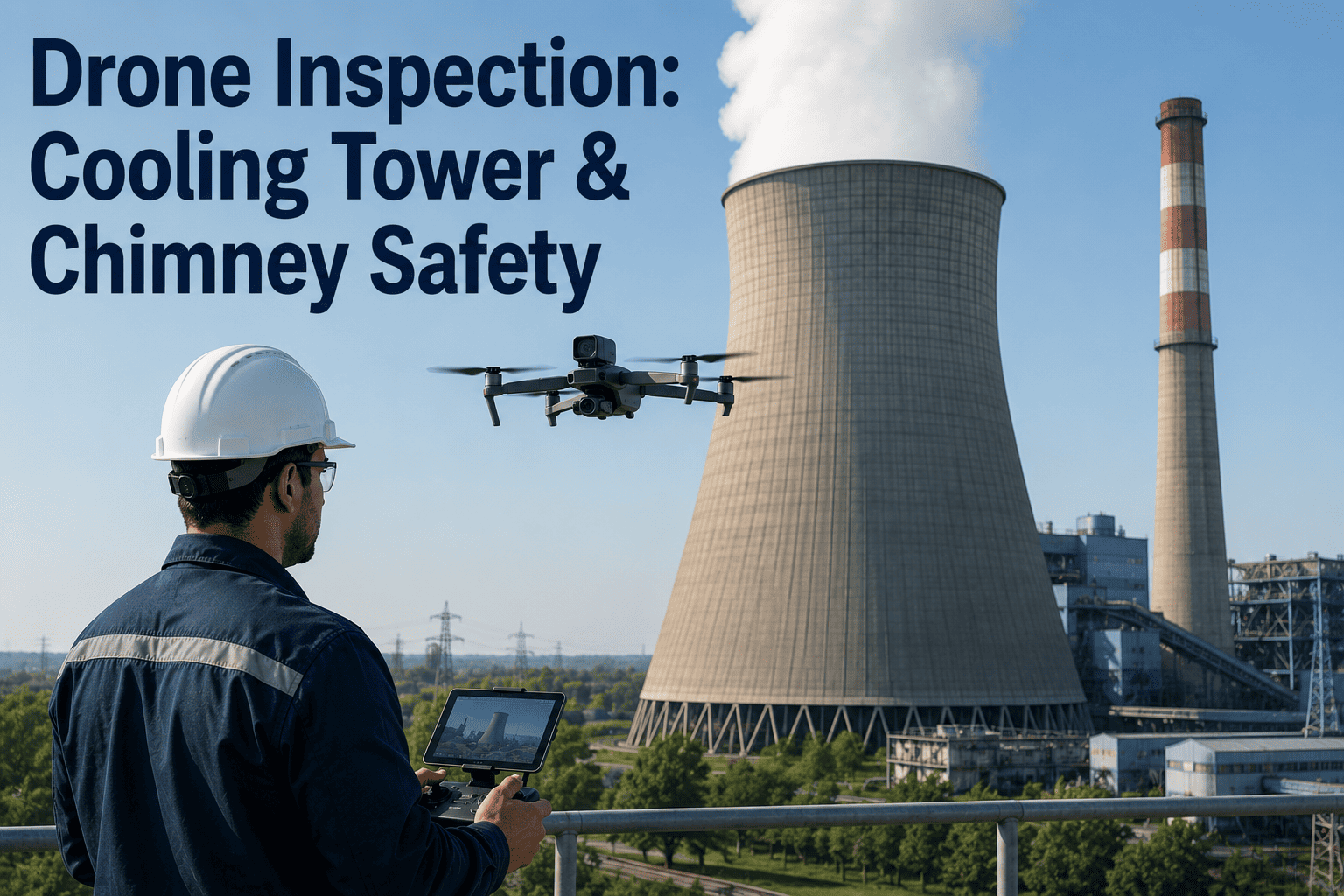
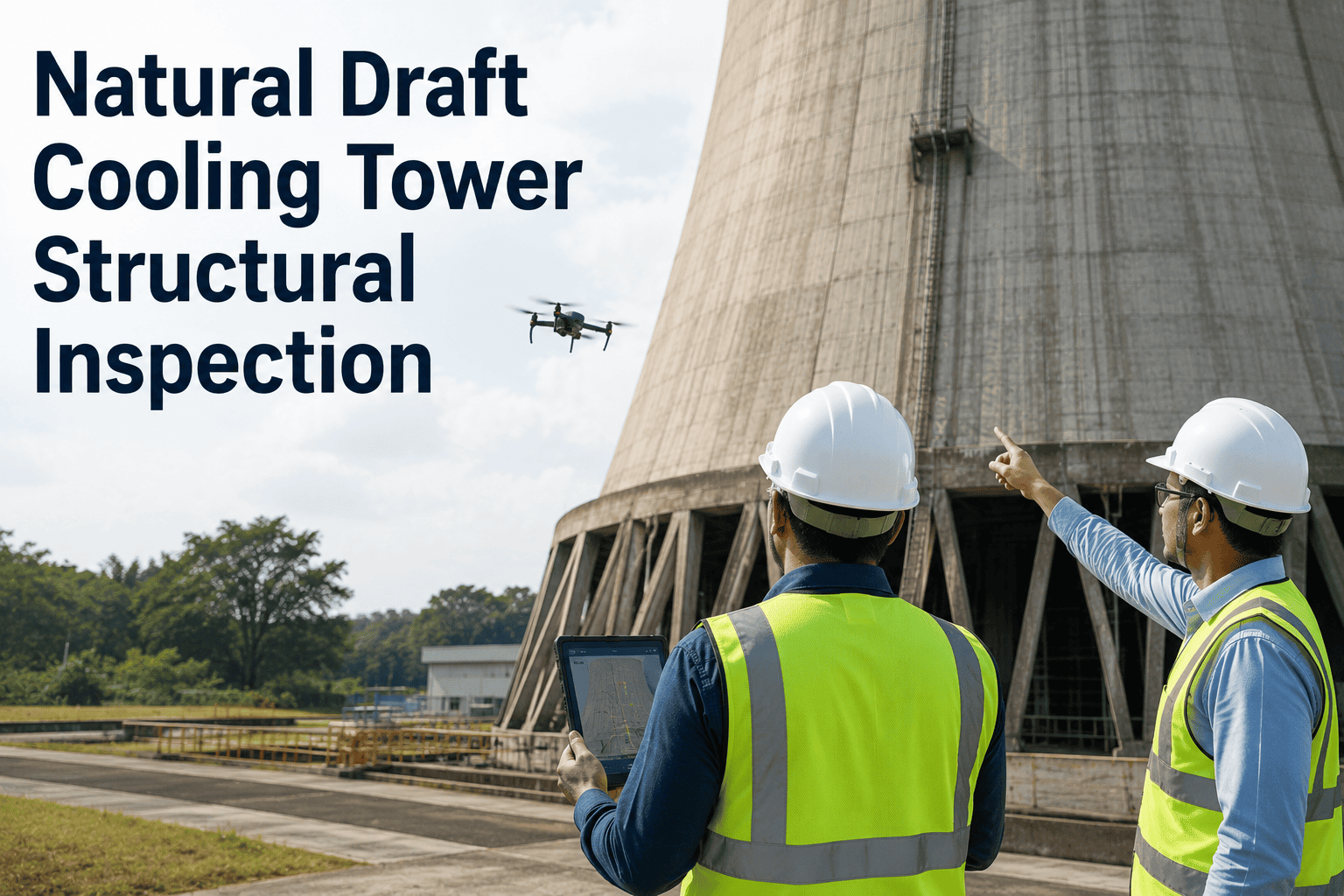
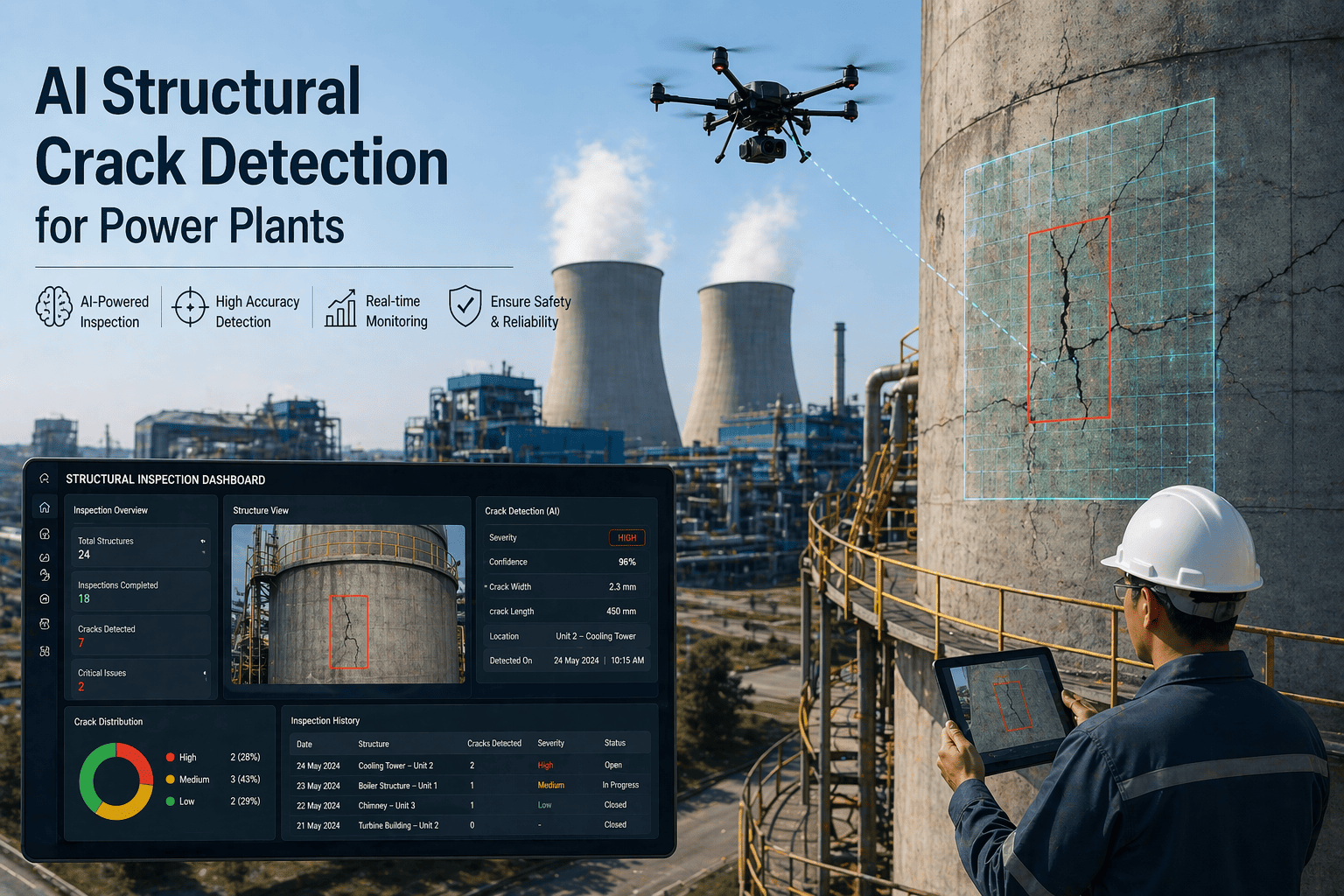
Cooling towers and chimneys at power plants and industrial facilities are among the most structurally exposed assets on any site, subjected to constant thermal cycling, chemical exposure from cooling water treatment, wind loading, freeze-thaw cycles, and seismic activity. Traditional inspection methods rely on scaffolding, rope access, or crane-mounted platforms that expose workers to fall hazards, require extended outages, and still leave significant portions of the structure unexamined because physical access is either impossible or prohibitively expensive. Drone-based visual inspection has changed what is actually possible to see, capturing high-resolution imagery of fill media, structural steel, chimney liners, and tower shells from angles that human inspectors cannot safely reach, and the full inspection workflow including how findings flow into maintenance action is documented at iFactory support.
Drone Visual Inspection · Cooling Tower & Chimney
Drone Inspection for Cooling Tower and Chimney Structural Safety
High-resolution drone capture of cooling tower fill, structural steel frameworks, chimney liners, and shell surfaces — replacing scaffold-based inspection with faster, safer, and more complete structural assessment.
60-80%
Reduction in inspection time versus scaffold access
Zero
Fall hazard exposure during the entire inspection process
4K+
Resolution per frame for crack and corrosion detection
100%
Of exterior surface area captured and analyzable
The Manual Inspection Problem
What Scaffold and Rope Access Inspection Actually Leaves Unseen
Manual inspection of cooling towers and chimneys has been the industry standard for decades, but the method carries fundamental limitations that have nothing to do with inspector skill and everything to do with physics. Scaffolding can only reach areas where it can be erected, rope access inspectors can only cover routes where anchor points exist, and crane platforms can only position people where the boom reaches. The result is a patchwork of examined and unexamined surfaces, with the unexamined portions often being exactly the locations where structural degradation begins.
Cooling Tower Fill Media
Fill packs sit deep inside the tower structure, stacked in layers that are physically inaccessible without dismantling the distribution system. Manual inspection sees only the top layer, while degradation, fouling, and collapse often begin in the middle or bottom packs where moisture loading is highest and chemical concentration is most aggressive.
Less than 20% visually accessible by hand
Chimney Liner Interior
Brick or FRP liners inside industrial chimneys degrade from acid condensation, thermal shock, and flue gas velocity erosion. Inspecting the full internal circumference requires either internal scaffolding built from the bottom up — a multi-week exercise — or a drone flown through the chimney bore, capturing every liner joint and surface in a single pass.
Full circumference visible only with internal scaffold or drone
Tower Shell Upper Sections
The upper third of a natural draft cooling tower shell experiences the highest wind-induced stresses and the most extreme thermal differentials between inner and outer surfaces. Rope access from the top ring beam can cover some of this area, but the curved geometry means inspectors on ropes naturally sweep through the middle height while the very top edge near the lip gets minimal attention.
Upper lip and windward face often under-inspected
Structural Steel Connections
Mechanical draft cooling towers have extensive steel frameworks supporting fans, decks, and louvers. Bolted and welded connections at elevation are difficult to reach, and corrosion at these joints often starts on the hidden side of the connection where water collects. A drone can position a camera on both sides of every accessible connection from a single flight path.
Hidden-side corrosion invisible to rope access
Drone Inspection Coverage Zones
Cooling Tower and Chimney Areas Where Drone Capture Changes What You Know
A structured drone inspection covers the full exterior and accessible interior of cooling towers and chimneys in a systematic flight plan that ensures every surface is captured at resolution sufficient for crack detection, corrosion mapping, and structural deformation assessment.
The entire outer surface of hyperbolic or rectangular cooling tower shells is flown in a grid pattern at close range, capturing concrete surface cracking, spalling, reinforcement corrosion staining, cold joint deterioration, and construction joint opening. Each flight pass overlaps the previous by a minimum of 60 percent to enable full photogrammetric reconstruction if needed for deformation analysis.
Longitudinal and transverse crack mapping with width estimation
Spall depth assessment from shadow analysis in imagery
Rust staining trails indicating rebar corrosion progression
Joint width measurement across construction and expansion joints
Zone B
Fill Media & Distribution
Drone flown through the air inlet and into the fill section captures fill pack condition, fouling, biological growth, and structural collapse from an overhead perspective that manual inspection cannot achieve without dismantling the water distribution system above.
Zone C
Chimney Exterior Shell
Full circumferential flight at multiple elevations captures the chimney shell surface for concrete cracking, coating degradation, lightning strike damage, and thermal gradient cracking that appears as star patterns on the windward face.
Zone D
Chimney Liner Interior
Internal flight through the chimney bore captures liner brick condition, mortar joint deterioration, FRP liner blistering and delamination, and acid condensate damage patterns at each elevation band from the breech opening to the top.
Zone E
Basin & Foundation
Low-altitude flight over the cooling tower basin and surrounding foundation captures basin floor cracking, wall joint leakage indicators, settling patterns, and foundation perimeter erosion that affects structural support integrity.
Defect Classification Reference
Structural Defects Drones Actually Detect on Cooling Towers and Chimneys
The value of drone inspection is directly tied to the defect library the imagery is analyzed against. Without a structured classification system, drone footage is just video. With one, every frame becomes a data point that can be compared across inspection cycles to track degradation rates and prioritize structural interventions.
Defect Category
What the Drone Captures
Structural Significance
Typical Location
Concrete Cracking
Linear features in shell surface, width estimation from pixel scale, pattern mapping across panels
Indicates stress redistribution, reinforcement overload, or thermal restraint failure
Tower shell upper third, chimney windward face
Surface Spalling
Concrete loss areas with depth visible from shadow angle, aggregate exposure, edge geometry
Reduces cover depth to reinforcement, accelerates carbonation and chloride ingress
Tower shell below ring beam, chimney below cap
Rebar Corrosion Staining
Rust-colored streaks and blotches on concrete surface, often following crack paths or joint lines
Confirms active reinforcement corrosion, section loss progressing inside the concrete
Splash zone, cold joints, construction joints
Liner Deterioration
Brick displacement, mortar loss, FRP blistering, liner surface discoloration from acid attack
Compromises acid resistance of chimney, allows gas-side corrosion of outer shell
Chimney interior, especially below breech and at acid dewpoint elevation
Fill Media Damage
Collapsed or displaced fill packs, fouling layers, biological growth coverage, broken support members
Reduces heat transfer efficiency, creates water distribution maldistribution and local overloading
Inside tower fill section, all elevations
Steel Frame Corrosion
Section loss on structural steel, bolt head corrosion, weld degradation, connection plate rusting
Reduces connection capacity, can lead to local buckling or connection failure under wind load
Fan deck supports, louver frames, walkway connections
Foundation Distress
Basin floor cracking patterns, wall tilt indicators, perimeter erosion, settlement-related cracking
Affects overall structural stability, can induce shell stresses not accounted for in original design
Basin floor, foundation perimeter, ground-level shell base
Method Comparison
Scaffold and Rope Access Versus Drone Inspection on Cooling Tower and Chimney Structures
The comparison is not between good inspection and bad inspection — it is between partial, slow, hazardous inspection and complete, fast, zero-hazard inspection. Both methods produce findings. The difference lies in coverage completeness, speed, safety profile, and the ability to repeat the inspection at intervals short enough to track degradation rates rather than just snapshot condition.
Traditional
Scaffold and Rope Access
Surface Coverage
40-60% of exterior, near-zero interior fill access
Inspection Duration
2-4 weeks including scaffold build and dismantle
Safety Risk
Fall hazard throughout, confined space entry for interiors
Repeat Frequency
Every 3-5 years due to cost and outage requirements
Data Output
Written report, selected photographs, inspector notes
Cost per Inspection
High — scaffold, labor, outage revenue loss, insurance
Drone-Based
AI-Analyzed Drone Inspection
Surface Coverage
95-100% of exterior, full interior fill and liner access
Inspection Duration
1-3 days flight time, analysis in days not weeks
Safety Risk
Zero personnel at height, no confined space entry needed
Repeat Frequency
Annually or more often, cost allows routine scheduling
Data Output
Geotagged image library, defect map, severity ranking, trend history
Cost per Inspection
Significantly lower — no scaffold, minimal outage impact, no height insurance
Every Year You Wait Between Scaffold Inspections Is a Year of Unseen Degradation Progressing on Your Most Exposed Structures.
Drone inspection makes annual structural assessment of cooling towers and chimneys practical and affordable — with every finding geotagged, classified, and trended against prior inspections.
Cost and Risk Impact
What Drone Inspection Actually Saves on Cooling Tower and Chimney Programs
The financial case for drone inspection is not abstract — it is calculable from the line items that disappear from the inspection budget and the risk costs that drop when structural condition is tracked continuously instead of sampled every few years. The following breakdown represents typical cost differences observed across industrial cooling tower and chimney inspection programs that have transitioned from scaffold-based to drone-based workflows.
Scaffold Elimination
$150K - $400K
Per inspection cycle, depending on tower height and chimney dimensions. This covers scaffold rental, erection labor, dismantling, and the extended outage window required to build and remove it. Drone inspection needs no scaffold at any elevation.
Outage Duration Reduction
$50K - $200K
Scaffold-based inspection often requires the unit to be offline for the full scaffold build-inspect-dismantle cycle. Drone inspection can be completed during a short outage window or even during operation for exterior surfaces, returning generating capacity sooner.
Fall Hazard Insurance
$20K - $80K
Working at height on cooling towers and chimneys carries significant insurance premiums and latent liability. Removing personnel from height eliminates this cost category entirely from the inspection budget.
Forced Outage Avoidance
$500K - $2M+
The largest single cost category is the forced outage that did not happen because annual drone inspection caught a structural defect before it became a failure. Even one avoided forced event pays for decades of drone inspection.
Inspector Labor Efficiency
60-80% Reduction
One drone pilot and one visual analyst replace a scaffold crew of six to ten people working for weeks. The labor efficiency gain is not just cost — it is scheduling flexibility that allows inspection to happen when the plant needs it, not when scaffold availability permits it.
Trend Data Value
Ongoing
Annual drone inspections build a year-over-year imagery record that allows degradation rate calculation for every tracked defect. This data drives capital planning with actual condition trends instead of age-based assumptions, often deferring major structural repairs by years.
Inspection Process
How a Cooling Tower and Chimney Drone Inspection Actually Runs From Start to Finish
A structured drone inspection is not an ad hoc flight — it is a planned, repeatable process that produces consistent, comparable results across inspection cycles. The workflow from pre-flight planning through final report delivery follows a defined sequence that ensures no surface is missed and every finding is traceable to a specific location on the structure.
1
Pre-Flight Planning and Airspace Coordination
The inspection team reviews the tower and chimney geometry, identifies restricted zones, establishes flight altitudes and grid patterns for each surface, files any required airspace authorizations, and confirms weather windows. Flight plans are documented so the exact same coverage can be replicated in future inspections for direct comparison.
2
Systematic Flight Execution
The drone flies the planned grid pattern over each surface zone — tower shell exterior at multiple elevation bands, chimney exterior in circumferential passes, interior fill section through air inlet or access opening, and chimney liner through the breech or top opening. Each pass captures overlapping imagery at the resolution required for the target defect size.
3
Image Ingestion and Zone Tagging
All captured imagery is ingested into the analysis platform and tagged by structure, zone, elevation band, and approximate compass orientation. This geo-referencing ensures that a crack found on the northwest face of the tower at 80 meters elevation in this inspection can be directly compared to the same location in the prior year's inspection.
4
AI Vision Analysis and Defect Detection
The vision model scans every frame for the defect classes relevant to the structure type — concrete cracking, spalling, corrosion staining, steel section loss, fill damage, liner deterioration — bounding each detection with location coordinates and an initial severity classification based on the visual characteristics of the defect.
5
Engineer Review and Severity Confirmation
A qualified structural engineer reviews the AI-flagged detections, confirms or adjusts severity classifications, adds contextual notes about the structural significance of each finding, and dismisses false positives. This human-in-the-loop step ensures the final report reflects engineering judgment, not just pattern matching.
6
Report Delivery and Maintenance Integration
The final deliverable includes a defect map tied to structure geometry, individual finding cards with imagery and severity ratings, a trend comparison against prior inspections showing which defects are stable, growing, or new, and maintenance recommendations ranked by structural priority. Findings can be exported directly into the plant maintenance management system.
Field Case
Catching Chimney Liner Deterioration That Scaffold Inspection Had Rated as Satisfactory Two Years Prior
A 180-meter industrial chimney at a petrochemical facility had undergone its most recent internal inspection three years earlier using scaffold built from the base, with the inspection report noting the brick liner as generally sound with minor mortar loss in a few locations rated as low priority. The facility scheduled a drone-based interior inspection as a trial, partly to evaluate whether the drone approach could replace the scaffold cycle and partly because operations had noticed a slight increase in flue gas temperature at the chimney outlet that suggested liner degradation might be progressing faster than the last report indicated.
The drone flown through the chimney bore captured the full internal circumference at one-meter elevation intervals from the breech opening to the top. The imagery revealed extensive mortar loss across approximately 40 percent of the liner circumference between 60 and 95 meters elevation — the zone where acid dewpoint condensation concentrates — with brick displacement visible in several areas that had not been accessible from the scaffold platform position three years prior. The scaffold inspection had been constrained to the areas reachable from the scaffold working platforms, which left large swaths of the liner circumference at mid-elevation unexamined because the internal diameter made it impossible to position platforms to see the far side of the liner from any single scaffold bay.
The drone findings triggered an immediate engineering assessment that classified the liner condition as requiring repair within the next planned turnaround rather than waiting for the next five-year inspection cycle as the prior scaffold-based report had suggested. The repair scope was precisely defined by the drone defect map, allowing the contractor to mobilize with the correct materials and access plan instead of discovering the full extent during the repair window. The facility estimated that catching the liner deterioration through drone inspection, rather than waiting for a liner failure event that could have forced an emergency shutdown and potentially exposed the outer reinforced concrete shell to direct acid flue gas contact, avoided a major structural risk and an uncontrolled outage scenario. The drone inspection cost was approximately eight percent of what the prior scaffold inspection had cost, with significantly better coverage and a complete digital record for future comparison.
40%
Liner circumference with significant mortar loss found
3 years
Since scaffold inspection rated the same liner as satisfactory
92%
Cost reduction versus the prior scaffold-based inspection
1 emergency
Potential forced outage avoided by early detection
Compliance and Standards
How Drone Inspection Fits Within Existing Structural Assessment Frameworks
A common question from facility engineers and asset managers is whether drone-based inspection findings are accepted by the standards and codes that govern cooling tower and chimney structural assessment. The answer is that drone imagery is a data capture method — the structural assessment itself is performed by qualified engineers using the same criteria applied to any inspection data, regardless of how it was collected.
ACI 350.3 / ACI 307
Concrete cooling tower shell and chimney design and assessment standards
These standards define the structural assessment criteria — crack width limits, concrete strength requirements, reinforcement condition thresholds. Drone inspection provides the crack mapping, spall measurement, and corrosion staining data that feed into these assessments. The standards do not prescribe how the inspection data is collected, only what must be evaluated.
CTI Standards
Cooling Technology Institute guidelines for cooling tower structural and thermal performance
CTI inspection protocols describe what to look for and how to classify findings. Drone inspection fulfills the visual inspection component of these protocols with superior coverage, and the imagery archive provides the documentation trail that CTI guidelines recommend for condition tracking across inspection cycles.
OSHA / ANSI
Worker safety requirements for inspection at height and in confined spaces
Drone inspection eliminates the fall hazard and confined space entry that trigger OSHA compliance requirements for traditional inspection methods. This does not just reduce risk — it eliminates entire regulatory compliance categories from the inspection scope, simplifying permit requirements and reducing overhead.
FAA Part 107
Commercial drone operations in the United States
All drone inspection flights are conducted under FAA Part 107 or applicable local regulations by certified remote pilots. Airspace authorizations are obtained for facilities in controlled airspace, and flight logs and pilot certifications are maintained as part of the inspection documentation package.
Frequently Asked Questions
What Facility Engineers and Asset Managers Ask About Drone Inspection
Can a drone inspection actually replace a full scaffold-based structural inspection of a cooling tower?
Drone inspection replaces the visual data collection component of the inspection — it captures more surface area at higher resolution than scaffold-based visual inspection can achieve. What it does not replace is the engineering assessment that interprets the findings against structural criteria, or the physical testing methods like concrete core extraction, cover meter surveys, or hammer sounding that may be needed to confirm subsurface condition. In practice, most facilities use drone inspection as the primary visual data source and follow up with targeted physical testing only at locations the drone findings have flagged, rather than deploying scaffold for a blanket visual sweep. To discuss how this applies to your specific structures,
book a demo with our team.
What happens if weather conditions are not suitable for flying on the scheduled inspection date?
Drone operations require minimum visibility and maximum wind speed thresholds that vary by drone model but generally prohibit flight in rain, fog, or sustained winds above 25-30 knots at the operating altitude. If conditions are unsuitable on the scheduled date, the flight is rescheduled to the next available weather window. Because drone inspection requires hours rather than weeks, the scheduling flexibility is significantly greater than scaffold-based inspection, which once erected cannot easily be paused and resumed. The
support team coordinates scheduling and communicates weather hold decisions with the facility to minimize disruption.
How does drone inspection handle the interior of a natural draft cooling tower where GPS signal is unavailable?
Inside enclosed structures where GPS is denied, the drone uses visual navigation and obstacle avoidance systems that rely on onboard cameras and sensors rather than satellite positioning. Flight paths for interior sections are pre-programmed based on the known geometry of the structure, and the drone maintains position relative to the surrounding surfaces using optical flow and ranging sensors. The pilot monitors the feed in real time and can take manual control at any point. Interior flights of cooling tower fill sections and chimney bores are routine operations that have been performed hundreds of times across the industry.
What resolution do the drone cameras capture, and is it sufficient to detect the crack widths that matter for structural assessment?
Inspection-grade drones carry cameras that capture 20 megapixel or higher still images and 4K video at close range to the structure surface. At a typical working distance of three to five meters from the concrete surface, this translates to a ground sample distance of approximately one to two millimeters per pixel, which is sufficient to detect and measure cracks down to approximately 0.3 millimeters in width — well within the range that structural assessment standards consider significant for reinforced concrete cooling tower shells. For chimney liner inspections where the drone flies through the bore at slightly greater distance, the resolution is still sufficient to detect brick displacement, mortar loss, and liner surface deterioration that indicates active acid attack. To see sample imagery from actual inspections,
book a demo.
How do we compare drone inspection findings from year to year to track degradation rates?
The inspection platform maintains a permanent image archive tied to structure, zone, elevation, and orientation metadata. When a new inspection is completed, the system can pull prior imagery of the same location for side-by-side comparison and automated change detection. Cracks that have lengthened, spalls that have deepened, and corrosion stains that have expanded are flagged as progressing defects with measurable rate-of-change data. This trend capability is one of the primary advantages over traditional inspection, where comparison depends on an inspector remembering what they saw years earlier or manually matching photographs from different reports. The platform handles this automatically, and the
support team can configure the comparison views and alert thresholds for your specific structures and defect priorities.
Stop Inspecting Your Cooling Towers and Chimneys Once Every Few Years and Hoping Nothing Changed in Between.
Annual drone inspection with AI-analyzed findings gives you a trended structural condition record for every cooling tower and chimney on your site — with zero scaffolding cost and zero personnel at height.