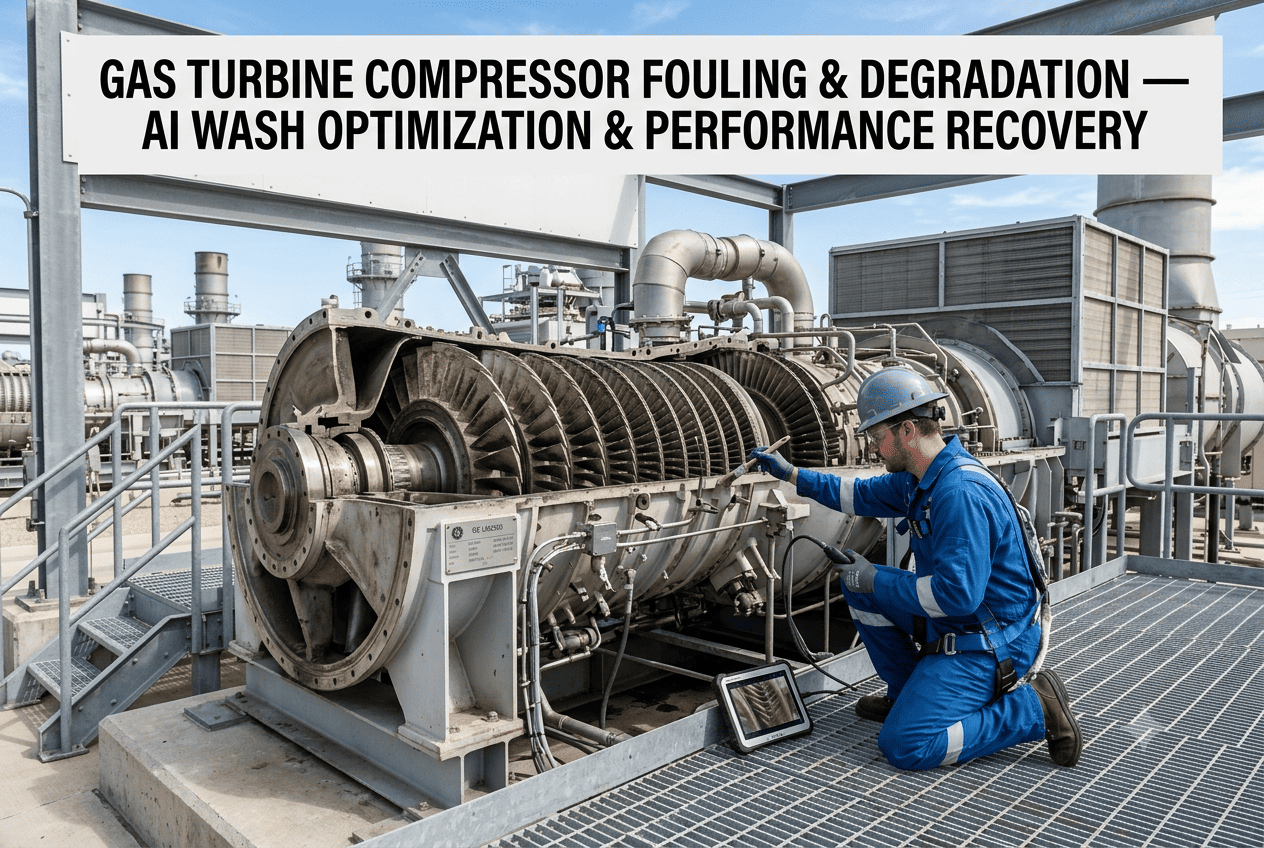
Most reliability teams still wash gas turbine compressors on a fixed calendar — offline every 30 days, online every 72 hours — because that is what the commissioning manual said to do years ago. The trouble is that fouling has nothing to do with a calendar. A turbine running in a coastal, dusty, or high-humidity site can lose several points of compressor efficiency in a fraction of the time it takes an identical unit in a cleaner environment to reach the same point. Wash too early and you burn outage hours and wash fluid for no real gain. Wash too late and you quietly burn extra fuel and lose megawatts every single day the compressor stays dirty. iFactory tracks compressor discharge pressure, mass flow, and efficiency trend continuously so every wash is triggered by the turbine's actual condition, and you can book a demo to see the exact point iFactory would have called for your last wash.
A Dirty Compressor Is the Single Largest Recoverable Loss on Your Gas Turbine — and Most Plants Are Still Guessing at When to Wash It
Compressor fouling accounts for the majority of all recoverable gas turbine efficiency loss over the life of the unit. iFactory's AI analytics track pressure ratio, mass flow, and efficiency drift in real time so your team knows exactly when an online or offline wash will actually pay for itself.
Fouling Is Not a Single Event — It Is a Slow, Predictable Curve That Most Plants Never Actually Plot
Airborne particles between 1 and 5 microns slip past inlet filters and settle on the inlet guide vanes and early compressor stages. Each layer changes the airfoil profile the compressor was designed around, which pulls down mass flow, pressure ratio, and isentropic efficiency at the same time. None of that shows up as an alarm. It shows up as a slow drift in the numbers a reliability engineer already has on a trend screen, if anyone is watching that screen closely enough.
Not Every Turbine Fouls the Same Way — Frame Type Changes How Fast the Clock Runs
Field studies comparing an aero-derivative unit against a heavy-duty frame under the same fouling conditions found the aero-derivative machine lost far more ground on every metric that matters to a reliability engineer.
| Metric | Aero-Derivative Unit | Heavy-Duty Frame |
|---|---|---|
| Power output decline | 7% to 16% | Noticeably smaller |
| Thermal efficiency decline | 2.6% to 6% | Noticeably smaller |
| Heat rate increase | 2.7% to 6.6% | Noticeably smaller |
| Fouling sensitivity | High | Lower, but still significant over time |
The takeaway for a reliability program is simple: a fixed wash calendar copied from a sister site with a different frame type is almost guaranteed to be wrong for at least one of your units.
Stop Copying a Wash Schedule From the Commissioning Manual
iFactory reads your compressor's actual degradation curve and tells you when an online or offline wash will pay for itself on your specific unit, site, and season.
Online and Offline Washing Are Not Competing Strategies — They Solve Two Different Problems
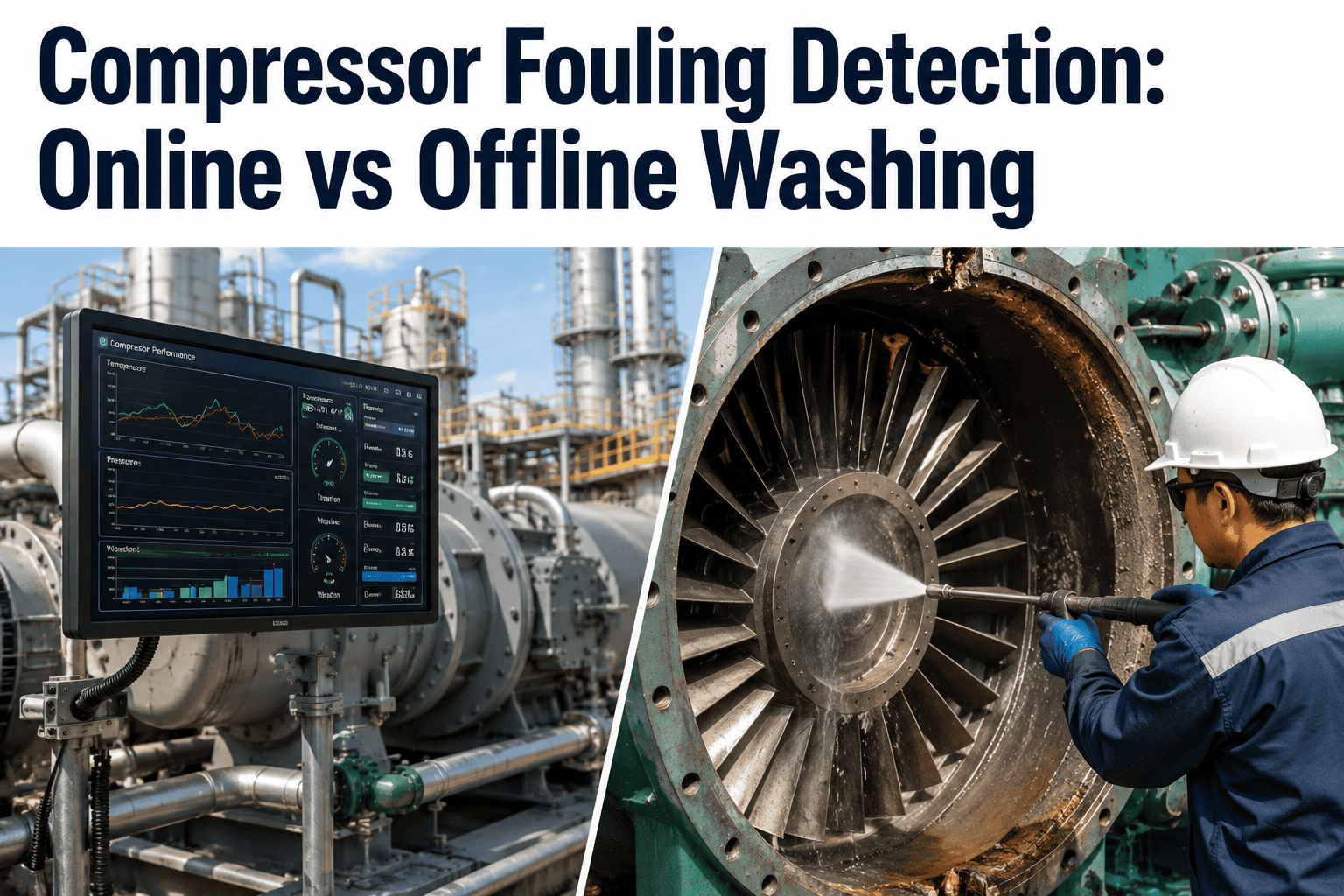
The most common mistake reliability teams make is treating online washing as a substitute for offline washing, or vice versa. Field data consistently shows the two methods are complementary: one slows the fouling rate, the other resets it.
Online Washing
Injects demineralized water into the compressor while the unit runs at reduced load, typically as an automated sequence. It cannot dissolve baked-on deposits and does not restore all fouling-related loss, but it slows the accumulation rate and stretches the interval before the next offline event is needed.
Offline Washing
Requires a full shutdown, compressor cranking at reduced speed, a detergent-and-demin-water soak, and multiple rinse cycles — typically 4 to 12 hours total. Executed correctly, it recovers roughly 6% efficiency per event, often restoring nearly all fouling-related loss back to the day-zero baseline.
Four Signals iFactory Tracks to Call the Right Wash at the Right Time
A condition-based wash program only works if the underlying signals are trended continuously and cross-checked against each other, not read off a single gauge once a shift.
Compressor Discharge Pressure
CDP is the earliest and most sensitive indicator of fouling onset, often shifting well before efficiency or output show a visible change.
Corrected Mass Flow
Fouled airfoils physically restrict airflow. Tracking corrected mass flow against ambient conditions separates true fouling from weather-driven noise.
Isentropic Efficiency Trend
The slope of the efficiency curve since the last wash tells you whether you are in the fast early-degradation window or the slower steady-state slide.
Heat Rate Drift
Rising heat rate converts every point of fouling directly into a fuel-cost number, which is the figure that gets a wash approved without a fight.
Five Questions to Ask Before You Approve the Next Compressor Wash
Use this checklist alongside your trend data before signing off on either an online or an offline wash event.
What Condition-Based Wash Scheduling Changes in Practice
Sites that move from a fixed calendar to condition-triggered washing consistently report the same pattern: fewer unnecessary washes, fewer missed ones, and a measurable swing in annual profit.
Questions Reliability Engineers Ask About Compressor Wash Optimization
Turn Your Compressor Wash Schedule Into a Data-Driven Decision, Not a Date on a Board
iFactory trends compressor discharge pressure, mass flow, efficiency, and heat rate continuously, so your team washes exactly when the numbers say it will pay off.