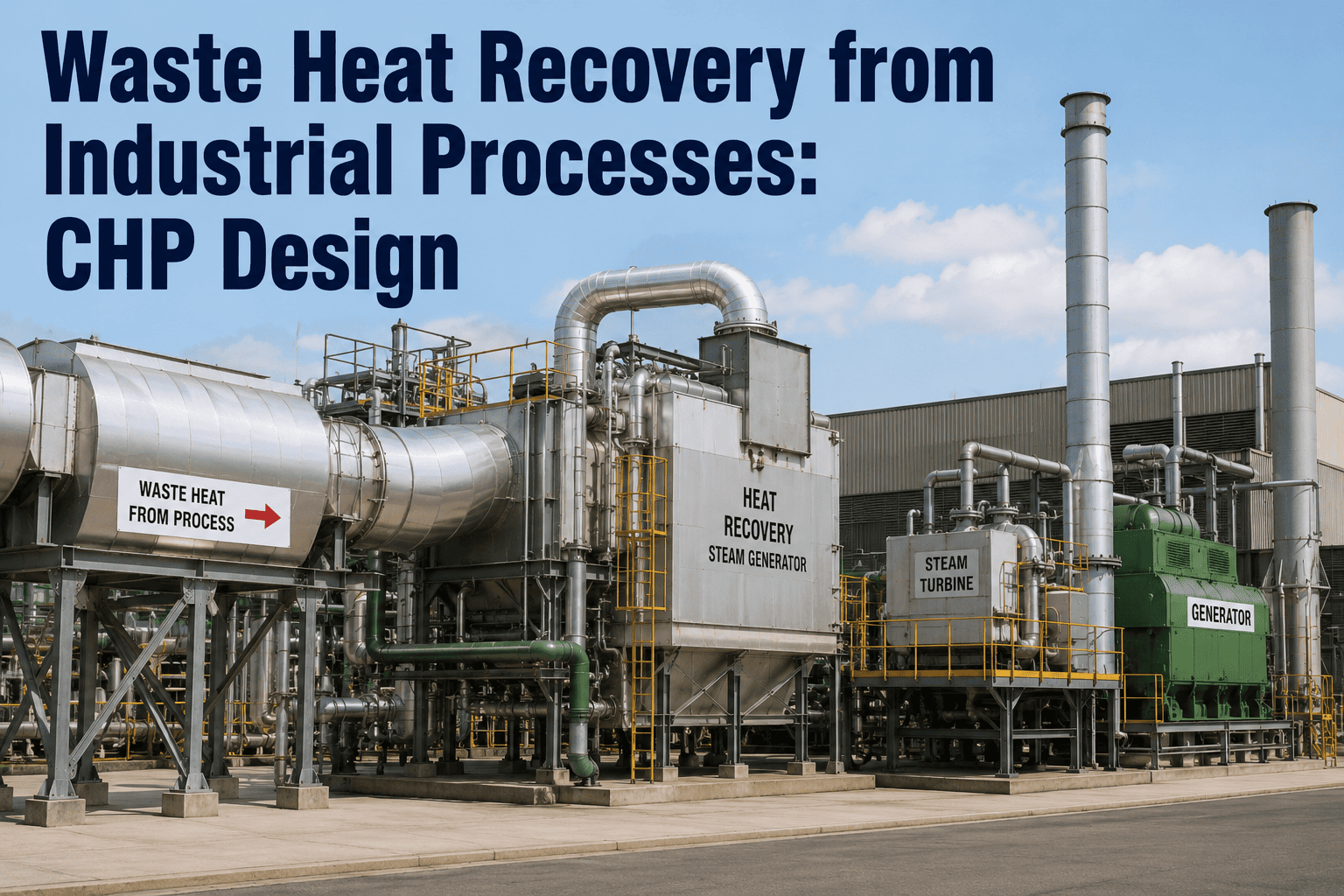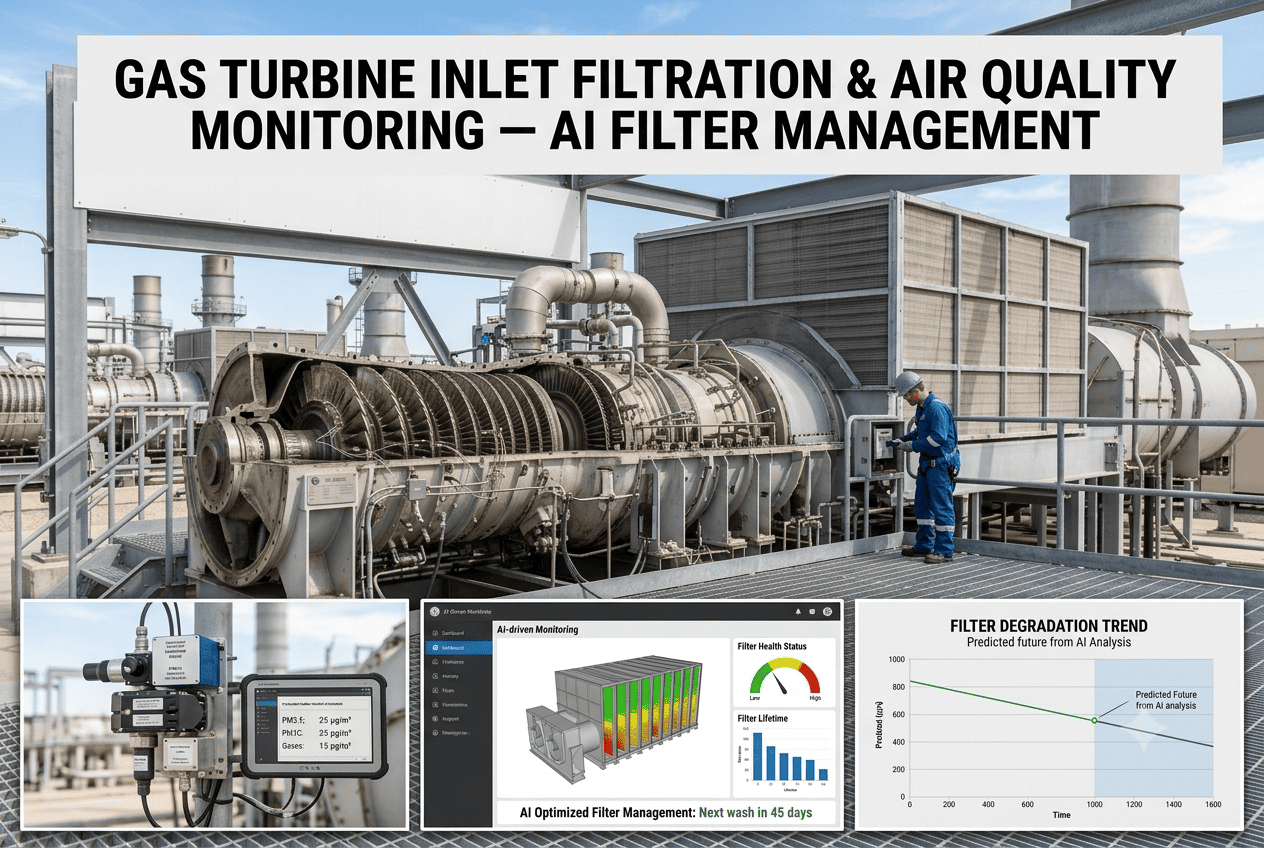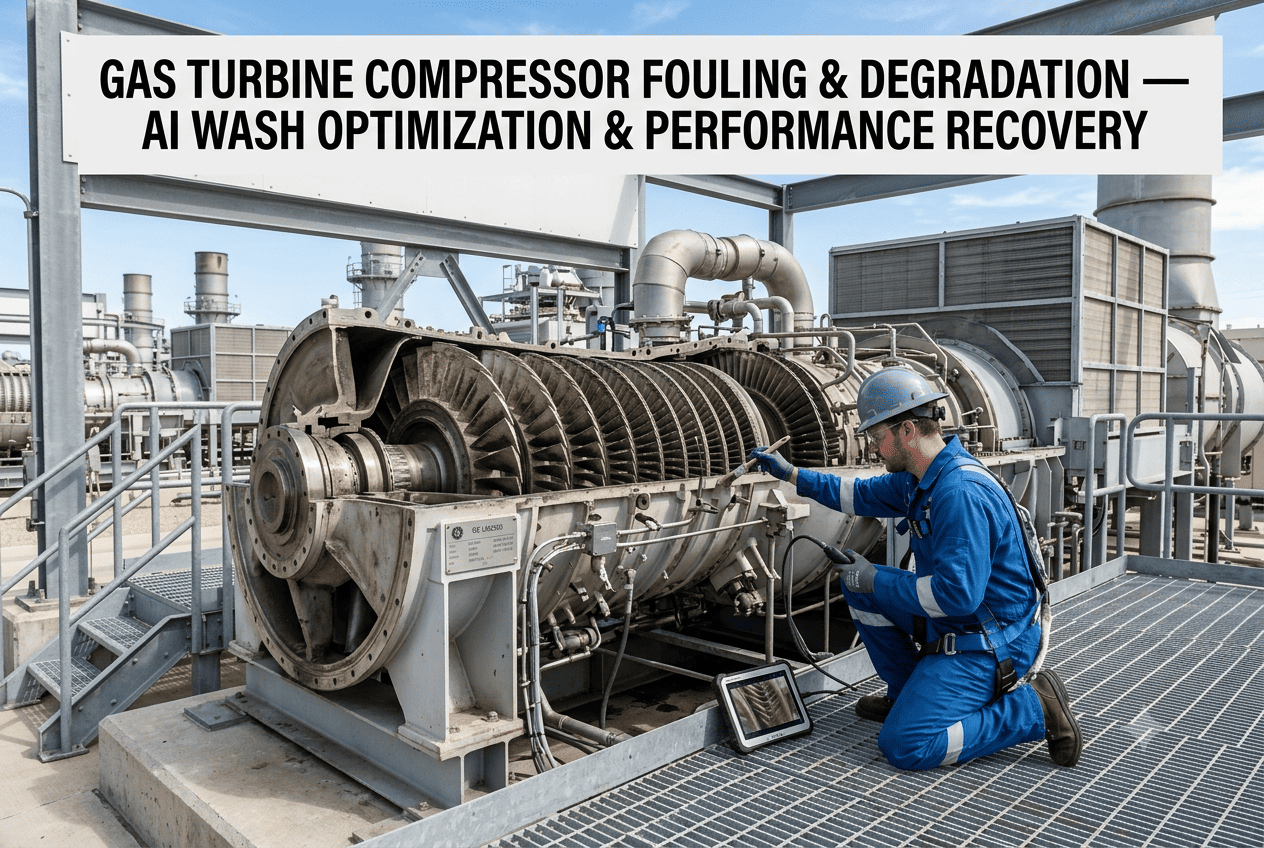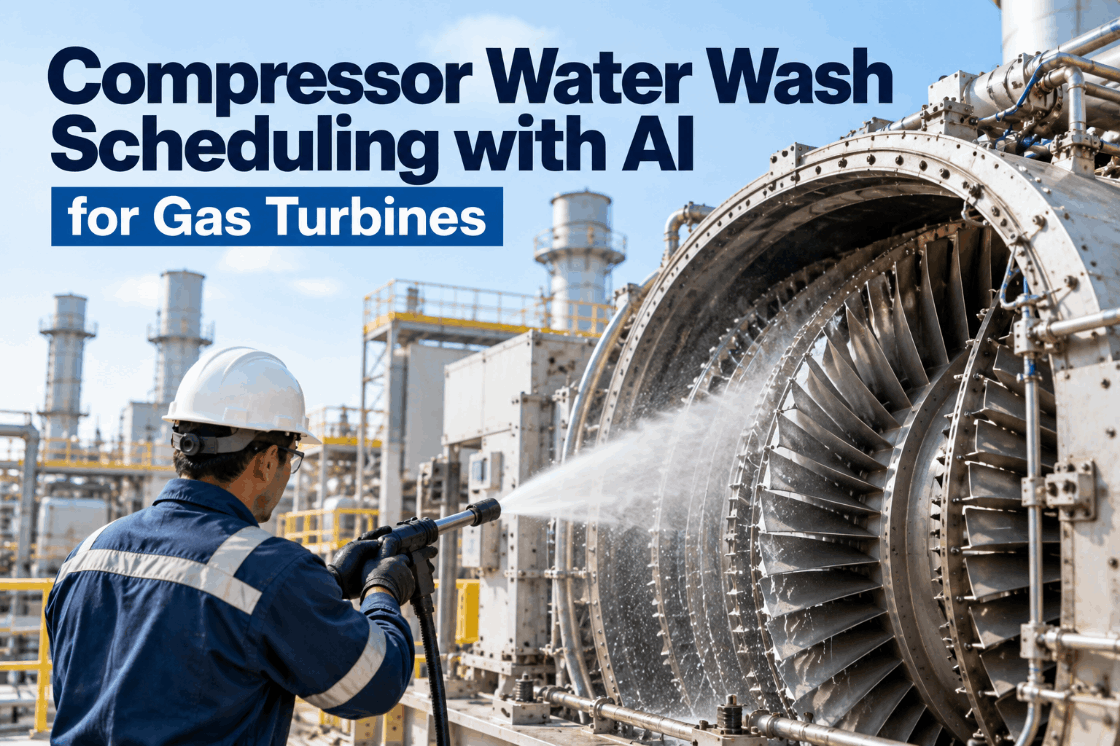
Every gas turbine compressor loses output as dirt builds on its blades. An online wash slows the loss. An offline wash recovers most of it, but takes the unit off line. The hard part is not the wash itself. It is choosing when to do it, so the recovered megawatts are worth more than the outage and the wash cost. This guide covers compressor water wash scheduling using corrected performance, fouling rate and the dispatch forecast, with a worked example. Test your current wash plan in a short review.
Compressor Water Wash Scheduling with AI for Gas Turbines
AI estimates fouling from corrected performance data, suggests the next online or offline wash around the dispatch forecast, and measures the megawatts recovered after each wash. Your team approves every wash.
- Fouling rate from corrected output
- Offline washes placed in low-value hours
- Recovered MW measured after every wash
Why Wash Timing Matters More Than Wash Frequency
The same wash can make money or lose money, depending on when it happens.
A fouled compressor moves less air. Output falls and heat rate rises. An offline wash brings most of that back, but the unit has to stop. If that outage lands in hours when the market wanted the unit, the lost margin can be larger than everything the wash recovers. If it lands in hours when the unit would have been idle anyway, the outage costs almost nothing. A scheduling approach weighs three things together: how fast the unit is fouling, what the lost output is worth, and when the next low-value window opens. Our performance engineers can review how your washes are timed today.
Calendar washing
- Same interval in dusty and clean seasons
- Offline washes booked before dispatch is known
- Raw output compared, so weather hides fouling
- No record of what each wash recovered
Scheduled by condition and dispatch
- Fouling rate tracked from corrected data
- Offline washes placed in low-value windows
- Online washes keep the rate down between them
- Recovered MW measured after every wash
Online vs Offline Compressor Wash
Two different tools. A good schedule uses both.
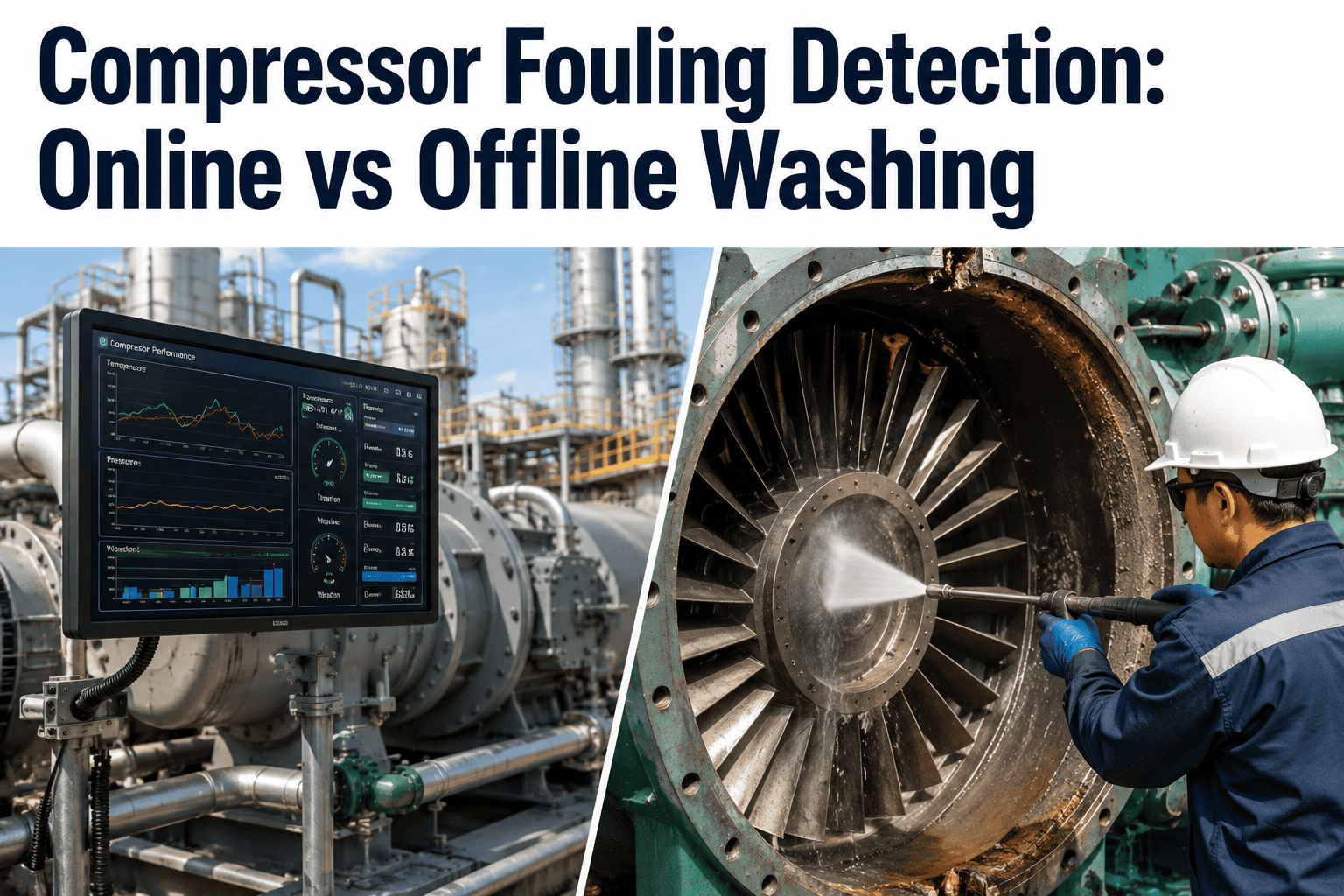
An online wash sprays demineralised water, sometimes with detergent, into the compressor inlet while the unit runs. It needs no shutdown and mainly cleans the inlet guide vanes and front stages. In a Turbomachinery Magazine article on compressor degradation, Turbotect's Jean-Pierre Stalder put the gain at about 0.2% to 1% of power per online wash, and recommended washing daily or every two to three days. An offline wash, also called a crank wash, is done with the unit shut down and cooled, turning on the starter at crank speed while wash solution is sprayed in. It reaches more stages and can recover nearly all of the fouling loss. The same article gave 12 to 36 hours for an offline wash. Plan both wash types for your units in a working session.
Summary for orientation. Your OEM wash procedure sets temperatures, flow rates, detergent and limits.
What Drives the Compressor Fouling Rate
Fouling follows the air the unit breathes, not the calendar.
Fouling comes from fine material that passes the inlet filters and sticks to the blades. In the same Turbomachinery Magazine article, Rainer Kurz of Solar Turbines said particles of 1 to 5 microns are the size most responsible for fouling, which is why filter quality matters so much. Oily vapour makes deposits sticky. Salt matters near the coast. These sources change with season and wind, so the fouling rate on one unit varies from month to month. A wash schedule that ignores this will be early in clean months and late in dirty ones. Ask our specialists to read your fouling rate history.
Dust and sand
Dry, windy weeks and nearby earthworks.
Sea salt
Coastal sites, fog and onshore wind.
Oily vapour
Makes other deposits stick harder.
Local emissions
Cement, process plants, flares, traffic.
Pollen and insects
Short spring and summer peaks.
Filter condition
Damaged or bypassed filters let more through.
Measuring Fouling with Corrected Performance
Raw output moves with the weather. Corrected output moves with fouling.
Output rises and falls with the weather, so raw megawatts cannot show fouling. Ratings are quoted at ISO reference conditions, which ISO 3977-2 sets at 15 °C, 101.325 kPa and 60% relative humidity. Performance monitoring corrects each reading back to these or to a site reference, using the OEM correction curves for ambient temperature, pressure and humidity. Once output, heat rate and compressor discharge pressure are corrected, a steady downward slope between washes is fouling, not weather. Kurz noted in the article above that compressor discharge pressure is one of the most effective signals for tracking fouling. That slope is the fouling rate, and the schedule is built on it. Set up correction for your units with our performance team.
Read
Output, heat rate, CDP, inlet conditions.
Filter
Steady-state points at similar load.
Correct
OEM curves to reference conditions.
Trend
Slope since the last offline wash.
Forecast
Loss expected by each future window.
Wash When It Pays, Not When the Calendar Says
The wash agent tracks corrected performance, forecasts the fouling loss and suggests offline washes in low-value dispatch windows, then measures what each wash recovered.
Worked Example: Lost Output vs Wash Cost
The wash is the same. Only the timing changes the answer.
Take an illustrative 175 MW unit that is expected to run 16 hours a day for the next 28 days, or 448 running hours. Corrected data show that an offline wash now would recover an average of 3.0 MW over that period, allowing for fouling coming back. At an illustrative margin of $30 per MWh, that is 1,344 MWh worth $40,320. Water, detergent, labour and start costs for the wash are taken as $12,000. If the wash fits in a weekend when the unit was not going to be dispatched, the net gain is $28,320. If the same 18-hour wash falls in dispatched hours, it also gives up 18 × 175 = 3,150 MWh, or $94,500 of margin, and the result is a loss of $66,180. All figures are illustrative. Check the numbers for your own unit with our engineers.
Illustrative only. Real margins, heat rate gains, start costs and recovery depend on your unit and market. Heat rate savings are left out for simplicity.
Planning Offline Washes Around Dispatch
The best window is often already in the forecast.
Most plants know days ahead when a unit is likely to be off line or at low load, such as weekends and low-demand nights. The wash agent reads the dispatch forecast, compares each window with the forecast fouling loss and suggests the window with the best net value. It also checks that the window is long enough for cooldown, wash, soak, rinse and drying, and that crew, demineralised water and detergent are ready. If no good window opens before the loss grows too large, it says so, and the team decides whether to take a paid outage or wait. Walk through a real forecast with us in a short session.
Measuring Wash Effectiveness
If a wash is not measured, nobody knows if it worked.
Every wash should leave a before and after record. For an offline wash, that means corrected output, heat rate and compressor discharge pressure at matching load just before shutdown and soon after restart, plus the final rinse water conductivity. For online washes, the trend over the following days shows whether they are slowing the fouling rate. A wash that recovers less than usual is a signal to inspect nozzles, filters or the procedure. Review your wash records with our team.
Compressor Water Wash Scheduling Checklist
Eight checks before the wash plan goes live.
Use this checklist for one unit first. Tick items already in place. Get help with any gaps from our setup team.
Compressor Wash Mistakes to Avoid
A wash in the wrong hour can cost more than the fouling.
These are the patterns that most often weaken wash programs. A short wash review can find them.
What works
- Corrected data, not raw output
- Online washes between offline washes
- Offline washes matched to dispatch windows
- Before and after readings for every wash
What fails
- Fixed intervals in every season
- Short rinses to save time
- Poor water quality in the wash skid
- Ignoring filters when fouling speeds up
How iFactory Runs Compressor Water Wash Scheduling
The Wash Optimization Agent, on your own network.
iFactory's Wash Optimization Agent estimates fouling from performance data, recommends the next online or offline wash around dispatch forecasts and measures recovered MW after each wash. It runs on an on-prem AI server inside your plant.
Fouling estimate
From corrected performance data.
Ambient correction
Weather taken out of the trend.
Dispatch windows
Offline washes in low-value hours.
Online wash plan
Kept running between offline washes.
Work orders
Opened once the team approves.
Recovered MW
Measured after each wash.
Wash timing, outage and dispatch decisions remain with your operations team. Figures on this page are worked examples.
Turnkey AI: Delivered, Connected and Live in 6–12 Weeks
You do not build this. It arrives ready.
iFactory ships as a pre-configured NVIDIA AI server with the software pre-loaded, racked and ready. Rack it, plug in power and Ethernet, and the AI is live on your network. Our team handles cabling, network setup, PLC, SCADA, DCS and CMMS integration, historian and dispatch system links, operator training and 24×7 remote monitoring. Data stays on your network. For a scope matched to your plant, request a turnkey quote.
Ship, network and data
Server installed. Historian, ambient and dispatch forecast data connected. Wash history loaded.
Model training and pilot
Correction curves, fouling model and wash cost set up for one unit. Suggestions checked against past washes.
Go-live and training
Wash plan live. Operations and maintenance trained. 24×7 monitoring begins.
Frequently Asked Questions
What is compressor water wash scheduling?
Planning when to run online and offline compressor washes, based on how fast the unit is fouling and when an outage costs the least.
What is the difference between an online and offline wash?
An online wash runs with the unit on line and mainly cleans the front stages. An offline wash is done shut down at crank speed and reaches more stages.
Why use corrected performance?
Output changes with temperature, pressure and humidity. Correcting to reference conditions separates fouling from weather.
What causes compressor fouling?
Fine dust, salt, oily vapour, pollen and local emissions that pass the inlet filters and stick to the blades.
Does online washing replace offline washing?
Usually not. Online washes slow fouling between offline washes. Most units still need offline washes to recover the rest.
Does the AI decide when to wash?
No. It suggests a window and shows the numbers. Operations and maintenance approve the wash.
How is wash effectiveness measured?
By comparing corrected output, heat rate and discharge pressure at matching load before and after each wash.
What data is needed?
Historian data for output, fuel, discharge pressure and inlet conditions, plus wash records and the dispatch forecast.
How do we start?
Start with one unit and its wash history. A 6-week pilot connects data, sets up correction and checks suggestions against past washes. To plan it, contact our team.
Put Your Next Offline Wash in the Right Window
In thirty minutes we look at one unit's corrected performance and dispatch pattern and show where the next wash would pay best. You keep the analysis either way.
- 1Six months of historian data for one unit
- 2Dates of recent online and offline washes
- 3Your OEM wash procedure
- 4A typical dispatch forecast
- 5Rough cost of one offline wash