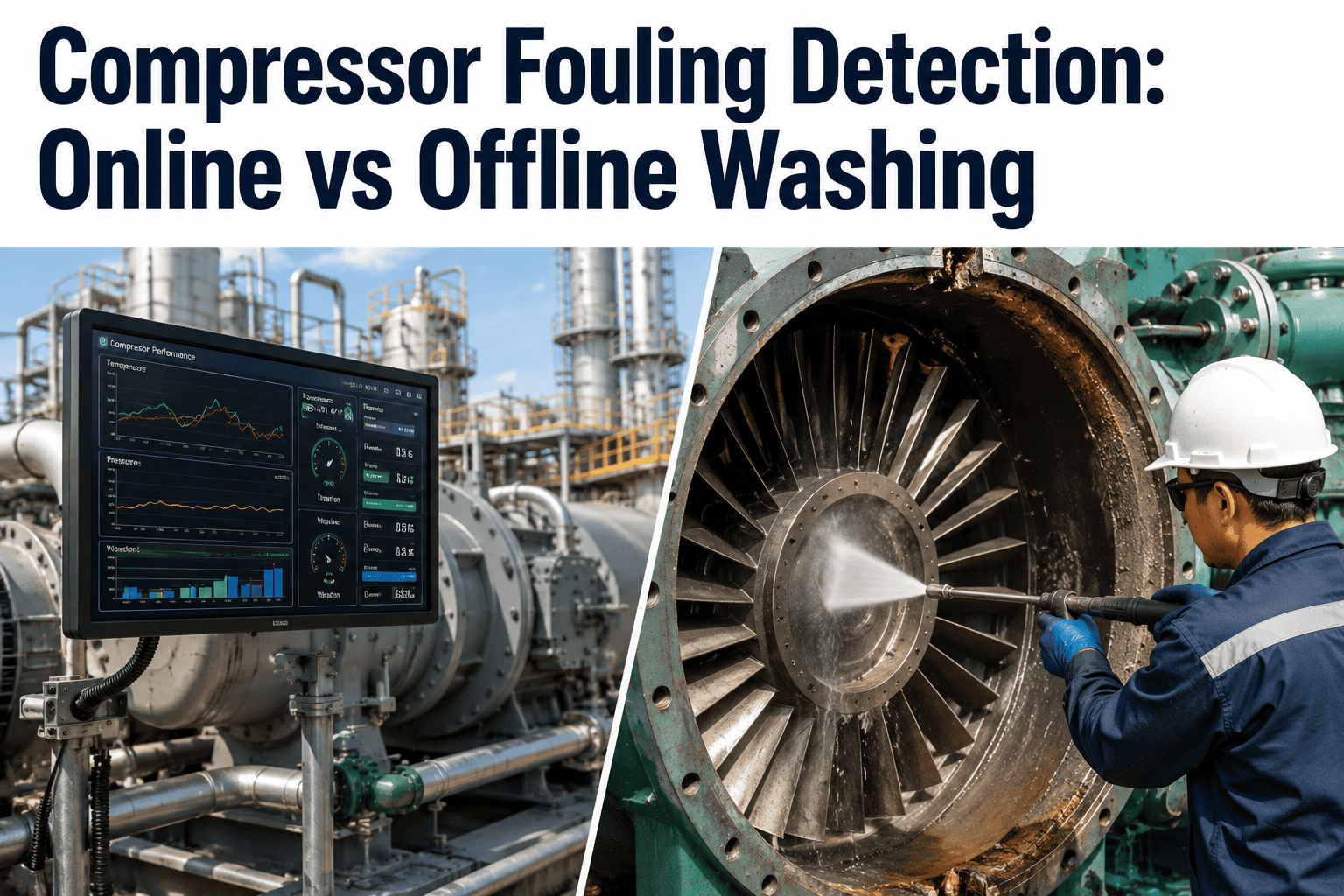
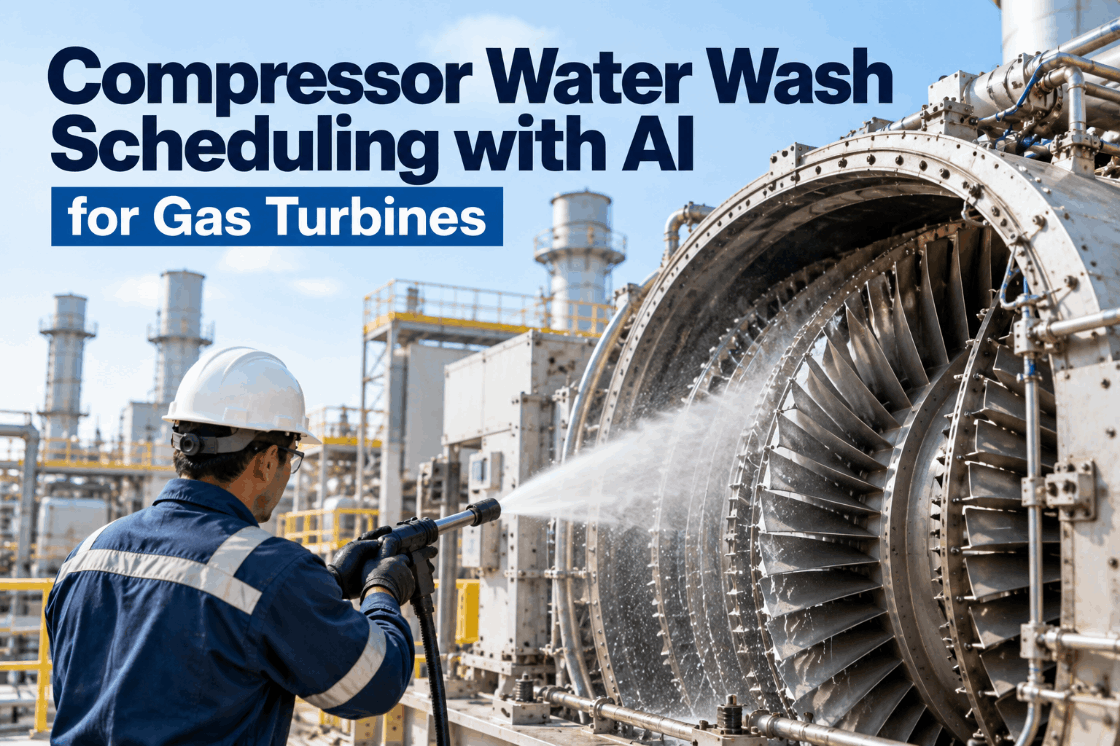
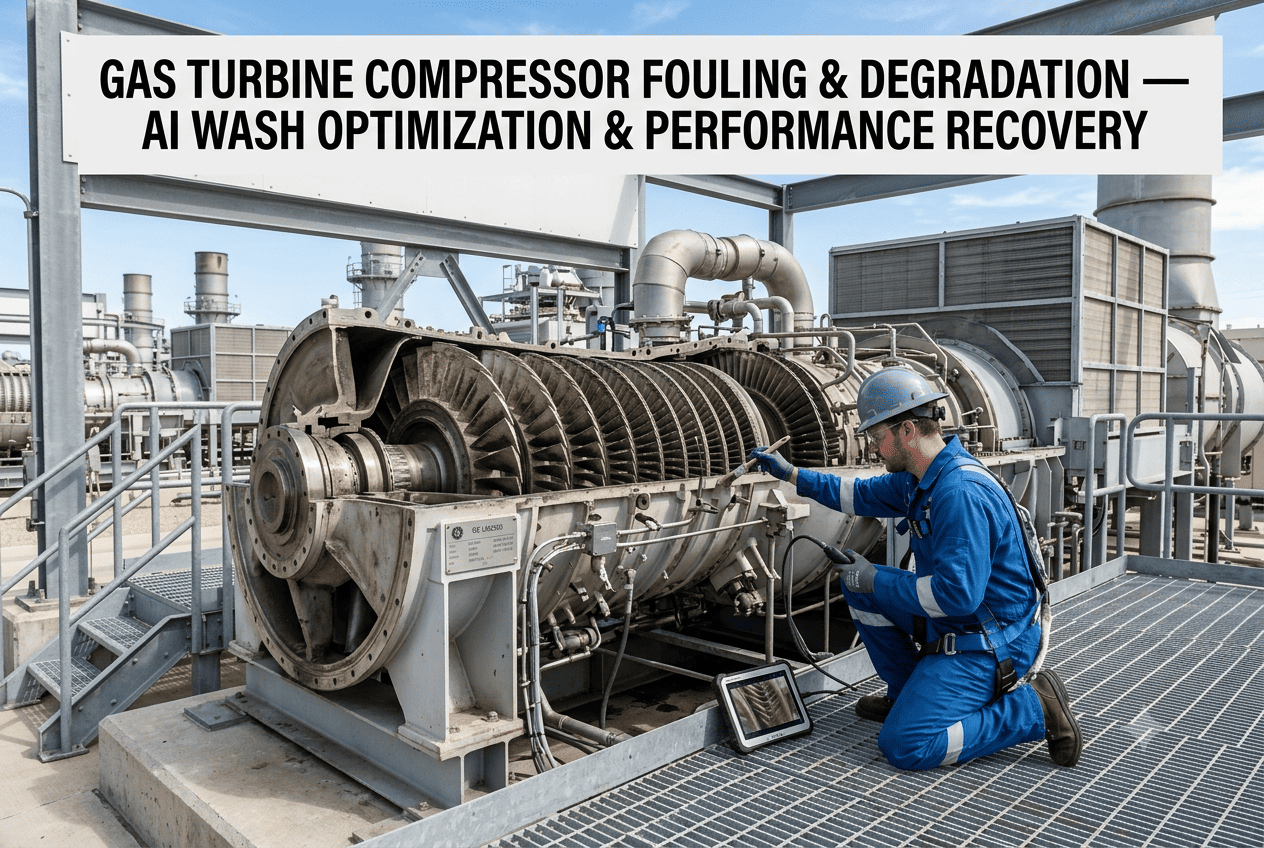
Compressor fouling starts small — a thin film of salt, dust, or oil vapor on the first few stages of blading — and by the time an operator notices the power output alarm, the turbine may have already lost five to eight percent of rated capacity. The tricky part is not knowing that fouling exists, it is knowing exactly how much has accumulated and whether an online wash will fix it or whether the deposits have already baked on hard enough to need a full offline crank wash. Getting that call wrong either wastes a shutdown on a problem online washing could have solved, or leaves output on the table for months waiting on a wash that was never going to work. This page walks through how to detect fouling early through trending, and how to choose correctly between iFactory support for detection setup.
Power Generation · Compressor Health
Know Exactly When to Wash, and Which Wash Will Actually Work
Pressure ratio and mass flow trending catch fouling weeks before output drops enough for anyone to notice on a shift log.
Pressure Ratio-3.4%
Mass Flow-2.9%
Days Since Last Wash11
Recommended ActionOnline Wash
5–8%
Power output typically lost to fouling before it is caught without continuous trending
2.3–2.8%
Efficiency recovered per online wash event at moderate fouling levels
5.85–6.5%
Efficiency recovered per offline crank wash when executed correctly
2,000 hrs
Fired hours beyond which baked-on deposits resist online washing entirely
Early Detection
The Two Trends That Tell You Fouling Is Starting
Fouling is invisible until it is trended. Two parameters move before power output does, which is exactly why they matter more than watching the megawatt meter.
Step 1 — Pressure Ratio
A drop in compressor discharge-to-inlet pressure ratio at constant load is the earliest and most reliable fouling signal, often visible days before output changes.
Step 2 — Mass Flow
Reduced airflow capacity follows pressure ratio decline closely. Trending both together filters out normal ambient temperature noise.
Step 3 — Rate of Change
A fast decline over days points to a high-fouling event such as a filter bypass. A slow decline over weeks points to gradual site-condition fouling.
Step 4 — Wash Decision
The trend, not the calendar, decides whether an online wash will hold the line or whether an offline crank wash is already required.
Stop Guessing Which Wash Your Turbine Needs.
iFactory trends pressure ratio and mass flow continuously and recommends online or offline washing before output drops.
Online vs. Offline Washing
Choosing the Right Wash Method for the Fouling You Actually Have
Factor
Online Wash
Offline Wash
Turbine state
Running at reduced load, no shutdown needed
Requires shutdown, cranking, and cooldown
Typical recovery
2.3–2.8% efficiency per event
5.85–6.5% efficiency, near-full recovery
Best for
Fresh, loose deposits caught early through trending
Baked-on deposits beyond what online washing can dissolve
Frequency
Every 3–7 days at moderate fouling sites
Monthly to quarterly, condition-driven not calendar-driven
Downside if used alone
Cannot dissolve hardened deposits, loss keeps compounding
Production lost during every shutdown event
Why the Timing Decision Matters
A Plant Running No Structured Wash Program Loses 10–15% of Rated Output
The combination of online and offline washing, sequenced by trend data rather than a fixed calendar, consistently recovers the most performance for the least production loss. Waiting until output visibly drops means the fouling has usually already crossed into the range where online washing alone cannot fully recover it, forcing an unplanned offline wash at a worse time than a scheduled one would have been.
No Program
Output losses reach 10–15% of rated capacity before anyone notices without trending in place.
Online Only
Maintains performance within 2–3% of baseline until deposits harden beyond what water alone removes.
Combined Program
Online washing extends the interval between offline events while offline washing resets the baseline fully.
Site Condition Drivers
Why the Same Wash Schedule Fails at Two Different Sites
Fouling rate is not a turbine property, it is a site property. The same frame and the same wash program can produce very different results depending on what the compressor is actually breathing in.
Coastal & Marine
Salt-laden air accelerates both fouling and hot section corrosion risk, requiring demineralized water discipline on every online wash.
Industrial & Urban
Hydrocarbon vapor and fine particulate combine to form sticky deposits that resist online washing sooner than dry particulate alone.
Agricultural & Arid
High particulate load with low humidity fouls faster in volume but the deposits stay looser, often responding well to frequent online washing.
Inlet Filtration Health
A degraded or bypassed inlet filter can turn a normally low-fouling site into a high-fouling one almost overnight.
Wash Quality Verification
How to Know a Wash Actually Worked
A wash event without a follow-up check is a guess dressed up as maintenance. Confirming recovery closes the loop and builds the trend history that makes the next scheduling decision easier.
Before
Record pressure ratio and mass flow at matched load and ambient conditions immediately before the wash.
After
Re-check the same parameters within a few hours of return to load, at the closest matching ambient condition available.
Trend
Log the recovered percentage against the wash type so future scheduling decisions are based on this unit's actual response, not a generic assumption.
From the Field
What Changed Once Washing Was Triggered by Data
We used to online wash every ten days on the calendar regardless of what the turbine actually needed, and offline wash once a quarter whether or not it made sense. Once we started trending pressure ratio and mass flow, we found we were sometimes online washing units that were barely fouled and letting others run past the point where an online wash would even help. Matching the wash to the actual trend cut our offline wash frequency by a third while holding output steadier than before.
— Rotating Equipment Engineer, Gas-Fired Power Plant
Frequently Asked Questions
Compressor Fouling and Washing — Common Questions
How can you tell fouling has crossed from online-washable to offline-only?
The clearest signal is that pressure ratio and mass flow keep declining even after an online wash, or recover only partially instead of returning close to their prior baseline. Once fired hours since the last offline crank wash pass roughly two thousand hours in a moderate-to-high fouling environment, deposits typically harden enough that online washing stops being effective on its own.
Book a demo to see this threshold tracked automatically for your units.
Does online washing eliminate the need for offline crank washing?
No. Online washing slows fouling accumulation and extends the interval between offline events, but it uses lower-pressure water injection at load and cannot fully dissolve hardened, baked-on deposits the way a soak-and-rinse offline wash can. The two methods are complementary rather than substitutes for each other.
What causes fouling to accumulate faster at some sites than others?
Ambient air quality is the dominant factor — coastal sites with salt-laden air, sites near agricultural or industrial particulate sources, and units with degraded inlet filtration all foul significantly faster than a clean, dry inland site. Higher humidity also increases the tendency of small particles to adhere to compressor blade surfaces rather than pass through.
Is there a risk to washing too frequently?
Excessive online washing without demineralized water increases the risk of sodium and chloride-driven hot section corrosion, and unnecessary offline washes cost production time without adding recoverable performance if the turbine was not meaningfully fouled. Trend-driven scheduling avoids both the under-washing and over-washing failure modes.
How quickly can a plant start trending fouling instead of relying on calendar washes?
Most plants already have the pressure ratio, mass flow, and ambient condition data needed in their historian, which means the trending and threshold logic can be layered on top of existing sensors without new hardware in most cases.
Contact support to review what data your control system already provides.
Wash On the Trend, Not the Calendar
Continuous pressure ratio and mass flow trending, automatic online-vs-offline recommendations, and recovery verification after every wash event.