A reservoir rarely serves just one purpose. The same pool of water is expected to generate power during peak demand hours, hold back capacity for flood control during storm season, release enough downstream flow to support irrigation schedules, and maintain environmental flow requirements for the river ecosystem below the dam, often all in the same week. Operations Directors managing this balance have traditionally relied on static operating rules and manual inflow estimates, which work reasonably well until weather patterns shift faster than the rules were built to handle. AI-driven reservoir management brings live inflow forecasting and generation scheduling into that decision, and teams looking at this shift usually start with a short reservoir optimization walkthrough using their own basin data.
Hydropower / Water Resource Management
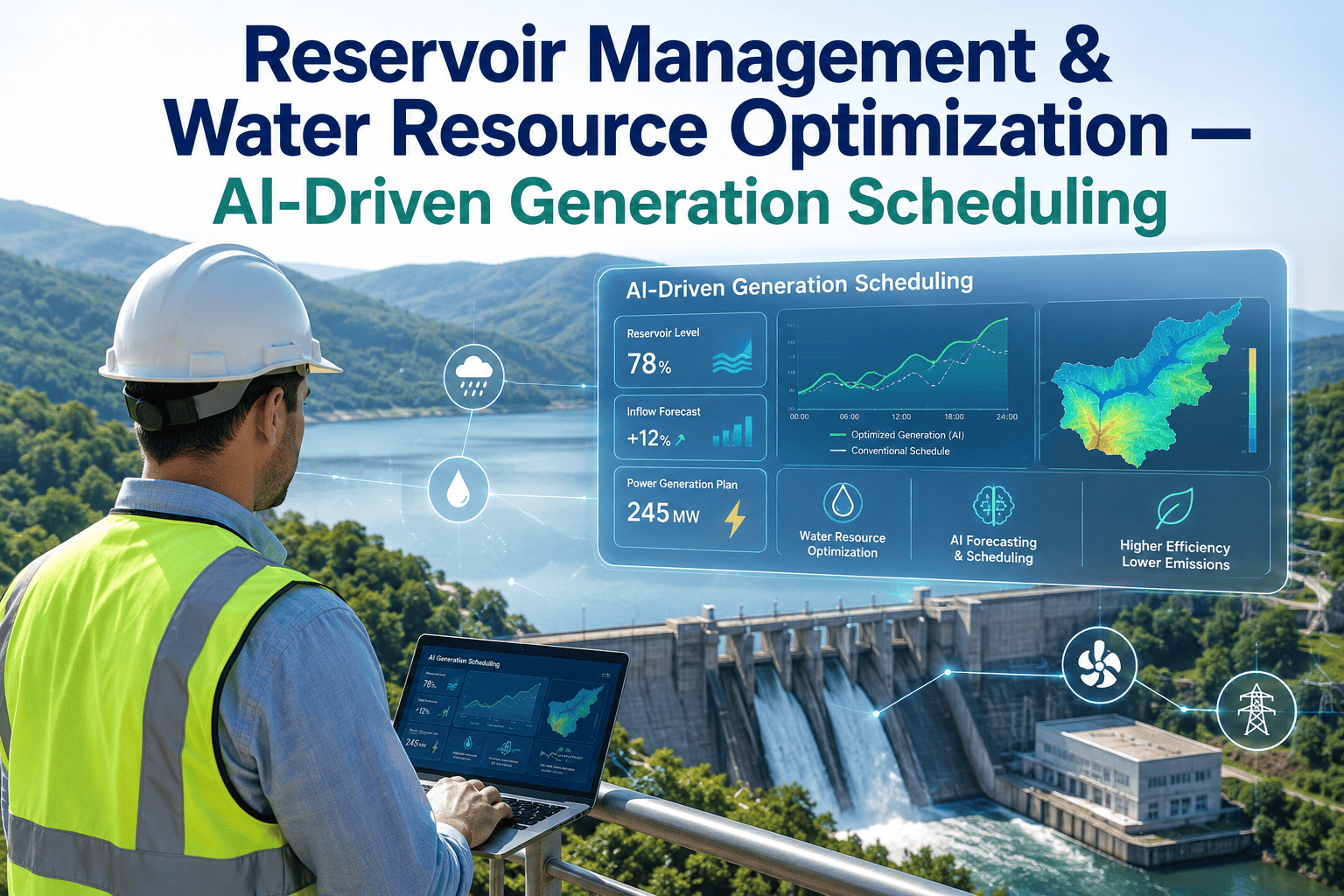
Reservoir Management & Water Resource Optimization
AI-driven inflow forecasting, water level management, and generation scheduling that balances power generation, flood control, irrigation, and environmental flow requirements against a single, constantly changing water budget.
Maximum pool
Normal operating range
Minimum pool
Four Demands, One Water Budget
Balancing Competing Uses Without Overcommitting the Reservoir
Every release decision made for one purpose reduces what is available for the other three, which is what makes reservoir operation fundamentally a balancing exercise rather than a single optimization target. AI scheduling models weigh all four demands together against the current and forecasted water budget instead of prioritizing whichever one happens to be most urgent that day.
Power Generation
Releases timed against peak demand periods and power purchase commitments.
Flood Control
Reserved storage capacity maintained ahead of forecasted high-inflow events.
Irrigation Supply
Downstream releases scheduled around agricultural demand windows.
Environmental Flow
Minimum downstream flow maintained to support river ecosystem health.
Curious how your current release schedule compares against an optimized allocation across all four demands?
Forecast to Schedule
How Inflow Forecasting Drives Generation Scheduling
01
Basin-Wide Inflow Forecasting
Snowpack, precipitation, and upstream gauge data feed a rolling forecast of expected inflow over the coming days and weeks, updated continuously rather than estimated once at the start of a season.
02
Water Budget Projection
Forecasted inflow is combined with current storage to project how much water is available for release across the planning horizon without breaching minimum or maximum pool constraints.
03
Multi-Objective Scheduling
The model proposes a release schedule that meets flood control and environmental flow minimums first, then allocates remaining flexibility toward generation timing and irrigation demand.
04
Continuous Re-Forecasting
As new inflow data arrives, the schedule is re-evaluated so operators are working from a current picture rather than a plan built on a forecast that is already days old.
Seasonal Operating Modes
How Priorities Shift Across the Year
| Operating Mode | Primary Constraint | Scheduling Focus |
|---|---|---|
| Flood season | Reserved flood storage capacity | Proactive releases ahead of forecasted high inflow |
| Irrigation season | Downstream agricultural demand | Release timing aligned with irrigation withdrawal schedules |
| Dry season | Minimum pool and environmental flow | Conservative releases to protect storage through low inflow |
| Peak demand periods | Power purchase agreement targets | Generation timed to high-value demand windows within other constraints |
Why Operations Directors Care
Every Constraint Satisfied, Nothing Left on the Table
Operating from static rules tends to build in conservative margins on every objective at once, which protects against risk but also leaves generation revenue and irrigation flexibility unused in years when conditions are better than the rule assumed. A live forecast-driven schedule can safely narrow those margins because it is working from current data rather than a worst-case assumption baked in months earlier, recovering value without increasing risk to flood control or environmental flow commitments.
MWh
Additional generation captured by scheduling around peak demand windows
Risk
Lower flood risk through proactive, forecast-driven storage management
Compliance
Consistent delivery on environmental flow and irrigation commitments
Common Questions
Reservoir Optimization, Explained Simply
Does the AI model make release decisions automatically without operator approval?
The model produces a recommended release schedule based on current forecasts and constraints, but operators retain full authority over what is actually implemented, since regulatory and license requirements typically require human sign-off on reservoir operations. The value is in giving operators a data-backed starting point instead of building the schedule from scratch each planning cycle. Most teams review recommendations against their own judgment before any release changes are made, and a short reservoir scheduling walkthrough shows how that review step fits into a typical week.
How accurate is inflow forecasting compared to traditional snowpack and precipitation estimates?
Traditional seasonal estimates are typically updated on a monthly or seasonal cadence, while a continuously updated forecast incorporates new precipitation, snowpack, and upstream gauge readings as they arrive, narrowing the forecast window as an event approaches. This does not eliminate forecast uncertainty, but it does reduce how long a schedule operates on stale information. Accuracy improves further once the model has a season or two of basin-specific data to learn from.
Can this account for water rights agreements and license conditions specific to our reservoir?
Yes, minimum flow requirements, irrigation delivery obligations, and other license-specific constraints are built into the model as hard limits that the scheduling recommendation cannot violate, rather than treated as soft preferences. This is typically configured during setup using the reservoir's existing operating license and any water rights agreements already in place. Any change to those underlying agreements simply requires updating the corresponding constraint in the model.
What happens during an extreme inflow event that exceeds forecast expectations?
The continuous re-forecasting approach means the model updates its projections as soon as new inflow data comes in, rather than waiting for the next scheduled forecast cycle, which shortens the time between an unexpected event and a revised release recommendation. Flood control constraints are treated as a priority ahead of generation and irrigation targets specifically to handle these situations. Operators are still the ones executing emergency response procedures, with the model providing updated data to support that decision.
How long does it take to get a working forecast model for a specific reservoir?
Initial setup typically uses the reservoir's historical inflow, release, and storage records to establish a baseline model, which can often be running within a few weeks depending on data availability. Forecast accuracy then improves progressively as live data accumulates and the model learns the basin's specific seasonal patterns. Support is available throughout that ramp-up period to review how the forecasts compare against actual conditions.
See how forecast-driven scheduling would perform against your reservoir's own constraints. Book a walkthrough with our team.




.png)