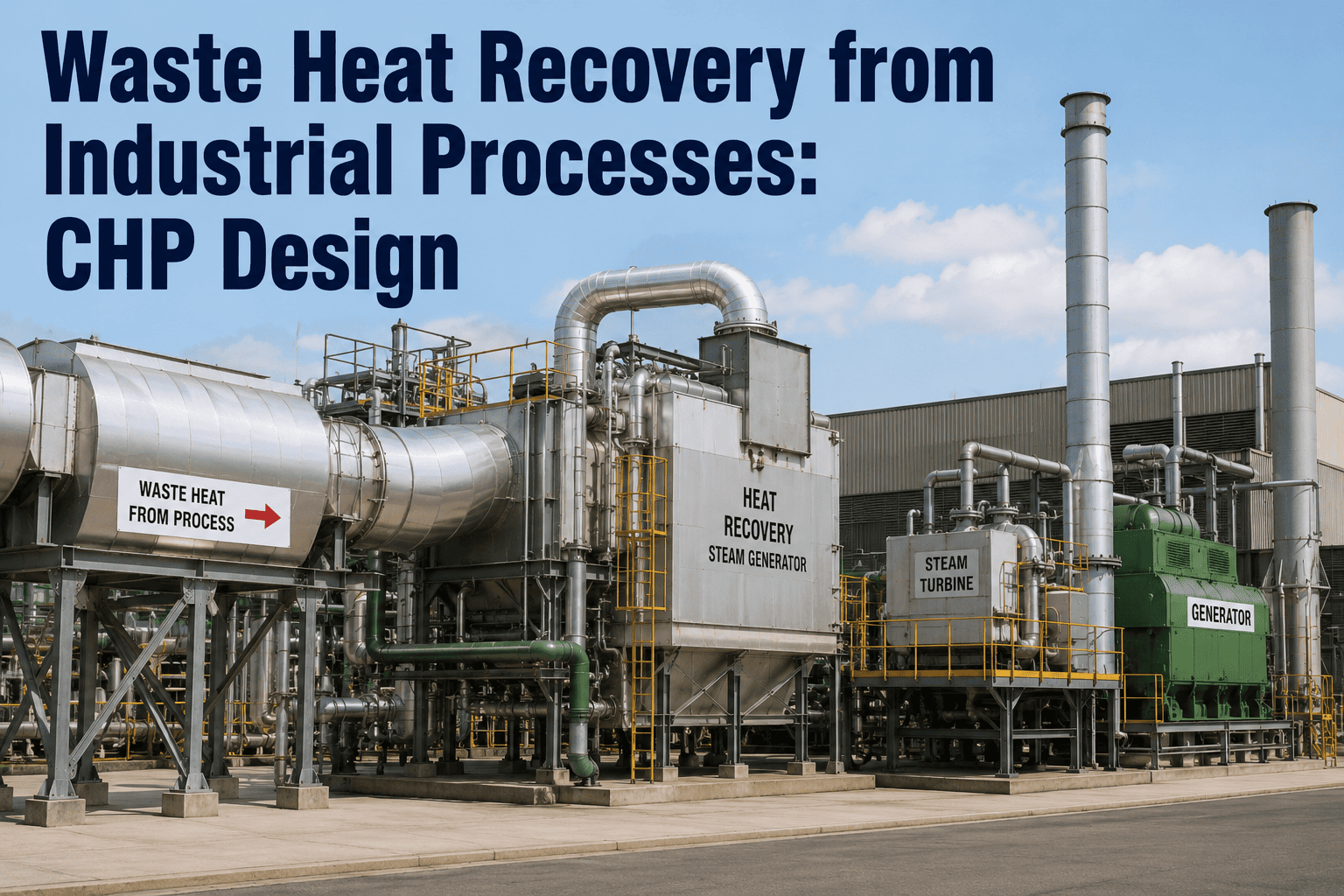
Most industrial processes reject more usable heat than they consume as fuel — a kiln exhaust, a furnace flue, or a compressor discharge stream running well above ambient temperature and going straight to atmosphere. That rejected heat is not waste in the thermodynamic sense; it is a fuel-equivalent energy source sitting unused because the plant was never designed to capture it. Building a CHP system around that waste heat, rather than around a dedicated fuel-burning prime mover, changes the economics of the whole project. iFactory's Book a Demo covers how a heat source assessment turns into an actual system design.
The Design Question Comes Before the Equipment Selection
The most common mistake in waste heat recovery projects is starting with the equipment — deciding on an ORC skid or a heat recovery steam generator before actually characterizing the heat source it will be paired with. Industrial waste heat streams vary enormously in temperature, flow consistency, and contamination, and low-grade heat below roughly 300°F behaves very differently in a recovery system than high-grade heat above 450°F. A design process that starts by profiling the actual source — not a generic assumption about "waste heat" — avoids the expensive rework that comes from sizing equipment against the wrong operating envelope.
Profiling the Heat Source Before Choosing a Technology
The single biggest driver of achievable conversion efficiency. High-grade sources above 450°F support conventional steam Rankine cycles; low-grade sources as cool as 200°F still have recovery value but generally point toward an ORC.
Batch processes with intermittent waste heat output need a design that tolerates cycling without excessive thermal stress, while continuous streams support a simpler, steadier system sized closer to nameplate capacity.
Particulate, corrosive gases, or fouling agents in the exhaust stream determine whether direct heat exchange is viable or whether an intermediate heat transfer loop is needed to protect the recovery equipment.
Cooling water or ambient air availability on-site constrains cycle efficiency just as much as source temperature does, and is frequently underweighted in early-stage feasibility studies.
Comparing the Three Main Recovery Technologies
Best for High-Grade, Continuous Sources
A mature, well-understood technology best suited to consistent high-temperature sources such as kiln exhaust or furnace flue gas above roughly 450°F. Steam turbines have over a century of operating history and the widest base of qualified maintenance expertise, which keeps lifecycle costs predictable.
Best for Low- to Medium-Grade Heat
Uses a working fluid with a lower boiling point than water, enabling economical power generation from sources as low as 200°F where a conventional steam cycle would be impractical. ORC systems are increasingly the default choice for the low-temperature streams that make up the majority of industrial waste heat, since more than 85% of industrial waste heat is estimated to fall below 300°F.
Best for Medium-Grade Heat With Variable Load
Uses an ammonia-water working fluid mixture that changes composition during the cycle, giving it a thermodynamic edge over ORC for medium-grade heat sources, particularly where the heat source temperature or flow varies. The added complexity of the working fluid mixture generally means higher capital cost, which limits its use to projects where the efficiency gain justifies it.
From Heat Source to Commissioned System
Heat Source Audit
Temperature, flow rate, and duty-cycle data are logged across representative operating conditions — including seasonal or campaign-driven variation — to build an accurate heat availability profile rather than a single design-point estimate.
Technology Selection and Sizing
The audited profile determines whether a steam, ORC, or Kalina cycle is the right fit, and the system is sized against the realistic, not theoretical maximum, heat availability to avoid an oversized unit that never reaches rated output.
Heat Exchanger and Interface Design
Contamination and corrosivity findings from the audit drive the choice between direct and indirect heat exchange, protecting the power generation equipment from the realities of the actual exhaust stream.
Grid and Steam Integration
Electrical output is designed for either grid export or on-site consumption, and any recovered steam or hot water output is matched to an existing plant thermal demand so the "heat" half of CHP has a real destination.
Commissioning and Performance Validation
The commissioned system is validated against the audited heat availability profile, confirming actual recovered output matches the design basis before the project is handed over to plant operations.
Why the Economics Favor Waste-Heat-Sourced CHP
A conventional CHP system burns fuel specifically to generate power and heat, and its economics live or die by fuel price. A waste-heat-sourced system uses an energy stream the plant is already paying for as a byproduct of its core process — the fuel cost for the power generation portion is effectively zero, since the heat would otherwise be rejected regardless of whether it's recovered. This is why waste heat recovery projects often post shorter payback periods than comparable fuel-fired CHP, even though the underlying power generation technology — an ORC skid, a steam turbine — may be functionally similar. The tradeoff is that a waste-heat-sourced system is only as reliable as the process generating the heat: if the kiln or furnace shuts down, the recovery system's output drops with it, which is a design constraint worth planning around rather than a reason to avoid the investment.
Common Waste Heat Sources by Industry
Every industrial sector produces waste heat somewhere in its process, but the temperature and character of that heat varies widely by the equipment generating it. Recognizing which source category a plant is working with is often the fastest way to narrow down the shortlist of viable recovery technologies before a full audit begins.
| Industry | Typical Waste Heat Source | Approximate Temperature Range |
|---|---|---|
| Cement | Kiln exhaust, clinker cooler vent air | 300–750°F |
| Steel and Metals | Reheat furnace flue gas, EAF off-gas | 400–1,200°F |
| Glass | Melting furnace regenerator exhaust | 500–900°F |
| Chemical and Petrochemical | Reactor cooling streams, compressor discharge | 150–400°F |
| Refining | Fired heater stack gas, process condensate | 200–600°F |
| Food and Beverage | Boiler blowdown, dryer exhaust | 150–350°F |
Payback Drivers Worth Modeling Explicitly
Because the fuel input to a waste-heat-sourced system is effectively free, payback period is driven almost entirely by capital cost, achievable conversion efficiency, and the value of the energy displaced — not by ongoing fuel price risk the way a conventional CHP project would be. Displaced electricity value matters more than the wholesale power price in most cases, since on-site consumption offsets a plant's retail rate rather than earning a lower export rate. Financing structures that share the capital cost with a recovered-energy offtake agreement can also shorten the effective payback for the host plant, which is worth exploring during the same feasibility phase as the technical sizing work rather than as a separate, later conversation.
Maintenance and Operating Considerations
A waste-heat-sourced recovery system inherits an operating rhythm from the process it's attached to, which changes how it should be maintained compared to a standalone fuel-fired unit. Because output tracks the host process's schedule, planned maintenance on the recovery equipment can often be aligned with existing process shutdowns rather than requiring its own separate outage window — a meaningful advantage for plants trying to minimize total downtime days per year. Working-fluid systems like ORC and Kalina units require periodic fluid quality checks and leak monitoring specific to their working fluid, while steam-based systems fall under the more familiar boiler and turbine maintenance practices most power and process engineering teams already run. Heat exchangers exposed to contaminated exhaust streams typically need the most frequent attention, since fouling on the hot side directly erodes recovery efficiency well before it becomes an operational failure.
Permitting and Interconnection Basics
Adding power generation capacity, even from a waste heat source, typically triggers a review by the local utility if the system will ever export to the grid or operate in parallel with utility service, so interconnection requirements deserve an early conversation rather than a late-stage surprise. For projects consuming all recovered power on-site with no grid export, the permitting burden is generally lighter and centers more on standard equipment and emissions permitting than on utility interconnection studies. Air permitting is usually a non-issue for the recovery system itself, since it doesn't introduce a new combustion source — the heat is already being generated by the host process regardless of whether it's recovered — but any changes to the host process's exhaust path to route heat to the recovery system should be checked against the facility's existing air permit conditions.
Frequently Asked Questions
What temperature range makes a waste heat source worth recovering?
There is no strict cutoff, but practical recovery generally starts becoming economical above roughly 150–200°F for an ORC system, with efficiency and the range of viable technologies both increasing as source temperature rises above 450°F into steam Rankine territory. Below that lower threshold, the achievable conversion efficiency is low enough that the economics usually only work if the recovered heat can be used directly for a thermal purpose — preheating, drying, or hot water — rather than converted to electricity. A heat source audit conducted through Book a Demo identifies where a specific stream falls on that spectrum.
How does an ORC system differ from a conventional steam turbine in practice?
An ORC uses an organic working fluid with a much lower boiling point than water, which lets it extract useful power from heat sources too cool to economically boil water into steam. Mechanically, ORC systems are typically delivered as a compact, packaged skid with lower operating pressures than a steam system, which generally means simpler operation and a smaller footprint, though at somewhat lower peak thermal efficiency than a well-matched steam cycle running on a high-grade source. The right choice depends entirely on where the specific heat source falls on the temperature and flow profile developed during the audit.
Can waste heat recovery equipment handle a process that shuts down periodically?
Yes, but the design needs to account for cycling from the start rather than treating intermittent operation as an afterthought. Systems sized and designed around a continuous, steady heat source can suffer accelerated thermal fatigue if the underlying process cycles frequently, so batch or campaign-driven operations typically call for a design with faster startup and shutdown tolerance and components rated for more frequent thermal cycling. This is one of the key reasons the flow-consistency profile gathered during the heat source audit matters as much as the peak temperature reading.
What happens to the recovered steam or hot water if there's no on-site use for it?
If a plant doesn't have an existing thermal demand — space heating, process preheat, an absorption chiller — that can absorb recovered steam or hot water, the project effectively becomes a power-only waste heat recovery system rather than a true combined heat and power installation. That's not necessarily a problem: a power-only ORC or steam system can still capture strong economics from a good heat source, but identifying a thermal offtake early in the design process is what unlocks the additional value that makes CHP economics more attractive than power-only recovery alone.
How is the recovered power typically used — on-site consumption or grid export?
Most industrial waste heat recovery installations are designed for on-site consumption first, offsetting purchased electricity at the plant's retail rate, which is generally worth more than the wholesale rate available for grid export. Grid export or feed-in arrangements become relevant mainly when the recovered power output exceeds what the plant can use, or when local utility programs offer favorable terms for exporting excess generation. iFactory Support can walk through the interconnection considerations specific to a given site and utility territory.