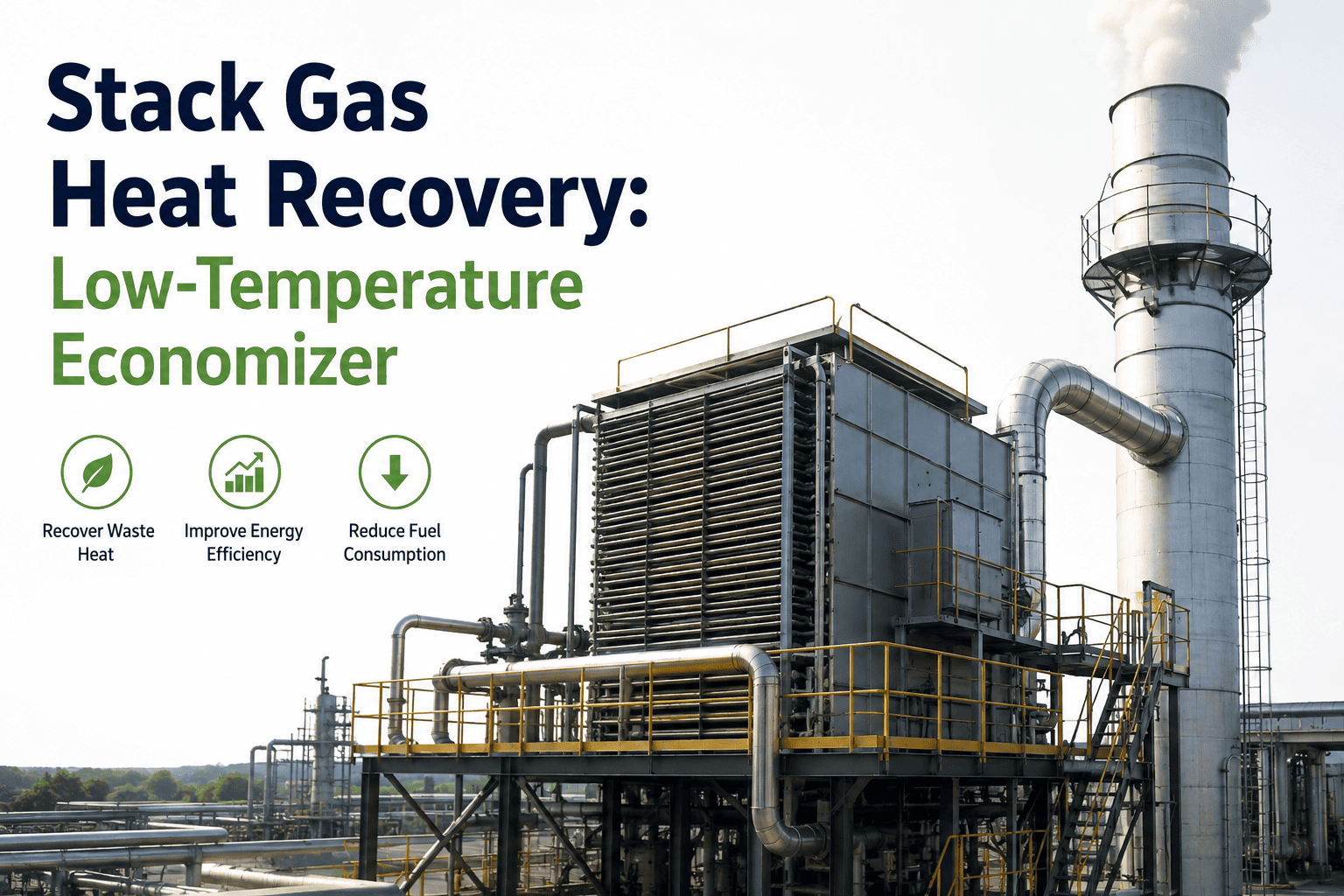
A boiler running at 82% combustion efficiency still sends roughly one-fifth of the fuel's energy straight up the stack as hot gas, and most of that gas leaves far above the temperature it actually needs to. Pushing a conventional economizer's outlet temperature down by even 40-50°F recovers real, measurable fuel savings — but push it too far and you cross into acid dew point territory, where flue gas moisture and sulfur trioxide condense into sulfuric acid on the first cold metal surface they touch. iFactory's thermal efficiency platform tracks that dew point in real time against live fuel and excess air data, so low-temperature and condensing economizers can be pushed to their real recovery limit without corroding out in eighteen months.
The Cheapest BTUs in Your Plant Are Leaving Through the Stack
Every degree of stack temperature you don't recover is fuel you already paid for. Low-temperature and condensing economizers can pull another 3-8% out of the same gas stream — the limiting factor isn't the technology, it's knowing exactly where the acid dew point sits at any given moment.
Where the Money Goes Up the Stack
A standard economizer, sized conservatively to stay well clear of any corrosion risk, typically leaves the stack somewhere between 300°F and 350°F on natural gas and considerably higher on residual fuel oil. Every 40°F of additional heat pulled out of that stream before it exits translates to roughly a 1-2.5% improvement in overall boiler efficiency, and on a large industrial boiler running continuously, that difference compounds into a fuel bill line item worth chasing hard. The gas still carries usable sensible heat well below that conservative cutoff, and if the fuel is clean enough, it carries a second, larger pool of latent heat locked in water vapor that a condensing surface can recover on top of it.
Two Different Pools of Heat Are Leaving With That Gas
Sensible heat is the easy part — it is simply the temperature drop of the flue gas itself, recovered by a conventional finned-tube economizer that preheats boiler feedwater or combustion air. Latent heat is a different animal entirely: flue gas carries a substantial amount of water vapor, produced both from hydrogen in the fuel and from combustion air humidity, and that vapor holds roughly 970 BTU per pound locked up as heat of vaporization that a sensible-only economizer never touches. A condensing economizer, built with corrosion-resistant surfaces and operated below the flue gas's water dew point, forces that vapor to condense and release its latent heat directly into the cooling medium — which is why a well-designed condensing system on clean-burning natural gas can add several additional efficiency points on top of what a conventional unit already recovers.
The Acid Dew Point Line You Cannot Cross Without a Plan
Every fuel containing sulfur produces some sulfur trioxide during combustion, and that SO3 combines with water vapor in the flue gas to form sulfuric acid vapor at a temperature well above where plain water would condense on its own — this is the acid dew point, and it sits meaningfully higher than the water dew point for any fuel with real sulfur content. Drop metal surface temperature below that line and sulfuric acid condenses directly onto the tubes, and even dilute concentrations attack carbon steel fast enough to perforate an economizer within a year or two of continuous operation. Natural gas, with negligible sulfur, largely sidesteps this problem and lets a condensing economizer run all the way down toward the water dew point instead — but any boiler that burns fuel oil, or that switches between gas and oil, needs the acid dew point calculated and tracked, not estimated once at design time and forgotten.
| Fuel Type | Approximate Sulfur Content | Acid Dew Point Range | Water Dew Point Range |
|---|---|---|---|
| Natural gas | Negligible | Not applicable | 100-130°F |
| Low-sulfur #2 fuel oil | 0.05-0.5% | 220-250°F | 110-135°F |
| Standard #2 fuel oil | 0.5-1.0% | 250-270°F | 110-135°F |
| Residual #6 fuel oil | 1.0-3.0%+ | 270-300°F+ | 115-140°F |
Matching Material to the Corrosion Zone
A well-designed low-temperature economizer doesn't use one material end to end — it stages material selection by zone, matching corrosion resistance to how close that section of tube runs to the dew point. The hottest zone, still safely above any condensation risk, can stay on ordinary carbon steel. The transition zone approaching the acid dew point needs upgraded resistance, and the coldest condensing zone — where acid or water is actively forming — needs materials built to sit in that environment indefinitely rather than survive it briefly.
| Zone | Typical Temperature Range | Recommended Material | Failure Mode If Undersized |
|---|---|---|---|
| Hot / dry zone | Above 350°F | Carbon steel, standard fin construction | Rarely fails from corrosion in this zone |
| Transition zone | Within 30-50°F of acid dew point | Corten or low-alloy weathering steel | Localized pitting near intermittent condensation |
| Condensing zone | Below acid dew point | Glass-tube, Teflon-coated, or high-nickel alloy | Tube-wall perforation within 12-24 months on bare steel |
| Condensate collection | Ambient, continuously wet | Stainless steel or PVC-lined collection pan | Pan corrosion and undetected condensate leakage |
A Retrofit That Ran Into the Line and Backed Off Too Far
A process plant running a fuel-oil-fired boiler installed a low-temperature economizer sized to bring stack temperature down toward 220°F, chasing the efficiency gain the vendor's sizing sheet promised on paper. Within the first heating season, spot-checked wall thickness on the coldest tube rows had already dropped measurably below new-tube baseline, and the maintenance team responded the only way a static design allows — raising the control setpoint back up near 280°F to stay safely clear of the acid dew point, giving back most of the efficiency gain the retrofit was built to capture. The core problem wasn't the economizer design; it was that the acid dew point actually shifts with fuel sulfur content and excess air trim, and a fixed setpoint chosen at commissioning can only ever be right for one operating condition. Once dew point tracking was added and the setpoint allowed to float a few degrees above the live-calculated line instead of a static worst case, the unit settled several degrees lower than the original safety margin without repeating the corrosion pattern.
Stop Guessing at Where the Dew Point Actually Sits
iFactory calculates acid and water dew point continuously from live fuel sulfur content, excess air, and moisture data, so your economizer setpoint tracks the real chemistry instead of a worst-case design number.
How Continuous Dew Point Tracking Changes the Calculus
A static design margin has to assume the worst combination of fuel sulfur and excess air the boiler will ever see, and then hold that margin permanently — which means giving up recoverable heat on every single day the boiler isn't actually at that worst case. Continuous monitoring flips that logic: it calculates the real acid and water dew point from what the boiler is actually burning right now, and lets the economizer setpoint float as close to that live number as the safety margin allows, recovering the heat that a fixed design number leaves on the table.
| Approach | Setpoint Basis | Response to Fuel Switching | Typical Recovered Margin |
|---|---|---|---|
| Fixed design margin | Worst-case sulfur and excess air, set once | None — same setpoint regardless of actual fuel | Conservative, leaves heat unrecovered |
| Continuous dew point tracking | Live-calculated from actual combustion chemistry | Setpoint adjusts automatically as fuel sulfur changes | Captures additional degrees safely on cleaner-burning days |
Rolling Out Low-Temperature Recovery in Four Phases
A low-temperature or condensing economizer retrofit works best staged, not installed all at once against an assumed worst case. Baselining actual fuel variability first tells you how much margin you really need before a single tube gets specified.
Mistakes That Undo the Efficiency Gain
Frequently Asked Questions
What's the actual difference between a conventional and a condensing economizer?
A conventional economizer recovers sensible heat only, cooling the flue gas down while staying well above any dew point, typically leaving the stack in the 300-350°F range on most fuels. A condensing economizer is built specifically to operate below the water dew point, using corrosion-resistant materials and built-in condensate collection to also capture the latent heat released when water vapor in the flue gas condenses. That latent heat pool is often larger than people expect — on clean natural gas it can add several additional efficiency points on top of what sensible-heat recovery alone provides. Contact support to assess which approach fits your fuel mix.
Why does the acid dew point matter more than the water dew point on fuel oil?
Sulfur in the fuel combines with water vapor during combustion to form sulfuric acid vapor, and that acid condenses at a temperature meaningfully higher than plain water would on its own — often 100°F or more above the water dew point on higher-sulfur fuel oil. Design a low-temperature economizer against the water dew point alone on a sulfur-bearing fuel and you'll cross the acid dew point long before you reach your intended target temperature, corroding tubes that were never meant to sit in acidic condensate. Natural gas largely avoids this problem because its sulfur content is negligible.
Can a boiler that switches between natural gas and fuel oil still use a condensing economizer?
Yes, but the design and control strategy both need to account for the fuel switch rather than being sized around one fuel. The condensing zone material has to be built for the acid dew point of whichever fuel carries more sulfur, and the setpoint control needs to shift automatically when the boiler switches fuels rather than holding a single fixed number that's only correct for one of the two. Book a demo to see how live dew point tracking handles a dual-fuel switch in practice.
How much efficiency gain is realistic from a low-temperature economizer retrofit?
On clean natural gas with a full condensing design, dropping stack temperature from a conventional 300-350°F range down toward 100-130°F can realistically add several percentage points of overall boiler efficiency beyond what a standard economizer already captures. On sulfur-bearing fuel oil the achievable gain is smaller, since the acid dew point limits how far the outlet temperature can safely drop, but a well-tracked setpoint can still recover a meaningful margin beyond a conservative fixed design number.
What happens to the condensate a condensing economizer produces?
Condensate from a condensing economizer is typically acidic, since it forms from the same combustion byproducts that create the dew point corrosion risk in the first place, and it needs to be collected in a corrosion-resistant pan and routed through a neutralization system before it reaches a drain. Skipping proper condensate handling shifts the corrosion problem from the tube bundle to the collection and drain system instead of eliminating it, and can create a compliance issue depending on local discharge regulations.
Recover the Heat Without Guessing at the Corrosion Line
See how iFactory ties live dew point calculation to your economizer setpoint, feedwater preheat, and tube-wall thickness trending on a single dashboard.