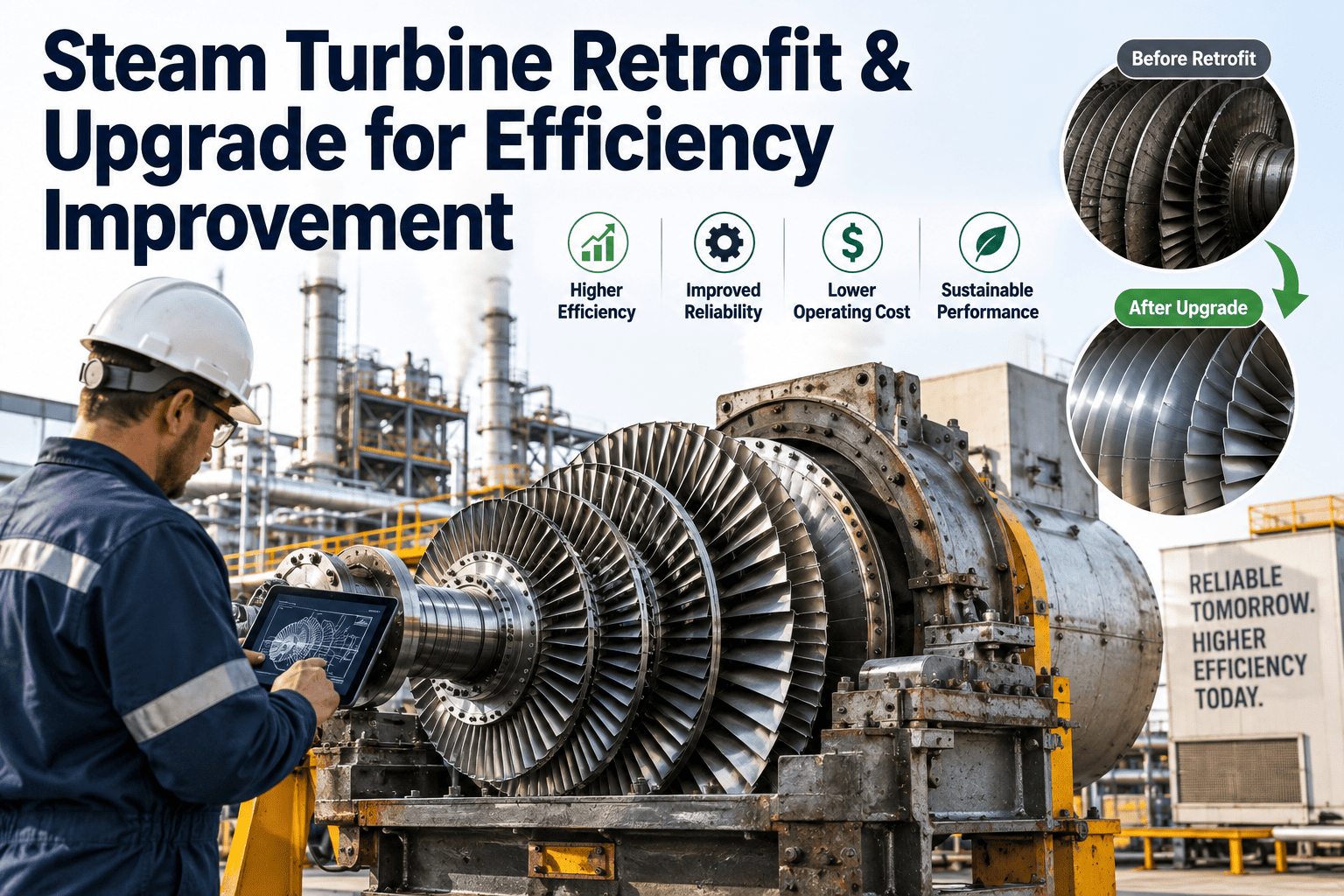
A steam turbine that shipped from the factory at design efficiency rarely stays there for long. Blade profiles erode, seals wear open their clearances, and steam chests and valves that were tuned for the original design conditions gradually throttle more flow than they should, and over the operating life of a unit these losses typically add up to somewhere between 2 and 5 percent of efficiency, depending on operating hours and how well the machine has been maintained along the way. The good news for a plant weighing a full turbine replacement is that modern computational design tools now let engineers retrofit new blading, seals, and valves into an existing casing and recover most or all of that lost performance, often at a fraction of the cost and outage time of a new unit, and in many documented projects the recovered performance ends up matching or exceeding the original nameplate rating. iFactory helps reliability teams build the data case for that decision and then track whether the guaranteed gain actually shows up in operation, and you can book a demo to see how heat rate tracking works before and after a retrofit.
Turn an Aging Steam Turbine Back Into a Near-New-Unit Performer
Modern steam path design, updated sealing systems, and valve modifications can be retrofitted into an existing casing to recover the efficiency a turbine has lost over years of operation, and in many documented projects performance ends up exceeding the original design point.
Where the Lost 2 to 5 Percent Efficiency Actually Accumulates
Efficiency loss on an aging steam turbine is rarely one single problem. It builds up gradually across four distinct areas of the machine, and understanding the split matters because it determines which part of a retrofit scope delivers the fastest payback for your specific unit.
Blade path condition is consistently the largest single contributor because every hour of operation exposes the blades to erosion, deposit buildup, and the small dimensional changes that quietly widen the gap between actual and design aerodynamic performance, which is exactly why modern blading is usually the first scope item engineers evaluate in a retrofit study. Seal leakage tends to be the second largest contributor and often the fastest to fix, since a worn labyrinth or packing seal can be replaced without touching the rotor's aerodynamic path at all, making it a common first phase for plants that want to capture an early efficiency win before committing to a full blading project. Valve and flow path losses grow whenever a unit's actual operating point has drifted from the steam conditions it was originally sized for, a common situation for units that have shifted toward more cycling duty since commissioning. Moisture and low-pressure end losses are usually the smallest of the four, but they matter most on units with a large LP exhaust annulus, where even a modest improvement in moisture removal can meaningfully reduce erosion on the last-stage blades and extend the interval before the next outage-driven inspection.
Four Upgrade Paths, Each With a Different Cost and Gain Profile
A retrofit does not have to mean tearing the whole turbine down to bare metal. Most projects target one or two of the four scope areas below, chosen based on which loss source is dominant on that specific unit and how much outage time the plant can afford, and each area brings a distinctly different combination of cost, schedule impact, and expected performance return.
Steam Path and Blading Upgrade
Highest Typical GainReplacing original blading with computer-designed profiles, integral shroud technology, and improved root attachments reduces friction and secondary flow losses across every stage, and is the single most impactful retrofit available for a unit that has been in service for decades, frequently delivering enough gain on its own to justify the full project cost before any other scope item is even added.
Seal System Upgrade
Fast PaybackModern labyrinth, brush, and leaf seal designs hold tighter clearances while still flexing for thermal expansion during startup, cutting the steam leakage past shaft glands and interstage seals that has quietly grown wider with every thermal cycle over the years, and because the work rarely touches the rotor's aerodynamic profile it can often be completed with a shorter and less disruptive outage than a full blading replacement.
Valve and Steam Chest Modification
Load-MatchingRe-profiling main stop and control valves and optimizing the steam chest flow path reduces throttling losses that occur when valves originally sized for one set of steam conditions are now running under a different, typically lower, operating point.
Rotor and Material Upgrade
Reliability FocusedMonoblock rotor designs and corrosion-resistant materials in the low-pressure section address disc cracking and stress corrosion risk on older units, extending service life while supporting the higher loads that come with a blading and steam path upgrade.
Most successful projects combine two or three of these scope areas rather than pursuing all four at once, since the blading and seal work typically share the same outage window and the incremental engineering cost of adding seal upgrades to a blading project is usually small compared to running them as two separate outages years apart. Valve work and rotor material upgrades are more commonly deferred to a second phase once the initial steam path retrofit has proven out its performance gain in operation.
Why Most Plants Upgrade the Existing Turbine Instead of Replacing It
A full turbine replacement is sometimes the right call, but for the majority of units still within their structural service life, retrofitting the steam path inside the existing casing delivers most of the performance gain at a fraction of the capital and schedule of a new machine. The comparison below summarizes the trade-off across the factors that typically drive the decision, and in practice most plants find that a retrofit clears the investment hurdle well before a full replacement would.
| Decision Factor | Steam Path Retrofit | Full Unit Replacement |
|---|---|---|
| Capital Cost | A fraction of a new unit, scoped to the specific loss sources identified | Full new turbine, foundation, and auxiliary system cost |
| Outage Duration | Typically weeks, often fitting inside an existing scheduled outage window | Extended outage for demolition, installation, and commissioning |
| Typical Efficiency Gain | Recovers lost efficiency and frequently exceeds original design point | Full modern efficiency, but at much higher cost per point gained |
| Payback Period | Commonly two to four years depending on fuel cost and capacity factor | Much longer payback horizon given the higher capital outlay |
| Infrastructure Reuse | Existing casing, foundation, piping, and connections are reused | New foundation and connections typically required |
The infrastructure reuse line matters more than it might first appear. Reusing the existing foundation, condenser connections, and steam and feedwater piping is often what allows a retrofit project to fit inside a normal planned outage window, while a full replacement typically forces a much longer civil and piping scope that extends the outage well beyond a standard turnaround. That schedule difference, more than the raw capital number, is frequently the deciding factor for plants that cannot absorb an extended forced outage during peak demand season.
What Published Retrofit Projects Have Delivered in Practice
These figures come from documented retrofit projects reported across the power generation industry and illustrate the range of outcomes a well-scoped steam path upgrade can realistically deliver, though the exact result for any single unit depends on its specific condition and original design margin.
The range across these figures reflects real differences in starting condition. A unit that has been well maintained on a conservative baseload duty cycle will show a smaller gain than one that has been cycled hard for years with deferred blade and seal maintenance, which is exactly why an accurate current-state baseline matters more than any published industry average when scoping a retrofit for a specific turbine.
How iFactory Supports the Decision Before and After Cutover
A retrofit is only a good investment if the guaranteed efficiency gain actually shows up in daily operating data once the unit is back online, and that requires the same rigor on the measurement side that the OEM applies on the engineering side.
Before Committing Capital
iFactory builds a clean baseline from your existing heat rate, valve position, steam flow, and pressure history, quantifying exactly how much efficiency has been lost and where, so the retrofit scope is built around your unit's real degradation rather than an industry average estimate.
After Cutover
Once the retrofit is complete, continuous heat rate and steam path performance tracking confirms whether the guaranteed gain is actually being realized in operation, and flags the moment any new degradation begins creeping back into blading, seals, or valves.
This before-and-after discipline is the piece that is easiest to skip under outage schedule pressure and the one that pays off most over the following years, since a retrofit that is never independently verified can quietly lose its gain to the same erosion, fouling, and seal wear mechanisms that degraded the original steam path in the first place, without anyone noticing until the next scheduled performance test years later.