Most "digital twin" conversations skip straight to the exciting part, the what-if simulations and AI-driven optimization, without addressing the far less glamorous work that actually makes those simulations trustworthy: model calibration against real operating data. A digital twin that hasn't been calibrated against your specific unit's actual performance curves is just a generic thermodynamic model with an expensive name, and its recommendations will drift from reality the moment your compressor starts fouling differently than the model assumed. See how iFactory builds and continuously recalibrates gas turbine digital twins with a Book a Demo.
A Model Is Only As Useful As Its Distance From Reality
iFactory builds gas turbine digital twins calibrated continuously against live operating data, so optimization recommendations reflect how your specific unit actually performs today, not how a generic model assumed it would perform on day one.
What A Gas Turbine Digital Twin Actually Is, And Isn't
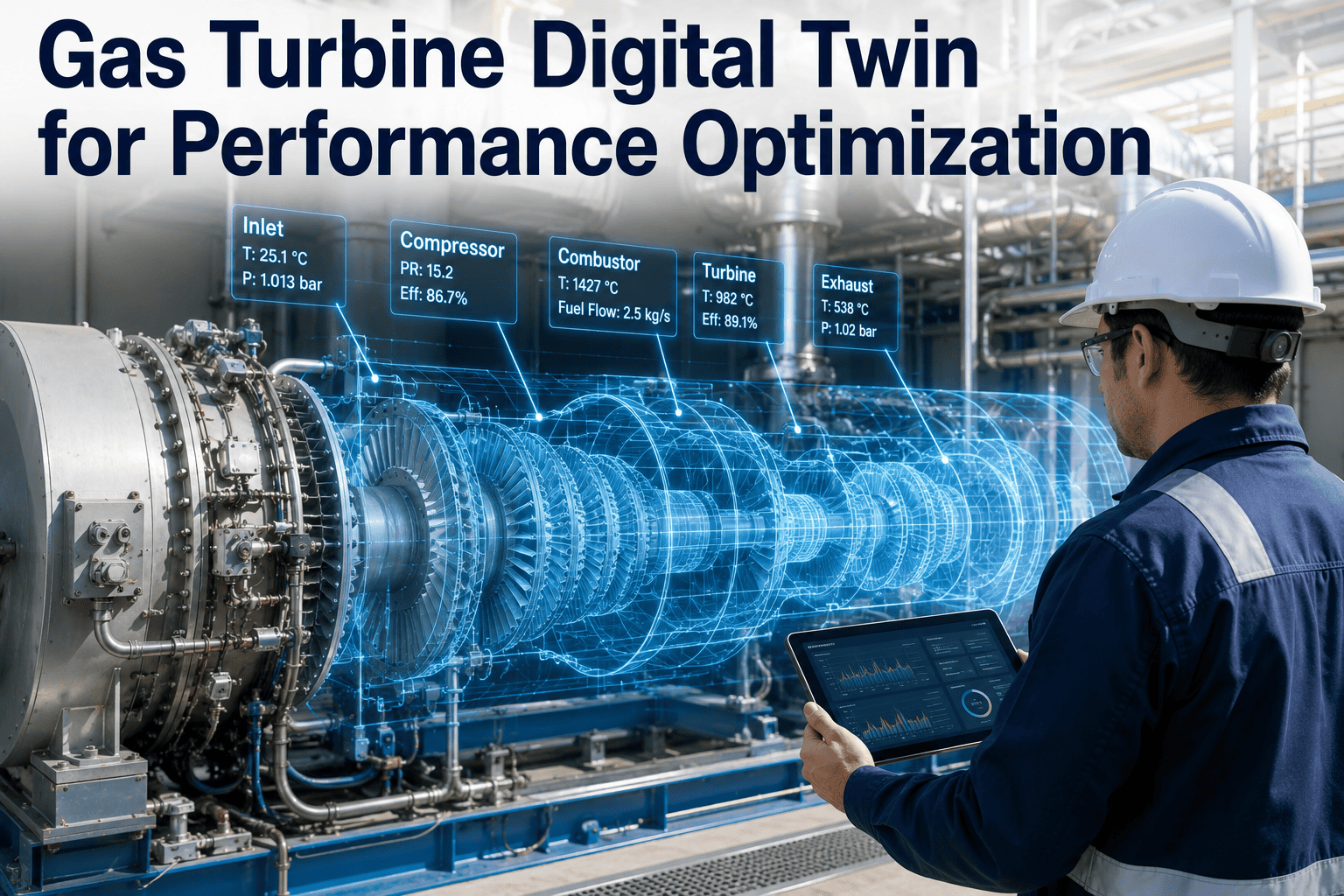
A digital twin is not simply a thermodynamic performance curve loaded into software. It is a live model that ingests real-time operating data, continuously compares predicted performance against actual measured performance, and adjusts its internal parameters to keep predictions accurate as the physical machine ages, fouls, and degrades. A static model calibrated once at commissioning and never touched again is closer to a performance reference table than a true digital twin, and the difference matters enormously once the unit is a few years into its operating life.
It Is A Living Model
Parameters update continuously as new operating data arrives, so the twin's predictions track the actual machine rather than a fixed snapshot from commissioning.
It Is Not A Replacement For Sensors
The twin depends entirely on quality sensor data as its input, and it cannot compensate for missing or drifting instrumentation upstream of the model.
It Is A Decision Support Tool
Its purpose is to let engineers test operating changes safely before committing them on the physical unit, not to make control decisions autonomously.
How A Twin Stays Accurate As The Turbine Ages
Calibration is the process that keeps a digital twin honest. Without it, a model built at commissioning will steadily diverge from reality as compressor fouling, hot section wear, and seasonal ambient shifts change how the actual turbine behaves compared to its original baseline.
Establish Baseline
Build the initial model from commissioning test data and OEM performance curves as the starting reference point.
Compare Predicted To Actual
Continuously measure the gap between the model's predicted output and the turbine's actual measured performance under the same conditions.
Adjust Model Parameters
Update internal efficiency and degradation parameters so the model's predictions realign with what the turbine is actually doing today.
Flag Uncalibratable Drift
A gap that can't be closed through normal recalibration signals a genuine mechanical issue rather than expected aging, which is a diagnostic finding on its own.
A Twin That Isn't Recalibrated Is Just A Guess With Better Graphics
iFactory continuously recalibrates your gas turbine digital twin against live operating data, so optimization recommendations stay grounded in how the unit performs today.
Finding The Operating Point That Actually Maximizes Value
Once a twin is calibrated, its most immediate use is identifying the operating point that best balances efficiency, output, and component life under current ambient and market conditions, since the theoretically most efficient setpoint is not always the most valuable one once fuel price, dispatch requirements, and hot section wear rate are all factored in together.
Load Point Selection
The twin evaluates efficiency across the achievable load range under current ambient conditions to identify where heat rate is actually best today, not at design conditions.
Firing Temperature Trade-Off
Higher firing temperature increases output but accelerates hot section wear, and the twin quantifies that trade-off in terms of dollars rather than leaving it as a qualitative judgment call.
Inlet Conditioning Impact
Evaporative cooling and chilling decisions can be tested against the twin before committing, since their value shifts significantly with humidity and ambient temperature.
Compressor Wash Timing
The twin projects the efficiency recovery a wash would deliver at current fouling levels, helping decide whether a wash is worth the output loss during the wash cycle itself.
What-If Scenarios A Twin Can Actually Answer With Confidence
Not every what-if question is equally reliable to answer with a digital twin. Scenarios close to the twin's calibrated operating range produce high-confidence answers, while scenarios far outside historical operating conditions carry more uncertainty and should be treated as directional rather than precise.
| Scenario Type | Example Question | Confidence Level |
|---|---|---|
| Near-Range Load Change | What happens to heat rate at 90% load versus 100% today | High |
| Seasonal Ambient Shift | How will output change as ambient temperature rises next month | High |
| Fouling Progression | What is the efficiency loss if compressor wash is delayed two weeks | Moderate |
| Extreme Ambient Or Fuel Change | How does the unit perform on a fuel blend never previously run | Low to Moderate |
Scenarios closer to previously observed operating conditions inherit the model's calibrated accuracy, while scenarios extrapolating well beyond historical data should always be validated with engineering judgment before being acted on directly.
What A Twin Needs Underneath It To Actually Work
A digital twin is only as good as the data feeding it, and that data has to flow continuously and reliably rather than arriving as periodic manual exports for the twin to remain trustworthy between calibration cycles.
How Often A Twin Should Actually Be Recalibrated
Recalibration frequency should match how quickly the underlying physical condition actually changes, rather than following an arbitrary fixed schedule applied uniformly across every parameter in the model.
Where Digital Twin Projects Lose Credibility
Digital twin initiatives tend to lose engineering trust for a small set of recurring reasons, and most of them are avoidable with the right calibration discipline from the start.
Calibrating Once And Walking Away
A model calibrated only at commissioning drifts further from reality every month the turbine ages, until its recommendations are no longer trustworthy enough to act on.
Treating All Scenario Outputs As Equally Confident
Extrapolating far outside historical operating conditions and presenting the result with the same confidence as a near-range prediction erodes trust the first time it proves wrong.
Feeding The Model Poor Quality Sensor Data
Uncalibrated or drifting instrumentation upstream of the twin corrupts every downstream prediction, regardless of how sophisticated the modeling approach itself is.
Skipping Post-Intervention Recalibration
Failing to recalibrate immediately after a wash or repair means the twin keeps predicting against a baseline that no longer reflects the machine's current condition.
What Plants Typically See After Deploying A Calibrated Twin
Plants that move from a static performance model to a continuously calibrated digital twin tend to see the same categories of improvement, with magnitude depending on unit age and how much operating flexibility exists in dispatch.
Frequently Asked Questions
Q: How is a digital twin different from the performance curves already provided by the OEM?
OEM performance curves represent expected behavior for a new or reference-condition unit under standardized test conditions, while a digital twin is calibrated specifically against your unit's actual, current, aging condition and updates continuously as that condition changes. The OEM curve is a useful starting baseline, but relying on it alone months or years into operation means comparing the real machine against a version of itself that no longer exists. Reach out through Support Contact to discuss how your existing performance data could feed an initial calibration.
Q: How much historical operating data is needed before a twin becomes reliable?
A meaningful initial calibration typically requires operating data spanning enough ambient and load variation to characterize the unit's behavior across its normal operating envelope, which for most units means at least several months covering a range of seasonal conditions. The twin continues improving in accuracy as more data accumulates, particularly around less common operating points, so reliability builds progressively rather than being achieved as a single fixed milestone.
Q: Can a digital twin predict the exact impact of a specific maintenance decision before it's made?
For scenarios close to the unit's calibrated operating history, such as projecting the efficiency recovery from a compressor wash at known fouling levels, the twin can provide a high-confidence quantitative estimate. For less common interventions with limited historical precedent on that specific unit, the twin's output should be treated as a directional estimate to inform the decision rather than a guaranteed outcome, and engineering judgment remains an important part of the final call.
Q: Does building a digital twin require replacing existing SCADA or historian infrastructure?
No. A digital twin is typically built as a layer that consumes data from existing SCADA and historian infrastructure rather than requiring replacement of either system. The twin needs reliable, continuous access to process and ambient data, which most plants already collect, and the primary integration work involves connecting that existing data flow into the modeling and calibration engine rather than standing up entirely new data collection infrastructure.
Q: How do we know when the twin's predictions can no longer be trusted?
A well-built calibration process tracks the ongoing gap between predicted and actual performance as its own metric, and a persistent gap that resists normal recalibration is itself the signal that something has changed on the physical unit beyond what the model's standard parameters can account for. Rather than trust degrading silently, this approach turns declining model accuracy into an explicit, visible flag that prompts investigation. A Book a Demo session can show how this tracking works in practice.
Build A Digital Twin That Stays Accurate As Your Turbine Ages
iFactory combines continuous calibration with operating point optimization and scenario analysis, so your digital twin stays a decision-making tool instead of a stale reference model.