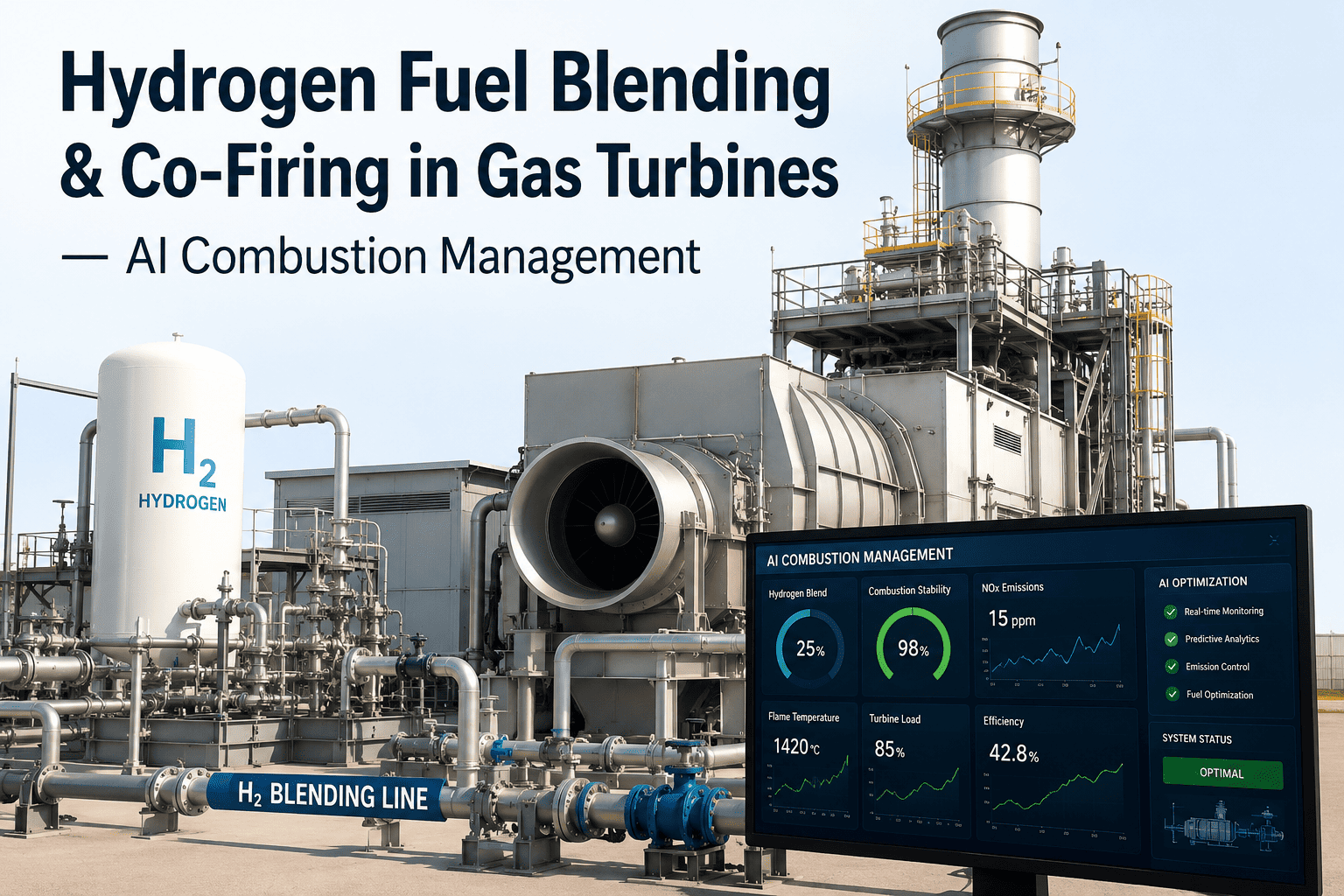
Every percentage point of hydrogen added to a gas turbine's fuel stream changes how the flame behaves. Flame speed climbs, the reaction zone shifts upstream inside the combustor, and nitrogen oxide formation can rise sharply even as the same hydrogen improves how resistant the flame is to blowout at lean, low-load conditions. Process engineers running blending trials at 5%, 10%, or 20% hydrogen by volume are finding that a fuel nozzle setting proven safe on pure natural gas can push combustor dynamics into an unstable regime the moment hydrogen enters the mix. Getting this right takes continuous visibility into flame behavior, not a periodic combustion tuning campaign. Talk to start monitoring your combustor's response to hydrogen blending.
What Changes at Each Blend Ratio, From First Trial to Full Firing
Hydrogen does not behave like a simple fuel substitution. Its effect on flame speed, reactivity, and heat release grows sharply as the blend ratio climbs, and each threshold below tends to expose a different combustor limitation.
Most existing dry low NOx combustors absorb this level with only a small emissions shift. This is where the majority of utilities running blending pilots sit today, and it is the easiest ratio to monitor because baseline combustion behavior barely moves.
Flame speed increases become measurable, flashback risk starts appearing in older nozzle geometries, and NOx trends upward in a way that shows on emissions monitoring within days rather than months of operation.
Standard premix combustors reach their operating limits here. Thermoacoustic instability becomes a real operating risk, and many plants introduce water or steam injection, or move to staged and micromix combustor hardware to hold emissions in check.
This requires purpose-built micromix or diffusion-style combustors with dedicated dilution and cooling strategies. NOx control now depends entirely on mixing quality, since hydrogen's flame temperature and reactivity leave little margin for error.
Natural Gas Alone vs. Hydrogen-Blended Combustion
What AI Combustion Monitoring Tracks During Blending
A blend ratio change is not a one-time tuning event — it is a shift that keeps moving as ambient conditions, load, and fuel supply change. Continuous monitoring is what keeps the combustor inside its safe operating window at every ratio.
Optical and infrared flame sensors track how far upstream the reaction zone moves as hydrogen content increases, flagging early signs of flame attachment to nozzle surfaces.
Continuous emissions data is correlated against real-time blend ratio, not just logged against load, so a NOx creep gets tied to the fuel change that actually caused it.
Dynamic pressure transducers watch for the frequency signatures of thermoacoustic instability, which becomes more likely as hydrogen fraction and firing temperature rise together.
Because hydrogen's small quenching distance lets flames sit closer to metal surfaces, models trained on nozzle-specific baselines catch early flame-holding behavior before it damages hardware.
Gas chromatograph and calorimetry feeds confirm the actual delivered hydrogen fraction, since supply-side blend ratios frequently drift from the number in the operating plan.
Liner and transition-piece temperature data is tied back to blend ratio history, surfacing the thermal fatigue risk building in hardware long before a borescope inspection would catch it.
How iFactory Manages Combustion Through a Blend Ratio Change
Flame scanners, dynamic pressure transducers, gas chromatographs, and existing DCS/SCADA emissions feeds stream data continuously, with no rip-and-replace of your control system.
The platform builds a separate behavioral baseline for each hydrogen fraction your unit runs, since normal vibration and pressure signatures at 5% blend look nothing like normal at 50%.
Deviations are scored by severity and tied to a likely cause — NOx creep, flashback risk, or dynamics instability — so operators know what is happening and why, not just that a threshold was crossed.
Recommended actions — adjust blend ratio, schedule a nozzle inspection, or trigger a combustor tuning pass — are generated automatically and routed to the right technician.
Watch How iFactory Flags Flashback Risk Before It Damages a Nozzle
In a 30-minute session, we walk through the full monitoring loop using actual combustor dynamics data from a blending trial — anomaly scoring, blend-specific baselines, and the alerts that gave one operator two weeks of lead time on a nozzle issue.
Hydrogen Blend Ratio vs. Combustion Behavior
These effects are drawn from combustion research on hydrogen–methane blending and reflect general trends across swirl-stabilized and premix combustor designs, not any single turbine model.
| Hydrogen Blend | NOx Trend | Lean Blowout Stability | Flashback Risk | Typical Hardware Response |
|---|---|---|---|---|
| 0–10% | Minimal increase | Slightly improved | Low | Usually no modification needed |
| 10–20% | Noticeable rise | Improved | Low to moderate | Nozzle inspection, tuning pass |
| 20–40% | Significant rise without tuning | Meaningfully improved | Moderate | DLN recalibration, dilution air changes |
| 40–65% | High, mixing-quality dependent | Strongly improved | Moderate to high | Staged or micromix combustor upgrade |
| 65–100% | Controlled only with advanced mixing | Strong at lean conditions | High | Purpose-built hydrogen combustor |
Five Failure Modes That Show Up First When Blending Goes Unwatched
Emissions can drift upward gradually as blend ratio changes, and without continuous correlation to fuel composition, a plant can breach its permit before anyone notices the trend.
Hydrogen's fast flame speed and short quenching distance let the flame travel back into the nozzle under the wrong conditions, causing burn damage that is expensive and slow to repair.
Pressure oscillations can build resonance inside the combustor as hydrogen fraction rises, and left unchecked, this can force an automatic trip at the worst possible moment.
Local hot spots from uneven mixing accelerate creep and cracking in liners and transition pieces, shortening component life well ahead of the scheduled overhaul.
Every risk above compounds into the same outcome: an emergency shutdown to inspect or replace hot-section hardware that a monitored blending program would have caught weeks earlier.
Frequently Asked Questions
Most units running standard dry low NOx combustors can accept blends in the 5–20% by volume range with limited hardware changes, though the exact ceiling depends heavily on your specific nozzle design and firing temperature. Beyond that range, NOx and flashback risk typically rise faster than emissions permits or nozzle metallurgy can absorb without a tuning pass or hardware upgrade. Talk to support to baseline your unit's current blend tolerance.
Hydrogen does not produce carbon emissions, but its faster flame speed and higher adiabatic flame temperature increase thermal NOx formation through the same thermal mechanism that drives NOx in any high-temperature flame. The cleaner-burning story only holds when combustion is retuned — leaner mixtures, adjusted air staging, or micromix designs — to offset that higher flame temperature.
Flashback happens when the flame front travels upstream into the premix zone or nozzle instead of staying anchored in the combustion chamber. Hydrogen's high flame speed and small quenching distance make this far more likely than with natural gas, especially during load transients or turndown. Book a demo to see how flashback detection works on live combustor data.
In almost every case, yes. Standard premix combustors are not designed for hydrogen's reactivity at high blend ratios, and reaching 100% typically requires purpose-built micromix or diffusion-style hardware with dedicated cooling and dilution strategies. Most fleets treat this as a multi-year roadmap, stepping up blend ratio incrementally rather than jumping straight to full hydrogen firing.
Rather than relying on a single combustion tuning event that assumes a fixed fuel composition, AI monitoring builds a distinct operating baseline for each blend ratio and continuously compares live sensor data against it. That means a shift toward flashback conditions, rising NOx, or dynamics instability gets flagged in near real time, well before it becomes a hardware failure or a permit violation. Talk to connect your combustor's sensors today.
iFactory AI Combustion Management for Hydrogen Blending and Co-Firing
iFactory connects to your existing DCS and SCADA infrastructure to give process engineers continuous visibility into flame stability, NOx formation, and combustor dynamics at every hydrogen blend ratio — from a 5% pilot to a full hydrogen firing roadmap. No rip-and-replace, no guesswork between tuning campaigns.