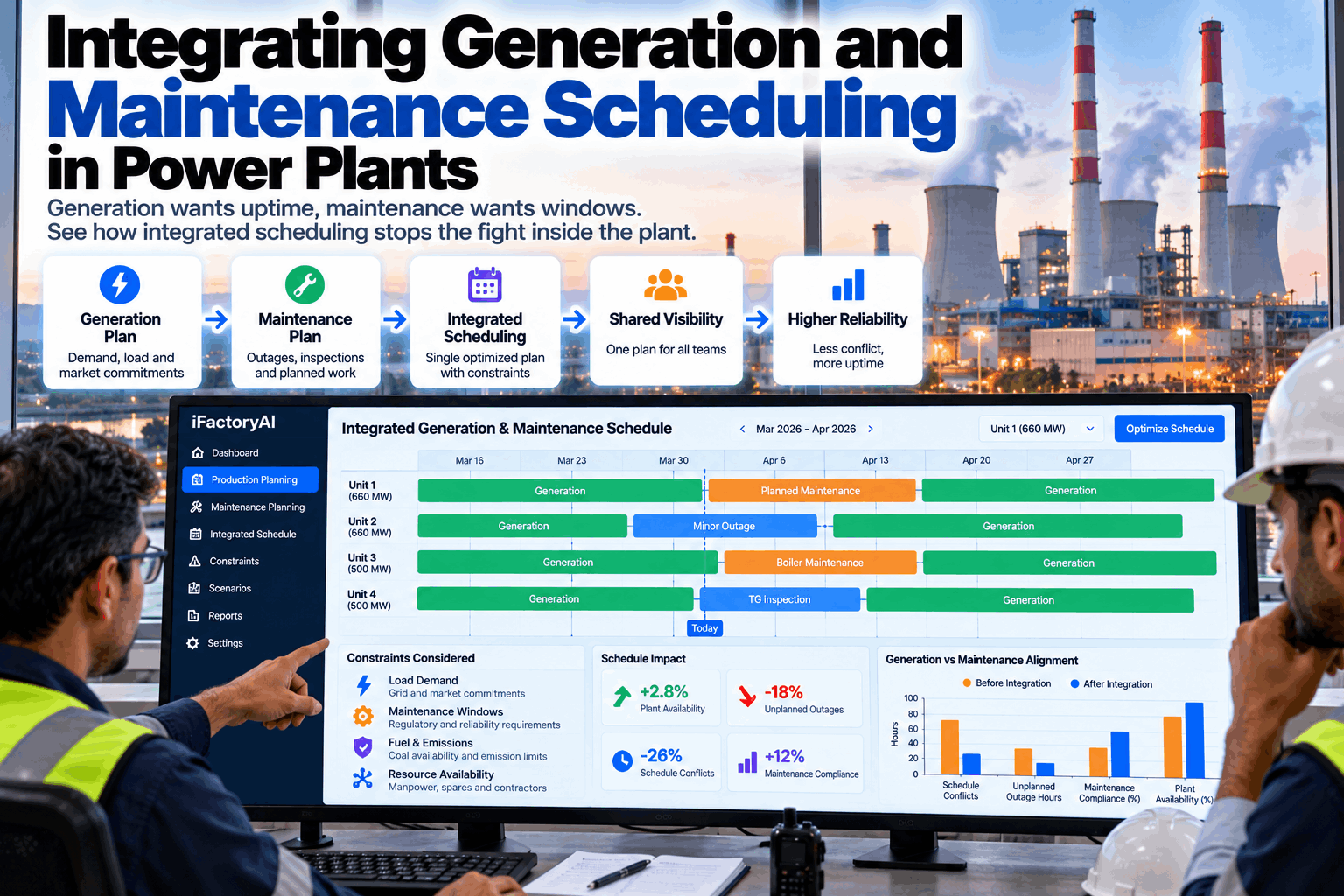
Generation wants every megawatt available when prices peak. Maintenance wants the unit off to fix the mill that has been vibrating for a week. Both are right, and without one shared plan they argue every Monday. This guide shows how integrated generation and maintenance scheduling turns that argument into a single plan both teams can trust. Start with a planning review.
Integrating Generation and Maintenance Scheduling in Power Plants
Put dispatch forecasts, prices, equipment risk and maintenance work in one plan. Jobs land in low-value windows, risky equipment is fixed before it forces an outage and both teams see the same trade-offs.
- Why generation and maintenance plans collide
- How outage types decide what can wait
- How one plan places work in the right window
Why Generation and Maintenance Collide
Each team plans from its own screen, so each sees half the picture.
Operations plans around dispatch, prices and grid commitments. Maintenance plans around work orders, parts, permits and crews. Each team builds a sensible plan from its own data, and the two plans meet only in the weekly meeting, usually as two spreadsheets on one screen. By then, with little time left, the choice is often between delaying a repair that keeps getting riskier or taking the unit off when it is worth the most. Our planning specialists can map where your two plans split.
What generation sees
- Dispatch forecast and prices
- Grid and contract commitments
- Unit availability targets
- Weather and demand peaks
What maintenance sees
- Open work orders and backlog
- Equipment condition alerts
- Parts, permits and crews
- Inspection and compliance dates
When operations can see how fast a fault is getting worse, and maintenance can see what an outage costs on a given day, most disagreements settle quickly. Integration starts with sharing those two numbers. Once both teams trust them, the weekly meeting moves from arguing to choosing between clear options.
Outage Types Decide What Can Wait
Every deferral moves work up or down the urgency ladder.
The NERC Generating Availability Data System sorts outages by how long they can wait. Planned outages are scheduled well in advance. Maintenance outages can be pushed past the next weekend but not to the next planned outage. Forced outages range from immediate to postponed until the end of the next weekend. Good joint scheduling moves work down this ladder, catching it as maintenance before it becomes forced. Check your outage mix in an outage review.
Scheduled well in advance, such as an annual overhaul, with a set duration.
Can be deferred past the next weekend, but must happen before the next planned outage.
Can wait beyond six hours, but the unit must come off before the end of the next weekend.
The unit must come off within six hours.
The unit must come off now or very soon.
Most forced outages start as a known issue that was deferred too long or never seen. Tracking how many forced outages had an open work order or alert beforehand shows how much a joint plan could have caught. That number is often the strongest argument for starting.
Plan Across Four Horizons
Each horizon answers a different question with different people.
Integrated scheduling is not one meeting. It is a set of linked plans, from the annual overhaul down to the next shift. Each level hands its decisions to the next, so the daily plan already knows which work is waiting for a window. Operations and maintenance should both sit at every level, not only at the weekly meeting. Questions on structure go to our support desk.
Planned outages
Overhaul dates agreed with the grid operator, major parts ordered, contractors booked.
Maintenance windows
Low-demand periods matched to the maintenance outage backlog and inspections due.
Joint plan
Jobs placed in online, derate or offline windows using forecast prices and risk.
Opportunity list
Ready jobs prepared for an unplanned stop or a dispatch-off period.
Many grid operators and power pools need notice before a unit is taken out or derated, and planned outages may only move with their approval. Build those notice periods into each horizon, so a job is never placed in a window the plant cannot actually claim.
How Joint Scheduling Works
Match each job to the cheapest safe window.
A joint scheduler looks at every open job and asks three questions: what does the unit need to be doing for this work, how fast is the risk growing and what does each possible window cost. Many jobs can be done online or during a partial derate, without taking the unit off at all, which is often the biggest win. Plan the rules in a scheduling workshop.
A perfect window is wasted if the parts are not on site or the permit is not prepared. Track readiness on every job, so the plan only offers windows to work that can actually start. Jobs that are not ready still show on the plan, with what is missing and who owns it.
What One Shared Plan Is Worth
Moving work from high-value hours to low-value ones, and catching faults before they force an outage, often pays for integration within the first season.
Opportunity Maintenance: Be Ready for the Stop
An unplanned stop is a chance, if the work is ready.
When a unit trips or is dispatched off unexpectedly, hours of offline time suddenly appear. Plants that keep a ready list of offline jobs, with parts and permits prepared, can use that time well. Plants that do not usually return the unit without touching the backlog, and the same jobs then need another outage later. Build your list in an opportunity list session.
An opportunity list is only useful if it is ready when the stop happens. Review it in the weekly joint meeting: confirm parts, permits and crews for each job, and remove anything that is no longer ready. Sort the list by duration, so the shift team can pick what fits the expected stop at a glance.
Integrated Scheduling Mistakes to Avoid
Integration fails when one team still owns the plan alone.
The aim is one plan that both teams build, own and trust every week. When the tool is owned by one side, or when risk and cost are guessed instead of measured, the old argument comes back. A short rollout plan session helps set shared rules.
What works
- One plan both teams can see and change
- Risk and window cost shown as numbers
- Readiness tracked on every job
- Agreed rules for who decides in a tie
What fails
- Two plans reconciled once a week
- Deferring condition alerts without a limit
- Scheduling work that is not ready
- No list prepared for unplanned stops
Some trade-offs will still be close. Decide beforehand who has the final say in each case, such as operations below a risk threshold and maintenance above it, so a close call does not become a long argument. Write the rule down, review it each quarter and change it only when both teams agree.
How iFactory Joins Generation and Maintenance
Dispatch, risk and work orders in one on-prem plan.
iFactory connects your DCS, historian, condition monitoring and maintenance system through an on-prem AI server inside your network. It estimates how fast each fault is getting worse, prices each possible window from your dispatch forecast and places ready jobs where they cost least. Both teams see the same plan, with the reason behind every placement. Fit questions go to our solutions team.
Joint plan
Dispatch and maintenance on one calendar both teams can work in.
Risk growth
Condition data turned into how long each fault can safely wait.
Window pricing
Each possible outage or derate window priced from your forecast.
Readiness tracking
Parts, permits and crews checked before a job is offered a window.
Opportunity list
Ready offline jobs ranked for the next unplanned stop.
Maintenance system links
Work orders read from and written back to your existing maintenance system.
Results depend on your forecast quality, condition data and how consistently the joint plan is used. We measure moved jobs, margin protected and forced outage trends on your own data during the pilot, rather than promising a general figure.
Turnkey AI: Delivered, Connected and Live in 6–12 Weeks
You do not build this. It arrives ready.
iFactory ships as a pre-configured NVIDIA AI server with the software pre-loaded, racked and ready. Rack it, plug in power and Ethernet, and the AI is live on your network. Our team handles cabling, network setup, DCS, SCADA, PLC, historian and maintenance system integration, planner training and 24×7 remote monitoring. Plant data stays on your network. For a scope matched to your units, request a turnkey quote.
Ship, network and data
Server installed. DCS, historian, condition data and work orders connected.
Model training and pilot
Risk and window cost models trained on your history. Pilot joint plan on one unit.
Go-live and training
Joint plan live across units. Operations and maintenance planners trained. 24×7 monitoring begins.
Frequently Asked Questions
What is integrated generation and maintenance scheduling?
It is one plan that combines dispatch forecasts, prices and grid commitments with maintenance work, equipment risk and job readiness, so both teams agree on when each job happens and what it costs.
What is the difference between a maintenance outage and a forced outage?
Under NERC GADS, a maintenance outage can be deferred past the next weekend but must happen before the next planned outage. A forced outage cannot wait that long: it ranges from immediate removal to removal before the end of the next weekend.
Can maintenance be done without taking the unit off?
Often, yes. Work on redundant equipment can run online, and some jobs only need a partial derate. A joint plan sorts each job by the unit state it needs before looking for a window.
How does the plan decide when a job can wait?
It uses condition data to estimate how fast a fault is getting worse and compares that with the cost of each window. A job waits only while its risk stays inside an agreed limit.
What is opportunity maintenance?
It is work done during an unplanned stop or dispatch-off period. Keeping a ready list of offline jobs, with parts and permits prepared, turns lost hours into backlog reduction.
Does this replace our maintenance system?
No. Work orders stay in your existing maintenance system. The joint plan reads them, adds dispatch and risk information and writes scheduled dates back.
Which measures show the joint plan is working?
Track forced outage hours, the share of maintenance done in low-value windows, margin lost to maintenance, backlog age and how often jobs miss their window because they were not ready. Review them together in the weekly joint meeting.
Does this work for combined cycle and renewable sites?
Yes. The same logic applies wherever generation value changes by hour and equipment needs maintenance windows. Combined cycle units, hydro plants and wind or solar sites all benefit from placing work in low-value periods.
How do we start?
Start with one unit and its open maintenance outage backlog, where the payback is easiest to see. A 6-week pilot connects dispatch, condition and work order data and produces the first joint weekly plan. To plan it, contact our team.
Make Monday's Meeting Shorter
In thirty minutes we look at your dispatch pattern, your maintenance backlog and how the two plans meet today. You keep the notes whether or not you go further with iFactory.
- 1Last year's outage history by GADS type
- 2Your open maintenance backlog
- 3A typical weekly dispatch or price profile
- 4Current condition monitoring alerts
- 5One job you deferred too long




.png)