Most power plants already collect more sensor data than anyone has time to look at. The bottleneck isn't collection anymore — it's what happens after the data lands. A historian tag untouched for a decade, a SCADA archive nobody queries past 90 days, a CMMS export opened once a quarter — all of it is a data lake problem waiting for the right architecture. See how iFactory turns stored plant data into active analytics with a Book a Demo.
Your Plant Already Has The Data. iFactory Builds The Lake That Makes It Usable.
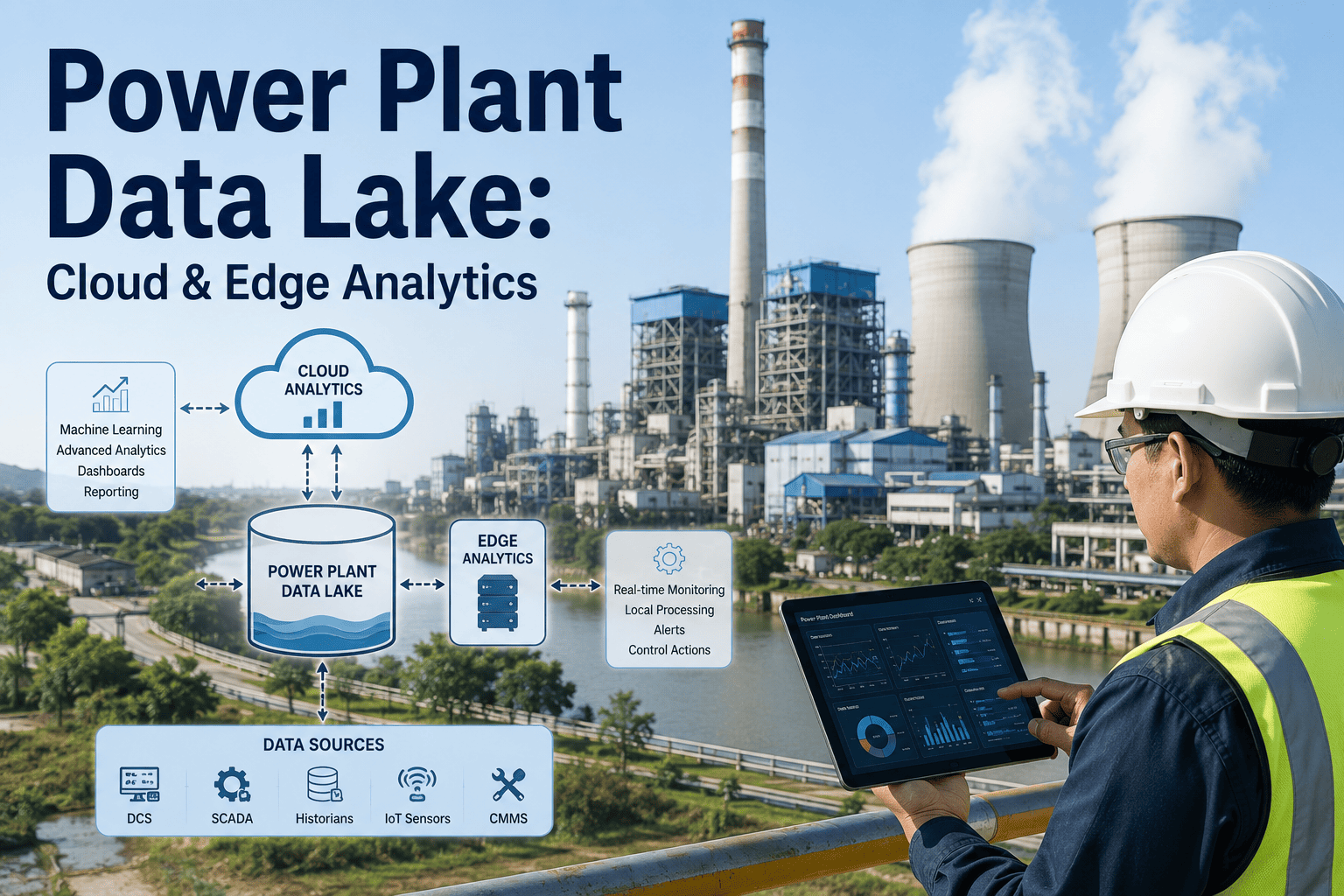
iFactory ingests SCADA, DCS, historian, and CMMS data into a structured data lake spanning both edge and cloud, so analytics models, dashboards, and reports draw from one queryable store instead of chasing raw exports across a dozen systems.
Not Every Byte Belongs In The Same Place
The first architectural decision in any power plant data lake is where processing and storage should happen — at the edge, close to the equipment generating the data, or in the cloud, where enterprise-wide analytics and long-term storage are more economical. Getting this split wrong either overloads the plant network sending everything to the cloud, or leaves the plant without the enterprise-wide visibility that leadership and engineering teams increasingly expect. The right answer is rarely all-edge or all-cloud; most plants that get this architecture right run a hybrid model where the edge handles anything time-sensitive or bandwidth-heavy, and the cloud handles anything that benefits from centralized compute, longer retention, or cross-site comparison.
Process At The Edge When
The decision needs to happen in milliseconds, such as vibration-based trip logic or combustion tuning adjustments, or the data volume is too high to justify constant cloud transmission, such as raw high-frequency vibration waveforms.
Send To The Cloud When
The analysis spans multiple units or multiple sites, the model requires more compute than is practical to run locally, or the output feeds enterprise reporting and long-term trend analysis that doesn't need millisecond responsiveness.
From Raw Sensor Reading To Query-Ready Dataset
A power plant data lake is not simply a large storage bucket where raw exports get dumped. It follows a structured pipeline that transforms raw, high-frequency sensor data into progressively more organized and queryable layers, commonly described as a bronze, silver, and gold zone architecture. Each zone exists for a specific reason: bronze preserves the original record for auditability, silver makes the data usable for direct analysis, and gold delivers exactly the shape of data a specific dashboard or report needs, without forcing every downstream consumer to repeat the same cleaning and aggregation work independently.
Raw Ingestion
Data lands exactly as it was generated by SCADA, DCS, historian, and CMMS sources, with no transformation applied, preserving a complete and unmodified record for auditability and reprocessing if a downstream error is later discovered.
Cleaned And Structured
Duplicate readings are removed, timestamps are aligned across time zones, units are normalized, and tags are mapped to a consistent asset hierarchy, producing a dataset that is clean enough for direct analysis but still granular.
Aggregated And Modeled
Data is aggregated into the specific views that dashboards, reports, and machine learning models actually consume — hourly efficiency rollups, equipment health scores, and KPI trend tables ready for direct query.
Stop Letting Raw Data Sit Idle In Storage.
iFactory structures your plant's SCADA, DCS, historian, and CMMS data into a query-ready lake, spanning edge and cloud, built for the analytics your team actually needs.
How Data Moves From The Plant Floor Into The Lake
The ingestion pipeline is the connective tissue between the plant's operational systems and the analytical layers described above. Each stage in the pipeline has a specific job, and skipping any one of them tends to produce a lake full of data nobody trusts enough to build decisions on. Plants that try to shortcut straight from raw collection to a finished dashboard, skipping validation and transformation, usually discover the gap the hard way — when a report shows an impossible efficiency number traced back to an uncaught sensor fault that was never flagged before it entered the lake.
Hot, Warm, And Cold — Matching Storage Cost To Access Frequency
Not all data needs to be instantly queryable at all times, and storing everything in the fastest, most expensive tier is one of the most common ways power plant data lake projects blow through their budget. A tiered storage strategy matches the cost of storage to how often the data is actually accessed.
| Tier | Typical Age | Access Pattern | Storage Location |
|---|---|---|---|
| Hot | 0–30 days | Real-time dashboards, active alarms | Edge or fast cloud storage |
| Warm | 30 days–2 years | Trend analysis, monthly reporting | Standard cloud storage |
| Cold | 2+ years | Regulatory retention, historical audits | Archive-tier cloud storage |
Moving data between tiers automatically as it ages is what keeps the lake affordable at scale — most plants generate far more historical data than they will ever query again, and paying hot-tier storage prices for all of it indefinitely is rarely justified by actual usage patterns. A well-designed tiering policy also means nothing is ever truly deleted before its retention obligation is met; cold-tier data is simply slower and cheaper to retrieve, not inaccessible, which matters when a regulatory audit or an unplanned root cause investigation suddenly needs a record from several years back.
Analytics That Aren't Possible When Data Is Scattered Across Silos
A structured data lake is not the end goal in itself — it's the foundation that makes certain classes of analytics possible for the first time, because they require data linked across systems and time periods that would otherwise never be queried together. The examples below are consistently the ones plants mention first once their lake is in place, largely because each one was effectively impossible, or at least impractical, before the underlying data existed in one structured, queryable location.
Cross-Unit Benchmarking
Comparing heat rate or availability across every unit in a fleet requires querying historian data from multiple sites in a consistent format, which is only practical once that data lives in one structured lake.
Predictive Maintenance Models
Training a model to predict bearing failure requires years of historian trend data linked to CMMS failure records for the same asset — exactly the kind of cross-system join a data lake is built to support.
Long-Term Degradation Analysis
Identifying slow equipment degradation trends over several years requires querying warm and cold tier data that most historians would otherwise have already purged or made prohibitively slow to access.
Regulatory And Compliance Reporting
Emissions and safety compliance reports often require years of historical records assembled quickly under deadline pressure, which a structured cold-tier archive makes far faster than manually pulling old exports.
Where Power Plant Data Lake Projects Tend To Stall
Data lake initiatives at industrial sites frequently start strong and then stall once the initial ingestion is complete, usually because a handful of foundational decisions were skipped or rushed at the outset.
Skipping The Zone Architecture
Dumping raw data straight into a single flat storage layer without a bronze, silver, gold structure produces a lake that is technically populated but practically unqueryable, because nothing has been cleaned, normalized, or aggregated for actual use.
No Tiering Strategy From Day One
Storing everything in hot-tier storage indefinitely because tiering felt like a "later" problem is one of the most common ways a data lake project quietly becomes too expensive to maintain within its first year.
Ignoring Data Quality At Ingestion
Loading years of historical data without validating it against expected sensor ranges means known bad readings and gaps propagate all the way through to the gold zone, undermining trust in every dashboard and model built on top of it.
Building The Gold Zone Before Requirements Exist
Pre-aggregating data into views nobody asked for wastes engineering effort; the gold zone should be built around specific dashboard and report requirements rather than guessed at speculatively ahead of actual demand.
Before building our data lake, pulling five years of historian data for a heat rate degradation study meant asking IT to restore old backup archives, which took nearly two weeks before analysis could even begin. Since iFactory tiered our historian data into hot, warm, and cold storage automatically, that same five-year pull now takes minutes because the cold tier is still queryable, just slower and cheaper than the hot tier. Our engineering team runs studies now that we simply never attempted before because the data was too much of a hassle to get to.
A Bigger Lake Needs Clearer Rules About Who Can Access What
As more source systems feed into the lake and more teams start querying it, governance becomes as important as the architecture itself. Without clear rules, a data lake risks becoming exactly the kind of unmanaged sprawl it was meant to replace.
Role-Based Query Access
Operators, engineers, and corporate analysts each get access scoped to the zones and asset groups relevant to their role, rather than blanket access to the entire lake regardless of job function.
Data Lineage Tracking
Every gold-zone table records which bronze-zone sources and transformation steps produced it, so an unexpected result can be traced back to its origin rather than treated as an unexplained anomaly.
Retention Policy Enforcement
Automated tiering and archival policies ensure data moves to cold storage or is purged according to the plant's regulatory retention requirements, without relying on someone remembering to do it manually.
Change Auditing On The Pipeline
Any change to the ingestion, validation, or transformation logic is logged, so the plant's data team can answer exactly when and why a particular calculation or schema changed if a downstream report ever looks different than expected.
Frequently Asked Questions
Q: Do we need to move all of our historian data to the cloud, or can some of it stay on-site?
No, and for most plants keeping everything on-site is neither necessary nor advisable. iFactory's edge and cloud architecture is designed specifically so that hot-tier data needed for real-time dashboards and active alarms stays local at the edge, where latency matters most, while warm and cold tier data that supports trend analysis and long-term reporting moves to cloud storage where it's more economical to keep for years. The split between what stays on-site and what moves to the cloud is configurable based on your plant's specific network constraints and reporting needs. Reach out through Support Contact to discuss the right split for your facility.
Q: How is a data lake different from just keeping data in our existing historian for longer?
Historians are optimized for high-frequency time-series storage and fast trend queries over relatively recent data, which is exactly what they're good at, but they are not typically designed to efficiently join that time-series data against CMMS work order records, asset metadata, or data from other source systems. A data lake structures data specifically to support these cross-system queries, and it applies tiered storage so that older data remains accessible without paying the cost of keeping it in the historian's most expensive storage tier indefinitely. Most plants run a data lake alongside their existing historian rather than replacing it, using the historian for its strength in fast recent-data trending while the lake handles longer-term storage, cross-system joins, and the aggregated views that feed dashboards and predictive models.
Q: What analytics tools can query the data lake once it's built?
The gold-zone tables in the lake are structured in standard formats that connect to common business intelligence and analytics tools, including dashboard platforms, spreadsheet-based reporting tools, and machine learning frameworks used for predictive maintenance modeling. Because the gold zone is already cleaned, aggregated, and organized around your asset hierarchy, most teams find that connecting a new analytics tool to the lake takes a fraction of the time it previously took to build a one-off data pull from the original source systems. A Book a Demo can show the specific export formats available.
Q: How long does it take to build a working data lake for our plant?
Timeline depends on how many source systems need to be connected and how much historical data needs to be backfilled into the lake versus captured going forward. A single-unit plant connecting its SCADA, DCS, historian, and CMMS with a modest historical backfill typically has a working bronze and silver zone within a few weeks, with the gold-zone views tailored to specific dashboards and reports following shortly after as those requirements are defined. Multi-unit fleets with larger historical archives to backfill take longer, primarily due to the volume of historical data being processed rather than any added architectural complexity.
Q: Is our data secure once it moves from on-site historians into cloud storage?
Data in transit to the cloud is encrypted, and cloud storage tiers are access-controlled so that only authorized users and applications can query them, following the same security posture expected of any enterprise cloud data platform. The edge layer that connects to your SCADA and DCS systems maintains read-only access to those control systems, and the boundary between the OT network and the cloud-bound data pipeline follows standard segmentation practices rather than creating a new open path into the control network. Discuss your specific security and compliance requirements with a Book a Demo.
Turn Years Of Stored Plant Data Into Answers Your Team Can Actually Query.
iFactory builds the edge-to-cloud data lake architecture that makes cross-system analytics, predictive maintenance, and long-term trend analysis possible.