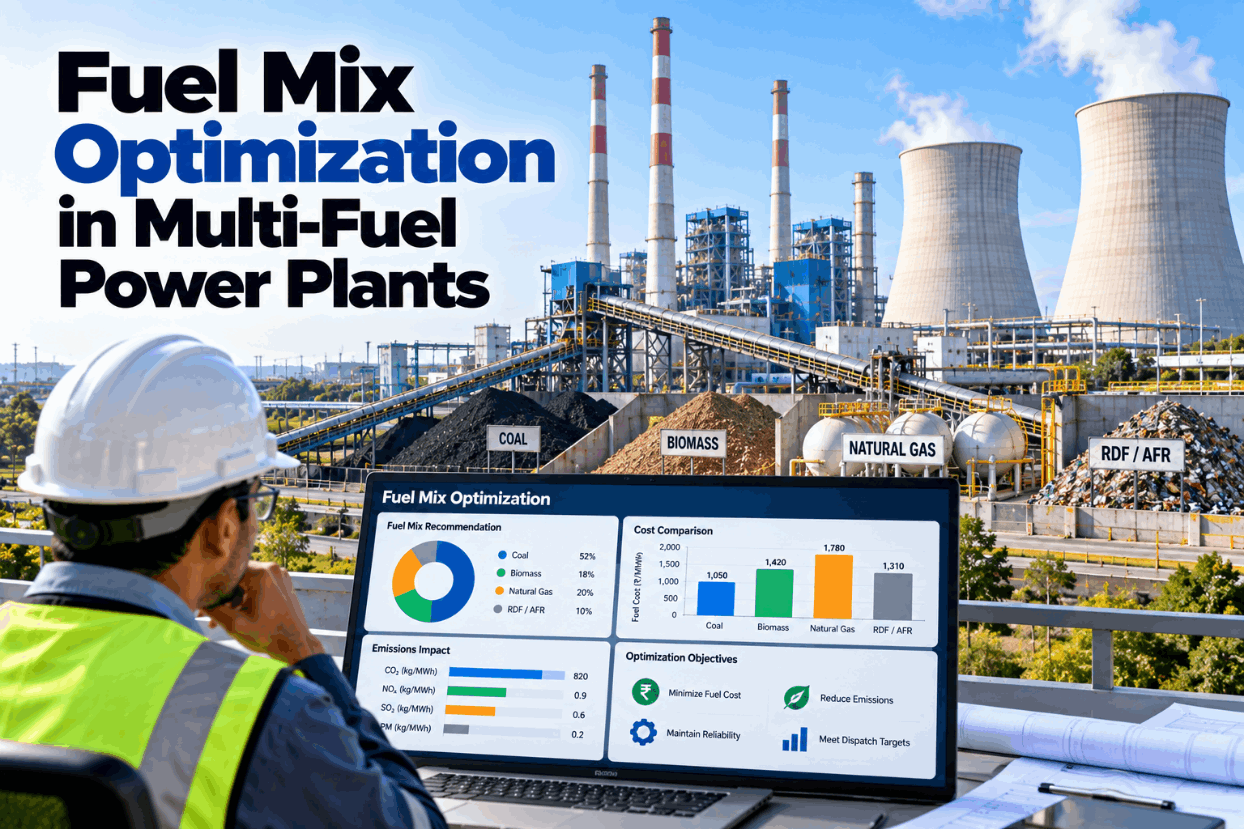
Few thermal plants burn a single fuel anymore. Coal stations blend domestic and imported coal, co-fire biomass pellets to meet policy and burn oil or gas for support. Some plants switch between coal and gas as prices move. Every day, someone decides the blend, and that decision changes fuel cost, boiler behavior, emissions and reliability at the same time. Too much high-slagging coal fouls the furnace; too little cheap coal raises cost; too few pellets misses the co-firing target. Most plants still set the blend by experience and fixed ratios. This guide covers why fuel mix matters, co-firing policy and limits, coal blending constraints, emissions, fuel switching, how blend optimization works and how to run it daily. To see your fuel mix modeled, book a short walkthrough.
Fuel Mix Optimization in Multi-Fuel Power Plants: Cost, Emissions and Reliability in One Blend
Domestic and imported coal, biomass pellets and support fuels blended to the lowest cost per MWh that respects boiler limits, co-firing targets and emission norms, every day.
Why Fuel Mix Is a Daily Optimization Problem
A multi-fuel plant faces a new blending decision every day. Coal arrives from different mines and ports with different calorific values, ash, moisture and sulfur. Biomass pellets must be co-fired to meet policy. Imported coal is often cheaper per unit of heat but may slag in boilers designed for domestic coal. Prices, stock levels and dispatch change constantly.
The trade-offs are real. A CEA study group on blending found that imported coal can cause slagging and fouling that limit rated load, raise mill fire risk with high-volatile coal and change electrostatic precipitator performance. The same study noted a typical domestic design coal of about 3,300 kcal/kg against about 5,000 kcal/kg for typical imported coal, a large difference to manage in one boiler.
Most plants set the blend with fixed ratios and adjust by experience when problems appear. That approach misses savings on good days and reacts late on bad ones. Treating fuel mix as an optimization, with costs and constraints made explicit, lets the plant choose the best blend for today’s fuels, prices and load.
A blend model turns experience into explicit rules. We can review your blending practice on a call.
Biomass Co-Firing Policy and Targets
India’s biomass co-firing policy has changed several times, so plants need to track the version that applies to them.
The Ministry of Power’s October 2021 policy set 5% biomass pellets after one year and 7% after two years, supported by the SAMARTH mission.
A June 2023 revision set 5% from FY 2024–25 and 7% from FY 2025–26. By May 2023, 47 plants had implemented co-firing.
A November 2025 revision set at least 5% pellets or municipal solid waste charcoal for most plants, with an additional 2% for plants in the Delhi-NCR region.
For NCR plants, at least half the pellet raw material must come from regional crop residue.
Reports in December 2025 described penalties on plants near Delhi that missed FY 2024–25 blending targets.
The SAMARTH FAQ specifies moisture up to 14%, bulk density of at least 600 kg/m³ and GCV ranges for torrefied and non-torrefied pellets.
For planners, the practical point is that co-firing is now a constraint in the blend, not an option. The optimizer must hit the required share over the compliance period while managing pellet supply, which is often seasonal and variable in quality.
Tracking co-firing share daily against the period target avoids year-end shortfalls. See it in a demo.
How Much Biomass a Coal Boiler Can Take
Boiler and mill design limit how much biomass can be co-fired without modification.
| Method | Typical share | Source and notes |
|---|---|---|
| Premixed with coal before mills | Up to around 10% of heat input; 5–8% more common | IEA Bioenergy Task 32; simplest, uses existing mills |
| Blended feed, pulverizer-limited | About 3% of heat input in some PC boilers | NREL/FEMP; mill capacity is the constraint |
| Separate biomass injection | Up to about 15% of heat input | NREL/FEMP; needs dedicated feed system |
| Direct injection to a mill group | Up to about 50% of that mill group’s heat input | IEA Bioenergy; larger modifications |
These ranges depend on pellet quality, mill type and boiler design. The SAMARTH FAQ notes that conventional boilers may need operational modifications. Plants usually find their own limit through trials, watching mill current, outlet temperature, flame stability and ash behavior.
Biomass brings environmental benefits beyond carbon. NREL notes that biomass contains negligible sulfur, so replacing 10% of coal feed with biomass cuts sulfur dioxide by about 10%, while nitrogen oxide reductions are usually smaller.
Our engineers can help set co-firing limits from your trial data.
Blending Imported and Domestic Coal
Imported coal is often blended with domestic coal to raise calorific value or cover supply gaps. The CEA study group set out practical limits and risks.
10–15% imported coal by weight, about 15–22% by heat, recommended for boilers designed for domestic coal.
Up to 30% where boilers are designed for blending.
High-slagging Indonesian coals kept at or below about 20%.
Low ash fusion temperatures cause deposits that can limit rated load.
High-volatile imported coal raises mill fire risk and can grind unevenly.
Changes in fly ash resistivity affect precipitator efficiency.
Blend quality also depends on how well coals are mixed. Layered stacking and reclaiming, or blending at the conveyor, give more even feed than alternating loads. Uneven blending can make the boiler see 100% imported coal for short periods even when the daily average is within limits.
Policy has pushed blending up and down over time. India advised 10% imported coal blending by weight in 2022 and directed a minimum of 6% through March 2024. Planners need a model that can test any share quickly against boiler limits.
Blend uniformity is often the hidden cause of slagging. Ask our team how it is tracked.
Emissions Constraints on the Blend
Fuel mix affects emissions directly, so emission norms become blend constraints.
Where FGD is not yet installed, fuel sulfur is the main lever on SO2. A blend optimizer that includes a sulfur limit can keep emissions within norms at least cost, rather than relying on a fixed low-sulfur coal share.
Emissions limits sit alongside cost in every blend we model during a rollout.
Switching Between Coal and Gas
Plants with access to more than one primary fuel, or portfolios with both coal and gas units, face switching decisions driven by price.
The US shows how strong the effect can be. The Energy Information Administration reported that natural gas overtook coal as the largest source of US generation in 2016 because of continued cost competitiveness, and that coal fell from 50% to 23% of generation between 2005 and 2019 while gas rose from 19% to 38%. When delivered gas prices more than doubled to $4.93 per MMBtu in 2021, EIA expected coal generation to rise 22% that year.
- Blend ratios set monthly
- Prices reviewed occasionally
- Boiler limits applied by experience
- Co-firing tracked at period end
- Emissions checked after the fact
- Switching decided by habit
- Blend chosen daily for current fuels
- Prices and stock in every decision
- Boiler limits as explicit constraints
- Co-firing share tracked daily
- Emissions limits in the optimization
- Switching tested on cost per MWh
Carbon intensity adds another dimension. EIA notes coal emits about 209 lb of CO2 per MMBtu against about 117 for natural gas, so fuel switching and co-firing both change carbon cost where it is priced.
Our specialists can model switching economics for your portfolio.
How Blend Optimization Works
Blend optimization finds the lowest-cost mix that satisfies every constraint. The structure is simple to describe.
Available fuels with stock, price, GCV, ash, moisture, sulfur and volatile content.
Ash fusion, slagging and fouling indices, mill capacity, flame stability.
Co-firing share, emission limits and required output.
Find the blend with lowest cost per MWh meeting all constraints.
Check the blend against stock, logistics and yard blending capability.
Compare predicted and actual boiler behavior and refine limits.
Illustrative. The optimizer shows the cost of each constraint, so planners know what each limit is worth.
Knowing the cost of each constraint is one of the most useful outputs. If relaxing a slagging limit slightly would save a lot, the plant can test whether better soot blowing makes that possible. If a co-firing target costs little, there may be room to exceed it for future credit.
See the constraint costs for your plant in a session.
Fuel Mix Optimization Checklist
Use this checklist to set up daily blend optimization.
Most plants have the fuel analysis and boiler data already. Combining them is the first step of a blend review.
What Fuel Mix Optimization Is Worth
Value comes from fuel cost, compliance and reliability together.
Because fuel is the largest operating cost, even a small percentage improvement in blend cost is valuable. Avoiding a single slagging-related load reduction or outage can be worth as much as months of fuel savings.
A review of last quarter’s blends and boiler events usually shows the opportunity. Book one with our advisors.
How iFactory Delivers Fuel Mix Optimization
Lowest-cost mix for today’s fuels and load.
Slagging, fouling and mill constraints built in.
Share against the period target, every day.
SO2 and particulate norms included.
What each limit costs, shown to planners.
Coal, gas and support fuel options compared.
It runs on premises and connects to your fuel lab, yard and DCS data. Share a quarter of fuel analyses and boiler data and we will show your optimized blends in a working session.
See What Your Fuel Blend Could Cost
Share fuel analyses, prices and boiler data. We build your blend constraints, optimize recent days and show the cost of each limit, including co-firing and emissions.
The cheapest blend uses 22% high-slagging imported coal, above the 20% guidance for that coal type. Holding it at 18% and adding 5% biomass pellets costs 0.6% more per MWh and keeps slagging in limits.
A Blend Checked Against Slagging Limits
This exchange shows how a fuel planner might use iFactory.
iFactory ships as a pre-configured NVIDIA AI server, racked and ready with the fuel mix optimization models loaded. Rack it, plug in power and Ethernet, and the AI is live on your network. Our scope covers data connections across fuel yard, laboratory, mills and boilers, DCS, historian, CMMS, scheduling, market and ERP integration, cabling and network setup, operator and engineer training, and 24×7 remote monitoring. Plans and recommendations run in advisory mode first, reviewed by your planners and engineers before anything changes in operation.
Server installed, DCS, historian, CMMS and schedule links live, historical generation, fuel and maintenance data loaded.
Models calibrated on your own plant data, then run in advisory mode with your planners reviewing every forecast and plan.
Rollout to the agreed units and planning cycles, planner and engineer training, and 24×7 remote monitoring in place.
Software, server and integration come as one package. For pricing on your plant, contact our sales team.
Frequently Asked Questions
Choosing the blend of fuels, such as domestic and imported coal, biomass pellets and support fuels, that gives the lowest cost per MWh while meeting boiler, co-firing and emission limits.
IEA Bioenergy reports premixed co-firing up to around 10% of heat input, with 5–8% more common. Separate injection can reach about 15%, depending on boiler and mill design.
The policy has been revised several times. The November 2025 revision requires at least 5% biomass pellets or MSW charcoal for most plants, with an additional 2% for Delhi-NCR plants.
A CEA study group recommended 10–15% by weight for existing boilers designed for domestic coal and up to 30% for new boilers, with high-slagging coals kept at or below about 20%.
They are mainly cement industry terms for fuel substitution and alternative fuels. Power plants usually describe the same idea as co-firing share by heat input.
Daily blend optimization can typically be in use within a 6–12 week rollout, using your existing fuel and boiler data. Plan it with our planners.
Choose the Best Blend Every Day, Within Every Limit
iFactory optimizes your fuel mix for cost per MWh, keeps slagging, co-firing and emissions within limits and shows what each constraint costs, so planners decide with evidence.
Illustrative index. The optimizer weighs cost, emissions, slagging and mill limits together, not cost alone.





.png)