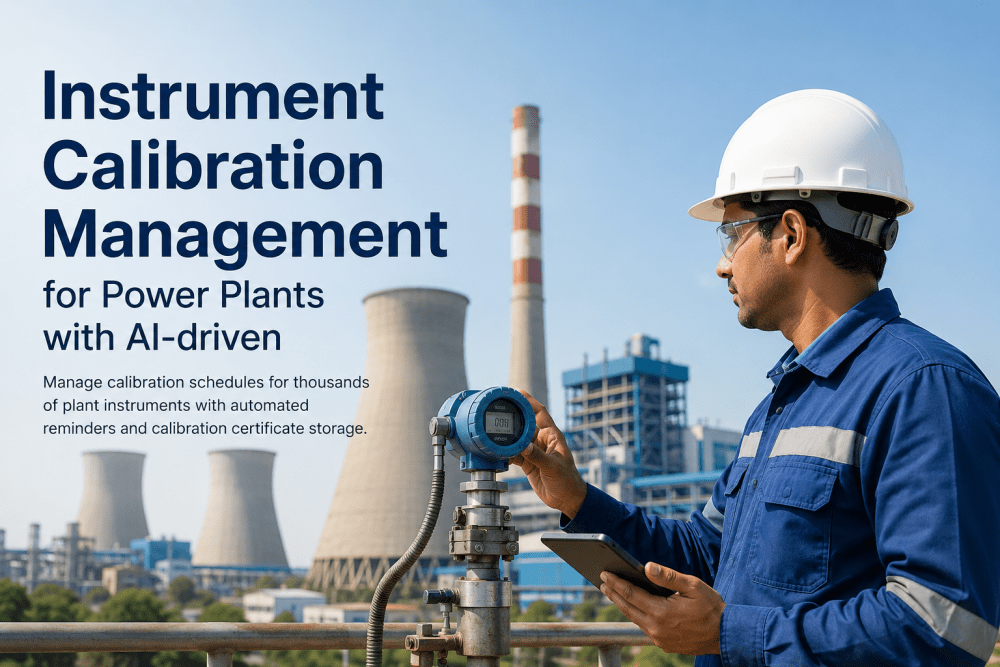
A pressure transmitter reading two percent high does not trip an alarm. It does not shut down a unit. It simply feeds a slightly wrong number into every control loop, efficiency calculation, and emissions report that depends on it until someone finally catches the drift during a scheduled check, months after the error started compounding. Power plants run thousands of temperature, pressure, flow, and level instruments, and fixed-interval calibration programs were never designed to catch which ones are drifting fastest. Maintenance teams exploring how AI-driven scheduling closes that gap can Book a Demo to see it applied to a live instrument list.
Every Instrument Drifts. Most Calibration Programs Never Find Out Until It Is Too Late.
iFactory replaces fixed-interval calibration guesswork with AI-driven scheduling that tracks drift trends, prioritizes high-risk instruments, and proves accuracy on demand.
Why Calendar-Based Calibration Wastes Effort and Still Misses Failures
Most power plants calibrate instruments on a fixed schedule — every six months, every year, every outage — regardless of how each individual instrument is actually behaving. A stable pressure transmitter that has held within tolerance for three straight cycles gets pulled and recalibrated anyway, consuming technician hours that could go toward instruments genuinely at risk. Meanwhile, a flow transmitter on a fouling-prone line can drift well past its acceptable error band weeks before its next scheduled check, silently distorting feedwater flow readings, heat rate calculations, and emissions monitoring the entire time. The core problem is that a calendar has no relationship to physics. Drift rate depends on instrument type, process conditions, vibration exposure, ambient temperature swings, and manufacturing tolerances — none of which line up neatly with a twelve-month cycle. Plants that keep running fixed-interval programs are effectively guessing twice: guessing which instruments need attention and guessing when.
- Every instrument treated identically regardless of drift history
- Stable instruments recalibrated needlessly, wasting labor hours
- High-drift instruments can exceed tolerance mid-cycle undetected
- Audit trail assembled manually before inspections
- Each instrument scheduled based on its own measured drift rate
- Calibration effort concentrated on instruments actually at risk
- Drift trends flagged weeks before tolerance is exceeded
- As-found and as-left readings logged automatically with full history
The Four Measurement Families Every Calibration Program Has to Cover
Power generation units depend on hundreds of instruments spread across four broad measurement families, and each family drifts for different physical reasons. A calibration program that treats them identically underserves all four. Understanding what drives error in each category is the starting point for building a schedule that actually matches instrument behavior.
Temperature Instruments
Thermocouples and RTDs on turbine bearings, flue gas paths, and feedwater heaters drift from thermal cycling, junction degradation, and insulation breakdown, with error accumulating gradually over thousands of start-stop cycles.
Pressure Instruments
Pressure transmitters on boiler drums, condensers, and steam headers drift from diaphragm fatigue, impulse line blockage, and reference leg contamination, often showing seasonal patterns tied to ambient temperature.
Flow Instruments
Differential pressure, ultrasonic, and vortex flow meters drift from fouling, wear on primary elements, and changes in fluid density, directly distorting heat rate and fuel consumption calculations when uncorrected.
Level Instruments
Drum level, condenser hotwell, and tank level instruments drift from density compensation errors and mechanical wear on displacer and float mechanisms, with consequences that reach directly into trip and interlock logic.
From Raw Readings to a Prioritized Calibration Schedule
AI-driven calibration management does not replace the technician who performs the physical check — it decides which instrument that technician should visit next and why. The process runs continuously in the background, turning every as-found reading into an input for the next scheduling decision rather than a number that sits in a spreadsheet until the next audit.
Capture As-Found and As-Left Readings
Every calibration event records the instrument's reading before and after adjustment, building the historical dataset the model needs to learn each instrument's individual drift behavior.
Model Individual Drift Rates
The system compares each instrument's trend against its own history and against similar instruments in comparable service, separating genuine drift from normal measurement noise.
Forecast Tolerance Exceedance
Instruments trending toward their acceptable error band are flagged with an estimated date of exceedance, giving planners real lead time instead of a surprise failure at the next scheduled check.
Generate a Risk-Ranked Work List
Calibration work orders are generated automatically and ranked by risk, so planners route technicians to the instruments that need attention first rather than the ones that happen to be next on a fixed list.
Log the Traceable Record
Every reading, adjustment, technician signoff, and instrument identifier is stored in a structured audit trail that stands up to a regulatory or quality inspection without manual reassembly.
Fixed-Interval Calibration vs AI-Driven Calibration Management
The table below lays out how the two approaches diverge across the factors that matter most to a maintenance manager building or defending a calibration budget.
| Factor | Fixed-Interval Calibration | AI-Driven Calibration Management |
|---|---|---|
| Scheduling basis | Calendar date regardless of instrument condition | Measured drift rate specific to each instrument |
| Technician time allocation | Spread evenly across stable and unstable instruments | Weighted toward instruments trending out of tolerance |
| Failure detection timing | Discovered only at the next scheduled check | Flagged weeks ahead based on trend forecasting |
| Audit preparation | Manual assembly of paper or spreadsheet records | Continuous, structured, inspection-ready records |
| Impact on process data | Unknown drift can distort readings for months | Drift trends surfaced before readings become unreliable |
Stop Guessing Which Instruments Need Attention.
iFactory turns your calibration history into a prioritized, defensible schedule built around how your instruments actually behave — not a calendar.
What a Calibration Management Program Needs Before Launch
Moving from fixed-interval to condition-based calibration does not require ripping out an existing program. It requires enough historical data and process discipline to let a model learn instrument-specific behavior, then a plan to keep feeding it clean data going forward. The checklist below covers the foundational pieces most plants need in place.
A structured instrument list mapping every temperature, pressure, flow, and level device to its tag number, location, and process context.
At least one to two years of as-found and as-left calibration history, even if it was recorded on paper or in spreadsheets originally.
Defined tolerance bands and acceptable error limits for each instrument category, aligned with process safety and reporting requirements.
A named owner for the calibration program who reviews flagged instruments and approves schedule changes on a regular cadence.
A commitment to logging every future calibration event consistently, since data quality going forward determines forecast accuracy.
Why Calibration Accuracy Reaches Well Beyond the Instrumentation Shop
It is easy to treat calibration as a back-office maintenance task with little visibility outside the instrumentation team, but the numbers a drifting instrument feeds into rarely stay contained there. A pressure transmitter feeding a boiler efficiency calculation, a flow meter feeding fuel consumption reporting, or a level instrument feeding a trip interlock all carry consequences that reach into operations, finance, and safety at the same time. When a plant manager questions a heat rate anomaly or an auditor asks for evidence that safety-critical instruments are within tolerance, the calibration program is the first place that scrutiny lands. Building a defensible, data-driven program is not just an efficiency improvement for the maintenance team — it is the foundation that every downstream number in the plant ultimately rests on. Teams that get this right stop treating calibration as a compliance checkbox and start treating it as a measurement quality program with visibility at the management level.
Calibration Management — Common Questions
How much historical calibration data do we need before AI scheduling becomes useful?
Meaningful drift forecasting typically starts to emerge once an instrument has two to three calibration cycles of as-found and as-left history, since the model needs enough data points to distinguish a genuine trend from normal reading variation. Instruments with less history are still tracked, just with wider uncertainty bands until more readings accumulate. Plants migrating from paper records can usually digitize the last one to two years of calibration certificates to jumpstart the process rather than starting from zero. Teams can Book a Demo to see how quickly a real instrument list starts producing useful forecasts.
Does condition-based calibration meet the same regulatory and audit requirements as fixed-interval programs?
Yes, and in most cases the audit trail is stronger, because every reading, adjustment, and technician signoff is captured automatically in a structured format rather than reconstructed from paper certificates before an inspection. Regulatory frameworks generally require documented evidence that instruments are maintained within specified accuracy limits, not a specific calendar interval, so a defensible risk-based schedule with complete records satisfies that intent as long as the rationale for each interval is documented and consistently applied.
What happens to instruments that show no meaningful drift over several cycles?
Instruments with a demonstrated history of stability are automatically shifted to a longer calibration interval, freeing up technician hours that would otherwise be spent reconfirming what the data already shows. This is one of the largest efficiency gains plants see, since a meaningful share of instruments in most fixed-interval programs turn out to be far more stable than their calendar-based schedule assumes, and that freed capacity gets redirected to instruments with active drift patterns instead.
Can this integrate with the CMMS and DCS systems we already use for calibration work orders?
Calibration management is designed to layer on top of existing CMMS and control system infrastructure rather than replace it, connecting through standard integration methods to pull instrument tag data and push generated work orders back into the same system technicians already use. The goal is to change how schedules are generated and how records are captured, not to force a parallel system that technicians have to learn and maintain separately. The iFactory Support team can walk through integration specifics for your existing systems.
How does the system distinguish real instrument drift from process changes or operating condition shifts?
The model looks at redundant instrument comparisons where available, cross-references similar instruments in comparable service, and factors in known process changes such as fuel switches or load pattern shifts before flagging a reading as instrument drift rather than a legitimate process variation. This layered comparison is what separates a reliable drift forecast from a simple threshold alarm, and it is also why accuracy improves as more historical readings and process context accumulate over time.
Bring Every Instrument Under One Defensible Calibration Program.
Talk to iFactory about connecting your instrument list, calibration history, and CMMS into a single AI-driven scheduling and audit trail system.