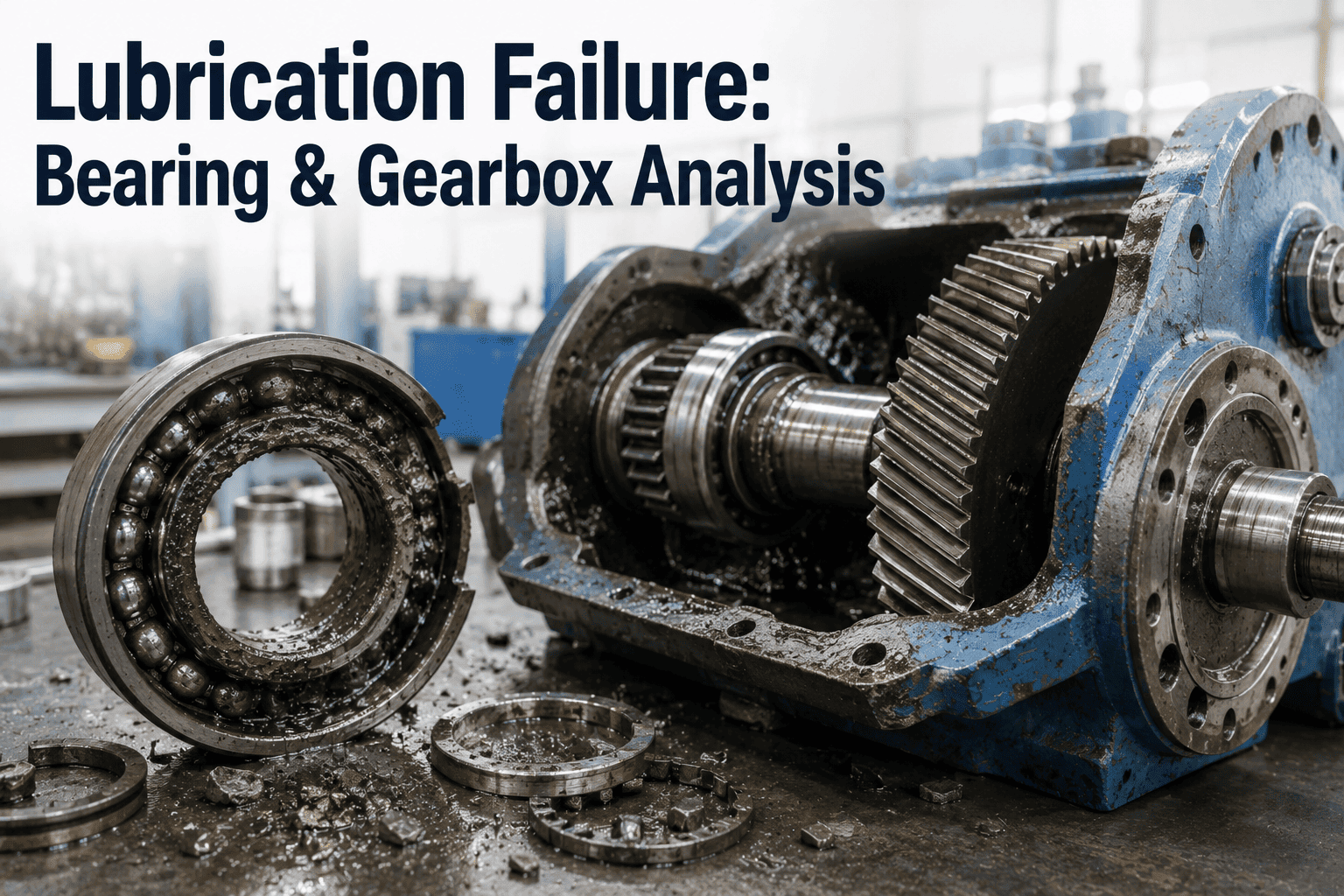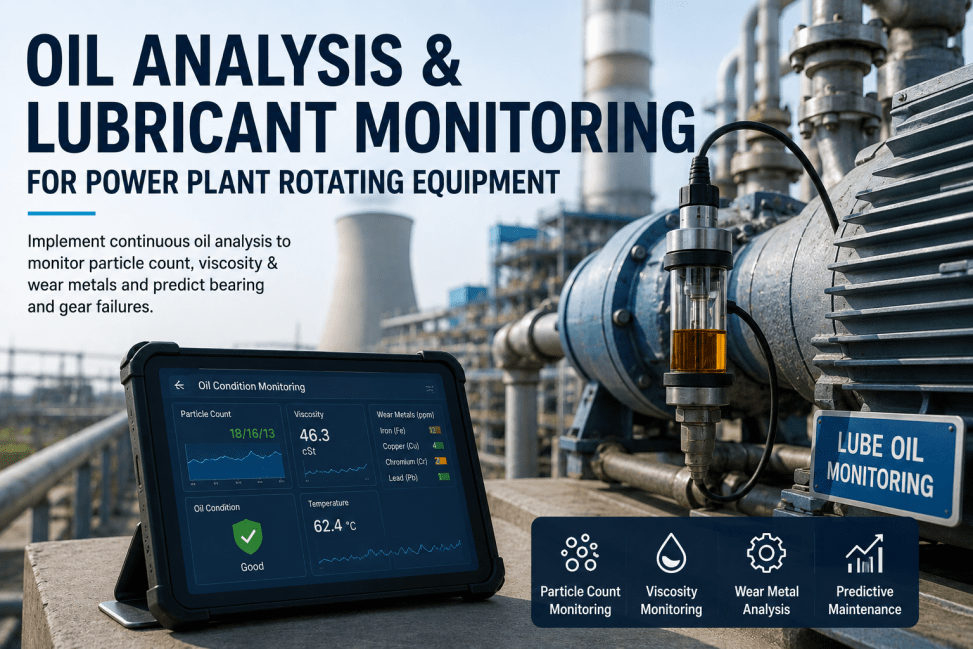
Power plant lubrication programs manage hundreds of oil-filled systems where fluid degradation often goes undetected until equipment shows performance symptoms — by which point bearing damage, gear wear, or valve stiction has already begun. Traditional oil analysis depends on periodic lab samples and simple threshold alerts that miss the gradual trends signaling developing problems. AI-driven fluid condition monitoring continuously analyzes oil data patterns across all your equipment, detecting wear metal acceleration, contamination ingress, and additive depletion weeks before conventional methods raise alarms. This approach enables maintenance managers to shift from calendar-based oil changes to truly condition-based lubrication strategies. Book a Demo to explore AI-powered oil analysis for your plant.
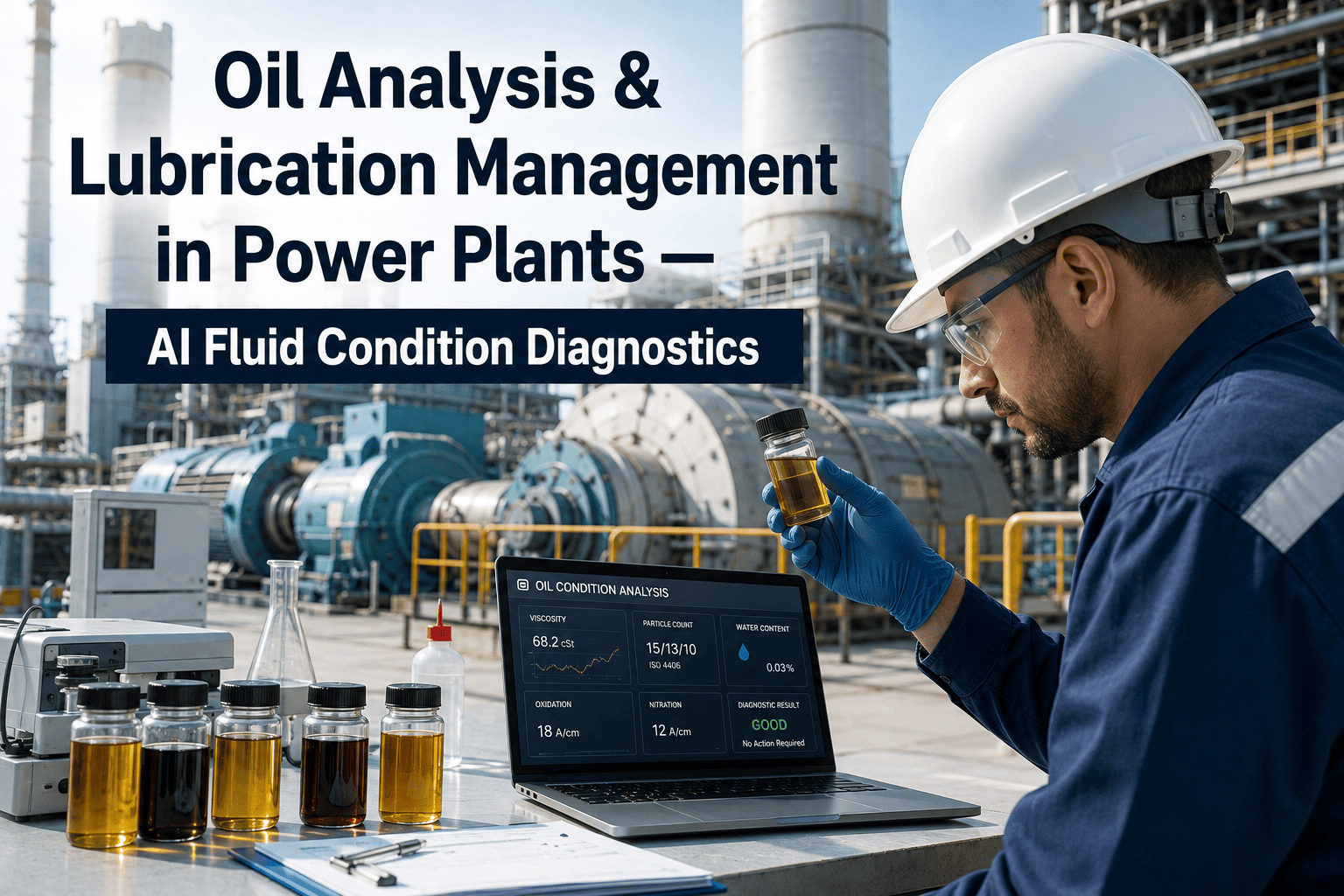
Oil Analysis & Lubrication Management in Power Plants
AI Fluid Condition Diagnostics
From wear metal trending to contamination prediction — a comprehensive guide to deploying AI-driven oil analysis across turbine, hydraulic, and gearbox lubrication systems.
What Poor Lubrication Management Actually Costs Power Plants
Fluid degradation is a silent driver of equipment failure that traditional programs consistently underestimate.
Turbine Bearing Failure Cost
A single lubrication-related bearing failure in a large steam turbine triggers emergency outage costs, replacement parts, and lost generation revenue that can exceed eight million dollars per incident.
Bearing Failures Linked to Lubrication
Industry research consistently shows that the majority of premature bearing failures in rotating equipment trace back to lubrication issues — contamination, inadequate lubrication, or degraded oil properties.
Oil Changed Too Early
Calendar-based oil change schedules result in roughly forty percent of lubricant replacements happening while the oil still has significant remaining useful life — wasting both oil and maintenance labor.
AI Condition Monitoring
AI-driven oil analysis evaluates fluid condition continuously, enabling oil changes based on actual degradation state rather than arbitrary time intervals — eliminating both waste and risk.
How AI Transforms Oil Analysis From Reactive to Predictive
Modern AI oil analysis systems process multiple data streams simultaneously, identifying degradation patterns that single-parameter threshold monitoring cannot detect.
Multi-Source Data Ingestion
ICP spectrometry results, particle count data, FTIR spectra, viscosity measurements, water content, and TAN values are collected from online sensors and lab submissions into a unified data platform. The AI system normalizes data from different sources and sampling intervals into a coherent timeline per asset.
Cross-Parameter Correlation
The AI engine analyzes relationships between parameters that human reviewers rarely connect — such as rising iron particles correlated with increasing oxidation and simultaneous zinc depletion. These cross-parameter patterns reveal root causes like overheating, seal failure, or coolant leaks much earlier than single-parameter thresholds.
Rate-of-Change Trend Analysis
Instead of flagging only when a parameter crosses a fixed limit, the AI calculates acceleration rates for every measured parameter. A gradual increase in copper concentration from 5 ppm to 15 ppm over three months triggers an alert even though both values are within acceptable limits — because the trend signals active wear.
Prognostic Action Recommendation
The system projects degradation trajectories and recommends specific actions — continue monitoring, increase sampling frequency, perform filtration, top-up additives, or schedule oil change — with estimated remaining useful life for each lubricated system. Book a Demo to see prognostic recommendations in action.
What AI Oil Analysis Detects Across Fluid Parameters
A complete AI-powered lubrication monitoring system tracks far more degradation indicators than traditional lab reports with static pass/fail thresholds.
| Fluid Parameter | Detection Method | Severity Indicator | Recommended Action |
|---|---|---|---|
| Wear Metals (Fe, Cu, Pb, Cr, Sn) | ICP-OES + AI trend analysis | Normal | Baseline trending continues |
| Water Contamination | Karl Fischer + AI ingress prediction | Elevated | Investigate seal and cooler integrity |
| Particle Count (ISO 4406) | Online particle counter + AI classification | Normal | Filtration performance adequate |
| Oxidation (TAN / FTIR) | Titration + FTIR + AI degradation model | Warning | Plan oil change within 30 days |
| Viscosity Deviation | Viscometer + AI thermal trend correlation | Normal | Within grade tolerance |
| Additive Depletion (Zn, P, Ca) | ICP + AI depletion rate modeling | Elevated | Evaluate additive supplement or change |
| Glycol Contamination | FTIR spectral analysis + AI detection | Critical | Immediate cooler inspection and oil replacement |
| Silicon / Dirt Ingestion | ICP + particle analysis + AI source identification | Elevated | Check breather filters and seal integrity |
AI Oil Analysis Across Power Plant Lubricated Systems
Every major lubricated system in a power plant presents unique degradation patterns that AI fluid condition monitoring addresses with equipment-specific diagnostic models.
Steam & Gas Turbine Lubrication Systems
Turbine oils face extreme thermal and oxidative stress. AI monitors oxidation progression, viscosity stability, additive depletion, and wear metal generation from journal bearings, thrust bearings, and governor components. The system detects the early stages of varnish formation by correlating decreasing solubility with rising particulate levels — a failure mode that traditional oil analysis consistently misses until deposits cause bearing temperature excursions or servo valve sticking.
EHC & Governor Hydraulic Fluids
AI monitors particle generation rates, viscosity stability, and acid number trends in fire-resistant and mineral-based hydraulic fluids. Early detection of seal wear particles and fluid degradation prevents the costly governor malfunctions that can trip turbine units.
Coal Mill & Cooling Tower Gearboxes
Heavy-duty gearbox lubricants are monitored for wear metal signatures specific to gear mesh and bearing components. AI distinguishes between normal break-in wear and abnormal spalling or scoring by analyzing particle morphology trends alongside elemental concentrations.
Boiler Feed Pump & Cooling Water Pumps
AI oil analysis for pump systems focuses on detecting seal leakage, bearing degradation, and water contamination that accelerates oil breakdown. The system correlates oil condition data with pump operating parameters like discharge pressure and vibration levels.
Grease-Lubricated Motor & Fan Bearings
AI tracks grease consistency degradation, base oil separation, and contamination ingress in grease-lubricated applications. By analyzing grease sample trends and correlating with bearing temperature and vibration data, the system optimizes relubrication intervals to prevent both over-greasing and under-greasing.
Side-by-Side: Traditional Oil Analysis vs AI-Powered Diagnostics
The gap between conventional oil analysis programs and AI-driven fluid condition monitoring shows up in every aspect of maintenance decision-making.
Traditional Oil Analysis
AI-Powered Oil Analysis
Measurable Returns from AI Lubrication Management
Deploying AI-driven oil analysis delivers financial returns across lubricant savings, failure prevention, and maintenance efficiency from the first quarter of operation.
Reduction in Lubricant Consumption
Condition-based oil changes eliminate the roughly forty percent of replacements that occur while oil still has significant remaining useful life under calendar-based programs.
Fewer Lubrication-Related Failures
Early detection of contamination, wear acceleration, and additive depletion enables intervention before these conditions cause bearing damage, gear failure, or hydraulic system malfunctions.
Reduction in Oil Analysis Costs
AI-directed sampling focuses lab resources on assets showing developing trends rather than blanket sampling programs, reducing unnecessary tests while improving diagnostic coverage on critical equipment.
Ready to Upgrade Your Lubrication Program with AI?
In 30 minutes, we'll show how iFactory's AI oil analysis platform connects to your existing oil data sources — lab results, online sensors, and CMMS records — to deliver predictive fluid condition diagnostics across your entire plant fleet.
Deploying AI Oil Analysis: From Assessment to Operational Value
A phased implementation ensures your AI lubrication management system delivers accurate diagnostics quickly while building on your existing oil analysis infrastructure.
Lubrication Program Audit
Map all lubricated assets, current sampling schedules, test packages, and historical data availability. Identify critical equipment where AI diagnostics deliver the highest value and gaps in current monitoring coverage.
Data Integration & Baseline
Connect lab data feeds, online sensor outputs, and CMMS maintenance records into the AI platform. Establish baseline condition profiles for each monitored asset using historical oil analysis results.
AI Model Training & Validation
Train equipment-specific diagnostic models using your historical data combined with industry failure case libraries. Validate model accuracy against known failure events and expert-verified diagnoses from your plant.
Operational Deployment & Learning
Activate AI diagnostics for initial asset groups with parallel monitoring alongside existing processes. Model accuracy improves continuously as new oil data, confirmed findings, and maintenance outcomes are incorporated.
AI Oil Analysis for Power Plants — Questions Answered
Common questions from maintenance managers evaluating AI-driven lubrication management for their power plant fleet.
Q: How does AI oil analysis improve on the lab reports we already receive?
AI oil analysis transforms static lab reports into dynamic diagnostic intelligence by analyzing trends across multiple sampling points, correlating changes between different parameters, and comparing your equipment data against fleet-wide patterns. While a lab report tells you iron is 15 ppm today, AI tells you iron has increased at an accelerating rate over three samples while zinc is depleting and oxidation is rising — a pattern that indicates active bearing wear compounded by thermal stress. This cross-parameter correlation is what enables early intervention that lab reports alone cannot provide. Book a Demo to see the difference in diagnostic depth.
Q: Can AI oil analysis handle the different lubricant types used across our plant?
Yes. AI lubrication management systems maintain separate diagnostic models for each lubricant type — turbine oils, hydraulic fluids, gear oils, and greases — because each has unique degradation chemistry, additive packages, and failure modes. The system recognizes that acceptable iron levels in a gearbox oil may indicate serious problems in a turbine oil, and adjusts its diagnostic thresholds and correlation models accordingly. When you introduce a new lubricant product, the system builds a new baseline profile from initial samples and adapts its models within a few sampling cycles.
Q: Do we need to install online oil sensors for AI analysis to work?
Online sensors improve the frequency of data collection but are not a requirement. AI oil analysis works effectively with periodic lab sample data by extracting more diagnostic value from each sample through trend analysis and cross-parameter correlation. Many plants start with their existing lab data and sampling infrastructure, then selectively add online sensors for the most critical equipment where continuous monitoring provides the highest value. The AI platform is designed to integrate both data sources seamlessly regardless of your starting point.
Q: How does AI detect oil degradation before parameters exceed standard limits?
AI detects degradation by analyzing the rate of change in each parameter rather than just comparing current values against fixed thresholds. A parameter that is still within specification but increasing at an accelerating rate triggers an alert because the trajectory projects it will exceed limits soon. Additionally, AI identifies combinations of marginal changes across multiple parameters that individually appear normal but together indicate a developing problem — such as slight viscosity increase combined with mild oxidation rise and early additive depletion, which together signal the onset of thermal degradation well before any single parameter crosses its alarm limit.
Q: What is the typical return on investment timeline for AI lubrication management?
Most power plants achieve measurable ROI within 12-18 months of deployment through a combination of reduced lubricant purchases from condition-based oil changes, avoided equipment failures from early contamination and wear detection, and reduced lab costs from AI-directed sampling optimization. The largest single ROI contributor is typically the avoidance of one significant lubrication-related equipment failure, which can offset the entire annual cost of the AI platform. As the system accumulates operational history, diagnostic accuracy improves and the financial benefits compound over time. Book a Demo to get a tailored ROI estimate for your plant.
Every Degradation Trend Tracked. Every Contamination Source Identified. Every Oil Change Optimized.
AI-powered oil analysis for power plant lubrication management is the operational advantage that separates proactive maintenance organizations from reactive ones in 2026. Let iFactory deploy it across your lubricated fleet.