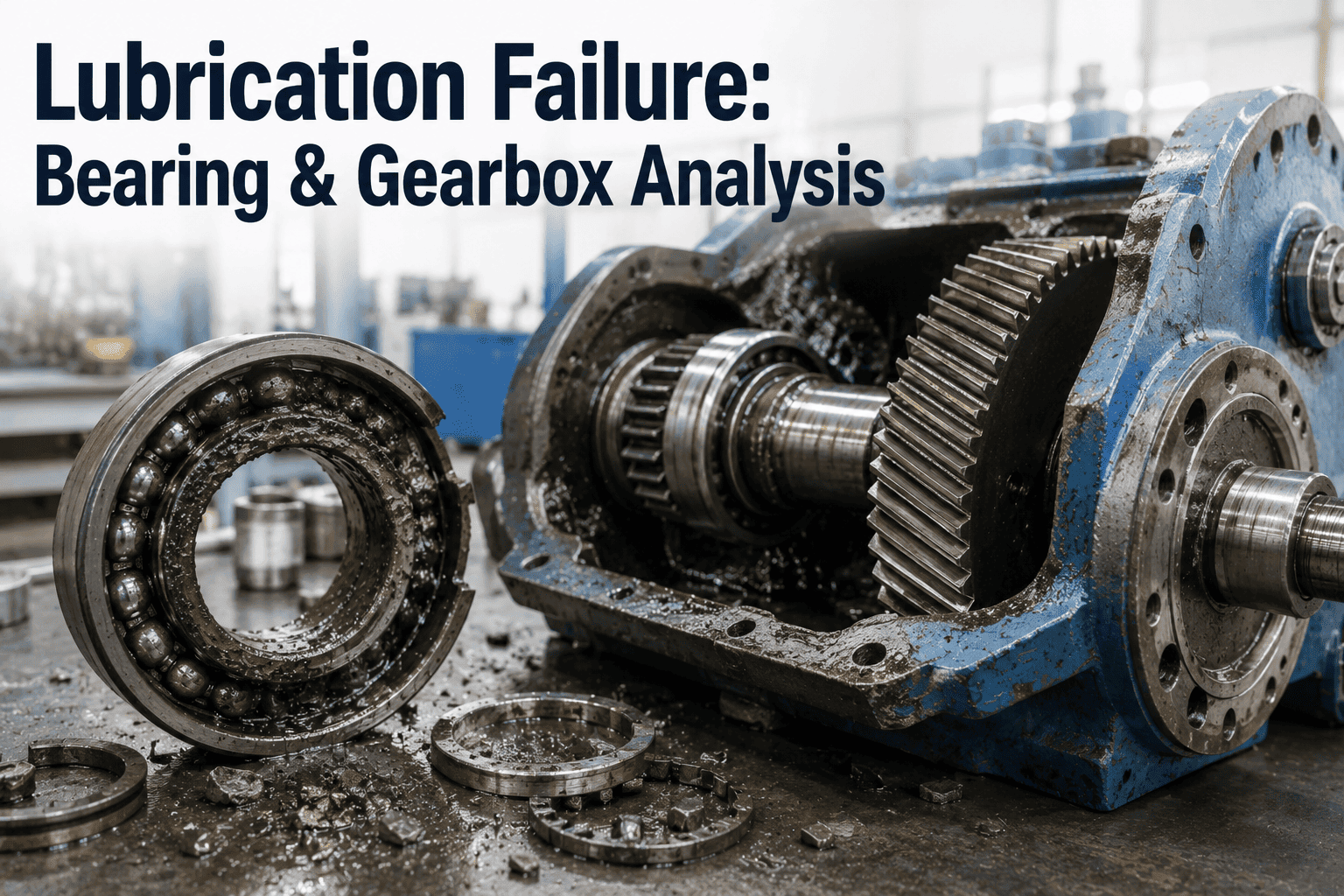
Most bearing and gearbox failures that get written up as "wear" or "fatigue" actually trace back to a lubrication problem somewhere upstream, whether that's the wrong grease for the load, a contaminated top-up, or an interval that was set once and never revisited. The mechanical failure is the visible event, but lubrication is usually where the real root cause is hiding. iFactory connects oil analysis results, lubrication schedules, and failure history so the pattern behind repeat failures becomes obvious instead of buried across separate maintenance records, and you can see it firsthand with a Book a Demo.
The Bearing Failed. The Lubrication Program Is Usually Where The Investigation Should Start.
Industry teardown studies consistently attribute a large share of bearing and gearbox failures to lubrication-related causes rather than pure fatigue, yet failure investigations often stop at the visible damage instead of tracing back to contamination, grease selection, or interval issues. iFactory links oil condition data directly to failure records so root cause analysis starts from evidence, not assumption.
Matching Bearing Damage Patterns To Their Lubrication Root Cause
The physical appearance of a failed bearing or gear tooth often points fairly directly at a specific lubrication issue, provided the damage pattern is read carefully rather than written off as generic wear.
| Damage Pattern | Likely Lubrication Cause | Confirming Check |
|---|---|---|
| Fine parallel scratches on raceway | Particulate contamination | Particle count and ISO cleanliness code |
| Dark etching, hydrogen embrittlement | Water contamination | Karl Fischer moisture test |
| Discoloration, overheating signs | Insufficient or wrong-viscosity lubricant | Viscosity check against OEM specification |
| Micropitting on gear tooth flank | Inadequate film thickness | Lambda ratio calculation for operating conditions |
| Varnish deposits on bearing surfaces | Oxidized or degraded oil | MPC score and acid number trend |
A single damage indicator can have more than one plausible cause, which is why the confirming lab check matters as much as the visual inspection in a genuine root cause investigation.
Where Lubrication Problems Actually Enter The System
Improper Regreasing Practices
Over-greasing raises internal bearing temperature and can force grease past seals, while under-greasing leaves surfaces starved during peak load conditions.
Wrong Lubricant Selection
Grease or oil chosen for a similar-looking application without matching load, speed, and temperature requirements often fails to build adequate film thickness.
Contaminated Top-Up Practices
Using uncapped containers, dirty funnels, or unfiltered transfer pumps introduces particulate and moisture directly into an otherwise clean system.
Mixed Or Incompatible Lubricants
Topping up with a different grease thickener type or oil base stock than what's already in service can degrade the lubricant's performance properties unexpectedly.
A Structured Approach To Lubrication Failure Investigation
What A Missed Lubrication Root Cause Actually Costs
Replacing a failed bearing without correcting the underlying lubrication issue almost guarantees a repeat failure, and the second failure is rarely cheaper than the first.
Reliability Engineers Face Repeat Failures
Without a documented lubrication root cause, the same bearing or gearbox position often fails again within a similar interval, consuming repair budget that a corrected lubrication program would have avoided entirely, and eroding confidence in the reliability program's ability to actually solve problems rather than just react to them.
Maintenance Managers Lose Planning Predictability
Recurring unplanned bearing and gearbox failures make it difficult to forecast parts inventory and labor needs accurately, forcing a reactive maintenance posture that consumes more resources than a corrected, condition-based lubrication schedule would require over the same period.
Trace Every Bearing Failure Back To Its Real Cause
iFactory links oil analysis trends to failure history so lubrication root causes surface automatically instead of getting missed in a teardown report.
Where Lubrication Failure Investigations Go Wrong
Stopping At "Normal Wear"
Classifying a failure as normal wear without checking oil analysis history closes the investigation before the actual lubrication cause has been ruled in or out.
Reviewing Only The Most Recent Sample
Looking at a single oil analysis result instead of the trend leading up to failure misses gradual contamination or additive depletion that built up over months.
Not Checking Task Compliance History
Assuming scheduled lubrication tasks were completed as planned without verifying against actual work order records overlooks a common and easily correctable root cause.
Fixing The Symptom, Not The Program
Replacing the failed part without updating the lubricant specification, interval, or handling procedure sets up the same failure to recur on the same or similar assets.
What Plants Typically See After Connecting Oil Data To Failure Records
Building A Lubrication Program That Actually Prevents Repeat Failures
A lubrication program that exists only as a paper schedule of intervals and product names rarely survives contact with a busy plant floor. Routes get skipped when staffing is tight, products get substituted when the specified grease isn't on the shelf, and none of it gets captured anywhere that connects back to the failure history it's supposed to be preventing. The programs that actually reduce repeat failures tend to share a common structure, one where the lubrication task, the product used, and the completion record are tied directly to the asset's failure and oil analysis history, so a missed or substituted task shows up as a visible gap rather than disappearing into a paper log nobody reviews until after something has already failed.
Getting to that point usually means starting with the assets that have the worst repeat-failure history rather than trying to overhaul the entire plant's lubrication program at once. Pulling the failure and oil analysis history for the ten or twenty worst-performing bearing and gearbox positions, checking each one against the framework above, and correcting the specific gap found at each position builds both a track record of results and a template that scales to the rest of the plant far more effectively than a blanket policy change applied everywhere at once without evidence behind it.
Connect Tasks To Outcomes
Link each lubrication work order to the specific asset's subsequent oil analysis results and failure history rather than tracking completion in isolation.
Start With Repeat Offenders
Prioritize the bearing and gearbox positions with the worst failure history first to build a track record before scaling program changes plant-wide.
Make Gaps Visible
Surface skipped tasks and product substitutions automatically so they get corrected before the next failure rather than discovered during the next investigation.
Frequently Asked Questions
Q: How can you tell the difference between fatigue failure and a lubrication-related failure?
Pure fatigue failure typically shows classic spalling with a smooth, polished progression pattern originating from a subsurface stress concentration, while lubrication-related failures more often show surface distress first, such as scratching, discoloration, or micropitting, that then progresses into secondary fatigue damage. Because advanced lubrication-related failures can eventually develop fatigue-like characteristics, checking oil analysis history alongside the damage pattern is important rather than relying on visual inspection of the failed part alone. Reach out through Support Contact to review a specific failure pattern against your oil analysis history.
Q: What is lambda ratio and why does it matter for lubrication failure analysis?
Lambda ratio compares the lubricant film thickness generated under operating conditions to the combined surface roughness of the two mating components, and it's a useful way to assess whether a bearing or gear is operating with adequate separation between metal surfaces. A lambda ratio below roughly one indicates boundary lubrication conditions where metal-to-metal contact is likely occurring, which explains micropitting and surface distress patterns even when the lubricant itself tests as chemically healthy in a standard oil analysis panel.
Q: Can contaminated lubricant be identified before it causes a failure?
Yes, routine particle counting and moisture testing typically catch rising contamination levels well before enough damage accumulates to cause a bearing or gear failure, provided sampling happens on a consistent schedule rather than only after a problem is already suspected. Trending ISO cleanliness codes against the target cleanliness level for that specific application gives an early warning that is usually available weeks to months ahead of any physical failure symptom. A Book a Demo session can show how this trending connects directly to your maintenance work order system.
Q: How often should regreasing intervals be reviewed and adjusted?
Regreasing intervals set at commissioning based on generic OEM guidance often don't reflect actual operating conditions like ambient temperature, contamination exposure, or load variation at a specific site, so a review after the first year of operating and failure history is generally worthwhile. After that, intervals should be revisited whenever a lubrication-related failure occurs, when operating conditions change meaningfully, or on a periodic basis such as annually, using oil analysis and grease sample data to confirm whether the current interval is appropriately conservative or actually too aggressive.
Q: Why do two identical bearings on the same machine sometimes fail from different lubrication causes?
Even identical bearing positions can experience different local conditions, such as one seal degrading before the other, uneven load distribution across the shaft, or one location being more exposed to ambient contamination during routine top-up procedures. This is why a failure investigation should treat each bearing position somewhat independently rather than assuming a single systemic cause automatically applies to every similar component on the same asset, even though checking for a shared cause is still a reasonable first step.
Stop Replacing Bearings Without Knowing Why They Failed
iFactory connects oil condition trends and task compliance directly to your failure records so root cause analysis is built on evidence, not guesswork.