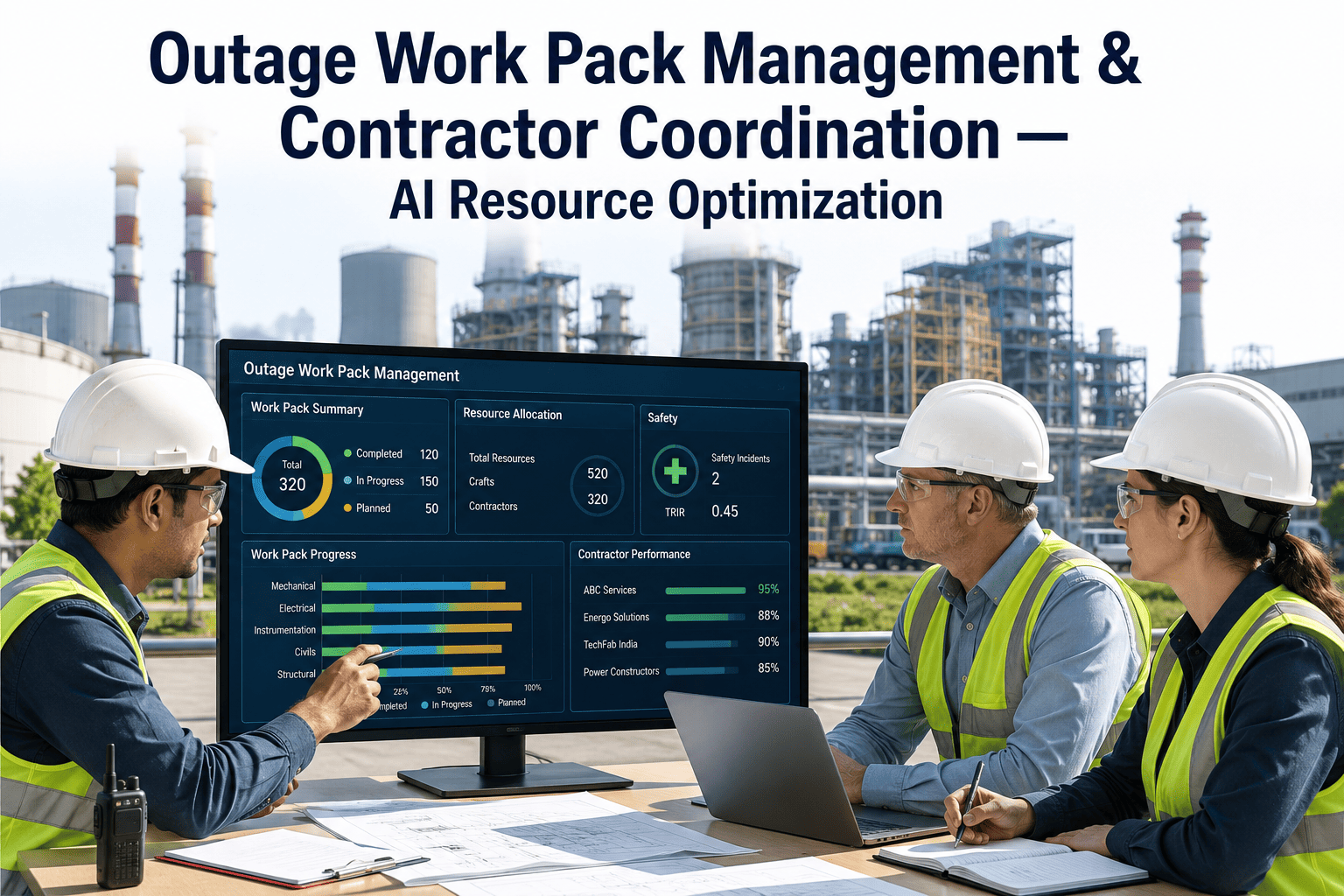
A major outage can involve fifteen to forty specialist contractor teams working in the same physical space during the same compressed window, and coordination breaks down the moment one handover goes unacknowledged or a permit quietly expires. Maintenance managers know the pattern well: a crew shows up on day one without certified personnel, a permit stalls a start by hours, or a scaffold conflict between two teams eats a shift nobody planned for. None of these are dramatic failures on their own, but stacked across dozens of work packages they routinely add days to a schedule that looked fine on paper. AI-powered resource optimization checks every work pack against its required crew, parts, permits, and tools well before the outage window opens, so day one starts with certainty instead of a scramble, and the readiness gaps most plants only discover the hard way can be reviewed ahead of time in a planning walkthrough.
OUTAGE WORK PACKS & CONTRACTOR COORDINATION
Make Sure Every Work Pack Is Actually Ready Before Day One
AI-powered resource optimization verifies crew certification, parts availability, permit status, and tooling for every outage work package well ahead of mobilization, closing the readiness gaps that quietly cost the most outage days.
15 to 40 Teams
Typical number of specialist contractor teams working concurrently during a major outage
3 to 7 Days
Added schedule time commonly traced back to coordination failures alone
10 Weeks Out
How far ahead material readiness checks can flag a missing part before it becomes a delay
What "Ready" Actually Means for a Work Pack
A work package is not ready just because it is scheduled. Every one of these needs to be confirmed before the crew shows up.
Crew Certified & Confirmed
The assigned contractor team has completed site induction and holds current certification for the specific scope of work.
Parts Staged
Every required spare is confirmed in stock or on order with a delivery date ahead of the scheduled task start.
Permits Pre-Approved
Hot work, confined space, and electrical isolation permits are staged and linked directly to the work order before shutdown.
Access & Tools Confirmed
Scaffolding, crane windows, and specialized tooling are scheduled with no overlap against other contractor teams.
The Coordination Failures Behind Most Outage Overruns
Late Mobilization
Teams that receive assignments only days before start often arrive without certified personnel or complete equipment.
Permit Delays
Paper-based permits can stall a contractor start by hours, and those hours compound across every shift of a multi-day outage.
Access Conflicts
Two contractor teams needing the same scaffold or physical space at the same time create on-site disruptions that were avoidable.
Untracked Scope Additions
Discovered work found during inspection needs a clear path to assignment or it stalls in coordination calls and emails.
See a Live Work Pack Readiness View for Your Next Outage
Walk through how crew, parts, permit, and tooling status would look across your full outage work package register.
How Work Pack Coordination Runs From Planning to Closeout
1
Work Package Creation
Every task is built into a structured package with scope, drawings, required crew type, and acceptance criteria attached.
2
Readiness Verification
Parts, permits, contractor certification, and tooling are checked automatically against each work package weeks ahead of mobilization.
3
Contractor Portal Access
Each contractor sees only their assigned scope, schedule, and permit status, updating progress directly without status calls.
4
Live Conflict Detection
Overlapping access, scaffold, or crane needs across contractor teams are flagged 24 to 48 hours before they cause a disruption.
5
Documented Closeout
Every completed package closes with labor hours, parts used, findings, and as-found versus as-left condition fully logged.
Frequently Asked Questions
Automated parts verification can run against every contractor work package roughly ten weeks before the outage start, comparing required materials against current stock and open purchase orders to flag anything that is missing or at risk of arriving late. This gives the procurement team a meaningful runway to expedite orders or source alternatives, rather than discovering a missing gasket or bearing on the day the task is scheduled to begin, which is one of the most common single-day delays in outage execution.
The system tracks the physical space, scaffold structure, and crane windows each work package requires and cross-references them against every other scheduled task in the same time window, surfacing conflicts 24 to 48 hours before they would otherwise become an on-site disruption. This kind of conflict is common in outages with fifteen or more concurrent contractor teams, since multiple crews often need the same access point without realizing it until someone shows up and finds it occupied.
Discovered work is logged as a formal scope addition directly against the affected asset, immediately visible to the outage manager and automatically assessed for its impact on the critical path before a contractor is assigned. This keeps scope changes processed in minutes rather than hours of coordination calls and email chains, and every addition is documented with its cost and schedule impact so nothing gets absorbed silently into the outage timeline. A full walkthrough of this workflow is available through support.
No, each contractor organization receives a role-limited portal showing only their assigned work packages, scheduled start times, permit requirements, and predecessor task status, without visibility into any other plant data. Contractors update their own task progress directly through this portal, which the outage manager sees reflected in the master schedule in real time, eliminating the need for phone calls or manual status compilation across dozens of teams.
Every completed work package closes with full documentation captured during execution, including labor hours, parts consumed, inspection findings, and as-found versus as-left equipment condition, rather than reconstructed afterward from paper notes or memory. This documentation is available immediately at outage completion for regulatory submissions, warranty claims, and next-cycle outage planning, and a demo can show exactly what that closeout package looks like for your equipment types.
ZERO AMBIGUITY ON DAY ONE
Give Every Contractor a Fully Ready Work Pack
See how crew, parts, permit, and access verification can eliminate the coordination failures that add days to your outages.





.png)