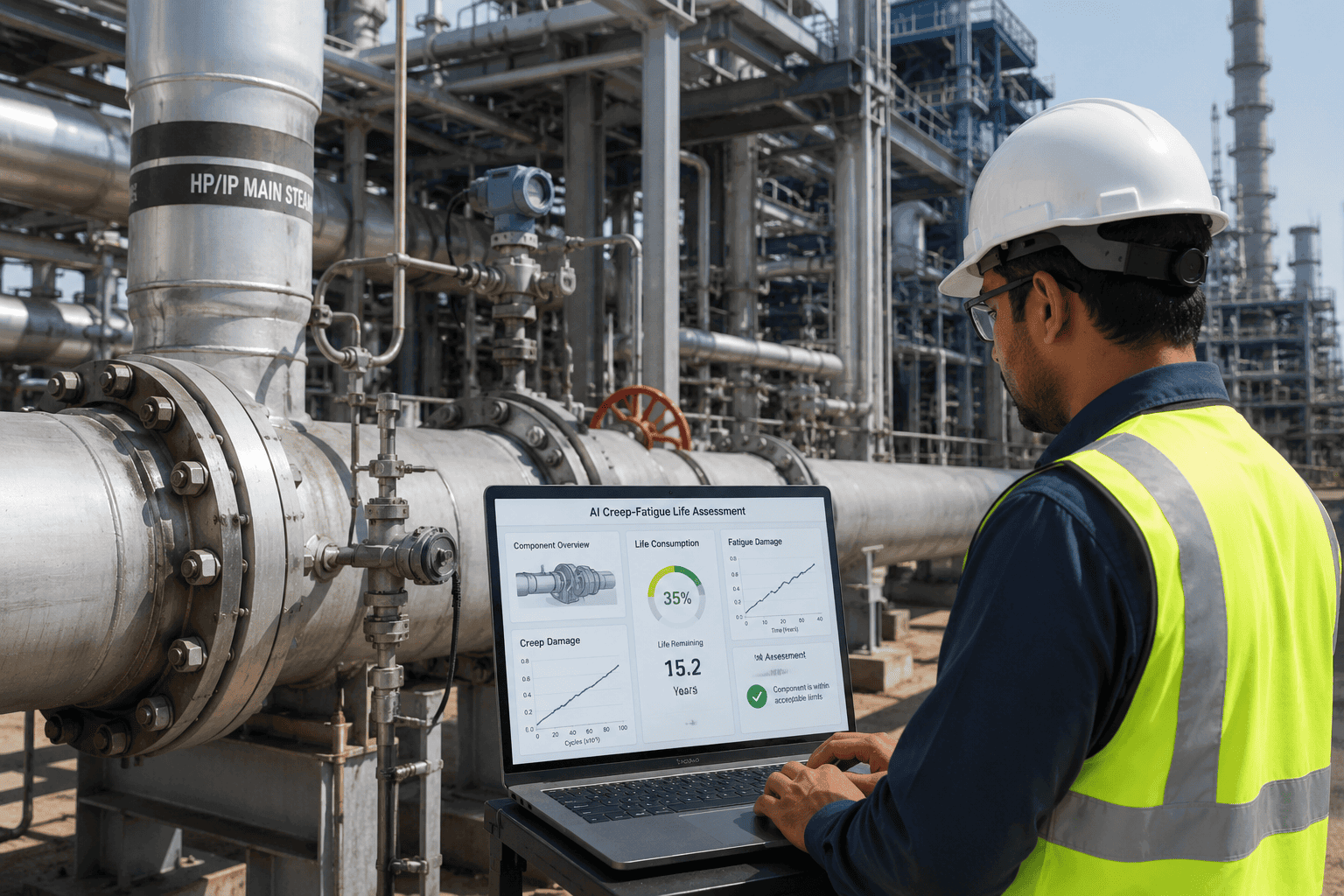
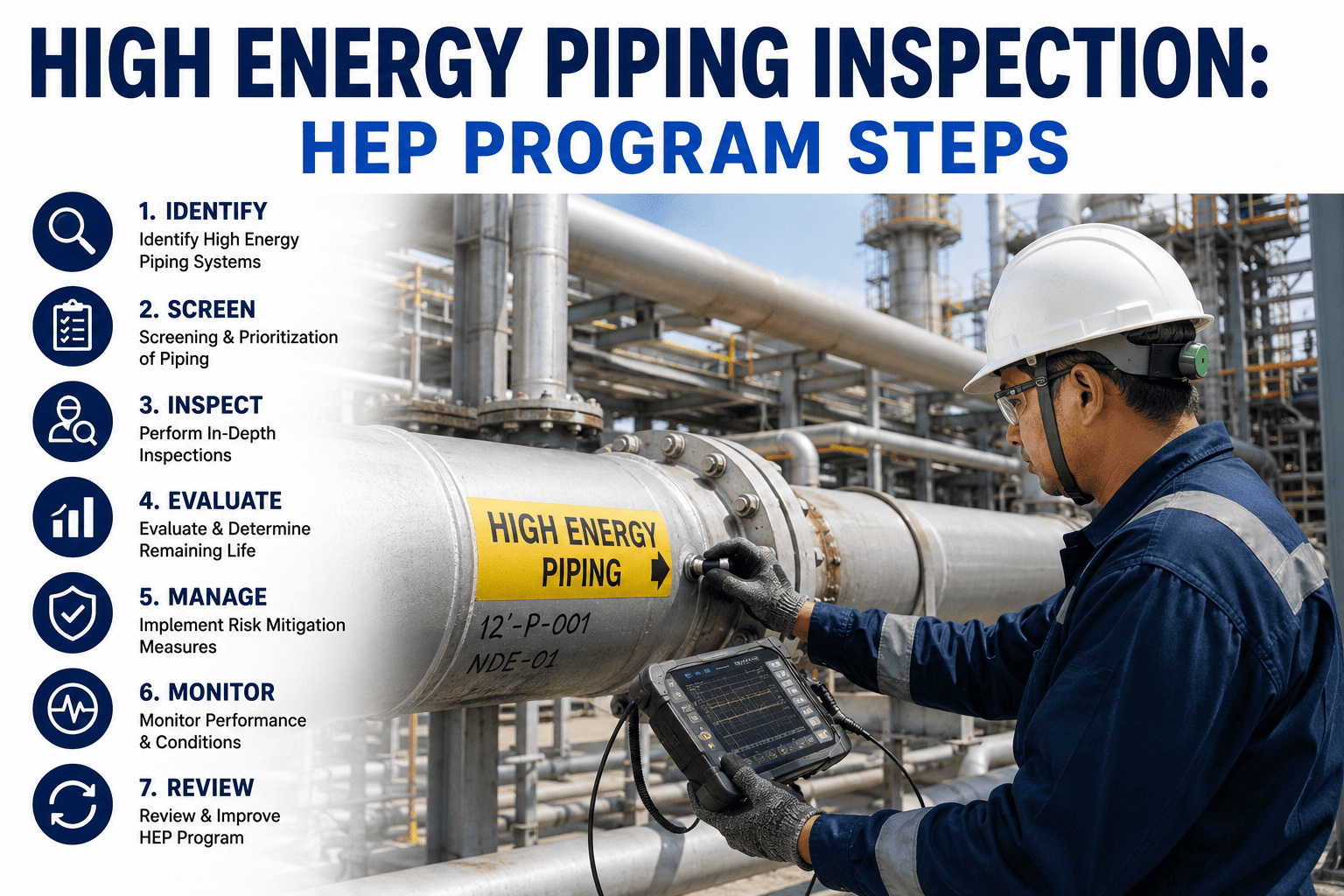
High-energy piping does not fail the way most plant equipment fails. A pump seizes and the motor trips. A valve leaks and the packing gets replaced. But when a main steam or hot reheat pipe ruptures, superheated steam at 1,000 degrees and 2,000 psi escapes with the force of an explosion — destroying everything and everyone in its path. The two catastrophic seam-welded hot reheat failures in the 1980s that killed plant workers proved that these systems cannot be managed with periodic visual inspections and hope. Creep damage accumulates invisibly inside grain boundaries over hundreds of thousands of operating hours, fatigue cycles from load-following operation crack surfaces that were designed for baseload, and hanger malfunctions silently redistribute stress to welds that nobody flagged as high risk. AI-powered integrity management tracks all of it — every weld, every cycle, every degree of temperature, every hanger load — and tells your team which joints are consuming life fastest before the next outage inspection window — book a demo to see it running against your piping data.
Balance of Plant · Piping Integrity AI
AI Creep-Fatigue Life Assessment for High-Energy Piping Systems
Know the remaining life of every weld in your main steam, hot reheat, and cold reheat piping — calculated from actual operating data, not from design assumptions that expired 200,000 hours ago.
350,000+ hrs
Many MS piping systems now exceed 3.5x their 100,000-hour ASME design life
1,000-1,050 F
Operating temperatures where creep voids form continuously in grain boundaries
Catastrophic Risk
HEP failures have caused fatalities — the only piping class where rupture is immediately life-threatening
What Makes Piping "High-Energy"
750 F
Temperature threshold
OR
1,025 psi
Pressure threshold
AND
Any piping system meeting these criteria per ASME B31.1 Power Piping Code requires a formal integrity management program with documented inspection, life assessment, and risk-based prioritization. This includes main steam lines from boiler outlet to HP turbine, hot reheat from HP turbine exhaust through reheater to IP turbine, and cold reheat from HP exhaust to reheater inlet.
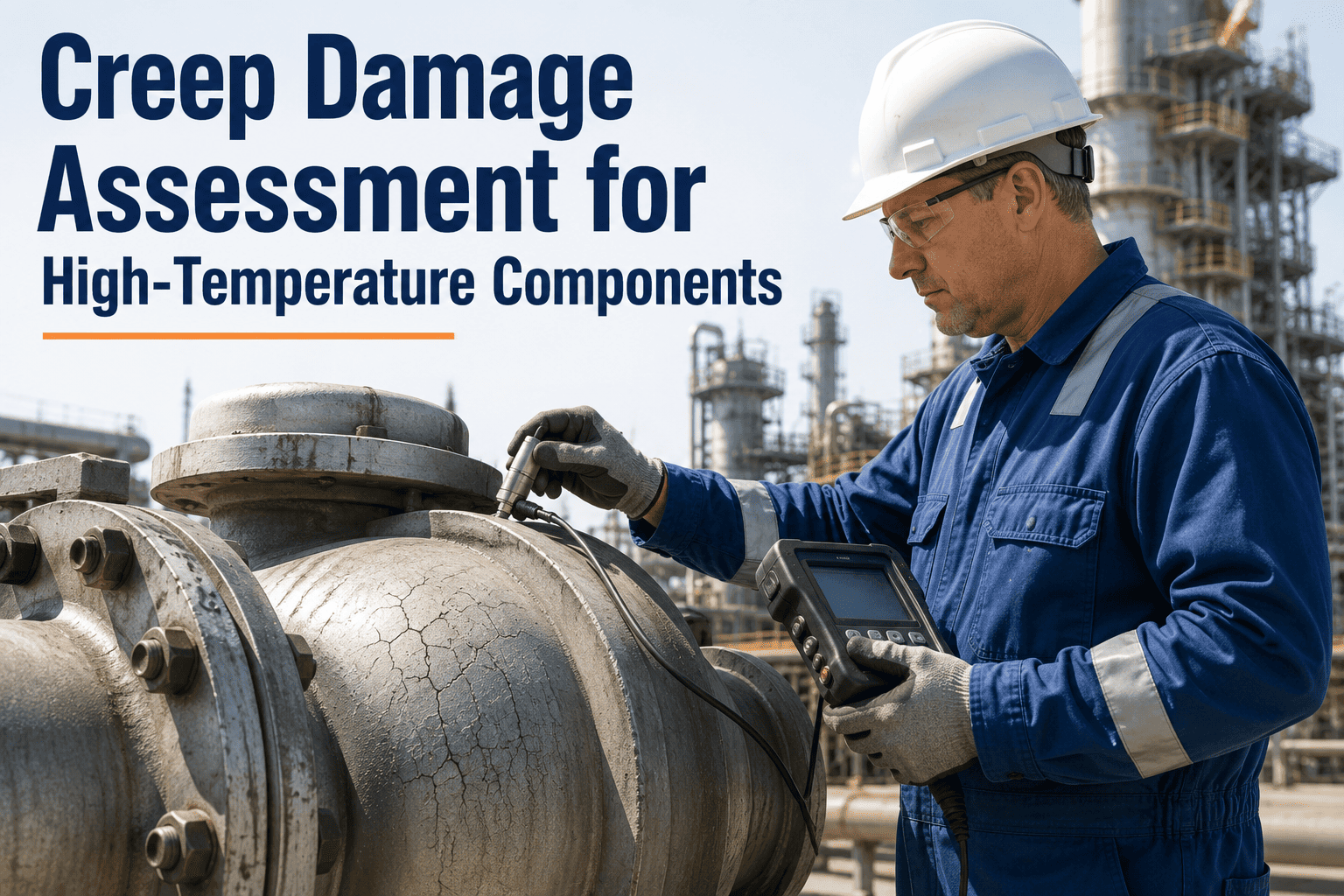
How Creep Damage Progresses — and Why It Is Invisible Until It Is Not
Creep is not a sudden event. It is a metallurgical process that unfolds over tens of thousands of hours at temperatures above 900 F, progressing through distinct stages that can be identified by surface replication — if someone is looking at the right weld at the right time.
Stage I — Isolated Cavities
0-60% life consumed
Individual voids form at grain boundary triple points under sustained stress. Detectable only by surface replication at high magnification. No visible cracking. Pipe is safe to operate with routine monitoring intervals.
Stage II — Oriented Cavitation
60-80% life consumed
Voids begin aligning along grain boundaries perpendicular to the principal stress direction. Pattern visible in replication. Monitoring intervals should be shortened. Phased-array UT recommended to assess cavity alignment depth.
Stage III — Micro-Cracking
80-95% life consumed
Cavities link to form micro-cracks along grain boundaries. Detectable by UT and potentially by acoustic emission monitoring. Repair or replacement planning must begin immediately. Operating restrictions may be warranted.
Stage IV — Macro-Crack and Rupture
95-100% life consumed
Micro-cracks coalesce into a through-wall or near-through-wall defect. Tertiary creep accelerates. Pipe must be removed from service. If this stage is reached without detection, catastrophic rupture is the outcome.
AI tracks life consumption continuously using Larson-Miller Parameter calculations from actual temperature and stress data, correlating the metallurgical stage from the most recent replication against the calculated life fraction — so the model validates itself with every inspection.
The window between detectable creep damage and catastrophic rupture is measured in inspection intervals, not in years. AI ensures the right welds are inspected at the right time by continuously risk-ranking every joint based on actual life consumption, not on a rotation schedule that treats all welds as equally risky.
Main Steam vs. Hot Reheat vs. Cold Reheat — What Each System Demands
| Parameter |
Main Steam |
Hot Reheat |
Cold Reheat |
| Temperature |
1,000-1,050 F |
1,000-1,050 F |
600-750 F |
| Pressure |
1,800-3,500 psi |
350-600 psi |
350-600 psi |
| Typical materials |
P22, P91, P92 |
P11, P22, P91 |
Carbon steel, P11 |
| Primary damage |
Girth weld creep, Type IV HAZ cracking |
Seam weld longitudinal creep, thermal fatigue |
Flow-accelerated corrosion, corrosion fatigue |
| Critical components |
Girth welds, elbows, tees, reducers |
Seam welds, long-radius bends, wye blocks |
Elbows, reducers, attemperator zones |
| Inspection priority |
Highest — every girth weld tracked |
Highest — seam welds are the 1980s failure mode |
Moderate — FAC wall thinning at flow changes |
The Inspection Toolkit — What Each Method Detects
No single NDE method catches every damage mechanism. AI integrates findings from all methods into a unified life assessment for each weld — so the metallurgical picture is assembled from multiple data sources rather than depending on any one technique.
Surface Replication
Detects: Creep cavity stage classification, microstructure degradation, grain boundary condition
When: Every outage at priority welds — the primary creep damage staging tool
Phased-Array UT
Detects: Subsurface crack size and depth, cavity alignment, volumetric defects in weld body
When: Follow-up when replication shows oriented cavitation or to size known indications
Conventional UT
Detects: Wall thickness for FAC trending, OD and minimum wall verification
When: Every outage for cold reheat and feedwater piping at FAC-susceptible locations
Magnetic Particle
Detects: Surface-breaking cracks at weld toes, thermal fatigue cracking, quench damage
When: Every outage at welds near attemperators, spray water injection, and turbine bypasses
Acoustic Emission
Detects: Active crack growth during operation, locates AE sources for follow-up NDE targeting
When: Between outages on hot reheat lines — monitors through insulation without removal
Hanger Monitoring
Detects: Load redistribution, spring bottoming, constant-force binding, support settlement
When: Continuous during operation — catches stress changes that inspection alone cannot see
How AI Transforms Piping Integrity from Periodic to Continuous
Weld Registry
Every circumferential weld, seam weld, branch connection, and fitting is catalogued with material grade, installation date, dimensional data, and complete inspection history. No more spreadsheet-based weld tracking that loses data when someone leaves the team.
Life Consumption Engine
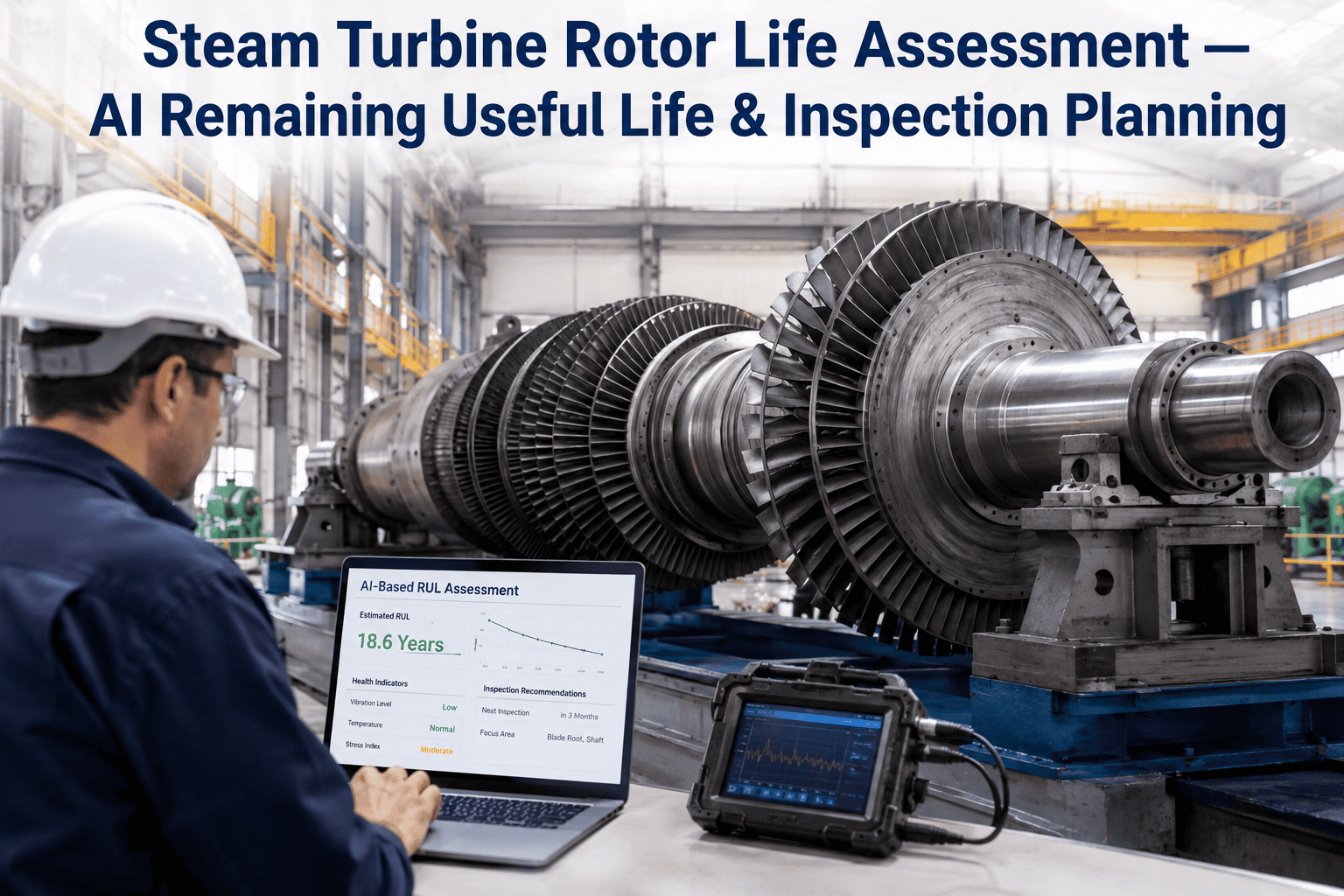
Larson-Miller Parameter calculations using actual temperature and pressure from the plant historian, actual startup/shutdown cycle counts against material-specific S-N curves, and creep-fatigue interaction per ASME-NH or R5 methodology — recalculated after every operating period and validated against every inspection result.
Risk-Ranked Inspection Planning
Every weld ranked by combined creep fraction, fatigue damage, stress analysis, material susceptibility, and inspection findings. The outage inspection plan is generated automatically, ensuring the highest-risk joints are examined first — even when the outage window is shorter than planned.
Hanger Health Integration
Real-time hanger load and displacement data feeds into the stress model. When a hanger malfunction redistributes load, the system recalculates stress at every affected weld and updates remaining life — catching accelerated damage that walkdown inspections at cold conditions would never see.
Turnkey AI Deployment — Rack, Connect, Assess
Every piping integrity deployment ships as a pre-configured NVIDIA AI server with weld registry, Larson-Miller life engine, hanger monitoring, and inspection management software pre-loaded. Your team racks it, connects to historian and inspection database, and the system begins building risk-ranked assessments within days. Cabling, network integration, operator training, and 24/7 remote monitoring included.
We have 340 girth welds on our main steam system and only a 14-day outage window. How do we decide which welds to inspect?
Based on current life consumption calculations, I have 23 welds above 0.65 life fraction and 8 welds above 0.75. Of those, 4 welds — MS-12, MS-47, MS-89, and MS-156 — are in the top risk tier due to combined high creep fraction, proximity to malfunctioning hangers HG-08 and HG-11, and P22 material susceptibility. I recommend surface replication at all 23 welds above 0.65, phased-array UT at the top 8, and prioritizing MS-47 first based on its 0.78 life fraction and last replication showing Stage 2B oriented cavitation. This scope fits within 10 days of NDE crew time, leaving 4 days of margin.
1,000+
Industrial clients worldwide
99.9%
Platform uptime guarantee
6-12 Wks
Rack to live assessment
Expert Insight
The biggest gap in most high-energy piping programs is not the quality of the inspections — it is the connection between the inspections and the life assessment. A plant does replication on 20 welds during an outage, gets the metallurgical report back three months later, and files it in a binder. Meanwhile, the stress analysis was done five years ago using design loads, and nobody has checked whether the hanger that was bottomed out last year has changed the stress at the weld that just showed oriented cavitation. AI closes that gap by connecting inspection findings, operating data, and hanger conditions into a single continuously-updated life model for every weld. The plants that adopt this approach stop finding surprises during outages — because the surprises were flagged between outages, when there was still time to plan the response.
Thomas Reinhardt — HEP Integrity Specialist, 22 years conducting piping stress analysis, remaining-life assessments, and metallurgical failure investigations for fossil and combined-cycle plants
Frequently Asked Questions
How does the Larson-Miller life calculation work with actual operating data?
The Larson-Miller Parameter (LMP) is a time-temperature correlation that relates the combination of operating temperature, stress, and time to creep rupture. Traditional assessments use design temperature and allowable stress, which overpredicts damage when actual temperatures are lower than design and underpredicts when temperatures exceed design during excursions. The AI system pulls actual temperature data from the plant historian at each piping segment, calculates the LMP for every operating interval, and sums the creep life fraction consumed over the entire operating history. The result is a remaining-life estimate grounded in what the pipe actually experienced — including hot-side excursions that a design-basis calculation would miss entirely. When the calculated life fraction is compared against the replication cavity classification from the most recent inspection, the model self-validates.
Book a demo to see the life engine running against your historian data.
What piping materials and assessment codes does the platform support?
The platform includes material property databases for P11 (1-1/4 Cr-1/2 Mo), P22 (2-1/4 Cr-1 Mo), P91 (9Cr-1Mo-V), P92 (9Cr-2W), and carbon steel grades — covering the full range of materials found in fossil and HRSG high-energy piping. Creep rupture properties, Larson-Miller constants, fatigue S-N curves for base metal and weldments, and isochronous stress-strain data are built in. Assessment methodologies include ASME B31.1 Power Piping Code, API 579-1/ASME FFS-1 Fitness-for-Service, EPRI high-energy piping guidelines, and R5 creep-fatigue interaction procedures. The system also supports Type IV HAZ creep cracking assessment specific to P91 and P22 dissimilar metal welds.
Contact support to confirm coverage for your specific material grades and code requirements.
How does risk-ranked inspection planning save money during outages?
A typical main steam system has 200-400 girth welds. Inspecting every weld during every outage is physically impossible and financially impractical — each replication point requires insulation removal, surface preparation, and several hours of metallurgical technician time. Without risk ranking, plants either follow a rotation schedule (which may miss the highest-risk welds for multiple cycles) or inspect based on accessibility (which prioritizes convenience over criticality). AI risk ranking ensures the NDE budget is spent on the welds with the highest calculated life consumption, the most concerning replication history, and the greatest exposure to hanger-induced stress redistribution. Plants consistently report that risk-ranked programs catch damage earlier while inspecting fewer total welds per outage — reducing NDE cost while improving program effectiveness.
Book a demo to see how the risk ranking would prioritize your specific weld inventory.
Why is hanger monitoring important for piping integrity?
A piping stress analysis assumes every support is functioning as designed — carrying its intended load and allowing the pipe to move freely during thermal expansion. When a spring hanger bottoms out, a constant-force support binds, or a rigid anchor settles, the load that support was carrying transfers to adjacent welds and supports, changing the actual stress at those joints. This stress redistribution accelerates creep damage at locations that the stress analysis said were safe. Walkdown inspections during cold outage conditions can identify some hanger problems, but many failure modes — binding at operating temperature, gradual load drift, intermittent restraint — only manifest during hot operation. Continuous hanger monitoring with load cells and displacement sensors captures the actual support behavior under operating conditions, feeds it into the stress model, and recalculates remaining life at every affected weld in real time.
Contact support to discuss hanger monitoring integration with your HEP program.
What ROI does AI piping integrity deliver for aging power plants?
The ROI comes from three sources: catastrophic failure avoidance (a single HEP rupture can cause fatalities, months of forced outage, and tens of millions in equipment replacement and liability costs), optimized inspection spending (risk-ranked prioritization reduces the number of welds inspected per outage while improving program effectiveness, saving NDE and insulation removal costs), and deferred capital expenditure (accurate remaining-life calculations allow plants to continue operating piping that a conservative design-basis assessment would have flagged for premature replacement, potentially deferring pipe replacement programs by years when the data supports continued operation). For plants operating beyond 200,000 hours on aging piping systems, the cost of the AI platform is typically recovered within the first outage cycle through more efficient inspection planning alone.
Book a demo to estimate the specific ROI for your HEP program.
Design Life Was a Starting Assumption — Not a Guarantee
Replace the binders, rotation schedules, and design-basis assumptions with AI that tracks every weld, every hanger, and every hour of actual creep-fatigue damage across your entire high-energy piping system.