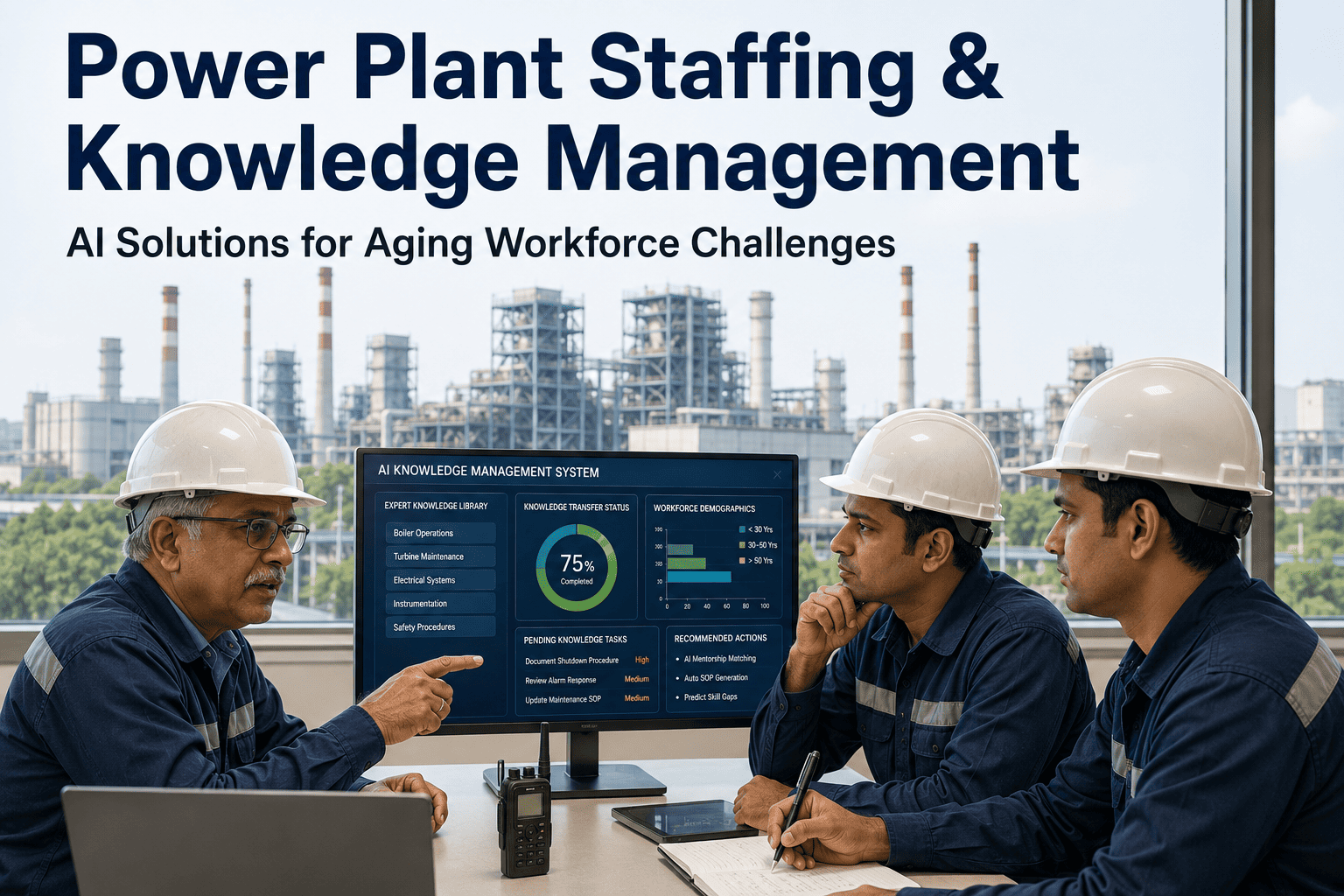
Somewhere in your plant right now, a maintenance technician with thirty-one years on the job knows exactly why that one feedwater pump vibrates slightly differently than its twin, and none of that knowledge exists in a work order, a manual, or a CMMS note — it exists only in his head. He is fifty-nine. Across the power generation industry, plant managers are watching a wave of retirements arrive faster than replacement hiring can absorb it, and the real cost is not the open headcount, it is the decades of undocumented judgment walking out the door with each departure. Closing that gap now requires more than faster recruiting; it requires AI-driven knowledge capture and staffing tools built specifically for the realities of an aging generation workforce.
The Workforce Pyramid Is Inverting Faster Than Most Plants Are Ready For
Generation plants built their operational depth over decades of relatively stable staffing, with senior technicians and operators accumulating plant-specific knowledge that new hires absorbed gradually through years of mentorship. That model assumed a steady pipeline of tenure. It did not assume a five-to-ten-year window in which a third or more of the most experienced staff would retire in a compressed span, taking troubleshooting instincts and undocumented workarounds with them faster than any structured knowledge transfer program could realistically keep up.
Composite workforce distribution reported across mid-size U.S. generation fleets, illustrating the succession gap between veteran and early-career staff.
Look closely at that middle tier and the real problem comes into focus. The experienced group is supposed to be the succession pipeline — the people who step up when veterans retire — but many of them were hired during the same lean staffing years that also thinned out structured mentorship programs. They have the tenure to be considered ready, but not always the depth of exposure to the rare, high-consequence events that veteran staff have simply seen more of over a longer career. Treating tenure as a proxy for readiness is exactly the assumption that AI-driven succession scoring is built to correct.
How AI Knowledge Capture Actually Preserves What Retiring Staff Know
Formal documentation efforts have existed for years and have consistently underperformed, because they ask veteran staff to sit down and write procedures from memory — a format that captures general knowledge but rarely captures the specific judgment calls that only surface when something goes wrong. AI-driven knowledge capture works differently, extracting expertise from the way experienced staff actually work rather than asking them to reconstruct it from a blank page.
The distinction matters more than it might seem. A written procedure tells a technician what steps to follow under normal conditions. It rarely explains why a veteran technician overrides that procedure on a specific piece of equipment, or what subtle symptom tips them off that a routine fault is actually something more serious. That kind of judgment only surfaces in the moment it is applied, which is precisely why capture has to happen inside real work rather than in a retrospective writing exercise months or years after the knowledge was formed.
Staffing Optimization: Matching Coverage to Actual Risk, Not Just Headcount
Knowledge capture solves the retention problem, but plant managers still need to solve the staffing problem in real time — deciding where to prioritize hiring, cross-training, and overtime coverage as the workforce shifts. AI staffing analytics gives that decision a data foundation instead of a gut-feel headcount target, replacing the annual budget-cycle guesswork most plants still rely on with a continuously updated view of where the organization's actual risk is concentrated.
This matters because headcount alone has never been the right measure of staffing health. A plant can be fully staffed on paper and still carry enormous risk if the handful of people who hold a rare certification or understand a specific legacy control system are all approaching retirement at the same time. Plant managers need visibility into that kind of concentrated risk long before it shows up as an unfilled requisition, and that visibility is exactly what tenure-blind headcount planning has never been able to provide.
The four capabilities below work together as a single continuously updated model rather than four separate reports, so a change in one — a new retirement date entered into HR, a completed cross-training certification — automatically ripples through the others and updates the overall risk picture in real time.
Measured Impact Across the Workforce Transition
| Workforce Metric | Before AI Knowledge & Staffing Tools | After Deployment |
|---|---|---|
| Time to resolve unfamiliar equipment faults | Hours, dependent on reaching a veteran staff member | Reduced 35–45% via searchable knowledge base |
| Documented troubleshooting knowledge per critical asset | Sparse, informal, undocumented | Structured entries captured continuously from daily work |
| Single-point-of-failure roles identified | Rarely tracked formally | Mapped and prioritized for cross-training |
| New hire ramp-up to independent competency | 18–24 months, informal mentorship | 12–16 months, supported by knowledge base and simulation training |
| Staffing shortfall lead time for recruiting | Reactive, often after vacancy occurs | 12–24 months advance visibility |
Frequently Asked Questions
Knowledge capture is designed to fit inside work technicians are already doing rather than requiring separate documentation sessions. AI-guided prompts appear during work order completion and equipment troubleshooting, capturing context and reasoning in short structured entries rather than asking for a formal written procedure. Contact support to see how the capture workflow fits your CMMS.
Every knowledge entry goes through a review step where senior staff or engineering can validate, correct, or add context before it is published to the searchable knowledge base, and usage analytics identify entries that may need refinement based on how often they actually resolve the issue technicians are searching for.
The model cross-references tenure and projected retirement timing with role criticality, certification requirements, and how much institutional knowledge for that role has already been captured, producing a prioritized risk ranking rather than a simple headcount gap report. Book a demo to see a sample risk map.
iFactory integrates with existing CMMS and HR data sources via API to pull tenure, certification, and work order history, and the knowledge base surfaces inside your existing maintenance workflow rather than requiring technicians to log into a separate application to search for guidance.
Knowledge capture can begin within weeks of deployment and is typically prioritized around staff with the nearest retirement dates first, so the highest-risk knowledge is captured before it becomes urgent. Staffing risk mapping is available almost immediately once tenure and role data are integrated. Contact support to discuss an accelerated timeline for near-term retirements.

.png)