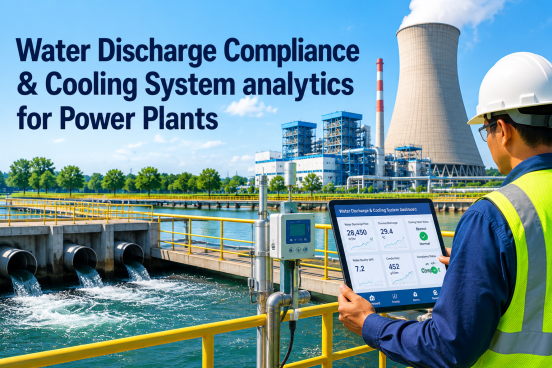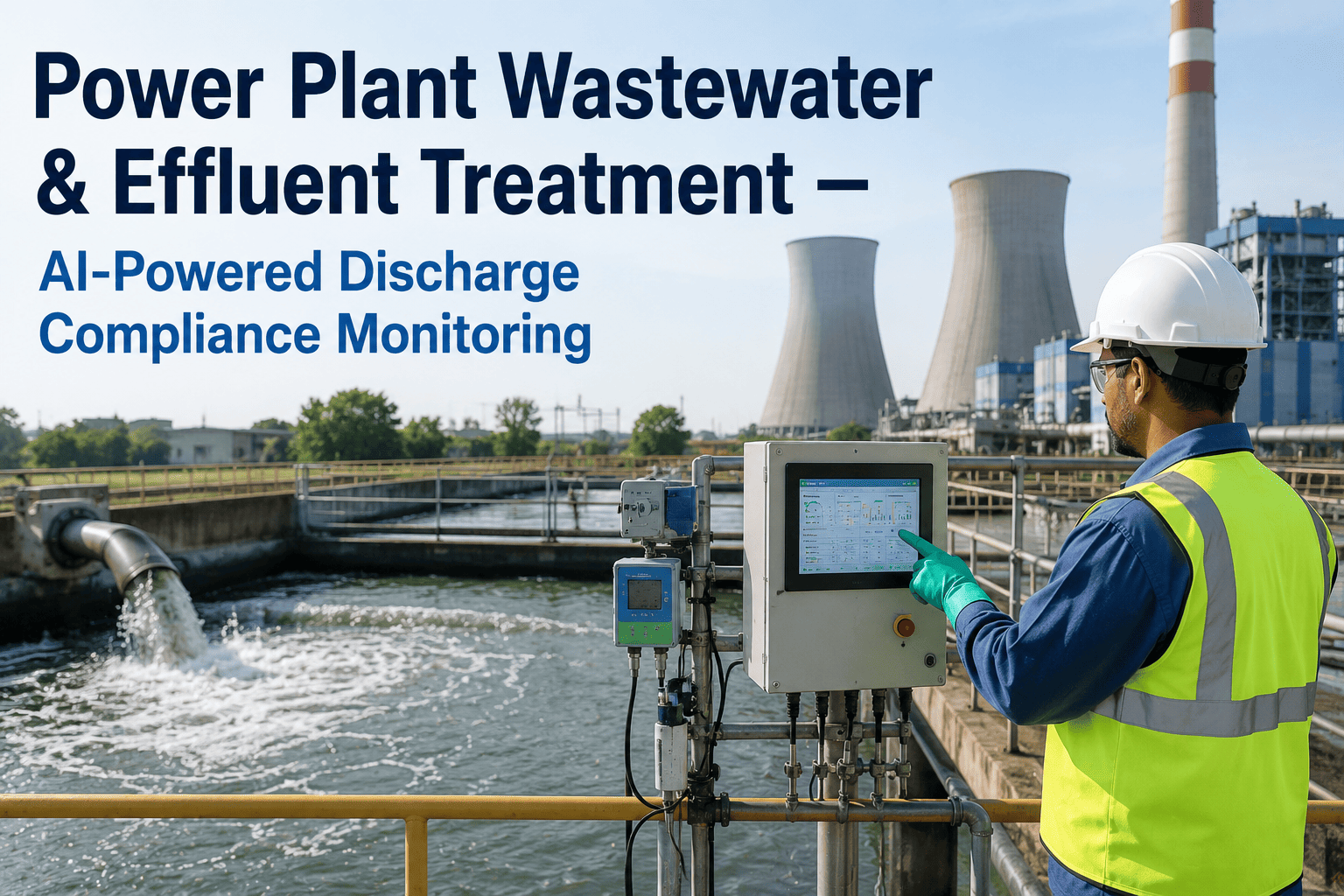
Power plant wastewater discharge compliance represents one of the most consequential regulatory risk areas that EHS managers navigate, with NPDES permit violations carrying penalties ranging from $56,460 per day per violation under the Clean Water Act to potential criminal liability for knowing violations. The EPA's 2020 Effluent Limitations Guidelines for the steam electric power generating category imposed stringent new requirements on FGD wastewater, bottom ash transport water, and combustion residual leachate that have forced dozens of plants to invest in advanced treatment systems or face shutdown of non-compliant discharge streams. AI-powered effluent monitoring is transforming how EHS teams manage this risk by providing continuous, predictive compliance intelligence that catches excursions before discharge occurs. Book a Demo to see how AI monitoring protects your discharge compliance posture.
Power Plant Wastewater and Effluent Treatment with AI-Powered Discharge Compliance Monitoring
An EHS management guide to AI-driven effluent monitoring, NPDES permit compliance tracking, and discharge risk prevention across FGD wastewater, cooling tower blowdown, ash pond discharge, and combustion residual leachate streams.
Replace periodic discharge sampling with continuous AI-powered compliance intelligence that predicts and prevents effluent limit exceedances before discharge occurs.
NPDES Permit Requirements and the 2020 Effluent Limitations Guidelines Impact
The NPDES permit system administered by EPA and delegated state agencies establishes facility-specific discharge limits for each wastewater outfall based on technology-based effluent limitations and water quality-based standards. The 2020 Steam Electric Power Generating Effluent Limitations Guidelines fundamentally reshaped compliance requirements for coal-fired power plants by establishing new best available technology economically achievable standards for FGD wastewater, bottom ash transport water, and combustion residual leachate. These new limits eliminated the longstanding regulatory certainty that many EHS teams had built their compliance programs around, requiring investment in new treatment technologies including chemical precipitation, biological treatment, membrane filtration, and zero liquid discharge systems. The compliance deadline timeline, combined with the operational complexity of new treatment systems, has created a period of elevated violation risk that AI monitoring is specifically designed to address.
FGD Wastewater — New BAT Limits
Total suspended solids below 30 mg/L, total mercury below 1.4 ng/L, arsenic below 5.0 ug/L, selenium below 7.6 ug/L, and nitrate below 16 mg/L. These limits require advanced treatment beyond conventional chemical precipitation for most FGD systems, with biological selenium removal and membrane filtration becoming standard technology selections. Compliance monitoring must track treatment system performance across multiple process stages to detect upsets before final discharge limits are exceeded.
Bottom Ash Transport Water — Zero Discharge Requirement
The 2020 ELG requires closure of bottom ash impoundments and elimination of surface discharge of bottom ash transport water. Plants must convert to dry handling or closed-loop recirculation systems. For EHS managers, this requirement eliminates one discharge stream but increases monitoring focus on remaining outfalls and requires documentation of closure compliance, groundwater monitoring at closed impoundment sites, and stormwater management at former ash handling areas.
Combustion Residual Leachate — New Subcategory Limits
Leachate from coal ash landfills and surface impoundments must meet new limits for boron, cadmium, chromium, fluoride, lead, antimony, and thallium. These limits apply to both active and closed CCR units, creating long-term monitoring obligations that extend well beyond plant operating life. AI monitoring systems track leachate quality trends against declining limit trajectories and predict when treatment system upgrades or closure activities will be required to maintain compliance.
Cooling Tower Blowdown — Existing Limits with Increased Scrutiny
Chlorine, total residual oxidant, zinc, and copper limits for cooling tower blowdown discharge remain under existing BAT standards but face increased regulatory scrutiny as other discharge streams are eliminated or treated to higher standards. With fewer discharge outfalls to monitor, regulatory agencies are allocating more inspection and sampling resources to remaining outfalls, increasing the probability that intermittent excursions will be detected through compliance sampling rather than self-reporting.
Five Critical Power Plant Wastewater Streams and Their Compliance Risk Profiles
Each wastewater stream at a power plant carries a distinct contaminant profile, treatment requirement, and compliance risk level that determines the monitoring intensity and AI model configuration needed for effective discharge protection. The following classification provides EHS managers with a structured risk assessment framework for prioritizing monitoring resources across multiple discharge outfalls.
FGD Wastewater
Flue gas desulfurization wastewater contains the most complex contaminant load at coal-fired plants, including dissolved solids, heavy metals, nutrients, and organic compounds from absorbent degradation. The 2020 ELG limits for mercury, selenium, arsenic, and nitrate require multi-stage treatment that introduces multiple failure points where process upsets can cause discharge exceedances. FGD wastewater consistently ranks as the highest-risk discharge stream in industry compliance data.
Ash Pond Discharge
Surface discharge from coal ash impoundments carries suspended solids, dissolved metals leached from ash, and sulfate from fly ash interaction with water. The CCR rule and 2020 ELG are driving ash pond closure, but remaining active discharge streams face strict interim limits and accelerated compliance timelines. Seasonal variations in precipitation and pond turnover events create intermittent quality excursions that periodic sampling cannot reliably capture.
CCR Leachate
Leachate generated by rainfall percolation through coal ash landfills and impoundments contains dissolved constituents at concentrations that vary with ash composition, contact time, and precipitation patterns. Leachate quality is inherently variable due to weather dependence, creating compliance monitoring challenges that require continuous analysis rather than periodic grab sampling to ensure that treatment systems are sized and operated correctly for the actual influent quality range.
Cooling Tower Blowdown
Cooling tower blowdown concentrates cycle-up minerals and treatment chemicals from the recirculating cooling water system. The primary compliance parameters are total residual oxidants, copper from heat exchanger corrosion, and zinc from corrosion inhibitor programs. Biocide discharge events following cooling system cleaning or shock treatment create intermittent excursions that are the most common cause of cooling tower blowdown violations.
Low-Volume Wastewater
Low-volume wastewater streams including floor drains, equipment washwater, laboratory waste, and metal cleaning wastewater are typically collected in a holding tank and batch-discharged after neutralization and treatment. While individual volumes are small, the variable composition and batch discharge pattern create compliance risk because each discharge event must meet permit limits, and treatment system performance is verified only at the point of discharge rather than through continuous monitoring.
Effluent Discharge Parameters, NPDES Limits, and AI Alert Configuration
Effective AI-powered compliance monitoring requires precise parameter thresholds calibrated below NPDES permit limits to provide early warning of developing exceedances. The following matrix presents the primary discharge parameters across wastewater stream types with AI alert thresholds set to enable corrective action before discharge occurs.
| Parameter | FGD Wastewater Limit | Ash Pond Limit | Cooling Blowdown Limit | AI Alert Threshold | Violation Consequence |
|---|---|---|---|---|---|
| Total Suspended Solids | 30 mg/L daily max | 30-100 mg/L | 30 mg/L monthly avg | 75% of permit limit | Per-day penalty; treatment system performance failure indication |
| Total Mercury | 1.4 ng/L monthly avg | Not typically limited | Not typically limited | 60% of permit limit | Major permit violation; triggers enhanced monitoring and reporting |
| Selenium (Total) | 7.6 ug/L monthly avg | 50 ug/L | Not typically limited | 65% of permit limit | Chronic toxicity concern; drives biological treatment requirement |
| Arsenic (Total) | 5.0 ug/L monthly avg | 50 ug/L | Not typically limited | 70% of permit limit | Carcinogenic constituent; heightened regulatory and public scrutiny |
| Nitrate as N | 16 mg/L monthly avg | Not typically limited | Not typically limited | 75% of permit limit | Nutrient discharge; potential watershed impairment designation |
| Total Residual Oxidant | Not typically limited | Not typically limited | 0.03-0.5 mg/L | 70% of permit limit | Acute toxicity to receiving water aquatic life; frequent violation cause |
| pH | 6.0-9.0 standard | 6.0-9.0 standard | 6.0-9.0 standard | 0.3 unit from limit boundary | Universal permit parameter; immediate violation upon exceedance |
| Boron | Not typically limited | CCR leachate: 2.9 mg/L | Not typically limited | 70% of permit limit | CCR-specific limit; drives leachate treatment requirement |
AI-Powered Discharge Compliance Monitoring Workflow
The iFactory AI effluent compliance engine operates through a continuous cycle of data acquisition, trend analysis, risk scoring, and response recommendation that closes the gap between treatment system upsets and discharge events. Unlike conventional compliance monitoring that relies on grab samples analyzed in a laboratory with results available 24 to 72 hours after discharge, the AI engine processes real-time sensor data to predict discharge quality before effluent reaches the outfall.
Influent and Process Monitoring
Online analyzers at treatment system influent and intermediate process points measure key parameters including pH, conductivity, turbidity, and selective ion concentrations. The AI engine tracks influent quality variations that indicate upstream process upsets — FGD absorbent changes, ash pond turnover events, cooling system biocide addition — and predicts the impact on final effluent quality based on treatment system response characteristics.
Treatment Performance Prediction
AI models trained on historical treatment system performance data predict final effluent quality at each discharge point based on current influent conditions, treatment chemical dosing rates, process equipment operating status, and residence time in each treatment stage. The prediction horizon extends 2 to 8 hours ahead of actual discharge, providing the time window needed for corrective action when predicted values approach permit limits.
Compliance Risk Scoring
Predicted effluent quality is compared against NPDES permit limits with AI alert thresholds to generate a real-time compliance risk score for each outfall. The risk score accounts for the confidence interval of the prediction, the magnitude of the predicted exceedance, the time remaining before discharge, and the regulatory significance of the parameter involved. High-risk scores trigger automated escalation notifications to EHS managers and treatment system operators.
Automated Response and Diversion
When the compliance risk score exceeds the intervention threshold, the platform generates specific response recommendations including treatment chemical adjustments, flow rate reductions, recycling to upstream holding tanks, or diversion to backup treatment capacity. For critical parameters approaching hard limits, the system can trigger automated diversion protocols that route effluent to holding tanks rather than discharging, preventing the violation entirely while corrective treatment is performed.
Violation Risk Assessment by Stream, Parameter, and Detection Method
The following risk matrix quantifies the violation probability for each combination of wastewater stream and critical parameter under conventional periodic sampling versus AI-driven continuous monitoring. This matrix enables EHS managers to identify the highest-priority monitoring investments by comparing the violation probability reduction achieved by AI monitoring against the regulatory penalty exposure for each stream-parameter combination.
Top value in each cell represents annual violation probability with conventional periodic grab sampling. Bottom value represents violation probability with AI-driven continuous monitoring deployed. N/A indicates parameter not typically regulated for that stream type.
Every discharge event that exceeds NPDES permit limits is a violation that carries financial penalties, regulatory scrutiny, and potential reputational damage regardless of whether it was detected through self-monitoring or agency inspection.
iFactory AI provides continuous compliance intelligence that predicts discharge quality 2 to 8 hours before effluent reaches the outfall, giving your EHS team the time window needed to correct treatment upsets or divert flow to holding tanks rather than discharging non-compliant effluent.
iFactory AI Effluent Compliance Modules for EHS Management
The iFactory AI platform delivers four integrated modules specifically configured for power plant wastewater discharge compliance, each addressing a distinct workflow requirement within the EHS management function from continuous monitoring through regulatory reporting.
Continuous Effluent Dashboard
Real-time display of all monitored discharge parameters across every outfall with NPDES permit limits, AI alert thresholds, and predicted discharge quality plotted against the compliance timeline. The dashboard provides an at-a-glance compliance status for each outfall using color-coded indicators that reflect the current compliance risk score, enabling EHS managers to immediately identify which discharge points require attention during any shift or operational period.
DMR Automation and Validation
Automated generation of Discharge Monitoring Report data from continuous monitoring records, with AI validation that flags potential data quality issues, calculates statistical permit compliance for averaging periods, and identifies sample results that may not represent actual discharge conditions due to sampling timing relative to treatment system upsets. The module reduces DMR preparation time by 60 to 80 percent while improving data accuracy and audit readiness.
Violation Prevention Engine
Predictive analytics that calculate the probability of permit exceedance for each parameter at each outfall based on current treatment system conditions, with automated alert escalation protocols that notify operators, supervisors, and EHS managers at defined risk threshold levels. The engine maintains an audit trail of all predicted exceedance events and the corrective actions taken, demonstrating due diligence in compliance management even if an excursion occurs despite preventive efforts.
Regulatory Reporting and Audit Trail
Comprehensive record management for all discharge monitoring data, treatment system operational records, corrective action documentation, and regulatory correspondence in a structured, searchable archive that supports NPDES permit renewal applications, agency inspection responses, and enforcement defense if needed. The module maintains a complete compliance history that demonstrates continuous, good-faith compliance efforts aligned with EPA compliance monitoring and enforcement policy guidance.
Power Plant Wastewater Discharge Compliance — Frequently Asked Questions
Conventional grab sampling programs typically collect discharge samples at daily or weekly intervals, meaning that intermittent quality excursions occurring between sample points go undetected and result in unreported violations that may be discovered later through agency compliance sampling. AI-powered continuous monitoring processes online analyzer data at intervals as frequent as every 60 seconds, detecting quality changes in real time and predicting discharge quality 2 to 8 hours before effluent reaches the outfall. This prediction horizon enables operators to adjust treatment chemical dosing, reduce flow rates, or divert non-compliant effluent to holding tanks for re-treatment, preventing the violation from occurring rather than detecting it after discharge. Book a Demo to see the AI prediction workflow for your specific discharge points.
The minimum analyzer configuration for AI-driven effluent compliance monitoring includes pH, conductivity, and turbidity analyzers at each discharge outfall, which address the most universally regulated parameters and provide early indication of treatment system upsets. For FGD wastewater compliance under the 2020 ELG, additional analyzers for total mercury, selenium, and nitrate at the treatment system effluent provide the direct compliance parameters needed for predictive monitoring. Many plants deploy additional analyzers at treatment system influent and intermediate process points to provide the AI engine with upstream data that improves prediction accuracy and extends the warning time horizon. Contact Support for an analyzer requirement assessment specific to your NPDES permit conditions.
The iFactory AI platform supports CCR rule compliance monitoring through dedicated configuration modules for both active ash pond discharge and post-closure groundwater monitoring. For active discharge, the platform monitors surface water quality at the discharge point with the same predictive compliance engine used for other wastewater streams, tracking TSS, pH, and CCR-specific parameters against interim discharge limits. For post-closure monitoring, the platform ingests groundwater monitoring well data, tracks constituent concentration trends against groundwater protection standards, and generates automated assessment reports that identify statistically significant increases requiring corrective action under the CCR rule closure performance standards. Book a Demo to review the CCR closure monitoring module capabilities.
The iFactory AI platform automates DMR data compilation by extracting monitored parameter values from the continuous data archive at the required reporting intervals — daily maximum, daily minimum, and monthly average for each parameter at each outfall — and validating the calculated values against raw data to identify potential anomalies or data gaps that could affect report accuracy. The module generates pre-populated DMR forms in the format required by the state permitting authority or EPA's NetDMR system, with automated flagging of any values that approach or exceed permit limits. While final DMR certification and submission remains the responsible official's obligation, the platform reduces preparation time by 60 to 80 percent and significantly reduces the risk of calculation errors or data transposition mistakes that can trigger compliance inquiries. Contact Support for DMR automation configuration for your permit structure.
Implementation typically requires 10 to 16 weeks from project kickoff to full operational deployment, depending on the number of discharge outfalls, the completeness of existing online analyzer infrastructure, and the complexity of NPDES permit conditions. Data connectivity and validation for existing online analyzers typically completes in 3 to 5 weeks. AI model training using historical discharge data, treatment system performance records, and DMR history requires 4 to 6 weeks to achieve prediction accuracy sufficient for compliance-grade monitoring. Dashboard configuration, alert threshold calibration against specific permit limits, DMR automation setup, and EHS team training completes the final 3 to 5 weeks. Plants with comprehensive online analyzer coverage at all discharge points achieve faster deployment, while plants requiring analyzer installations or upgrades require additional time for equipment procurement and installation. Book a Demo to get a site-specific implementation timeline estimate.
Eliminate NPDES Discharge Violations with Predictive Effluent Compliance Intelligence
iFactory AI connects your online discharge analyzers and treatment system data into a continuous compliance monitoring engine that predicts effluent quality before discharge, automates DMR preparation, and maintains the audit trail that demonstrates due diligence in every compliance interaction with regulatory agencies.