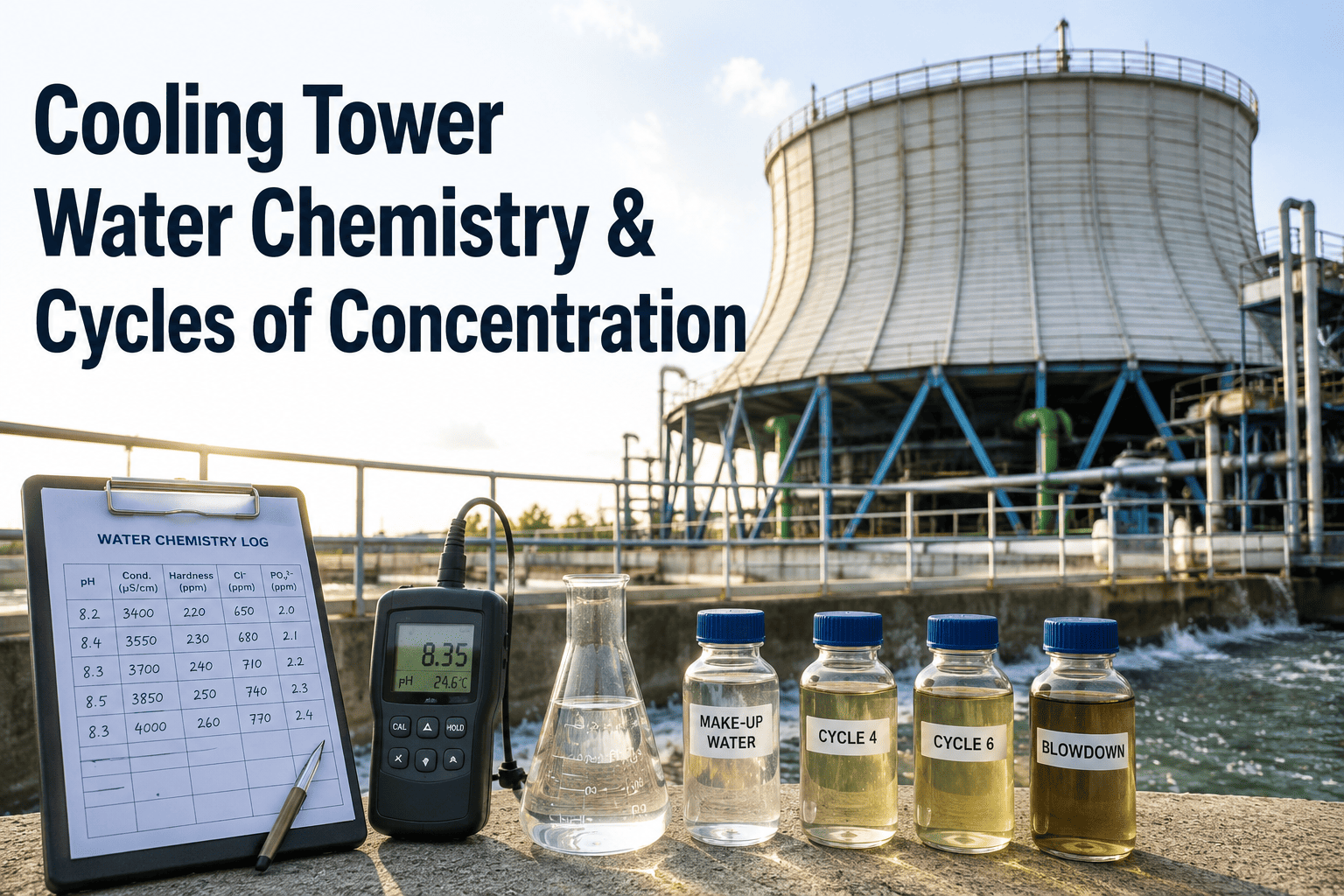
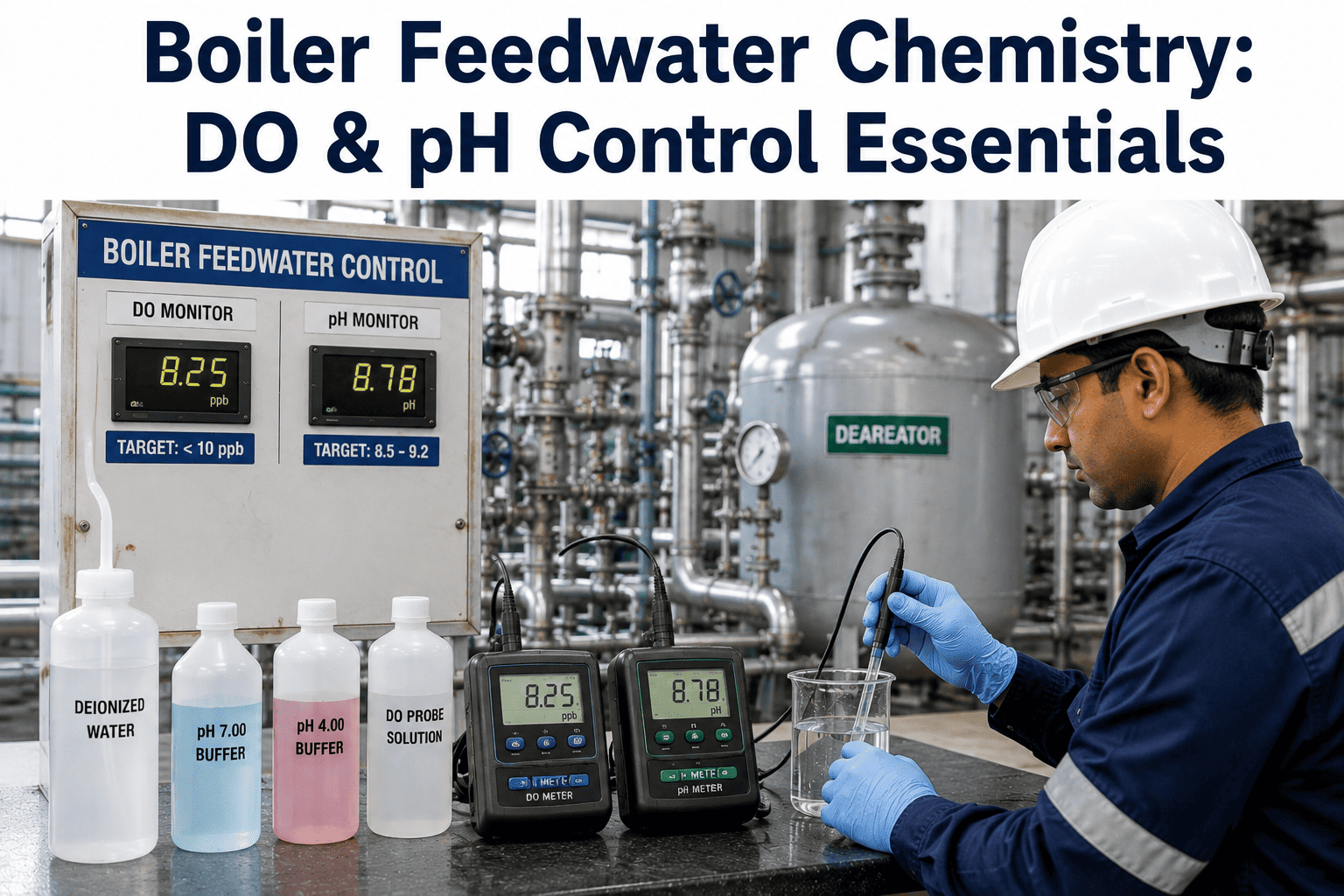
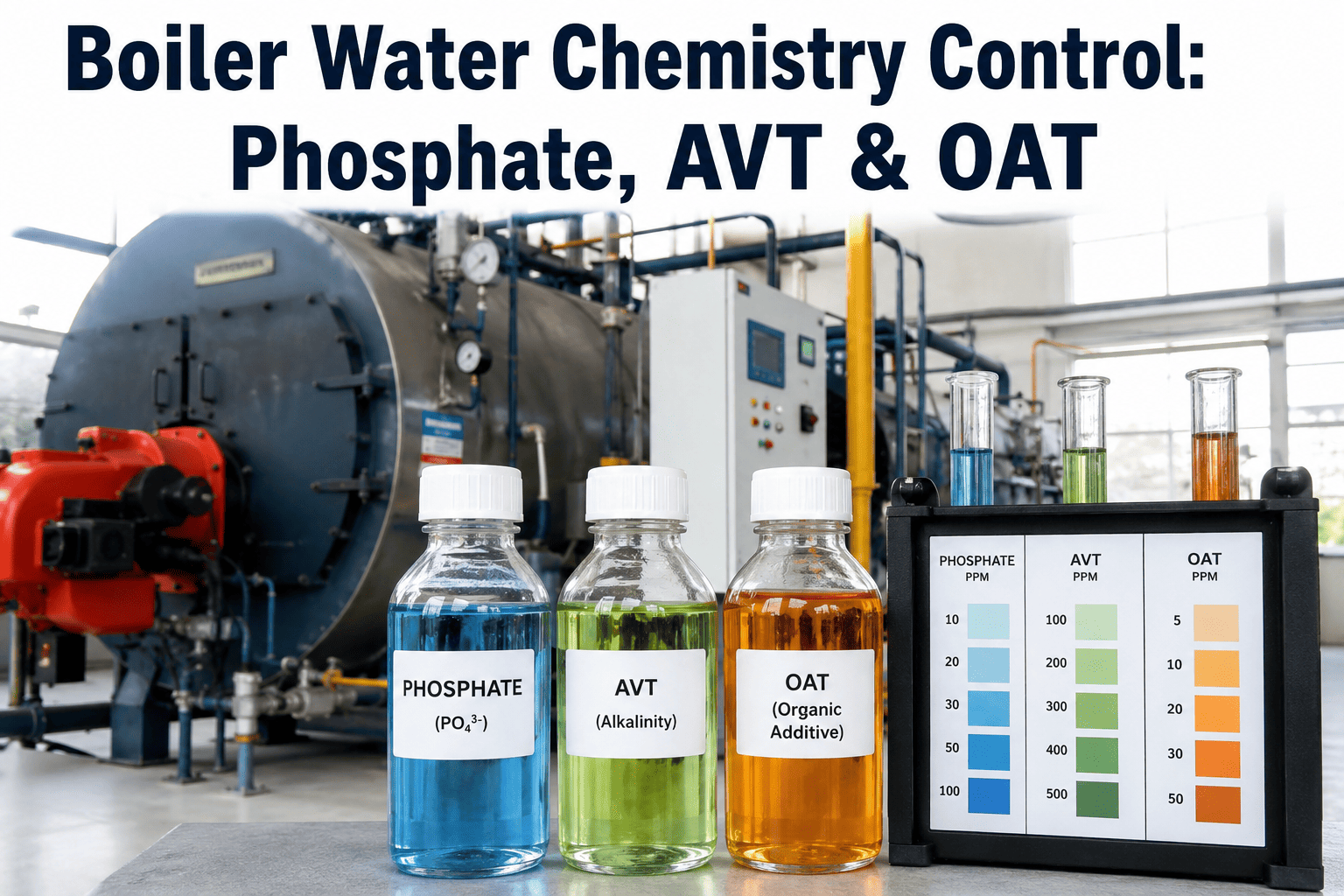
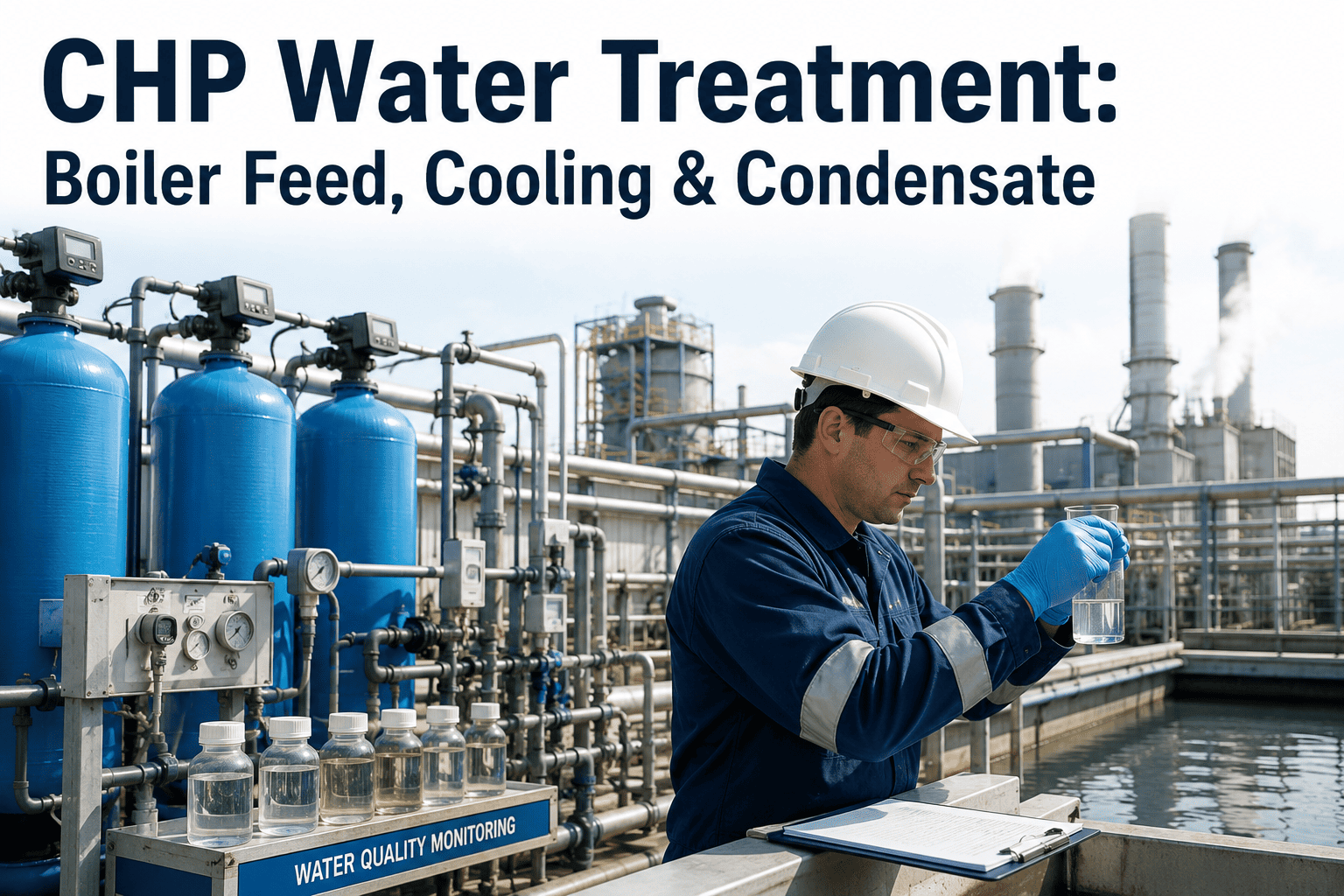
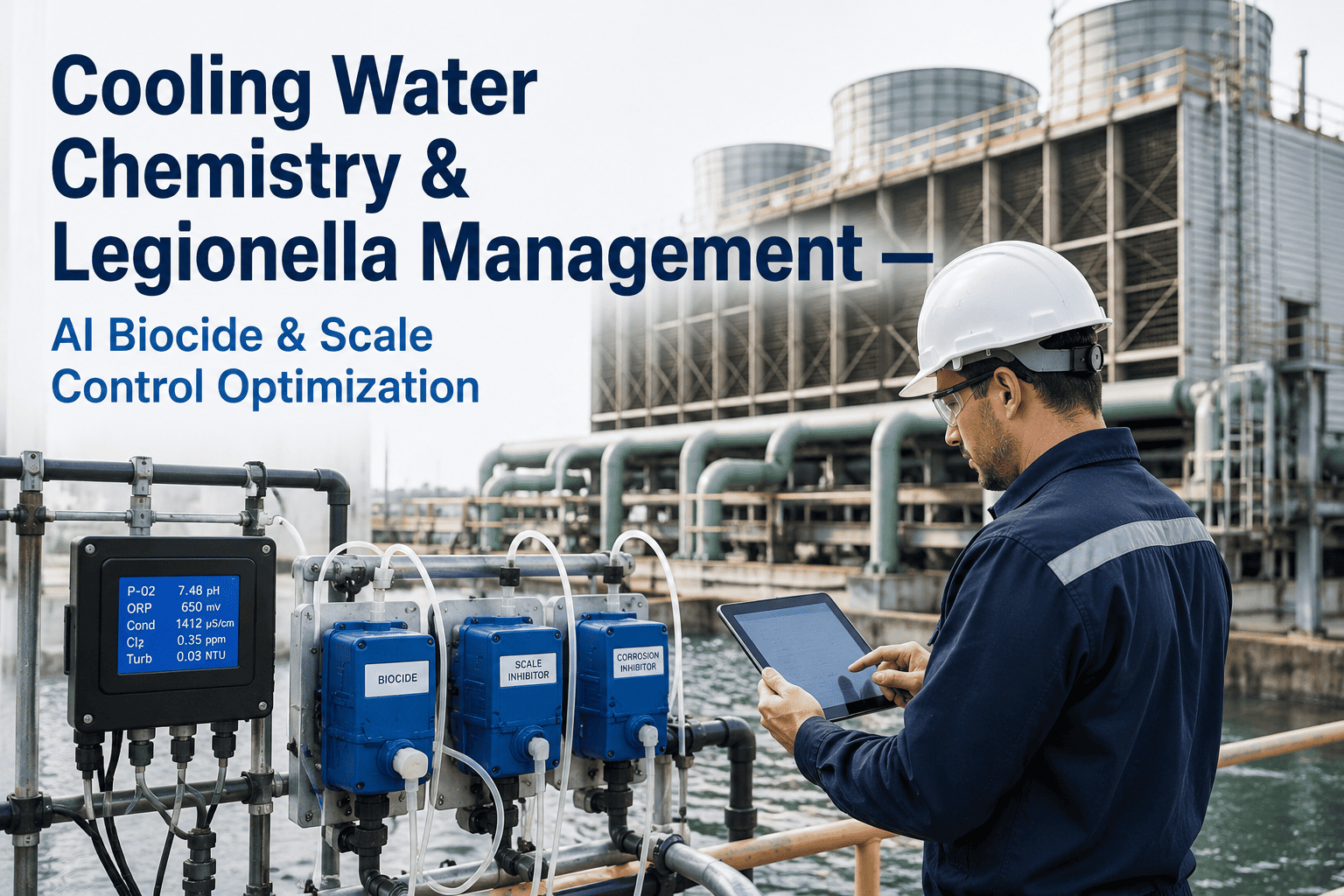
Every gallon of water a cooling tower evaporates leaves its dissolved minerals behind in the water that remains, and that concentration only has one direction to go: up. Left unmanaged, that rising mineral load eventually scales heat exchange surfaces, corrodes steel and copper, or feeds the biofilm that lets Legionella take hold — three failure modes that share a single root cause and a single fix, which is disciplined water chemistry and blowdown control. Facilities and utilities teams tightening their cooling tower program can Book a Demo to see cycles of concentration tracked continuously against blowdown and treatment dosing.
COOLING TOWER CHEMISTRY + CYCLES OF CONCENTRATION + SCALE AND CORROSION CONTROL
Cooling Tower Water Chemistry and Cycles of Concentration, Explained
iFactory tracks conductivity, cycles of concentration, and treatment dosing in one place so operators can push water efficiency higher without gambling on scale, corrosion, or microbiological risk.
The Number That Runs the Whole Program: Cycles of Concentration
Cycles of concentration, usually shortened to COC, is the ratio of dissolved solids in the circulating water to the dissolved solids in the makeup water feeding the tower. A tower running at five cycles holds roughly five times the mineral load of the water coming in, and every cycle higher means less blowdown, less makeup water, and less chemical purchased to treat it — which is exactly why COC has become the single metric most water and energy managers watch first when they talk about cooling tower efficiency.
The relationship in that second formula is why the water savings curve is so steep at the low end and flattens out fast. Moving a tower from 2 cycles to 4 cycles cuts blowdown dramatically, but moving from 8 cycles to 16 barely moves the needle further, because at higher cycles the denominator is already large enough that additional cycles produce diminishing returns. That non-linear relationship is exactly why most well-run towers target somewhere between four and eight cycles rather than chasing the highest number a spec sheet can technically support.
Water Savings by the Numbers
The financial case for running higher cycles is not abstract — it shows up directly in makeup water volume and blowdown discharge, both of which carry a hard dollar cost through utility billing and, in many regions, sewer discharge fees calculated on the same volume.
20–25%
Typical reduction in makeup water demand moving a tower from 3 to 6 cycles of concentration
4–8
Cycles of concentration range where most chemically treated towers operate safely
20+
Cycles achievable with softened makeup water and a properly engineered treatment program
The Balance Every Chemistry Program Is Actually Managing
Pushing cycles higher without the chemistry to support it does not save money — it trades a water bill for an equipment failure. Concentrated cooling water sits on a spectrum between two opposite failure modes, and a treatment program's entire job is to hold the water chemistry in the narrow band between them.
Scale-Forming Tendency
Water pushed too far toward saturation deposits calcium carbonate and other minerals directly onto heat exchanger tubes and tower fill, insulating those surfaces and forcing the system to work harder to reject the same heat load.
Corrosive Tendency
Water held too far the other direction becomes aggressive toward steel and copper surfaces, thinning pipe walls, pitting heat exchanger tubes, and shortening the service life of the entire wetted system.
The Langelier Saturation Index, or LSI, is the standard tool for locating where a given water sample sits on that spectrum. A strongly negative LSI signals corrosive water; a strongly positive LSI signals scaling water; and the target for most systems sits in a narrow band close to zero, slightly positive, where a thin protective film forms without runaway scale growth. Because LSI depends on pH, temperature, calcium hardness, and alkalinity all at once, it shifts constantly as cycles increase and as seasonal temperature changes affect the circulating water — which is why a one-time water test tells an operator almost nothing about whether the system is still in balance three months later. A facility that tests water chemistry only during commissioning or an annual audit is effectively flying blind for the rest of the year, since the same tower can drift from a safely balanced LSI in spring to a scaling-prone reading by late summer purely from temperature and load changes, with no chemical dosing error involved at all.
What a Real Treatment Program Actually Does
Raising cycles safely depends on a coordinated chemical program, not a single additive. Each component addresses a different failure mode, and skipping any one of them narrows how far cycles can safely be pushed regardless of how well the others are dosed.
Scale Inhibitors and Dispersants
Antiscalant chemistry interferes with crystal formation and keeps microscopic mineral particles suspended in the water rather than settling onto heat exchange surfaces, allowing systems to operate above their theoretical scaling threshold without visible deposit formation.
Corrosion Inhibitors
Film-forming or passivating inhibitors build a protective layer on metal surfaces that blocks the electrochemical reactions driving corrosion, and the correct inhibitor chemistry depends heavily on whether the system uses mild steel, copper alloys, or a mix of both.
Biocides and Microbiological Control
Oxidizing biocides such as chlorine or bromine and non-oxidizing biocides used in rotation control biofilm growth, algae, and bacteria — including Legionella — that thrive in the warm, aerated, nutrient-rich environment a cooling tower naturally provides.
pH and Alkalinity Control
Acid feed or alkaline adjustment keeps pH within the narrow window where scale inhibitors and corrosion inhibitors both function as designed, since most treatment chemistries lose effectiveness sharply outside their intended pH range.
Cycles of Concentration vs. Water and Chemical Usage
| Cycles of Concentration | Blowdown Volume | Water Usage | Scale Risk | Corrosion Risk |
| 1.5 – 2 |
Very high |
Very high |
Low |
High |
| 3 – 4 |
High |
High |
Low–Moderate |
Moderate |
| 5 – 6 |
Moderate |
Moderate |
Moderate |
Low–Moderate |
| 7 – 8 |
Low |
Low |
Moderate–High |
Low |
| 10+ (softened makeup) |
Very low |
Very low |
High without inhibitor program |
Low |
The pattern in that table is the entire logic of the cycles decision compressed into one row-by-row comparison: every step toward higher cycles trades water savings for a tighter scaling margin, and every step toward lower cycles trades water usage for a wider corrosion margin. A treatment program worth its cost is what lets a facility move that whole curve to the right, holding scale and corrosion risk low even as cycles climb, rather than accepting the unmanaged trade-off a bare-minimum program would face.
SCALE PREVENTION + CORROSION CONTROL + CHEMISTRY MONITORING
Keep Your Water Chemistry Inside the Target Zone Automatically
iFactory logs LSI, conductivity, and inhibitor dosing history side by side so drift toward scaling or corrosive conditions gets caught before it shows up as fouled tubes or pitted piping.
Why Makeup Water Quality Sets the Ceiling Before Chemistry Ever Gets Involved
The safe cycles ceiling for any tower starts with the makeup water itself, well before any treatment chemistry enters the picture. Hard, high-alkalinity municipal or well water carries a heavier mineral load into the system with every gallon of makeup added, which means a facility drawing from a hard water source will hit its scaling threshold at a lower cycles number than an identical tower fed with soft, low-alkalinity water — even with an equally well-run treatment program on both systems. This is why two facilities running the same chemical dosing rates and the same target LSI can end up with very different safe cycles ranges, and why comparing a facility's cycles number against a generic industry benchmark without accounting for local makeup water chemistry is one of the more common mistakes in setting an operating target.
Softening the makeup water before it enters the tower removes much of this ceiling by stripping out calcium and magnesium hardness ions before they ever have the chance to concentrate, which is exactly why softened-makeup systems can push into the twenties or higher on cycles while unsoftened systems typically plateau in the single digits. The capital and operating cost of a softening system has to be weighed against the water and chemical savings it unlocks, and that trade-off tends to favor softening most clearly at larger facilities where the water volume involved is large enough to make the softening investment pay back within a reasonable timeframe.
Microbiological Control: The Risk That Doesn't Show Up on a Conductivity Meter
Scale and corrosion damage equipment; uncontrolled microbiological growth in a cooling tower can be a genuine public health hazard. Cooling towers create nearly ideal conditions for Legionella and other waterborne bacteria — warm water, constant aeration, a steady nutrient supply from airborne debris, and a fine mist that can carry bacteria beyond the tower itself. Biofilm on tower fill and heat exchanger surfaces shields bacteria from biocide contact, which is why a program relying on biocide dosing alone, without periodic mechanical cleaning and biofilm monitoring, routinely underperforms its intended protection level even when dosing rates look correct on paper.
1
Rotate between oxidizing and non-oxidizing biocides rather than relying on a single chemistry, since sustained use of one biocide class allows resistant biofilm populations to build over time.
2
Inspect and mechanically clean tower fill, basins, and drift eliminators on a regular schedule, since biofilm shields bacteria from biocide contact regardless of dosing accuracy.
3
Monitor total bacteria counts and Legionella-specific testing on a schedule appropriate to the facility's risk profile, particularly for towers near occupied buildings or healthcare facilities.
4
Maintain a documented water management plan that ties biocide dosing, cleaning schedules, and test results together into a single auditable record.
Building a Cycles and Chemistry Program That Actually Holds
A cycles of concentration target set once at commissioning rarely stays correct for long, because makeup water quality, seasonal temperature, and system load all shift the safe operating window over time. The programs that sustain higher cycles without incident treat the target as a moving band that needs continuous verification, not a fixed number written into an operating manual and never revisited. This is fundamentally a data problem before it is a chemistry problem: the facilities that get this right are the ones with visibility into how conductivity, dosing, and inspection findings move together over time, not the ones with the most sophisticated chemical formulation on the shelf.
1
Establish a baseline LSI and conductivity target range specific to the facility's makeup water chemistry rather than borrowing a generic industry number.
2
Automate blowdown control off a conductivity setpoint so cycles hold steady between manual water tests instead of drifting with load and weather.
3
Track inhibitor and biocide dosing against actual makeup water volume, not a flat daily schedule, so treatment scales correctly as cycles and blowdown rates change.
4
Log heat exchanger and tower fill inspection findings alongside chemistry data to catch early scale or corrosion signs before they show up as a performance loss.
5
Reassess the cycles target seasonally, since makeup water hardness and system heat load both shift enough across a year to change what counts as a safe operating range.
Frequently Asked Questions: Cooling Tower Chemistry and Cycles of Concentration
What cycles of concentration should a typical cooling tower target?
Most chemically treated towers using unsoftened makeup water operate safely in the four-to-eight cycle range, with the exact target depending heavily on makeup water hardness, alkalinity, and the strength of the treatment program in place. Towers using softened makeup water can often push well beyond that range, sometimes into the twenties or higher, because removing hardness ions before they ever enter the system eliminates much of the scaling risk that limits cycles elsewhere. Facilities uncertain of their safe target can
Book a Demo to model the range against their own water chemistry rather than relying on a generic industry rule of thumb that ignores their specific makeup water source.
How much water can we actually save by running higher cycles?
Moving from roughly three cycles to six cycles typically cuts makeup water demand by twenty to twenty-five percent, and the savings curve is steepest at the low end of the cycles range, meaning the first few cycles gained deliver far more water savings than the same increase applied at an already-high cycles level. Because blowdown volume scales with evaporation divided by cycles minus one, the relationship flattens out noticeably past roughly eight to ten cycles, which is part of why most programs target a practical middle ground rather than chasing the theoretical maximum.
What is the Langelier Saturation Index and why does it matter for cooling towers?
The Langelier Saturation Index is a calculated value based on pH, temperature, calcium hardness, and alkalinity that predicts whether a given water sample tends toward scale formation or toward corrosion. A slightly positive LSI close to zero is the target for most systems, since it favors a thin protective film without runaway scale growth, while a strongly positive or strongly negative value signals the water chemistry has drifted out of the safe operating band and needs adjustment before scale or corrosion damage accumulates.
Why is chloride commonly used to calculate cycles of concentration instead of other dissolved solids?
Chloride is highly soluble and does not precipitate out of solution under normal cooling tower operating conditions, which makes it a more reliable tracer for calculating true cycles of concentration than minerals like calcium that can drop out as scale before a water sample is even taken. Conductivity is used as a faster, continuous proxy for this same ratio in most automated blowdown control systems, since it correlates closely with total dissolved solids without requiring a lab test for every reading. Contact
iFactory Support for guidance on setting up automated conductivity-based blowdown control.
Does running higher cycles increase Legionella risk?
Cycles of concentration itself does not directly drive Legionella risk the way it drives scale or corrosion risk, since bacterial growth depends more on temperature, biofilm presence, and biocide effectiveness than on dissolved mineral concentration. However, towers pushing higher cycles often reduce blowdown volume enough that biocide residence time and dosing strategy need to be reviewed, since less water turnover changes how quickly a biocide dose depletes and needs to be replenished to maintain consistent microbiological control.
COOLING TOWER WATER MANAGEMENT + CHEMISTRY + EFFICIENCY
Turn Cycles of Concentration Into a Managed, Provable Program
iFactory helps facilities teams push cycles higher with confidence, tracking LSI, conductivity, dosing, and inspection history together so water savings never come at the cost of scale, corrosion, or microbiological risk.