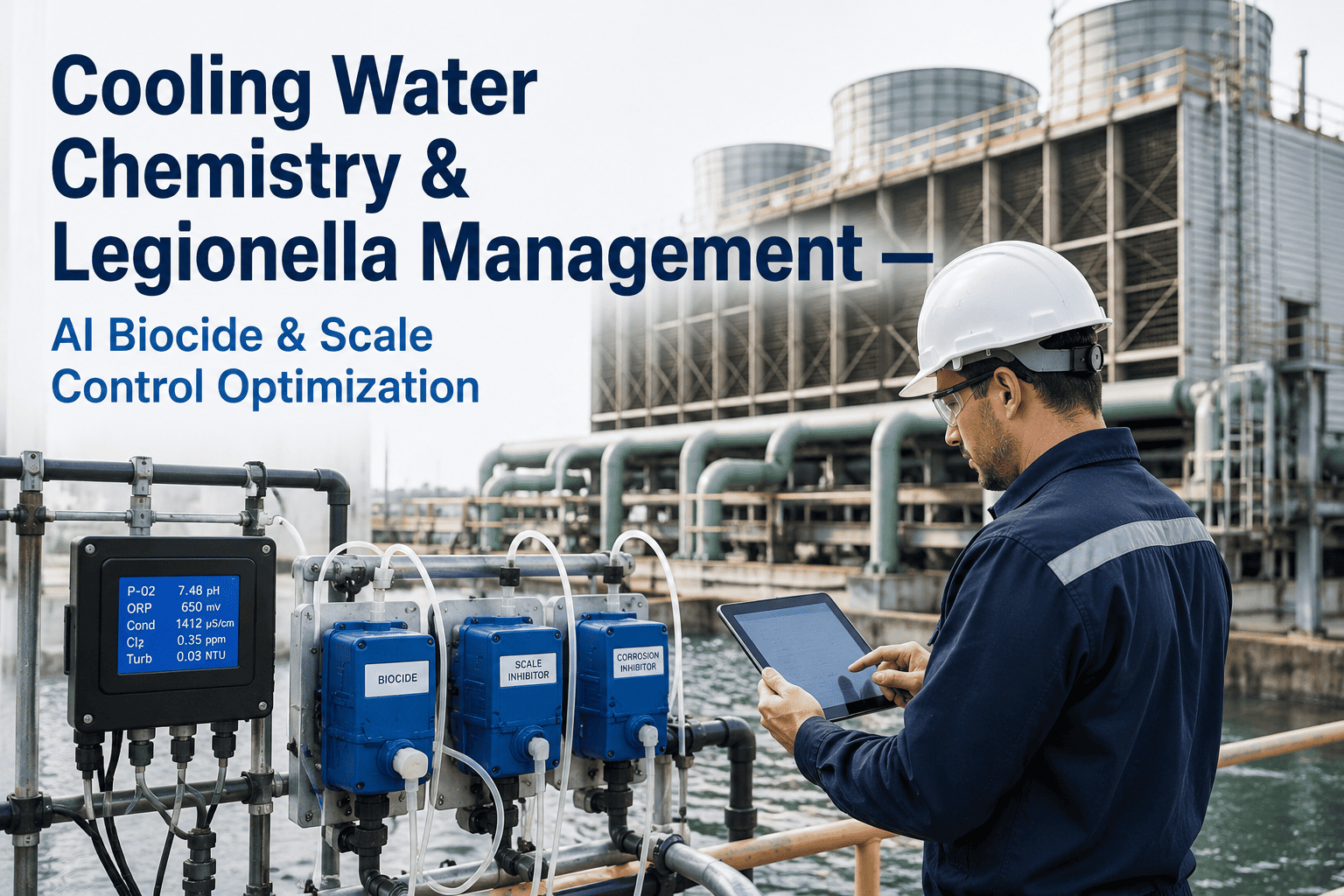
Cooling water systems at industrial facilities operate as ideal incubation environments for Legionella and other pathogenic microorganisms due to warm water temperatures between 25 and 45 degrees Celsius, nutrient availability from process contamination, stagnant zones in poorly designed distribution basins, and biofilm accumulation on heat exchange surfaces that shelters bacteria from biocide exposure. Process engineers responsible for cooling tower performance must simultaneously manage microbiological control, scale inhibition, corrosion protection, and cycle of concentration optimization within treatment programs that have traditionally relied on fixed-schedule biocide dosing and periodic laboratory analysis. AI-driven cooling water chemistry monitoring is now enabling a shift from calendar-based treatment to condition-responsive dosing that reduces biocide consumption by 20 to 40 percent while maintaining more consistent microbiological control. Book a Demo to explore AI-powered cooling water treatment optimization for your facility.
Cooling Water Chemistry and Legionella Management with AI Biocide and Scale Control Optimization
A process engineering guide to AI-driven biocide dosing, microbiological monitoring, scale prevention, and Legionella risk management for recirculating cooling water systems.
Move from calendar-based biocide dosing to condition-responsive treatment that adapts to real-time system conditions.
Recirculating Cooling Water System: Treatment Challenge Points and Monitoring Locations
Effective cooling water treatment requires monitoring and chemical intervention at multiple points throughout the recirculating loop, each presenting distinct conditions that affect microbiological growth rates, scale formation potential, and corrosion mechanisms. The following circuit diagram identifies the critical treatment intervention points where AI monitoring provides the greatest value in detecting developing problems before they impact system performance or Legionella control.
Cooling Tower Basin
Warmest water zone with maximum air exposure. Primary location for Legionella proliferation, algae growth, and biofilm accumulation on basin surfaces. AI monitors temperature, pH, conductivity, and oxidant residual to maintain conditions hostile to microbial growth while tracking evaporation-driven concentration cycles.
Biocide Injection Point 1Heat Exchangers
Highest heat flux zone where scale formation directly reduces heat transfer efficiency and biofilm creates differential aeration cells that accelerate localized corrosion. AI monitors approach temperature delta, flow rate, and fouling indicator trends to detect scale and biofilm accumulation before performance degradation reaches the threshold requiring offline cleaning.
Scale Inhibitor InjectionReturn Water Line
Cooling water returning from process heat exchange carries process contamination, corrosion products, and suspended solids back to the tower. AI monitors return water temperature differential, iron and copper concentrations, and turbidity to quantify the corrosion and fouling load entering the tower basin and adjust treatment chemical dosing accordingly.
Corrosion Inhibitor InjectionBlowdown Discharge
Controlled discharge point where concentrated water is removed to maintain target cycles of concentration. AI monitors blowdown water quality against discharge permit limits and optimizes blowdown rate to minimize water waste and chemical loss while keeping scaling ions below saturation thresholds. Biocide residual monitoring at this point confirms that discharged water meets regulatory oxidant limits.
Discharge Compliance MonitoringMakeup Water
Fresh water input that replaces evaporative and blowdown losses. Makeup water quality varies seasonally and directly impacts the treatment chemical demand, cycles of concentration achievable, and corrosion potential of the recirculating water. AI continuously tracks makeup water conductivity, alkalinity, hardness, and chloride to dynamically adjust treatment setpoints as source water quality changes throughout the year.
Makeup Quality MonitoringLegionella Risk Factors in Cooling Water Systems and AI Detection Capabilities
Legionella pneumophila thrives in cooling water systems when specific environmental conditions align simultaneously. The AI monitoring engine tracks each risk factor independently and calculates a composite Legionella risk score that reflects the real-time probability of significant Legionella colonization based on current system conditions, rather than relying on periodic culture results that reflect conditions from 7 to 14 days prior to reporting.
Temperature Zone: Active Proliferation
Water temperature between 35 and 45 degrees Celsius represents the optimal growth range for Legionella pneumophila with doubling times as short as 2 to 4 hours. AI monitoring tracks real-time temperature at multiple tower basin locations and predicts temperature trajectory based on ambient conditions, process heat load, and cooling tower capacity. When basin temperature enters this zone, the AI engine automatically increases biocide dosing frequency and alerts process engineers to the elevated colonization risk. Systems operating in this range for more than 4 cumulative hours per day require continuous oxidant residual above 1.0 mg/L free chlorine equivalent.
Temperature Zone: Sustained Growth
Water temperature between 25 and 35 degrees Celsius supports sustained Legionella growth at reduced but significant rates, with typical doubling times of 6 to 12 hours. This temperature range is the most common operating condition for industrial cooling towers in temperate climates during spring, summer, and fall months. AI monitoring maintains standard biocide residual targets but increases surveillance frequency for secondary indicators including heterotrophic plate count trends, total organic carbon increases, and biofilm activity markers that may indicate developing colonization even when temperatures remain in this moderate range.
Temperature Zone: Dormant Survival
Water temperature between 20 and 25 degrees Celsius suppresses active Legionella replication but does not eliminate organisms present in the system. Legionella can survive indefinitely in biofilm matrices at these temperatures and resume rapid proliferation when conditions improve. AI monitoring at this tier focuses on biofilm prevention through maintained biocide residual, regular biofilm dispersant dosing, and monitoring of surfaces with highest biofilm accumulation risk including tower fill media, distribution basin walls, and heat exchanger tube surfaces identified through thermal performance trend analysis.
Temperature Zone: Suppressed Activity
Water temperature below 20 degrees Celsius effectively suppresses Legionella growth, but biofilm-protected organisms remain viable and can re-colonize the system within 48 to 72 hours when temperatures return to favorable ranges. AI monitoring during cold-weather operation focuses on maintaining minimum biocide residual to prevent biofilm accumulation that would provide colonization sites when temperatures increase, and on tracking the rate of temperature change during seasonal transitions to pre-position biocide inventory and adjust dosing schedules before the system enters active growth temperature ranges.
Biocide Program Architecture and AI-Optimized Dosing Strategy
Effective microbiological control in cooling water systems requires a structured biocide program that combines oxidizing and non-oxidizing biocides in a complementary sequence designed to overcome the limitations of any single chemistry. AI optimization transforms this program from fixed-schedule dosing to a responsive system that adjusts dose timing, concentration, and product selection based on real-time microbial activity indicators and system conditions.
Continuous low-level oxidant residual maintained through sodium hypochlorite, bromine-based chemistry, or stabilized chlorine dioxide feed. Target residual of 0.2 to 0.5 mg/L free oxidant in the tower basin provides baseline microbiological control and prevents biofilm establishment on clean surfaces. The AI engine continuously adjusts feed rate to maintain target residual within a narrow band, compensating for oxidant demand changes caused by organic loading, sunlight degradation, temperature effects on reaction kinetics, and blowdown losses. Overfeed prevention is a key value driver — the AI engine reduces feed rate when demand drops rather than maintaining a fixed rate that produces excessive residual and increases discharge permit compliance risk.
Periodic elevated-dose oxidant treatment targeting biofilm disruption and resistant organism control. Shock doses of 3 to 10 mg/L free oxidant for 2 to 4 hours disrupt established biofilm matrices and expose sheltered bacteria to biocide contact. The AI engine determines shock dose timing based on biofilm indicator trends rather than calendar schedules, triggering shock treatment when HPC trends, TOC increases, or heat exchanger fouling rate changes indicate that biofilm accumulation has reached the threshold where continuous residual alone is insufficient. This condition-responsive approach typically reduces shock treatment frequency by 30 to 50 percent compared to weekly calendar-based schedules while maintaining equivalent or superior biofilm control.
Intermittent addition of non-oxidizing biocides such as isothiazolin, glutaraldehyde, or quaternary ammonium compounds to provide broad-spectrum kill of organisms that may have developed tolerance to the continuous oxidizing program. Non-oxidizing biocides are significantly more expensive than oxidizing chemistries, making dosing optimization a high-value AI application. The AI engine schedules non-oxidizing doses based on microbiological monitoring trends that indicate oxidant-tolerant organism emergence, adjusts dose quantity based on system volume and organic loading, and sequences non-oxidizing addition to avoid chemical incompatibility with oxidant residual from Phase 1 and Phase 2 treatments.
Scale Inhibition and Corrosion Protection: AI-Driven Chemical Optimization
Scale formation and corrosion in cooling water systems are driven by the same fundamental water chemistry parameters that the AI engine monitors continuously for microbiological control, enabling integrated treatment optimization that balances all three objectives simultaneously rather than managing each in isolation. The following parameter guide maps the key water chemistry measurements to their scale and corrosion implications with AI-managed control ranges that adapt to system operating conditions.
Cycles of Concentration
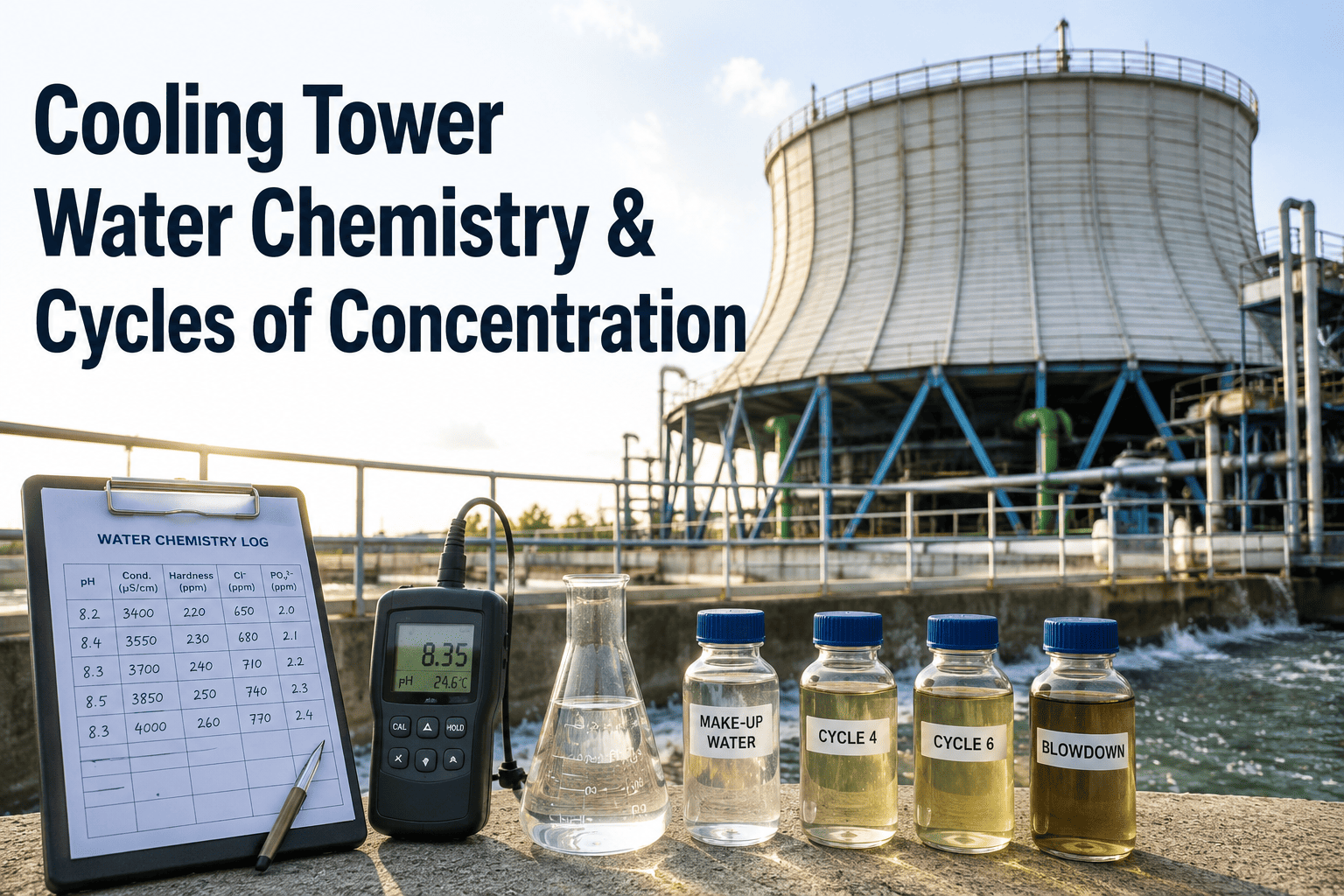
The ratio of dissolved solids in recirculating water to makeup water. Higher cycles reduce water consumption and chemical waste but increase scaling ion concentration toward saturation. The AI engine dynamically adjusts the blowdown rate to maintain the maximum cycles of concentration that keep all scaling indices below critical thresholds under current operating conditions, accounting for variations in makeup water quality and heat load that shift the scaling boundary throughout the day and across seasons.
Langelier Saturation Index
The LSI calculates the tendency of cooling water to dissolve or precipitate calcium carbonate based on pH, temperature, calcium hardness, total alkalinity, and total dissolved solids. The AI engine calculates LSI in real time using continuous sensor inputs and adjusts acid feed rate and scale inhibitor dosing to maintain LSI within the balanced range. Real-time LSI monitoring enables immediate response to makeup water quality changes that shift the saturation index, preventing both underfeed conditions that allow corrosion and overfeed conditions that waste chemical and create discharge compliance issues.
Conductivity Control
Conductivity serves as the primary surrogate measurement for total dissolved solids concentration and is the most common parameter used for automatic blowdown control. However, fixed-conductivity blowdown setpoints do not account for variations in the ratio of scaling ions to non-scaling ions in makeup water. The AI engine adjusts the conductivity setpoint dynamically based on makeup water chemistry analysis, maintaining the appropriate cycles of concentration for the actual scaling ion content rather than a fixed TDS proxy that may over-concentrate scaling ions during periods of hard makeup water or under-concentrate during soft water periods.
Your cooling water system is making treatment decisions every minute based on conditions that your current monitoring program cannot see between sample points. Every hour of suboptimal biocide residual is an hour of biofilm accumulation that will require a higher dose to correct later.
iFactory AI connects your cooling water analyzers, flow meters, and temperature sensors into a continuous treatment optimization engine that adjusts biocide dosing, scale inhibitor feed, and blowdown rate in real time based on actual system conditions rather than calendar schedules and fixed setpoints.
Measured Outcomes: AI-Optimized Cooling Water Treatment Versus Conventional Programs
Aggregated performance data from iFactory AI cooling water treatment optimization deployments across 38 industrial cooling systems between 2023 and 2025 demonstrates consistent improvements across chemical efficiency, microbiological control, water conservation, and heat transfer performance. The following benchmarks represent median outcomes across the deployment base, normalized for system size, water source quality, and treatment chemistry type.
Achieved through elimination of calendar-based overdosing, condition-responsive shock treatment scheduling, and AI-optimized non-oxidizing biocide sequencing that avoids unnecessary doses when microbiological indicators confirm effective control from the oxidizing program alone.
Heterotrophic plate count results maintained below 10,000 CFU/mL in 94 percent of routine samples after AI deployment, compared to 76 percent compliance under the prior fixed-schedule program. The improvement reflects consistent biocide residual maintenance rather than the cyclical residual depletion pattern characteristic of manual dosing.
Achieved through AI-optimized blowdown control that maintains the maximum safe cycles of concentration under dynamically varying conditions rather than conservative fixed-conductivity setpoints. Water savings are greatest at facilities with variable makeup water quality where fixed setpoints result in significant over-blowdown during soft-water periods.
Reduced variability in heat exchanger approach temperature indicating more consistent heat transfer performance resulting from improved scale and biofilm control. Lower approach temperature variability directly translates to more stable process cooling capacity and reduced risk of process temperature excursions that can impact production quality or throughput.
iFactory AI Modules for Cooling Water Chemistry and Legionella Management
The iFactory AI platform delivers a purpose-built module suite for cooling water treatment optimization, integrating real-time sensor data, laboratory sample results, and treatment system operational data into a unified decision support environment that automates routine treatment adjustments while providing process engineers with the analytical depth needed for strategic program optimization.
Cooling Water Intelligence Dashboard
Live visualization of all cooling water parameters including temperature, pH, conductivity, oxidant residual, LSI calculation, cycles of concentration, and microbiological indicator trends across multiple cooling systems from a single interface. Color-coded status indicators show treatment objective compliance for microbiological control, scale prevention, and corrosion protection simultaneously, enabling immediate identification of which treatment dimension requires attention.
Adaptive Biocide Dosing Engine
Algorithmic control of oxidizing and non-oxidizing biocide feed rates that maintains target residual within narrow bands while minimizing total chemical consumption. The engine adapts to oxidant demand changes caused by organic loading, sunlight exposure, temperature, and blowdown rate variations, and automatically schedules shock treatments and non-oxidizing doses based on microbiological trend analysis rather than calendar schedules.
Dynamic Scale Index Calculator
Real-time calculation of LSI, Ryznar Stability Index, and calcium sulfate saturation index using continuous sensor inputs, with dynamic blowdown setpoint adjustment to maintain all indices within the non-scaling, non-corrosive range. The module accounts for the specific scale inhibitor chemistry in use and adjusts the scaling threshold based on inhibitor concentration and performance data from historical scale deposition monitoring.
Legionella Risk Scoring Engine
Continuous calculation of a composite Legionella colonization risk score based on water temperature, biocide residual, HPC trends, biofilm indicators, system stagnation events, and seasonal risk factors. The risk score provides a quantitative basis for treatment program intensity decisions and generates automated alerts when risk score trajectories indicate developing conditions favorable to significant Legionella colonization, enabling proactive treatment intensification before positive culture results occur.
Cooling Water Chemistry and Legionella Management — Frequently Asked Questions
The ASHRAE 188 standard establishes the framework for cooling tower water management programs including control limits, monitoring frequency, and corrective action procedures, but it relies primarily on periodic laboratory culture results that have a 7 to 14 day reporting lag. During that lag period, system conditions may have changed significantly, and the culture result reflects historical rather than current conditions. AI monitoring supplements the ASHRAE 188 program by providing continuous real-time indicators of Legionella-favorable conditions — temperature, biocide residual, biofilm activity markers — that enable process engineers to adjust treatment intensity immediately when risk factors elevate, rather than waiting for a positive culture result that confirms colonization has already occurred. Book a Demo to see how AI monitoring integrates with your existing ASHRAE 188 compliance program.
The minimum analyzer configuration for AI-driven cooling water optimization includes pH, conductivity, and oxidant residual analyzers at the tower basin, which are standard instrumentation at most well-maintained industrial cooling systems. Temperature sensors at the tower basin, supply, and return lines provide the thermal data needed for LSI calculation and Legionella risk scoring. Optional but valuable additions include online turbidity for suspended solids tracking, online TOC for organic loading indication, and corrosion coupon or probe monitors for corrosion rate verification. The AI engine is designed to deliver increasing optimization value as additional analyzer inputs are added, but the core biocide dosing optimization and scale control functions operate effectively with the minimum pH, conductivity, oxidant, and temperature instrument set. Contact Support for an analyzer requirement assessment for your cooling systems.
The iFactory AI platform supports unlimited cooling system configurations from a single dashboard interface, with each system maintaining its own independent treatment program definition including biocide chemistry types and targets, scale inhibitor product and concentration ranges, corrosion inhibitor program, blowdown control parameters, and permit-specific discharge limits. This multi-system capability is particularly valuable for process engineers responsible for campus-scale cooling infrastructure where different systems may serve different process temperature requirements, use different water sources, or operate under different discharge permit conditions. The AI engine optimizes each system independently while providing portfolio-level reporting on aggregate water consumption, chemical usage, and compliance status. Book a Demo to see the multi-system dashboard in action.
The AI dosing engine maintains a chemical compatibility schedule that defines the minimum time interval and oxidant residual threshold required between oxidizing and non-oxidizing biocide additions for each product combination in the treatment program. When the AI engine determines that a non-oxidizing dose is needed based on microbiological trend analysis, it first verifies that the current oxidant residual has decayed below the compatibility threshold, schedules the non-oxidizing addition at the optimal timing window, and then manages the re-establishment of oxidant residual after the non-oxidizing contact period has elapsed. This automated sequencing eliminates the chemical incompatibility risk that occurs when manual dosing programs rely on operator memory and shift handoff communication to manage product sequencing. Contact Support to configure biocide sequencing for your specific product combinations.
The typical payback period for AI-driven cooling water treatment optimization ranges from 6 to 14 months depending on system size, current treatment program efficiency, water costs, and the specific optimization opportunities present at the facility. The three primary savings categories are biocide chemical cost reduction of 20 to 35 percent, water and sewer charge reduction of 10 to 20 percent from optimized blowdown control, and avoided heat exchanger cleaning costs from improved scale and biofilm control that extends cleaning intervals. Larger cooling systems with higher chemical consumption and water volumes typically achieve payback at the shorter end of the range, while smaller systems with already-efficient manual programs fall at the longer end. Book a Demo to get a site-specific payback calculation for your cooling systems.
Optimize Your Cooling Water Treatment Program with AI-Driven Chemistry Intelligence
iFactory AI connects your cooling water analyzers and treatment system data into a continuous optimization engine that adjusts biocide dosing, scale inhibitor feed, and blowdown rate in real time while calculating Legionella risk scores that enable proactive microbiological control before colonization occurs.