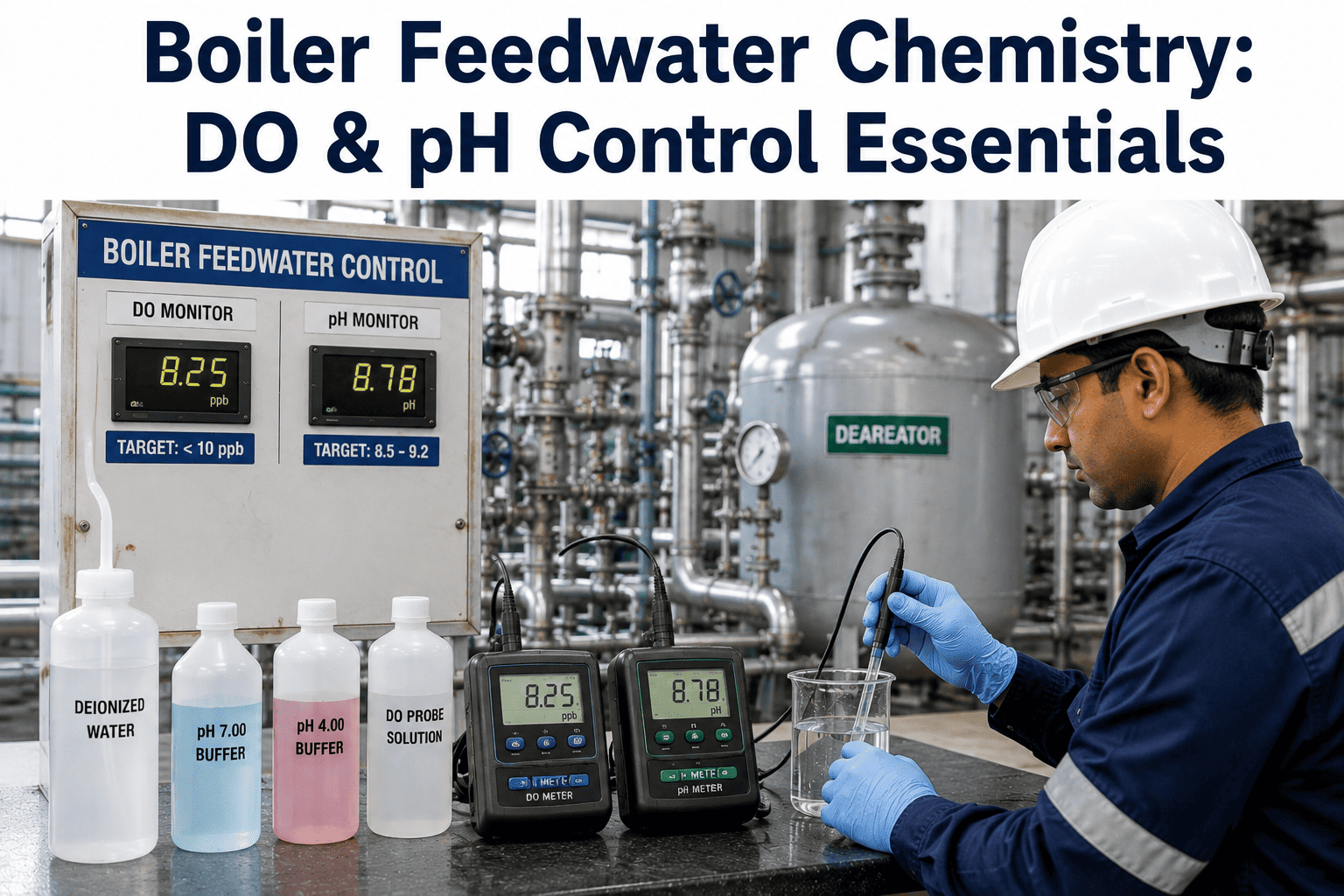
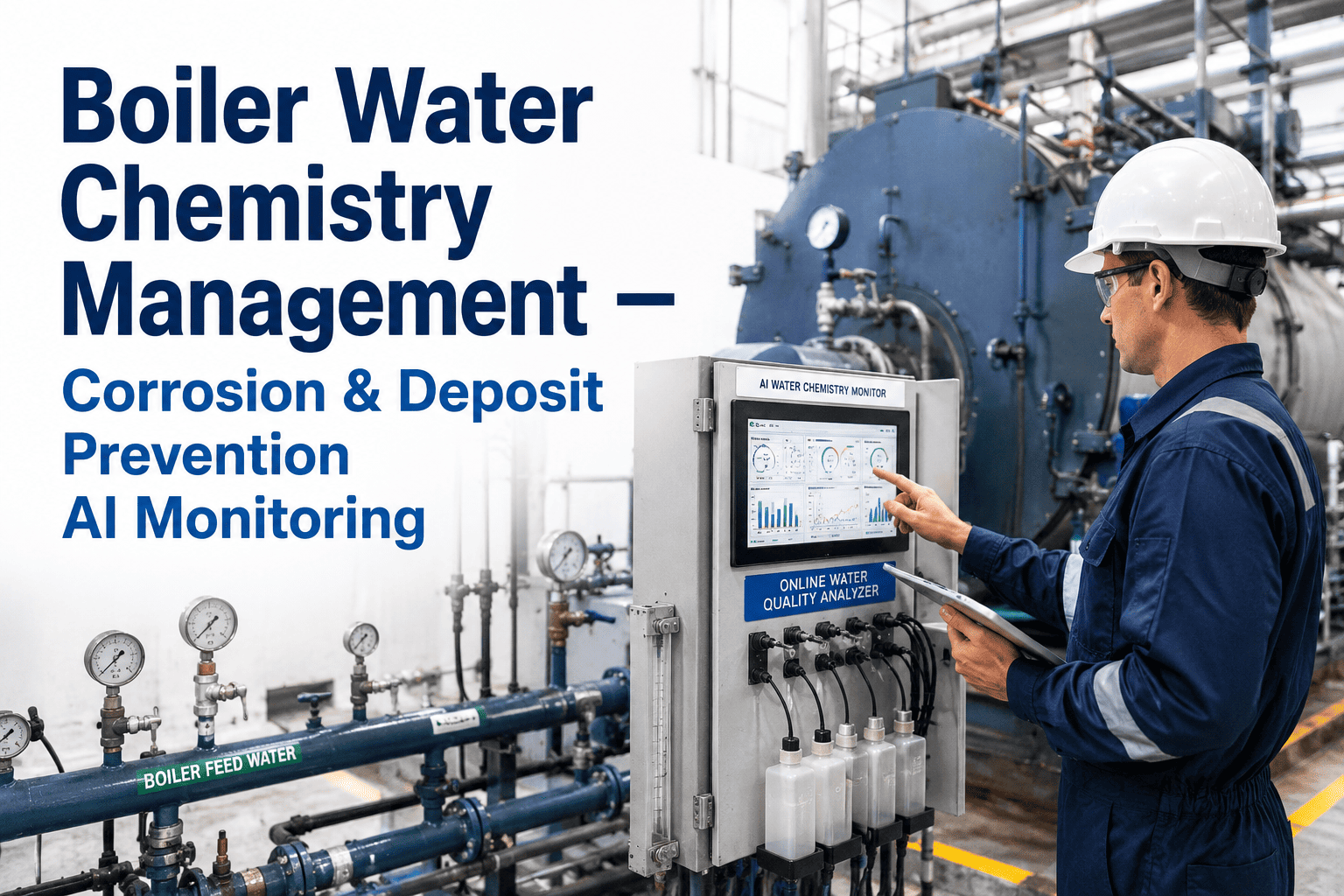
Boiler tube failures rarely start with a dramatic event, they start with water chemistry that drifted a little further out of range each week while every gauge on the panel still read normal. Dissolved oxygen slips in through a worn pump seal, pH wanders off target after a dosing pump loses calibration, and conductivity creeps up as cycles of concentration climb past what the boiler was designed to tolerate. None of these show up as an alarm, because feedwater chemistry is usually checked on a grab-sample schedule measured in hours, while the corrosion it causes accumulates in minutes, day after day, inside tubes nobody can see. By the time a leak forces an outage, the chemistry that caused it has usually been out of range for months. You can see how continuous chemistry trending closes that gap by choosing to book a demo with our team.
WATER CHEMISTRY · CORROSION PREVENTION · FEEDWATER TREATMENT
Your Boiler Tubes Are Corroding at the Exact Rate Your Chemistry Program Isn't Watching Closely Enough
Dissolved oxygen, pH, and conductivity determine how fast a boiler's tubes corrode from the inside, yet most plants still measure them a few times a shift. iFactory turns every chemistry reading into a continuous trend against target range, so a drifting dosing pump or a failing deaerator gets caught before it becomes a tube failure.
LIVE FEEDWATER CHEMISTRY STRIP · UNIT 2 DEAERATOR OUTLET
Dissolved Oxygen
7 ppb · In Range
Conductivity
1.1 µS/cm · In Range
Total Iron
28 ppb · Elevated
WHY CHEMISTRY DRIFTS UNNOTICED
Four Ways Feedwater Chemistry Slips Out of Range Without Tripping an Alarm
A boiler's water chemistry does not fail all at once, it drifts, and every one of the common causes below produces a slow slope rather than a step change. A slope is exactly what a grab-sample program checking a few times a shift is least equipped to catch, since the reading in between samples simply never gets taken.
What makes this especially costly is that the corrosion mechanisms these excursions trigger, oxygen pitting, acid attack, and caustic gouging, all progress fastest in the hours nobody is actively watching the chemistry. A dosing pump that drifts overnight can do more cumulative damage than one that fails outright during a shift when someone happens to be reviewing the panel.
Dissolved Oxygen Ingress at Pump Seals
Worn mechanical seals and air-entraining leaks on condensate and feedwater pumps let oxygen into the system continuously, overwhelming the deaerator and oxygen scavenger dosing that was sized for a cleaner system.
Condensate Return Contamination
A process leak into the condensate return system introduces contaminants that shift pH and conductivity together, and the shift often shows up first far from the actual leak, making the source hard to trace without continuous data.
Chemical Dosing Pump Drift
Diaphragm wear and calibration drift on oxygen scavenger and pH adjustment dosing pumps reduce actual chemical delivery gradually, long before anyone notices the pump is underperforming its setpoint.
Cycles of Concentration Swings
Blowdown rate changes shift how concentrated dissolved solids become inside the boiler drum, and an unmonitored swing in cycles of concentration can push conductivity past a safe limit within a single shift.
THE PARAMETERS THAT MATTER
The Core Chemistry Parameters That Actually Protect Boiler Tubes
Every major tube corrosion mechanism traces back to one of a small handful of chemistry parameters running outside its target band. Getting all four right at once is what separates a boiler that runs for decades without a tube leak from one that fights recurring failures despite regular chemical treatment.
See Every Chemistry Parameter Against Its Target Band, Continuously
iFactory turns DO, pH, conductivity, and iron readings into one continuously trended view, flagging drift long before a grab sample would have caught it.
TRACING THE WATER PATH
Following the Water Path Shows Exactly Where Chemistry Risk Enters
Feedwater chemistry is not set once at the start of the cycle, it is shaped and reshaped at every stage the water passes through on its way to the boiler drum. Mapping the path stage by stage makes it obvious where a monitoring gap actually matters, instead of treating chemistry as one number checked at one point.
1
Condensate Return
Returning condensate can pick up contamination from process leaks or air in-leakage at low-pressure joints, shifting pH and conductivity before the water ever reaches the deaerator.
2
Deaerator
The deaerator strips the bulk of dissolved oxygen through steam scrubbing, but a fouled tray or undersized vent rate lets a portion of that oxygen carry straight through to the feedwater pumps.
3
Chemical Dosing Point
Oxygen scavenger and pH-adjusting chemicals are injected here, and a drifting dosing pump at this single point can undo everything upstream treatment accomplished.
4
Economizer and Boiler Drum
Remaining oxygen and pH imbalance do their real damage here, where tube wall temperatures accelerate whatever corrosion reaction the chemistry has left available.
5
Blowdown and Cycles of Concentration
Blowdown rate determines how concentrated dissolved solids become inside the drum, and an unmonitored shift here can push conductivity past its limit even when everything upstream looks correct.
THREE WAYS PLANTS MONITOR CHEMISTRY TODAY
Grab Samples, Continuous Analyzers, or Trended Chemistry Data
Most plants already own the instrumentation to measure DO, pH, and conductivity continuously, the gap is usually in what happens to that data after it leaves the analyzer. A reading that appears on a panel for a moment and is never trended against history provides almost none of the early-warning value the instrument was installed to deliver.
WHERE PROGRAMS BREAK DOWN
Common Mistakes That Undermine an Otherwise Solid Chemistry Program
Most water treatment programs are designed correctly on paper, with the right chemicals, the right target ranges, and the right instrumentation. Where they break down is almost always in execution, in how consistently the data actually gets reviewed and acted on across every shift, not just the ones where someone happens to be paying close attention.
Reviewing Chemistry Once a Shift Instead of Continuously
A single review point per shift still leaves hours where a drifting dosing pump or a failing deaerator vent can do damage entirely unnoticed between checks.
Treating Each Parameter in Isolation
DO, pH, and iron levels are connected, a slow pH decline often precedes a rise in corrosion product transport, but a program that checks each parameter separately misses that relationship entirely.
Not Recalibrating Dosing Pumps on a Fixed Schedule
Diaphragm and check-valve wear reduces actual chemical delivery gradually, and a pump can run for months below its intended dosing rate before anyone verifies its output directly.
No Clear Owner for an Out-of-Range Reading
When a chemistry excursion is everyone's responsibility in theory, it frequently becomes no one's responsibility in practice until it shows up as a tube leak.
A REAL SCENARIO
How an Unnoticed pH Decline Led to an Economizer Tube Leak, and What Changed After
BEFORE
A mid-size cogeneration plant checked feedwater pH manually three times per shift. Over several weeks, a pH adjustment dosing pump lost roughly a third of its output to diaphragm wear, and feedwater pH drifted from 9.4 down toward 8.6, a range where mild steel becomes noticeably more susceptible to acid attack. Each individual grab sample still read within a broad acceptable range, so the slow decline was never flagged until an economizer tube pinhole leak forced an unplanned outage.
AFTER
After moving to continuous pH trending against a tight target band rather than a wide pass or fail range, the same gradual decline triggered an alert once pH crossed 9.0, weeks before it would have reached the level that caused the original leak. The dosing pump was inspected and its diaphragm replaced during a routine maintenance window, restoring pH to target before any measurable tube damage occurred.
GETTING STARTED
Four Steps to Strengthen Your Chemistry Program This Quarter
Map Every Chemistry Parameter to Its Actual Corrosion Risk
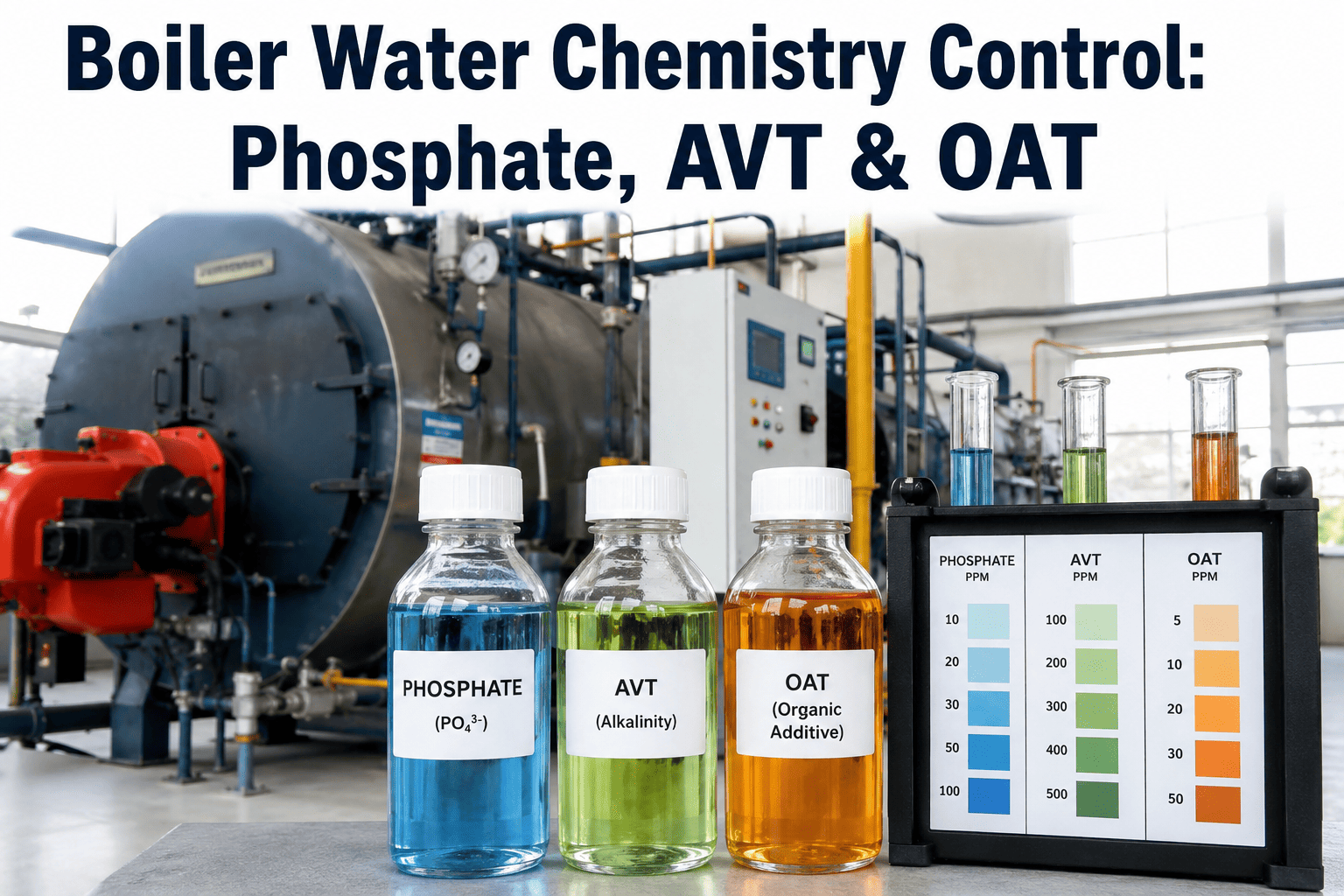
Confirm which mechanism, oxygen pitting, acid attack, caustic gouging, or scale, each of your tracked parameters is actually protecting against, so target ranges reflect real risk rather than a generic guideline.
Audit Every Continuous Analyzer Already Installed
Verify calibration on existing DO, pH, and conductivity analyzers, since an uncalibrated continuous instrument can be just as misleading as no instrument at all.
Put Dosing Pumps on a Fixed Verification Schedule
Check actual chemical delivery rate against setpoint on a defined interval rather than assuming a running pump is dosing at its rated output.
Assign a Clear Owner for Chemistry Alerts
Name who responds when a parameter crosses its target band and how quickly, so an excursion never sits unaddressed until the next shift review.
FREQUENTLY ASKED QUESTIONS
Questions Plant Teams Ask About Feedwater Chemistry Control
Why does dissolved oxygen matter so much even in small amounts?
Dissolved oxygen reacts directly with iron in feedwater piping and economizer tubes, creating localized pitting corrosion that concentrates damage in specific spots rather than wearing metal evenly. Even a few parts per billion above target, sustained for weeks, can create pitting deep enough to cause a tube failure long before general wall thinning would ever raise concern. That is why deaerator performance and pump seal integrity deserve as much attention as the oxygen scavenger dosing rate itself.
Book a demo to see how continuous DO trending catches this before it becomes tube damage.
What happens if boiler feedwater pH runs too high instead of too low?
Feedwater pH running too low accelerates acid attack on carbon steel, while pH running too high, especially in combination with high dissolved solids, can drive caustic gouging at tube surfaces where heat flux concentrates. Both directions of pH excursion damage tubes through different mechanisms, which is why a target band with both an upper and lower limit matters more than simply keeping pH above a single minimum threshold.
How quickly can a chemistry excursion actually cause measurable tube damage?
It depends heavily on severity and boiler operating conditions, but sustained excursions measured in weeks rather than hours are typically what convert a chemistry deviation into an actual tube leak. A brief spike that gets corrected within a shift rarely causes lasting damage on its own, which is exactly why catching a slow multi-week drift matters more than reacting only to dramatic single readings.
Contact our support team to see how drift detection differs from simple threshold alarming.
Is continuous chemistry monitoring worth it if grab sampling has worked so far?
Grab sampling can work for years without an obvious incident simply because most excursions self-correct before causing visible damage, which makes it easy to underestimate how much silent corrosion accumulates in between. The plants that eventually experience a chemistry-related tube failure almost always had a grab-sample program that looked adequate right up until the failure occurred, which is the core argument for continuous trending rather than periodic snapshots.
Can chemistry trending actually pinpoint which piece of equipment is causing an excursion?
Yes, when DO, pH, conductivity, and iron are trended together rather than reviewed as isolated numbers, the pattern of which parameter moves first and how quickly the others follow usually points directly at the source, whether that is a failing dosing pump, a condensate leak, or a deaerator performance issue. Isolated grab samples rarely provide enough resolution to make that connection with confidence.
Book a demo to see how correlated chemistry trends narrow down a root cause.
Turn Every Chemistry Reading Into an Early Warning, Not a Logbook Entry
iFactory continuously trends DO, pH, conductivity, and iron against target range, so a drifting dosing pump or a failing deaerator gets caught before it becomes a tube leak.