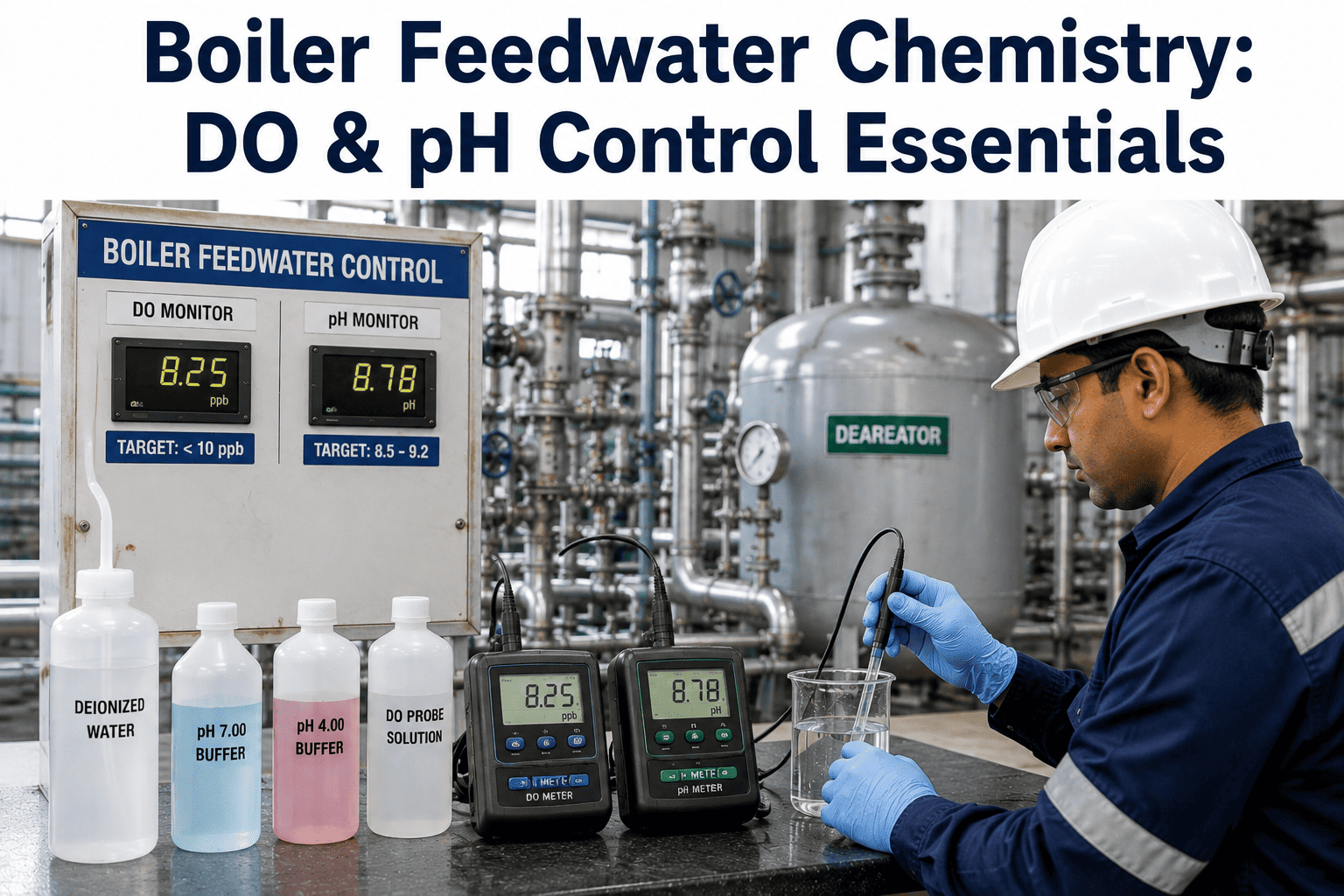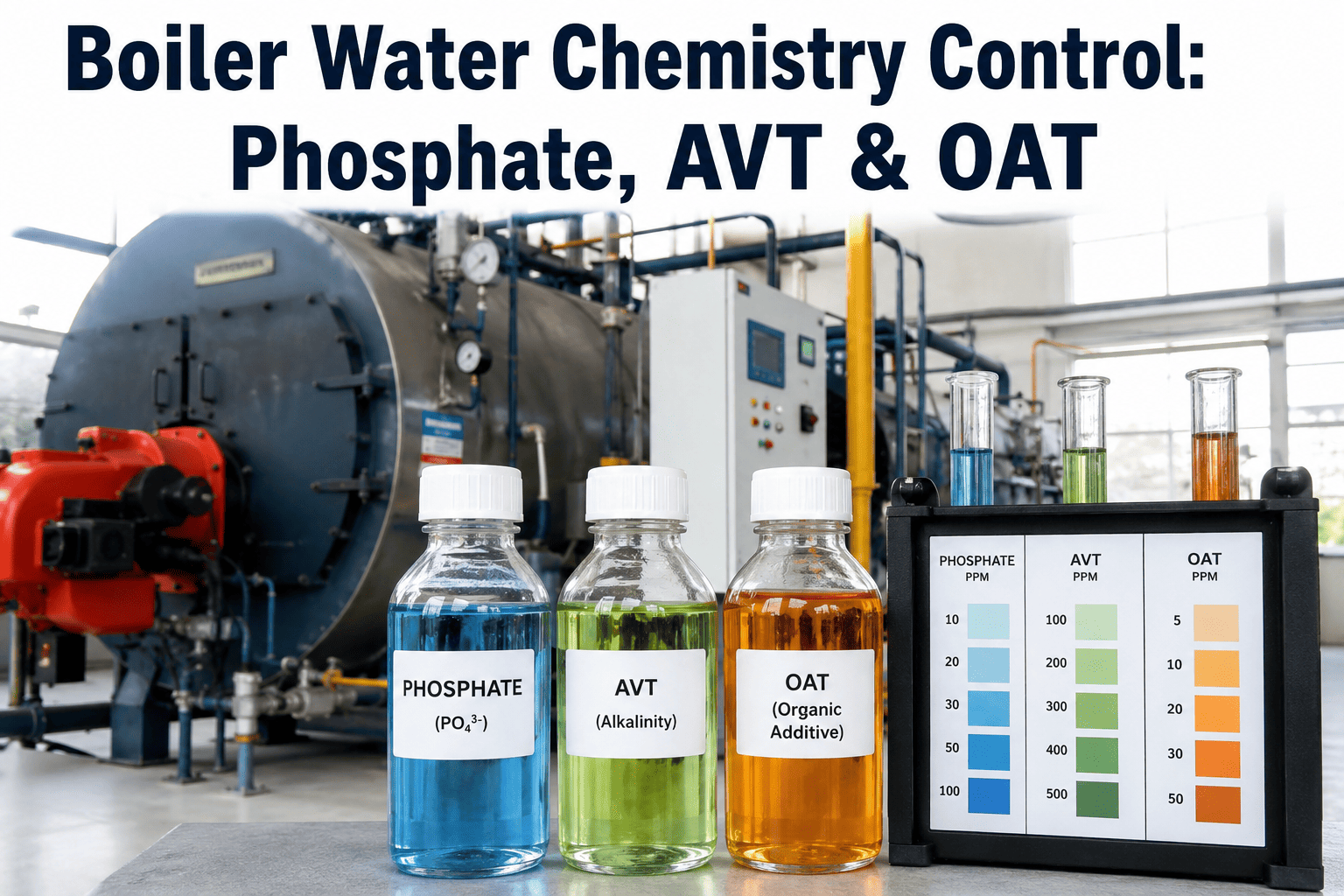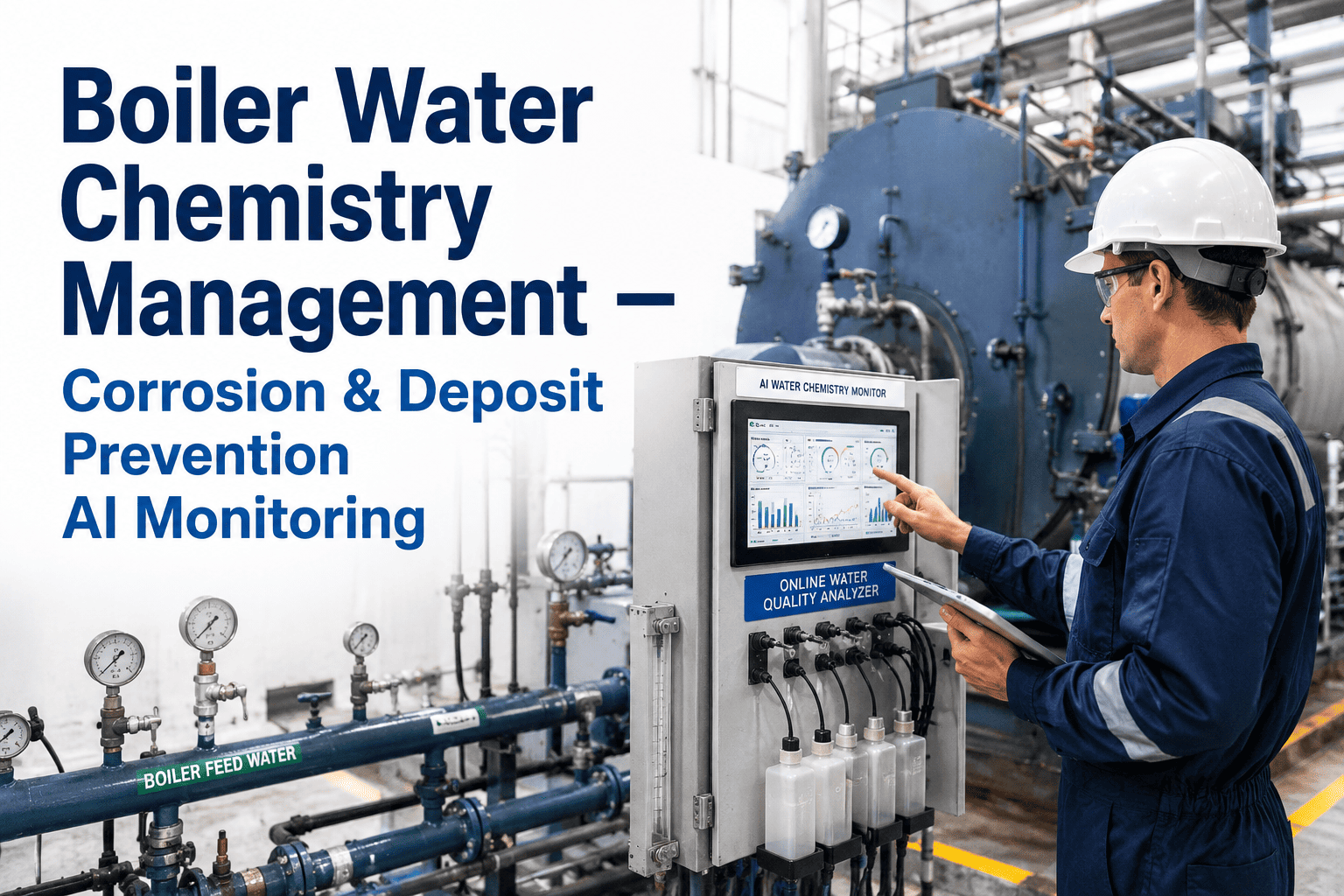
Boiler water chemistry failure remains the single largest controllable cause of forced outages in fossil and combined-cycle power plants, responsible for an estimated 30 to 40 percent of all tube failure incidents globally. Process engineers managing high-pressure boiler systems face a continuous challenge balancing corrosion inhibition, deposit control, and carryover prevention across treatment programs that must adapt to changing load profiles, makeup water quality variations, and condensate system contamination events. AI-driven water chemistry monitoring is now enabling a shift from periodic sampling and manual interpretation to continuous, predictive analysis that detects chemistry excursions hours before they reach damage thresholds. Book a Demo to explore how AI monitoring transforms your boiler chemistry program.
Boiler Water Chemistry Management with AI-Powered Corrosion and Deposit Prevention
A process engineering guide to AI-driven monitoring for corrosion prevention, deposit control, and carryover management across phosphate treatment, all-volatile treatment, and oxygenated treatment programs.
Move from periodic sampling to predictive chemistry intelligence that catches excursions before damage occurs.
Why Boiler Water Chemistry Failures Persist Despite Established Treatment Programs
Established boiler water treatment programs including phosphate treatment, all-volatile treatment, and oxygenated treatment have well-documented control ranges defined by EPRI, ASME, and OEM guidelines. Yet chemistry-related tube failures continue to occur because the gap between guideline specification and real-time plant operation is wider than most process engineering teams recognize. Load cycling, condensate system upsets, makeup water quality variations, and chemical feed system malfunctions create dynamic chemistry conditions that periodic grab sampling cannot capture. The typical plant samples boiler water chemistry at 4 to 8 hour intervals, meaning a contamination event or treatment deficiency can persist for hours before detection — sufficient time for localized corrosion or deposit initiation that may not manifest as a failure for weeks or months afterward.
Three Primary Boiler Water Treatment Programs and Their AI Monitoring Requirements
Each treatment program operates on fundamentally different chemistry principles and requires distinct monitoring parameter sets, control strategies, and AI model configurations. Understanding these differences is essential for process engineers designing AI monitoring systems that provide accurate, treatment-specific predictions rather than generic chemistry alerts.
Phosphate Treatment
Coordinated or congruent phosphate programs maintain a controlled phosphate residual in boiler water to buffer pH and sequester calcium hardness ingress. Monitoring focuses on phosphate residual, pH, sodium-to-phosphate molar ratio, and conductivity. AI models track phosphate demand trends that indicate condensate contamination levels and predict hideout return events during load changes that can cause localized caustic gouging or acid phosphate corrosion under deposits.
All-Volatile Treatment
AVT programs use ammonia for pH control and hydrazine or alternative oxygen scavengers to maintain zero dissolved oxygen in boiler water. This program requires precise ammonia dosing control to maintain pH between 9.0 and 9.6 without excessive conductivity. AI monitoring tracks the relationship between ammonia feed rate, condensate pH, and cation conductivity to detect condenser leaks, ammonia breakthrough into steam, and incorrect scavenger dosing that leaves the system vulnerable to oxygen pitting.
Oxygenated Treatment
OT programs deliberately maintain a controlled dissolved oxygen concentration of 30 to 150 ppb in feedwater and boiler water to promote formation of a stable protective magnetite layer on tube surfaces. This program is incompatible with copper alloys and requires ultra-pure condensate with cation conductivity below 0.2 microsiemens per centimeter. AI monitoring must detect any condensate quality degradation that violates OT prerequisites within minutes, as oxygen under impure conditions accelerates corrosion rather than preventing it.
Critical Chemistry Parameters, Control Ranges, and AI Alert Thresholds
Effective AI-driven boiler water chemistry monitoring requires clearly defined parameter thresholds that go beyond standard guideline ranges. The following table presents the primary monitored parameters across all three treatment programs, with AI-specific alert thresholds set below critical limits to enable proactive intervention before damage thresholds are reached.
| Parameter | Phosphate Treatment Range | AVT Range | OT Range | AI Alert Threshold | Damage Risk |
|---|---|---|---|---|---|
| pH at 25 C | 9.0 - 9.7 | 9.0 - 9.6 | 8.5 - 9.0 | 0.15 unit below target | Acid attack, caustic gouging |
| Cation Conductivity | Less than 5.0 uS/cm | Less than 0.3 uS/cm | Less than 0.2 uS/cm | 80% of limit value | General corrosion, deposit formation |
| Dissolved Oxygen | Less than 7 ppb | Less than 5 ppb | 30 - 150 ppb | 70% of limit or below 20 ppb for OT | Oxygen pitting, protective layer failure |
| Phosphate Residual | 2 - 8 mg/L | Not applicable | Not applicable | Below 1.5 mg/L or above 10 mg/L | Calcium scaling, caustic corrosion |
| Silica in Boiler Water | Less than 0.5 mg/L | Less than 0.2 mg/L | Less than 0.1 mg/L | 70% of limit value | Silica carryover, turbine deposition |
| Sodium | Less than 20 ppb | Less than 5 ppb | Less than 2 ppb | 60% of limit value | Caustic embrittlement, stress corrosion |
| Iron | Less than 20 ppb | Less than 10 ppb | Less than 5 ppb | Trending increase over 3 samples | Iron oxide deposits, flow restrictions |
| Copper | Less than 5 ppb | Less than 2 ppb | Not permitted | Any detectable level for OT | Copper plating, under-deposit corrosion |
How AI-Driven Chemistry Monitoring Detects Excursions Before Damage Begins
The iFactory AI water chemistry monitoring engine operates through a four-stage process that converts raw sensor data and laboratory sample results into predictive corrosion and deposit risk assessments. Unlike conventional alarm-based monitoring that reacts when parameters exceed fixed limits, the AI engine identifies subtle trend patterns and multi-parameter correlations that indicate developing chemistry upsets hours before any single parameter crosses a threshold.
Continuous Data Ingestion and Validation
The platform ingests data from online chemistry analyzers including pH, conductivity, dissolved oxygen, sodium, and silica sensors at intervals as frequent as every 60 seconds. Laboratory grab sample results are integrated into the same data stream with automatic time-stamp alignment. The validation layer flags sensor drift, calibration anomalies, and sample handling errors that could corrupt the analysis, ensuring that AI models operate on verified data inputs rather than raw readings that may include instrument artifacts.
Multi-Parameter Correlation Analysis
Individual parameter trends are analyzed in combination rather than isolation. The AI engine detects patterns such as simultaneous pH decline with conductivity increase that indicate condenser leak ingress, or phosphate residual decrease with sodium increase during load reduction that signals phosphate hideout. These multi-parameter correlations identify chemistry upsets that would not trigger alarms on any single parameter because each individual reading remains within its specified control range at the moment of detection.
Predictive Corrosion and Deposit Risk Scoring
Validated chemistry data and correlation patterns feed into predictive models trained on historical failure databases that relate specific chemistry excursion patterns to corrosion and deposit formation probabilities. The engine generates a real-time risk score for each major damage mechanism — oxygen pitting, acid attack, caustic gouging, hydrogen damage, and deposit-related overheating — with confidence intervals that account for current boiler operating conditions including pressure, temperature, heat flux, and load profile.
Automated Response Recommendations and Chemical Dosing Optimization
When the risk scoring engine identifies a developing excursion, the platform generates specific response recommendations including chemical feed rate adjustments, blowdown increases, load reduction advisories, and sample frequency changes needed to correct the chemistry condition. The dosing optimization module continuously calculates the minimum chemical input required to maintain all parameters within their target ranges, reducing chemical consumption by 15 to 30 percent compared to manual dosing while maintaining more stable chemistry control.
Conventional Sampling Versus AI-Driven Monitoring: Measured Performance Differences
Data collected from iFactory AI deployments across 23 boiler units in North American and European power plants between 2023 and 2025 demonstrates consistent and measurable performance advantages for AI-driven chemistry monitoring across every critical dimension. The following comparison quantifies these differences using aggregated project data normalized for boiler type, pressure level, and treatment program.
Your boiler water chemistry data contains early warning signals that periodic sampling cannot capture. Every hour of undetected chemistry excursion is an hour of accumulated corrosion or deposit risk that shortens tube life and increases forced outage probability.
iFactory AI connects your online chemistry analyzers and laboratory data into a continuous monitoring engine that detects developing excursions through multi-parameter correlation analysis and generates predictive risk scores before damage thresholds are reached.
iFactory AI Modules Deployed for Boiler Water Chemistry Management
The iFactory AI platform provides a modular suite of capabilities specifically configured for power plant water chemistry monitoring, with each module addressing a distinct aspect of the chemistry management workflow from data acquisition through predictive analytics to automated response recommendation.
Real-Time Chemistry Dashboard
Live visualization of all monitored boiler water chemistry parameters with treatment-program-specific control ranges, AI alert thresholds, and historical trend overlays. Color-coded status indicators show current condition for each parameter at a glance, with drill-down capability to view multi-parameter correlation plots and trend analysis for any selected time window. The dashboard replaces multiple standalone analyzer displays and paper logbooks with a single integrated view accessible from any device.
Predictive Corrosion Engine
Machine learning models trained on industry failure databases and plant-specific history that calculate real-time corrosion risk scores for each major damage mechanism. The engine correlates current chemistry conditions with historical failure patterns to predict the probability and expected timeline for corrosion initiation under current operating conditions, enabling proactive load adjustments or chemistry corrections before tube metal loss reaches critical levels.
Deposit Formation Tracker
Continuous monitoring of deposit precursor conditions including iron transport, hardness ingress, silica concentration trends, and phosphate hideout indicators. The module tracks cumulative deposit loading estimates on critical heat transfer surfaces and predicts cleaning schedule requirements based on current deposition rates, enabling planned outages for chemical cleaning rather than emergency responses to deposit-related overheating failures.
Chemical Dosing Optimizer
Algorithmic calculation of minimum chemical feed rates required to maintain all parameters within target ranges under current operating conditions. The optimizer accounts for load changes, makeup water flow variations, condensate return quality, and seasonal temperature effects on chemical reaction rates to dynamically adjust dosing setpoints. Plants using the optimizer report 15 to 30 percent reductions in annual chemical purchasing costs with improved chemistry stability compared to fixed-setpoint manual dosing programs.
Boiler Water Chemistry AI Monitoring — Frequently Asked Questions
The iFactory AI platform integrates with all major online chemistry analyzer brands and models through standard 4-20 mA analog signals, Modbus RTU/TCP digital communications, or OPC UA server connections. Compatible analyzer types include pH, conductivity, cation conductivity, dissolved oxygen, sodium, silica, phosphate, hydrazine, and ammonia analyzers from manufacturers such as Mettler Toledo, Swan Analytical, Hach, Endress+Hauser, and Yokogawa. The platform also ingests laboratory sample results from LIMS systems or manual data entry, automatically aligning grab sample timestamps with online analyzer data streams for unified trend analysis. Book a Demo to review the specific analyzer integration options for your plant.
The iFactory AI platform maintains separate model configurations for each treatment program type and supports planned transition workflows that gradually shift monitoring parameters, control ranges, and alert thresholds as the boiler water chemistry transitions from one program to another. During a phosphate-to-OT conversion, the platform tracks the phosphate residual depletion curve, monitors cation conductivity decline to OT-qualified levels, validates dissolved oxygen establishment within the OT control range, and continuously assesses whether condensate purity meets OT prerequisites at each stage. The transition monitoring workflow includes hold points where the AI engine confirms that prerequisite conditions are met before the next transition phase begins, preventing premature OT implementation that could accelerate corrosion. Contact Support for guidance on configuring treatment program transitions in the platform.
Implementation typically requires 8 to 14 weeks from project kickoff to full operational deployment, depending on the number of boiler units, the completeness of existing online analyzer infrastructure, and the complexity of data integration requirements. The first phase covering data connectivity and validation typically completes in 3 to 4 weeks. AI model training and calibration using historical plant data requires an additional 3 to 5 weeks. The final phase covering dashboard configuration, alert threshold tuning, and process engineer training completes in 2 to 5 weeks. Plants with comprehensive online analyzer coverage and existing digital infrastructure typically achieve full deployment at the shorter end of this range, while plants requiring analyzer upgrades or extensive integration work fall at the longer end.
Yes, the AI platform detects condenser leak signatures through multi-parameter correlation analysis that identifies the earliest indicators of cooling water ingress into the condensate system. The engine monitors cation conductivity trends in condensate and feedwater, sodium concentration changes, pH shifts, and the relationship between these parameters and condenser backpressure and cooling water temperature. In documented deployments, the AI engine has detected condenser leak onset an average of 4 to 12 hours before the leak magnitude becomes sufficient to impact boiler water chemistry parameters directly, enabling operators to initiate condenser isolation or leak detection procedures before boiler water quality is compromised. Book a Demo to see condenser leak detection case studies from operating plants.
The dosing optimizer continuously receives boiler load data, feedwater flow rates, makeup water volumes, and condensate return quality metrics as input variables to its dosing calculation algorithms. When load changes occur, the optimizer recalculates required chemical feed rates within each 60-second data cycle, accounting for the dynamic changes in boiler water volume, blowdown rate, and chemical consumption rate that accompany load transitions. The optimizer also incorporates learned response characteristics specific to each plant's chemistry system, including chemical mixing time delays, feed system response lags, and the relationship between dosing changes and parameter response times, to generate feed rate adjustments that prevent both under-dosing during load increases and over-dosing during load decreases. Contact Support to discuss dosing optimizer configuration for your specific boiler operating profile.
Stop Reacting to Chemistry Alarms and Start Preventing Chemistry Failures
iFactory AI converts your online analyzer data and laboratory results into continuous predictive intelligence that detects developing chemistry excursions through multi-parameter correlation analysis, scores corrosion and deposit risk in real time, and optimizes chemical dosing to maintain stable control across phosphate, AVT, and oxygenated treatment programs.