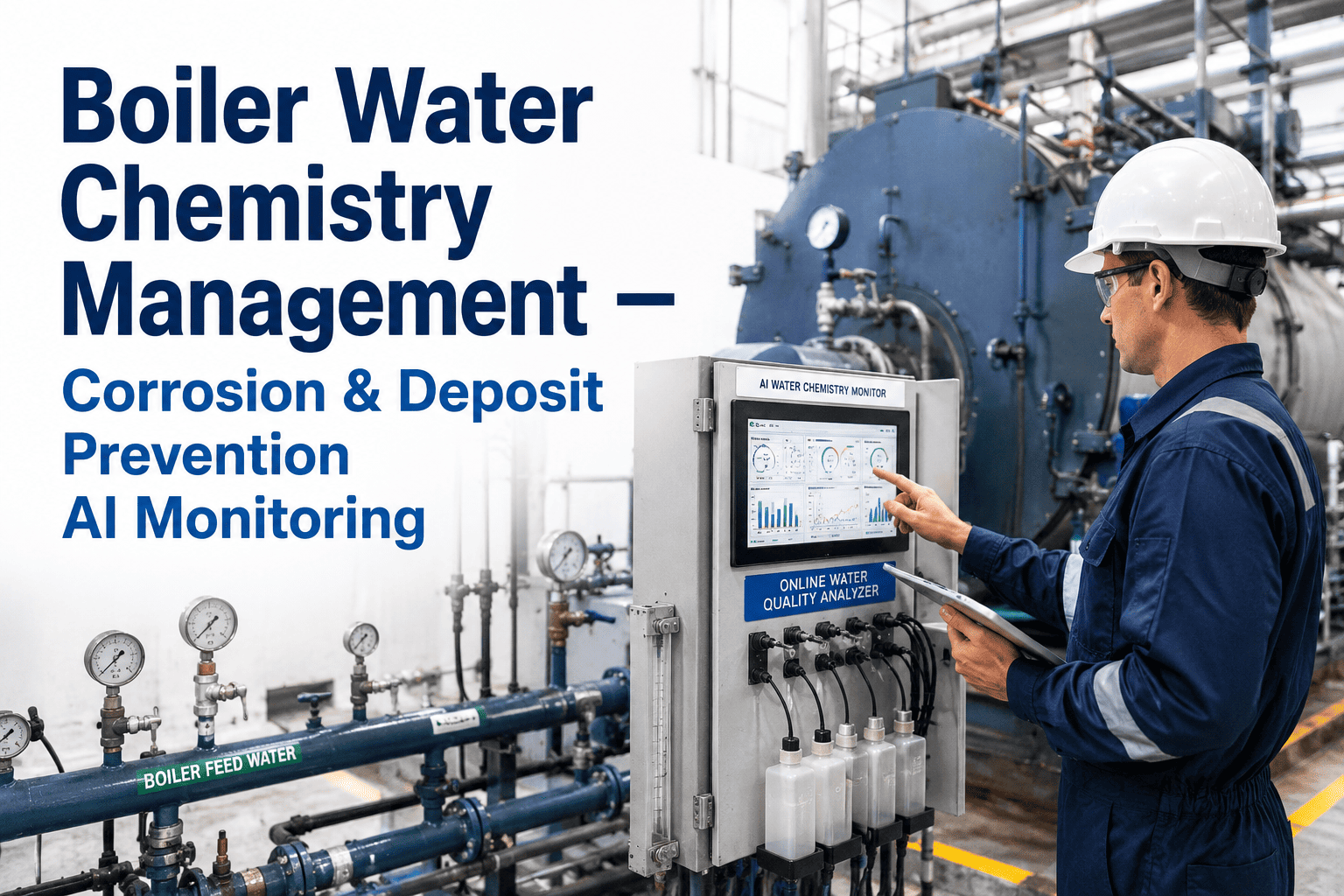
A cooling water system doesn't announce that its treatment program has failed. What it does is quietly generate iron oxide inside a chiller tube for six weeks until the heat transfer coefficient drops by fifteen percent, or eat through a heat exchanger shell over a summer until a leak develops during the plant's highest-load month. Every one of those failures was preceded by a corrosion rate that had already climbed past 5 mils per year on carbon steel — and every one of them was theoretically catchable by a monitoring program that either wasn't running, wasn't measured often enough, or wasn't tied to a work order. That's the gap corrosion monitoring is supposed to close: the coupon on the sidestream rack, the LPR probe on the return header, the ER probe on the makeup line, all continuously reporting whether the treatment program is actually delivering the mils-per-year the water treater promised on the service contract. Plants building a defensible corrosion monitoring program work with iFactory's water systems engineering team to map coupon rack placement, probe deployment, rating thresholds, and CMMS-integrated deviation routing to each specific cooling loop's metallurgy and duty cycle.
Corrosion Rate Monitoring · Cooling Water
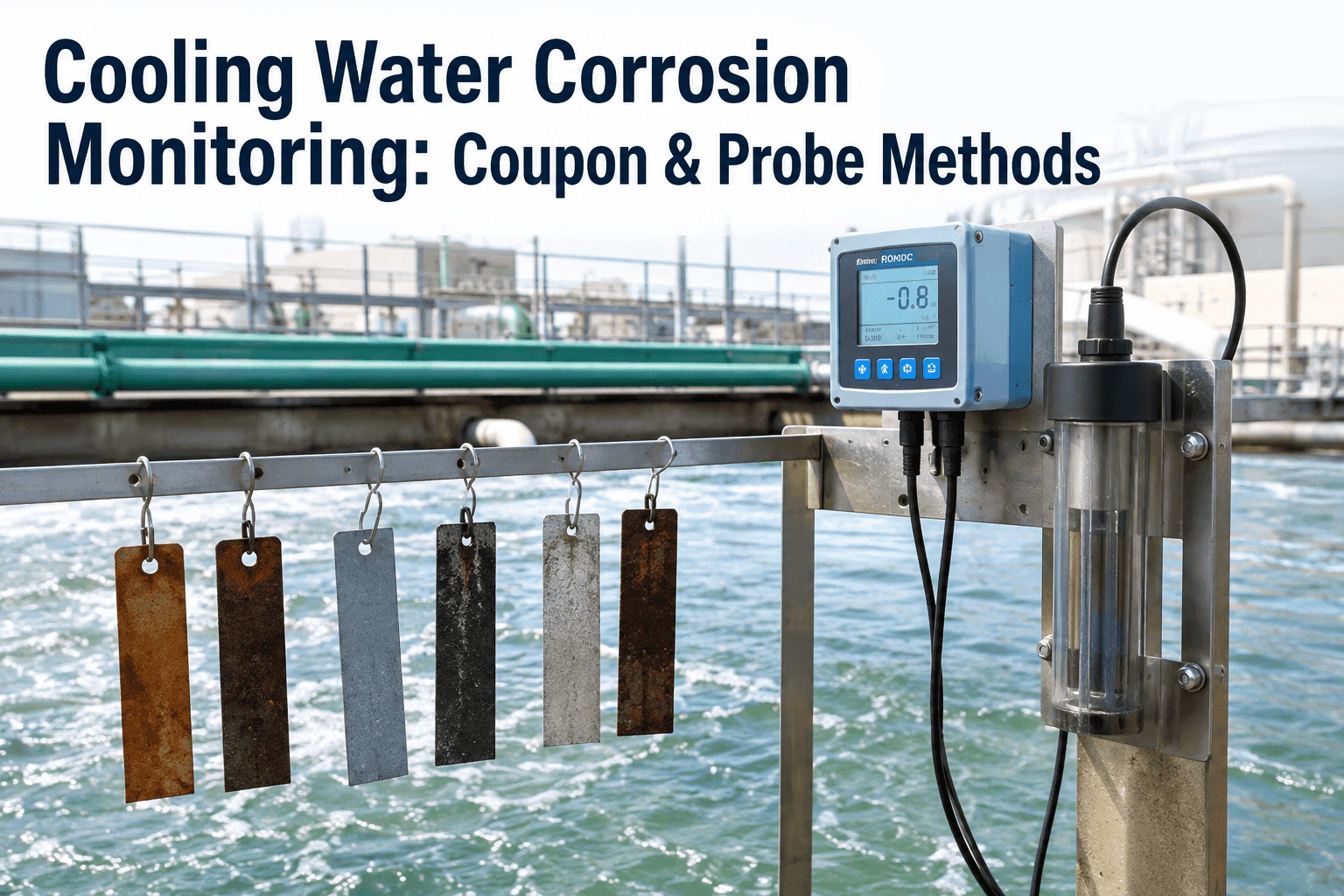
Cooling Water System Corrosion Monitoring: Coupon & Probe Methods
Measure actual metal loss on your cooling loops with coupons, LPR probes, and ER probes. Trend the corrosion rate against the Boffardi rating scale, verify treatment program effectiveness against MPY targets, and route out-of-band findings as CMMS work orders before the chiller tube fails during peak load.
Carbon Steel Corrosion Rating Scale (Open Recirc)
≤ 1 MPY
Excellent · target zone
1–3 MPY
Very good · treatment on spec
3–5 MPY
Good · monitor closely
5–8 MPY
Fair · investigate program
> 10 MPY
Severe · corrective action now
Per Boffardi standards, AWT Analyst
Why The Corrosion Number Actually Matters
The Silent Cost Of Not Knowing Your Cooling Loop's MPY
Every industrial cooling water system carries an untreated corrosion propensity that would eat mild steel at anywhere from forty to ninety mils per year if the water treatment program stopped working tomorrow. Treatment inhibitors — phosphates, azoles, polymers — hold that number down to a manageable range, but the specific number they achieve depends on cycles of concentration, LSI, pH, temperature, holding time, and half a dozen other variables that shift week to week. If nobody is measuring the resulting corrosion rate against a validated rating scale, the program has no honest quality metric, and the plant is running blind between failure events.
The catch is that corrosion happens on a timescale much slower than most process variables — slow enough that daily rounds miss it, and fast enough that quarterly inspections catch it only after significant damage has already accumulated. A 3 mpy rate on carbon steel means about 75 microns of wall loss per year, or 300 microns over a four-year exchanger service interval. A 10 mpy rate means the same tube loses 1 millimeter of wall in four years, and the failure envelope shortens dramatically. The plant that treats corrosion as a lagging indicator, only discussed after a leak event, is running its cooling assets at a lifecycle it doesn't actually understand.
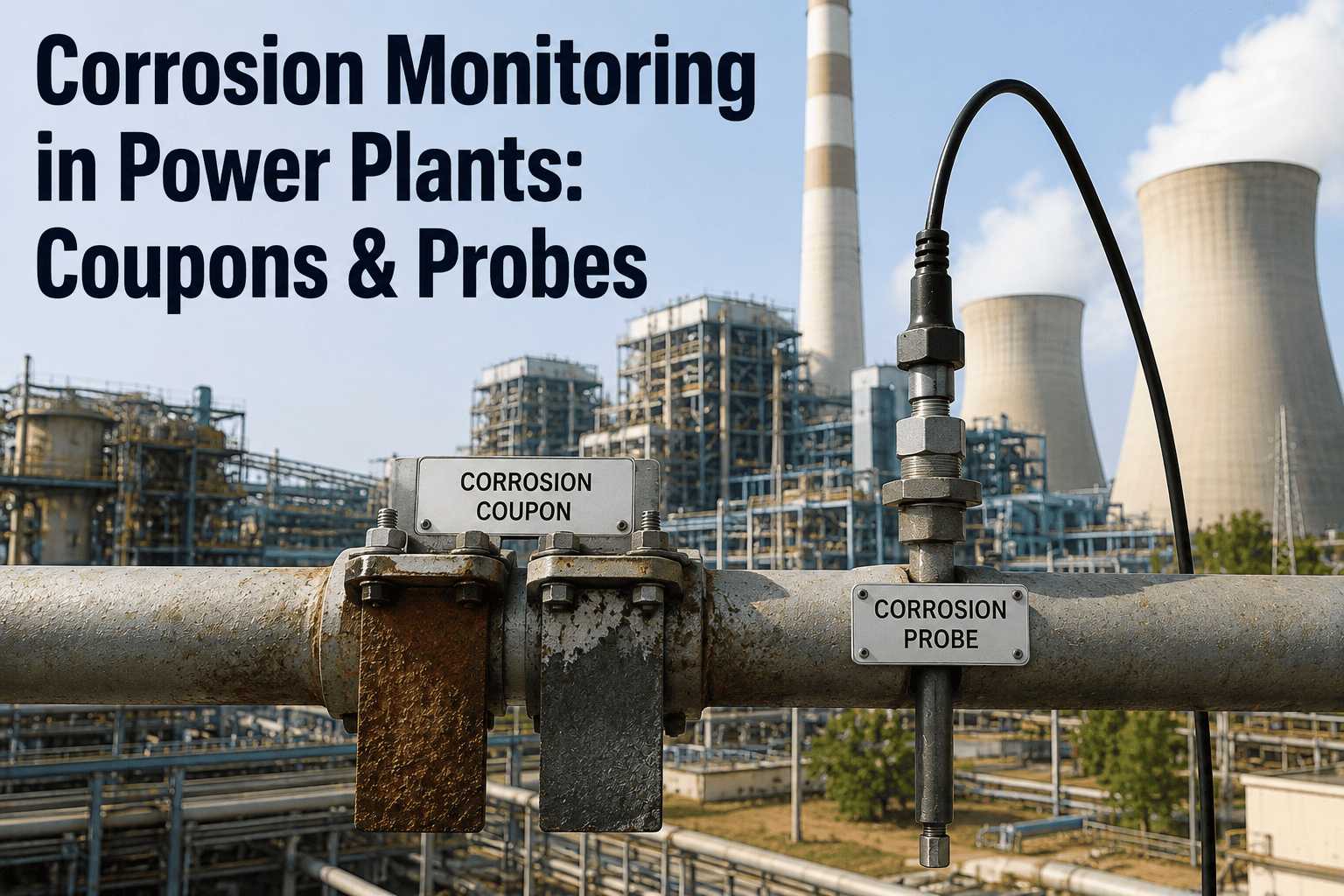
Corrosion monitoring closes that loop with three complementary methods. Coupons measure actual mass loss over 30 to 120 days, delivering the reference-quality corrosion rate that regulators, insurers, and water treatment contracts recognize as authoritative. LPR probes deliver instantaneous corrosion rate every few minutes, catching treatment program upsets in real time. ER probes track cumulative metal loss continuously, revealing the long-term trend that neither instantaneous readings nor point-in-time coupons can produce alone. Used together, they turn a cooling loop's corrosion story into a live, defensible number instead of a periodic post-mortem.
The Three Monitoring Methods, Side By Side
Coupon · LPR Probe · ER Probe — What Each Measures And When
The three cooling water corrosion monitoring methods each measure something different, on a different timescale, with different accuracy and different operational tradeoffs. A mature monitoring program uses all three because each one covers a blind spot the other two carry. The three-column framework below is how water treatment engineers actually think about deploying them.
Corrosion Coupon
Reference method
PrincipleMass loss over exposure time
ResultAverage MPY across exposure
Exposure30–120 days open · 90–365 days closed
LatencyWeeks to months for result
AccuracyReference-grade, authoritative
Best forTreatment program validation, audits
LPR Probe
Real-time rate
PrincipleElectrochemical polarization current
ResultInstantaneous MPY reading
ExposureContinuous, minutes-scale
LatencyMinutes for reading
AccuracyCan vary widely vs coupons
Best forReal-time upset detection, control
ER Probe
Cumulative loss
PrincipleElectrical resistance change
ResultCumulative metal loss over time
ExposureContinuous until probe life ends
LatencyTrends emerge over days to weeks
AccuracyConsistent across corrosion severity
Best forLong-term trending, wall thickness
The Coupon Rack Workflow
From Fresh Coupon To Reported Corrosion Rate — Every Step That Matters
The coupon method is deceptively simple in principle — hang a piece of metal, weigh it before and after — and unforgiving in execution. Sample preparation, exposure conditions, mounting order, and post-exposure handling each carry error sources that shift the reported MPY by amounts the plant will feel in decisions six months later. The six-step workflow below is the discipline that produces a defensible number.
01
Coupon Selection & Pre-Weight
Coupon material selected to match the system's metallurgy — carbon steel, copper, 304 stainless — one coupon per material. Each coupon degreased, dried, and weighed to four decimal places under laboratory-controlled conditions before installation.
02
Rack Placement & Mounting Order
Coupon rack mounted on a sidestream bypass downstream of chemical injection, representative of bulk system conditions. Less noble metals like carbon steel positioned upstream of more noble metals like copper to prevent ion plating artifacts.
03
Exposure Under Continuous Flow
Coupons held in place under continuous cooling water flow for the design exposure period — 30 to 120 days on open recirc systems, 90 to 365 days on closed loops. Bypass isolation valves closed only briefly and only during scheduled coupon changes.
04
Removal, Deposit Documentation & Chain Of Custody
Coupon removed carefully to preserve surface deposits — those deposits themselves are diagnostic. Photographed in situ, sealed in an envelope with removal date, and shipped to the lab under documented chain of custody for audit-quality reporting.
05
Lab Cleaning, Post-Weight & MPY Calculation
Lab strips deposits, weighs the cleaned coupon, and calculates MPY from mass loss, density, exposed area, and exposure duration. Pitting pattern, general corrosion character, and deposit chemistry all recorded in the corrosion analysis report.
06
Rating Against Boffardi Scale & Program Action
Reported MPY compared against the Boffardi rating for that metallurgy and system class. Anything in the fair, poor, or severe bands triggers a treatment program review and CMMS work order — not a note for the next quarterly meeting.
See Corrosion Trending Live
Watch Coupon, LPR, And ER Data Roll Into A Single Cooling Loop Dashboard
Book a walkthrough with iFactory's water systems engineering team and see live corrosion rate trending across carbon steel and copper coupons, real-time LPR readings, ER wall loss curves, and automatic CMMS work order generation when an MPY reading crosses the treatment program threshold.
Where A Monitoring Program Actually Delivers Value
The Six Places An MPY Number Pays For Its Own Program
Corrosion monitoring earns its keep in specific, quantifiable places on the plant's P&L. The stack below is the pattern that reliability leaders consistently cite when they take the program to their finance committee — every category compounds and every one is defensible with the data the monitoring program itself produces.
01
Heat Exchanger & Chiller Asset Life
Every mil per year of unnecessary corrosion shortens tube service life proportionally. Holding an open recirc system in the very good band instead of drifting into the fair band typically extends exchanger service intervals by years across the asset base.
02
Water Treatment Contract Accountability
The service contract specifies MPY targets. Without a defensible monitoring program, the plant has no ability to enforce the specification. Coupon data becomes the objective reference the plant and the treatment vendor both share.
03
Unplanned Leak & Shutdown Prevention
A corroded exchanger that fails during a summer heat wave costs the plant a production day — sometimes several. Trending MPY against the rating scale catches the drift before it consumes wall thickness margin and cascades into an unplanned outage.
04
Chemical Spend Optimization
Under-dosed treatment produces high MPY. Over-dosed treatment produces waste, environmental exposure, and unnecessary cost. Continuous corrosion data lets the plant tune inhibitor feed against actual system response rather than the vendor's default recipe.
05
Insurance & Regulatory Documentation
Property insurers and mechanical integrity programs increasingly require documented corrosion monitoring on cooling systems. A defensible MPY record with rating trends across coupons and probes is what the insurance adjuster wants to see at renewal.
06
Root-Cause Signal On Process Upsets
A sudden MPY spike on the LPR probe points at a specific process event — a treatment feed interruption, a pH excursion, a cycles of concentration jump. That signal is often the earliest available indicator that a process condition drifted out of specification.
Turning Numbers Into Action
How Corrosion Data Reaches The Work Order Instead Of The Filing Cabinet
The most common failure mode of a corrosion monitoring program isn't measurement accuracy — it's that the numbers never make it into the maintenance workflow. Coupons come back from the lab, get filed, and are only pulled out during the next audit. The five-stage integration below is what actually converts corrosion data into scheduled work.
Stage 1
Data Ingestion From Coupons, LPR, ER
Coupon lab results imported by CSV or API. LPR and ER probe data streamed continuously via industrial protocol. All corrosion data landed in a single time-series store with metallurgy, location, and system tag attached.
Stage 2
Rating Classification Against Boffardi Scale
Every reading auto-classified into excellent, good, fair, poor, or severe against the metallurgy-specific rating scale. Trend lines maintained per coupon rack, per probe, per cooling loop for portfolio-wide visibility.
Stage 3
Threshold Alerts & Escalation Rules
Configurable thresholds trigger alerts when readings cross into fair, poor, or severe bands. Escalation rules route alerts by system criticality — a chiller loop serving a critical process gets tighter thresholds and faster escalation than a comfort HVAC loop.
Stage 4
CMMS Work Order Auto-Generation
Threshold breaches generate structured work orders directly into the CMMS with the reading, the classification, the loop tag, the metallurgy, and the recommended treatment or investigation action. Nothing waits for the next quarterly meeting.
Stage 5
Audit-Ready Reporting & Trend Archive
Every reading and every work order archived with timestamps for insurance renewals, mechanical integrity audits, and water treatment contract reviews. The MPY story of every cooling loop is one export away, indefinitely.
Field Perspective
"
The framing I use with reliability leadership is that a cooling water treatment program without corrosion monitoring is a program running on faith. The water treater says the inhibitor package will hold carbon steel under 3 mpy. Fine — how does the plant verify that? If the answer is "we have coupons but we're not sure when they were last pulled," or "we have an LPR probe but nobody's read it in six months," then the program is a marketing claim, not an engineering discipline. That's how you end up with an exchanger failure that surprises everyone during peak summer load, when the corrosion rate had been sitting in the poor band for eighteen months and nobody had eyes on the trend. What makes a real monitoring program is boring stuff done consistently — coupons pulled on schedule, LPR and ER probes read weekly at minimum, results rated against Boffardi bands, deviations turned into work orders instead of filed. When plants build that discipline into their CMMS instead of into a paper binder, the whole conversation with the water treatment vendor changes. The plant starts holding the vendor to numbers. The vendor tunes the program to hit the numbers. And the cooling asset base starts operating at the service life the design intended, not the shortened life that undetected corrosion had been carving away.
Marcus Öberg-Nakamura
Cooling Water Reliability Lead · 23 years in water treatment programs, corrosion monitoring deployment, and mechanical integrity across chemical, power, and pulp & paper facilities
Common Questions
Frequently Asked Questions
Should our plant use coupons, LPR probes, or ER probes — or all three?
The best-performing programs run all three because each method fills a blind spot the others carry. Coupons deliver the reference-grade MPY that regulators and water treatment contracts recognize as authoritative, but they take weeks to months to produce a result and only give an average across the exposure period. LPR probes catch treatment upsets in near real time but can vary widely against coupon results and are limited in severely corrosive environments. ER probes deliver reliable cumulative metal loss trending across all severity levels but need time for meaningful trends to emerge. Coupons validate the program periodically, LPR catches upsets immediately, ER trends the long-term wall loss story — running only one method leaves the other timescales unmonitored.
Talk to water systems engineering about the right combination for your specific cooling loops.
How long should we expose corrosion coupons before pulling them for analysis?
Standard practice is 30 to 90 days for open recirculating cooling systems and 90 to 365 days for closed loops. Open systems experience faster water chemistry cycling and higher corrosion rates in general, so shorter exposures produce meaningful mass loss without allowing localized attack to distort the average corrosion rate. Closed systems corrode more slowly and require longer exposures to accumulate measurable mass loss above lab detection limits. Water flow through the coupon rack must remain continuous throughout the exposure — any prolonged stagnation periods introduce artifacts that shift the reported MPY away from actual bulk system corrosion. Many facilities standardize on a 90-day cycle for open systems as the sweet spot between meaningful data and reasonable program cadence.
What corrosion rate should we actually be targeting for our carbon steel cooling system?
The widely cited Boffardi rating standards published in AWT Analyst define the operating envelope: for open recirculating systems, a carbon steel corrosion rate below 1 MPY is classified excellent, 1 to 3 MPY is very good, 3 to 5 MPY is good, 5 to 8 MPY is fair or moderate, 8 to 10 MPY is poor, and anything above 10 MPY is very poor to severe. Closed loop targets are much tighter — excellent is below 0.2 MPY, and anything above 1 MPY is considered severe because there's no makeup water diluting the reaction products. Most well-run industrial cooling systems on modern phosphate or organic inhibitor programs hold carbon steel between 1 and 3 MPY consistently. Any reading in the fair band or worse should trigger a treatment program review rather than a note for the next meeting.
Why do LPR probe readings sometimes disagree so significantly with coupon results?
LPR is an electrochemical technique that measures the instantaneous polarization behavior of a small electrode surface, then extrapolates a corrosion rate using assumptions from the Stern-Geary equation. Coupons measure actual mass loss integrated over months of exposure. Published research on LPR probe versus coupon immersion tests shows readings can differ dramatically — sometimes over half of LPR results have been recorded 50% or more higher than the corresponding coupon result on the same water. The disagreement is largest at high calcium levels and in low-conductivity water where the electrochemical assumptions weaken. That's exactly why mature programs use LPR for real-time trend and upset detection while relying on coupons for the absolute MPY number that goes into contracts and audits.
How does corrosion monitoring data feed into the CMMS and treatment program decisions?
The highest-value programs treat every corrosion reading — coupon, LPR, or ER — as a potential work order trigger, not just a data point. Each reading is auto-classified against the Boffardi rating scale for its metallurgy and system class, and any classification in the fair, poor, or severe bands generates a structured CMMS work order with the reading value, the loop tag, and the recommended investigation action attached. Water treatment vendors receive the trend as part of their contract review cycle, giving both plant and vendor an objective shared reference for program performance. Insurance renewals and mechanical integrity audits pull the archived trend directly.
Book a demo to see the coupon-to-work-order pipeline running on real cooling loop data.
Build A Defensible MPY Record
Turn Corrosion Monitoring From A Paper Binder Into A Live Reliability Program
iFactory's cooling water corrosion monitoring platform is built for the specific realities of industrial cooling operations — mixed metallurgy loops, open and closed systems, coupon lab data plus continuous probe streams, and CMMS-integrated deviation routing. Coupon results, LPR readings, and ER trends come together into a single MPY intelligence layer that holds treatment programs accountable and turns cooling assets into a controlled reliability story instead of a periodic surprise.