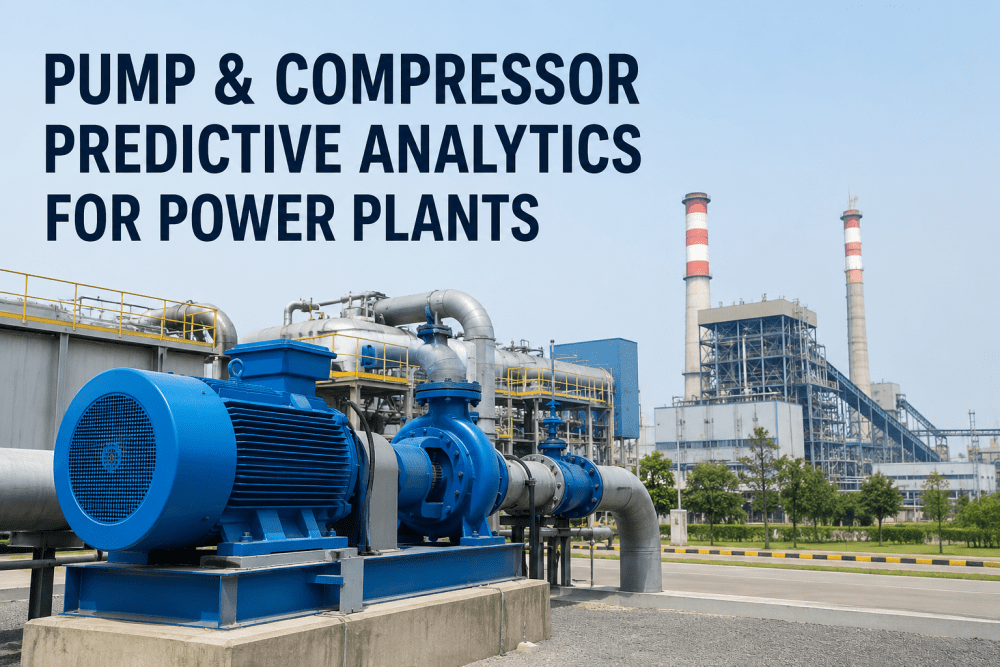
Pump and compressor failures in U.S. power plants do not announce themselves with alarms that anyone acts on. They announce themselves with trending deviations that standard SCADA systems register but do not interpret — rising bearing temperature on a boiler feed pump, increasing vibration velocity on a condensate pump, declining discharge pressure on a centrifugal compressor, a seal flush flow rate that has been dropping by 0.3 GPM per week for six weeks. Power plants that Book a demo
Why Power Plant Pumps and Compressors Fail Without Warning — and How Predictive Analytics Changes That
The economics of power generation depend on rotating equipment reliability. A single boiler feed pump failure at a 600 MW coal-fired unit during summer peak demand can cost $350,000–$650,000 per day in replacement power costs depending on the regional energy market.
The detection gap is structural. Power plant SCADA systems monitor hundreds of rotating equipment parameters per unit — bearing vibration, bearing temperature, winding temperature, seal oil pressure, suction and discharge pressure, flow rate, motor current — but each parameter is evaluated against a fixed, often generic threshold that was set during commissioning. A bearing temperature alarm set at 90°C cannot distinguish between a pump running at 82°C with a 0.4°C per week rising trend — which indicates progressive bearing degradation with a 6–8 week remaining useful life — and a pump running steadily at 86°C under normal full-load conditions.
Pump and Compressor Asset Groups: Failure Physics and Monitoring Parameters
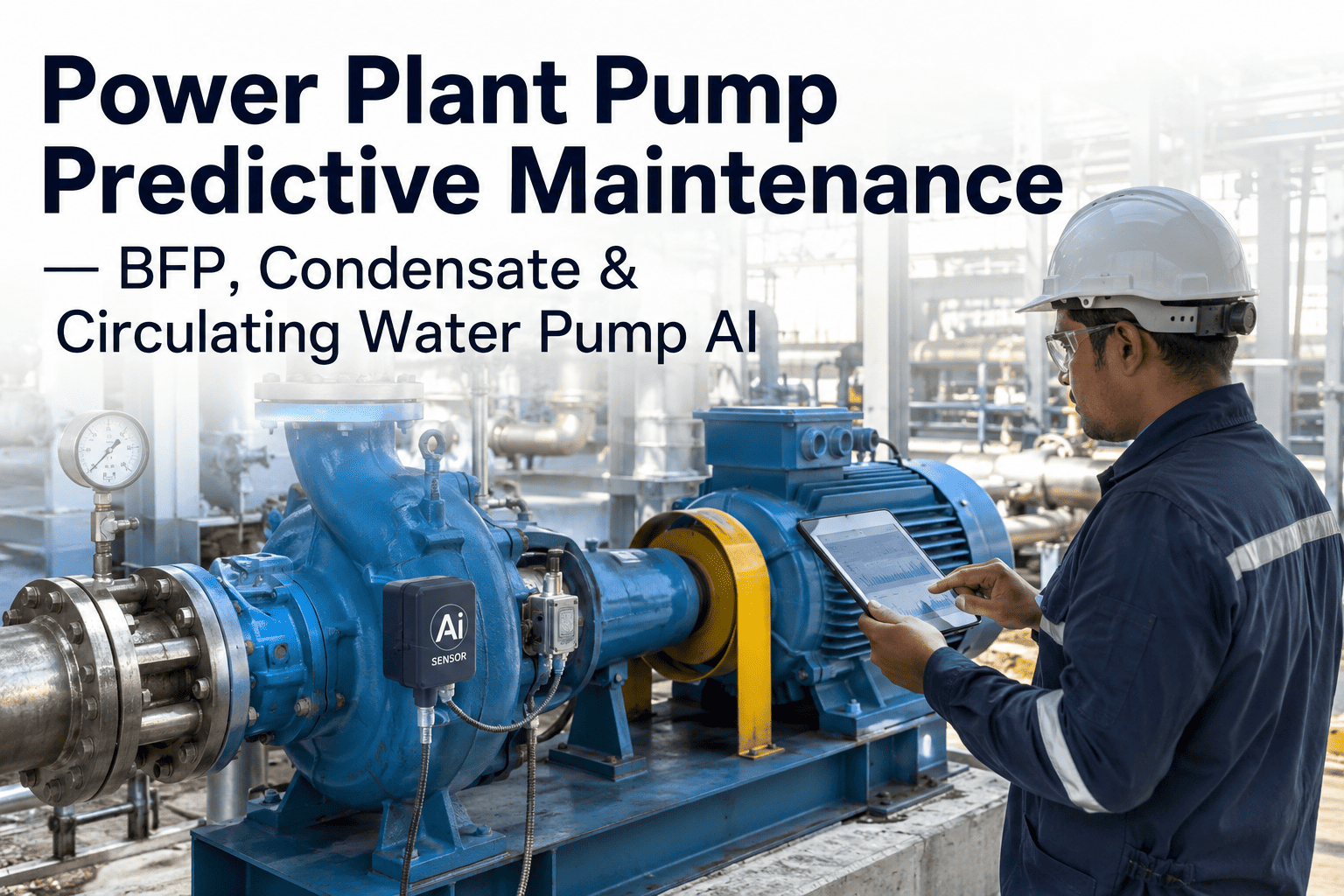
Power plant rotating equipment covers a wide range of pump and compressor types, each with distinct failure physics, critical monitoring parameters, and degradation timelines. iFactory's pump and compressor analytics library defines four high-consequence asset groups that account for the majority of unplanned rotating equipment outages in U.S. power generation — boiler feed pumps, condensate pumps, circulating water pumps, and centrifugal and reciprocating compressors — with monitoring frameworks calibrated to the specific failure modes of each.
Boiler Feed Pump Monitoring: Bearing, Seal, and Hydraulic Performance
Boiler feed pumps operate at the highest pressure and temperature conditions in the power plant water-steam cycle — discharge pressures of 2,000–4,500 PSI and feedwater temperatures ranging from 150°C to 300°C depending on the cycle configuration. The consequence of failure is not merely the pump itself but the immediate boiler feedwater starvation that triggers a master fuel trip if the backup pump fails to start and carry load. iFactory monitors every boiler feed pump on four critical parameter groups at 10-second intervals: bearing condition (vibration velocity and acceleration, bearing temperature trend, oil sample analysis due dates), mechanical seal condition (seal flush flow rate, seal cavity pressure, temperature differential across seal face), hydraulic performance (head-capacity curve deviation, suction pressure decay indicating strainer blockage, recirculation valve position and cycling frequency), and driver condition (motor bearing temperature, current imbalance, winding temperature trend rate against ambient).
Condensate Pump Monitoring: Cavitation, NPSH Margin, and Motor Health
Condensate pumps operate on the lowest suction pressure in the condensate-feedwater system — frequently at or near the saturation pressure corresponding to the condenser hotwell temperature. This makes them the asset class most vulnerable to cavitation damage, which erodes impeller vanes and diffuser passages progressively until hydraulic performance degrades below the minimum flow required for deaerator level control. iFactory monitors condensate pump suction pressure against the saturation pressure corresponding to hotwell temperature, calculates NPSH margin in real time, and generates trend-based alerts when margin is eroding due to condenser backpressure rise, hotwell temperature increase, or strainer fouling.Book a demo
Circulating Water Pump Monitoring: Large-Volume, Low-Head Reliability
Circulating water pumps are the largest-volume rotating equipment in the power plant — a typical 600 MW coal unit moves 250,000–400,000 GPM of circulating water through four to six pumps operating in parallel. While individual pump failure does not trip the unit immediately, the failure cascades through the system: reduced circulating water flow increases condenser backpressure, which reduces turbine efficiency by 2–5%, and if the loss is severe enough, forces a load reduction during precisely the high-demand periods when the plant can least afford it. iFactory monitors circulating water pump bearing condition, impeller condition, motor electrical health, and discharge valve position to detect developing failures before they force a pump outage.
Centrifugal and Reciprocating Compressor Monitoring: Performance and Valve Health
Compressors in power plants serve multiple critical functions: instrument air for pneumatic controls and valve actuators, process air for flue gas desulfurization and material handling, gas boosting for natural gas-fired turbines, and carbon capture system compression where deployed. Centrifugal compressors fail predominantly through bearing degradation, seal leakage, and aerodynamic instability (surge). Reciprocating compressors fail predominantly through valve and packing degradation, which reduces volumetric efficiency before it causes a catastrophic trip. iFactory monitors both compressor types with parameter sets specific to their failure modes and degradation physics.Book a demo
The Measurable Impact of Predictive Pump and Compressor Analytics
The economic case for predictive analytics on power plant rotating equipment is built on data that every plant already has but does not systematically use. The results reported by U.S. power plants that have deployed iFactory's pump and compressor analytics across their rotating equipment fleet are achievable within 12 months of full deployment and compound as the AI model learns from each maintenance event.
How iFactory's Analytics Engine Converts Vibration Data into Prevented Outages
Standard vibration monitoring systems report overall vibration levels in velocity (mm/s RMS) or acceleration (g's) against fixed ISO 10816-3 severity zones. The operator sees a green, yellow, or red indicator and is trained to escalate only when the reading enters the red zone.
From Calendar-Based to Condition-Based: How Inspection Intervals Change Under AI-Driven Monitoring
The most common finding in post-outage analyses of pump and compressor failures is not the absence of an inspection program — it is the misalignment between the inspection interval and the actual degradation rate. Calendar-based schedules cannot account for the variability introduced by load cycling, seasonal operation, water chemistry variations, and transient events that accelerate wear beyond the average rate assumed in the maintenance plan.
| Maintenance Element | Traditional Calendar Approach | iFactory AI Condition-Based Approach | Reliability Impact | Cost Impact |
|---|---|---|---|---|
| Boiler Feed Pump Bearing Replacement | Every 24 months regardless of condition | Triggered by vibration trend rate and remaining useful life prediction | Bearing replaced when wear rate accelerates, not when calendar says | Parts cost optimized; emergency bearing procurement eliminated |
| Mechanical Seal Replacement | Every 36 months or at pump overhaul | Triggered by seal flush flow rate and cavity pressure trend | Seal replaced before leakage forces emergency shutdown | Seal failure cost (average $18,000) avoided per event |
| Condensate Pump Impeller Inspection | Annual overhaul interval | Triggered by NPSH margin history and cavitation event count | Cavitation-damaged impellers detected before performance degrades | Impeller replacement scheduled during planned outage, not forced outage |
| Compressor Valve Inspection | Every 8,000 operating hours | Triggered by discharge temperature trend per cylinder and valve | Leaking valve detected when efficiency drops, not when seat fails completely | Valve replacement cost reduced through single-valve versus full-set replacement |
| Coupling Alignment Verification | Annually or after coupling replacement | Triggered by 1X RPM vibration amplitude trend and phase analysis | Misalignment detected at 3 mils, corrected before coupling wear accelerates | Coupling and seal wear extended by 40–60% |
| Oil Analysis Sampling | Quarterly scheduled sample | Triggered by bearing temperature trend and cumulative operating hours since last oil change | Oil condition correlated with bearing wear events; sample frequency increases during high-wear periods | Oil change interval optimized; bearing life extended by 25% |
Power plants deploying iFactory's condition-based inspection scheduling report a 67% reduction in maintenance labor hours per rotating asset per year — the result of eliminating unnecessary calendar-based replacements while concentrating inspection resources on assets whose condition data indicates elevated risk. Book a demo to see how iFactory transforms your pump and compressor maintenance program.
The True Cost of Unplanned Pump and Compressor Failures in Power Generation
The financial impact of an unplanned pump or compressor failure extends far beyond the repair cost of the failed component. For a typical 600 MW coal-fired unit or a 350 MW combined-cycle plant, the cascading cost of a critical rotating equipment
- Critical boiler feed pump failure: 14–21 day forced outage at 600 MW unit
- Replacement power cost: $80–$150 per MWh in regional day-ahead energy market
- Capacity market penalties for unplanned derates during summer or winter peak periods
- Startup fuel costs and auxiliary power consumption following forced outage return to service
- Grid interconnection violation exposure under NERC Reliability Standard BAL-002 for reserve capacity
- Premium for emergency replacement rotor: 40–80% above standard lead-time pricing
- Expedited freight: $15,000–$80,000 for oversized rotating element transport
- Contractor overtime labor: 2–3 shifts per day for duration of repair
- Temporary rental or replacement pump or compressor: $8,000–$25,000 per week
- Post-failure forensic analysis: $25,000–$60,000 for metallurgical and failure investigation
- Bearing failure cascading to shaft damage: shaft replacement adds $120,000–$400,000
- Seal failure allowing feedwater ingress into bearing housing: oil system flush and replacement
- Impeller fragments damaging diffuser and casing internal surfaces
- Coupling failure damaging both driver and driven equipment shafts
- Contamination of lubricating oil system requiring complete oil flush and filter change-out
- Insurance premium increases of 12–25% following major rotating equipment forced outage
- Independent market monitor scrutiny of forced outage reporting accuracy and duration
- NERC GADS forced outage rate impact affecting plant performance benchmark versus peer fleet
- Staff morale and retention impact at facilities with chronic forced outage history
- Opportunity cost of maintenance resources diverted from planned reliability upgrades
Expert Review: Why Power Plant Rotating Equipment Analytics Needs AI, Not Better Vibration Limits
I have spent 31 years in power generation reliability engineering — coal, combined cycle, and nuclear — and I have reviewed the failure analysis reports on more than 400 pump and compressor failures across 50-plus plants. The finding that appears with depressing regularity is that the condition monitoring system detected the degradation. The vibration data showed the trend. The temperature trend was in the historian. The oil analysis report flagged the contamination. The failure was documented in the data before it occurred. What was missing was not instrumentation. It was the system that would look at all of those data streams together, apply a trend-rate analysis rather than a fixed-threshold comparison, and deliver a decision support package — not another alarm — to a maintenance planner with a recommended time window for intervention. Book a demo
Conclusion: The Data Is Already There. The Analytics Layer Is What Prevents the Outage.
iFactory's pump and compressor predictive analytics platform delivers exactly that capability: asset-specific baseline calibration across boiler feed pumps, condensate pumps, circulating water pumps, and centrifugal and reciprocating compressors; failure-mode-specific detection algorithms that classify bearing defects, seal degradation, cavitation onset, impeller erosion, and valve leakage from multi-parameter trend data; consequence-weighted work order generation that ensures the highest-risk assets get the fastest intervention; and a continuous learning feedback loop that improves detection precision with every maintenance event. The financial case for deployment is straightforward: a single prevented boiler feed pump failure recovers the full platform investment 8 to 15 times over in avoided replacement power cost and emergency repair expense. The reliability case is equally clear. Book a demo of iFactory's pump and compressor analytics platform and see how your plant's existing condition monitoring data can be converted from a reporting burden into a reliability asset with 14–60 day advance warning of rotating equipment failures.
Frequently Asked Questions
The most critical pump failures in power plants are boiler feed pump failures — specifically bearing failure, mechanical seal failure, and impeller erosion. Boiler feed pump bearing failure is the highest-consequence rotating equipment failure in a coal or combined-cycle plant because the pump's failure to deliver feedwater triggers a master fuel trip and immediate unit shutdown. The failure mode is preceded by a detectable signal in vibration trend data: bearing housing vibration velocity trending above 4.5 mm/s RMS with an acceleration rate exceeding 0.3 mm/s per month.Book a demo
Existing vibration monitoring systems report overall vibration levels against fixed ISO 10816-3 or API 670 severity zones — green, yellow, alarm, trip — and generate an alert when a reading enters the alarm or trip zone. This approach has two fundamental limitations. First, fixed severity zones cannot account for pump-specific or compressor-specific operating baselines — a pump that has operated at 3.5 mm/s RMS for eight years is not degrading; a pump that moved from 2.0 mm/s to 3.5 mm/s over four months is in progressive bearing failure, yet at 3.5 mm/s both pumps read yellow on the same severity chart. Second, vibration-only monitoring cannot detect failure modes whose primary signal is not vibration
For a typical U.S. power generation facility — 600 MW coal unit or 2x350 MW combined-cycle plant with existing online vibration monitoring, SCADA connectivity, and a CMMS in place — a full pump and compressor analytics deployment with iFactory runs $75,000 to $155,000 in total investment over an 8–14 week implementation timeline. The cost breakdown is approximately: sensor connectivity and data integration from existing vibration monitoring systems, SCADA historians, and CMMS databases ($18,000–$40,000); iFactory platform configuration including asset criticality registration, pump and compressor-specific baseline establishment, failure mode library configuration, and consequence-based scoring matrix ($30,000–$65,000); condition-based inspection workflow automation including work order templates, escalation logic for critical pumps and compressors, and mobile inspection checklist deployment ($18,000–$35,000); and training and commissioning including reliability team onboarding, alarm response procedure documentation, and 30-day supervised operation with model tuning ($9,000–$15,000). The implementation breaks into three stages: Stage 1 (weeks 1–3) covers plant asset survey, criticality ranking, sensor connectivity validation, and baseline data collection; Stage 2 (weeks 4–8) covers failure mode library configuration, alert threshold calibration per asset type, inspection workflow deployment, and initial alert generation; Stage 3 (weeks 9–14) covers model optimization from field findings, reliability team training to full operational confidence, and documented evidence of detection capability before failure. The ROI is typically visible within the first 90 days — usually from the first bearing or seal degradation detected with sufficient lead time to schedule replacement during a planned low-demand window rather than a forced outage. A single prevented boiler feed pump failure recovers the full platform investment 8–15 times over.
Yes. iFactory's pump and compressor analytics platform is designed to integrate with the existing condition monitoring and maintenance systems that power plants already operate. Book a demo to discuss your plant's specific system architecture.
The failure physics of centrifugal and reciprocating compressors are fundamentally different, and iFactory applies distinct monitoring parameter sets and detection algorithms for each type. For centrifugal compressors, the primary failure modes are bearing degradation (detected through vibration velocity and acceleration enveloping at shaft rotational frequencies and bearing defect frequencies), dry gas seal leakage (detected through primary seal vent flow rate trending and secondary seal pressurization frequency — the dry gas seal is the single most expensive compressor component to replace at $40,000–$120,000 per seal assembly for a large multi-stage compressor), surge margin erosion (detected through operating point proximity to the surge line on the compressor performance map, calculated from suction pressure, discharge pressure.