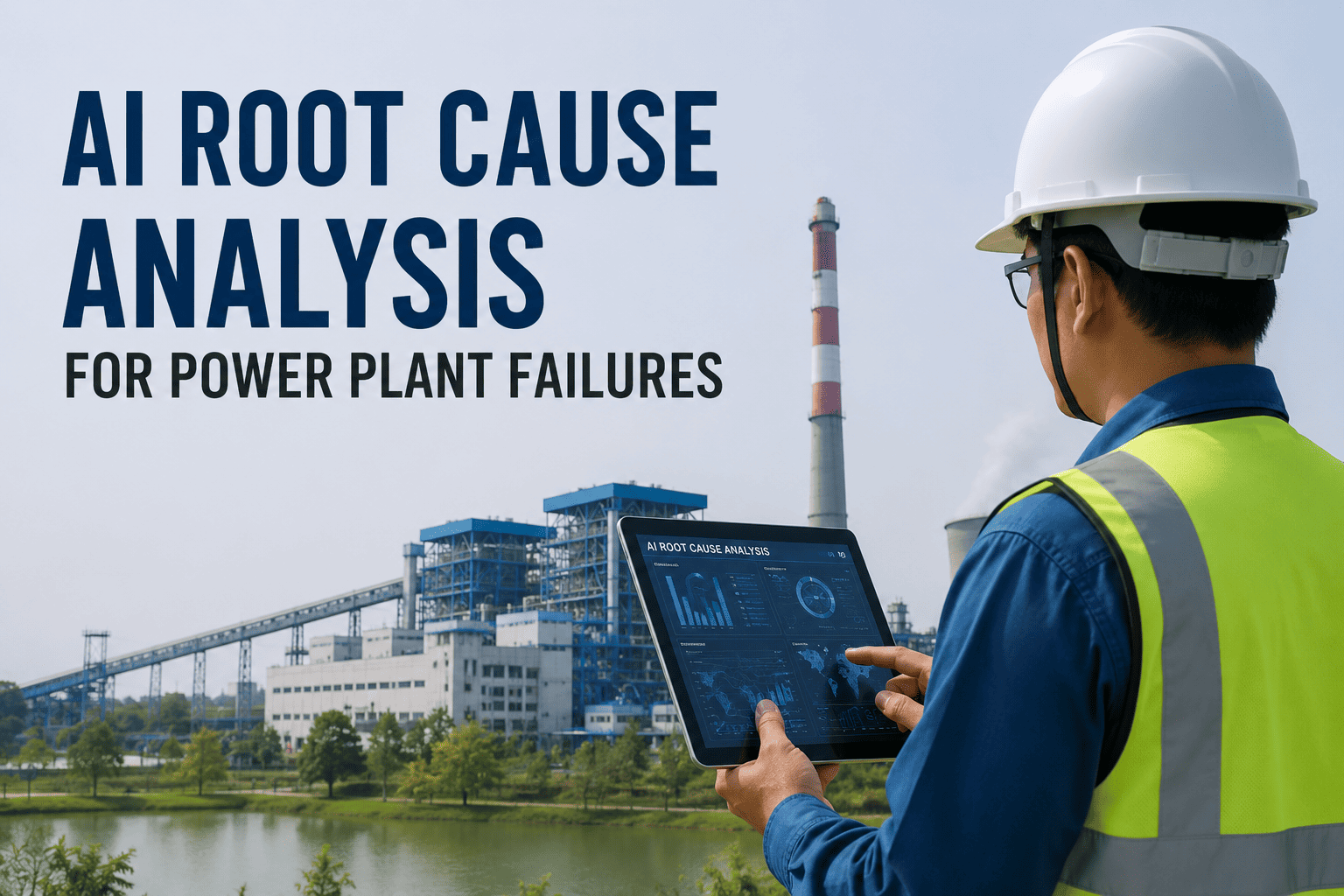
The same turbine trip happens for the third time this year, maintenance fixes it the same way, and everyone moves on to the next fire. That cycle is not bad luck, it is the predictable result of skipping root cause analysis and treating every failure as a standalone event instead of a symptom. Systematic RCA programs have been shown to cut recurring failures by a substantial margin and roughly halve unplanned downtime, but only when the right method gets matched to the right failure, since a fifteen-minute 5-Why session and a full fault tree analysis solve very different classes of problems. Book a demo to see how iFactory turns every completed RCA into a searchable failure history instead of a one-off report nobody reopens.
Reliability Engineering · Root Cause Analysis · Recurring Failure Prevention
Root Cause Analysis for Power Plant Failures: Matching the Method to the Problem
5 Whys, fishbone diagrams, and fault tree analysis each solve a different investigation problem. iFactory ties every RCA output to the asset's history so the next failure starts from evidence, not a blank whiteboard.
Why RCA Gets Skipped
The Real Cost of Fixing the Symptom Instead of the Cause
Unscheduled downtime in power generation can run into tens of thousands of dollars per hour, and a repeated failure that never gets root-caused pays that cost again every single time it recurs. The pattern is familiar: a crew fixes the immediate problem under outage pressure, documentation gets minimal, and the investigation stops the moment the unit is back online.
70%
Reduction in recurring failures reported by plants running systematic RCA programs
50%
Typical cut in unplanned downtime once RCA findings actually drive corrective action
$20K+
Per-hour cost range of unscheduled outages in critical generation assets
Common Pitfalls
Four Ways RCA Programs Quietly Fail Even When They Run
Running an RCA does not automatically prevent recurrence. Plants with active RCA programs still see repeat failures when the process itself has a structural weakness, and these four are the most common.
Stopping at the First Plausible Cause
A team under time pressure often stops questioning as soon as an explanation feels reasonable, even if it is only a contributing factor rather than the true root cause behind the failure.
No Owner on the Corrective Action
A finding that gets written up but assigned to no specific person and no deadline has a very low real-world completion rate, regardless of how sound the analysis behind it was.
Investigation Never Reopened After a Repeat
When the same failure mode recurs, it should trigger reopening the original RCA rather than starting a brand new investigation from scratch, since the recurrence is direct evidence the first root cause was incomplete.
Findings Live in a Report No One Reopens
An RCA report filed away and never cross-referenced against future failures on the same or similar assets loses most of its long-term value, turning a genuine insight into a one-time exercise.
iFactory Connects Every RCA to the Asset's Full Failure History.
Stop starting each investigation from a blank whiteboard. See every prior failure, method used, and corrective action for the asset in front of you.
The Three Core Methods
5 Whys, Fishbone, and Fault Tree: What Each One Is Actually Built For
5 Whys
Depth, Fast
Ask why repeatedly, typically five times, drilling straight through the symptom to the underlying cause. Works best on linear, single-cause failures a small team can resolve in under fifteen minutes without heavy data requirements. The technique's simplicity is also its main risk: a team that stops asking why too early walks away with a contributing factor mistaken for the actual root cause.
Best for: routine operational incidents, single-cause trips, quick turnarounds
Fishbone Diagram
Breadth, Visual
Maps potential causes across categories such as machine, method, material, and environment simultaneously, giving a full picture of every contributing factor before narrowing down to the most likely ones. It is particularly valuable when a team's early theories keep conflicting, since laying every possibility out visually across categories prevents the group from anchoring too quickly on the first idea raised.
Best for: complex failures with several interacting factors and no obvious single cause
Fault Tree Analysis
Rigor, Quantified
Uses Boolean logic gates to map every combination of events that could lead to the failure, assigning probabilities to each branch. Originally developed for aerospace and nuclear applications where quantified risk matters most. Building a fault tree takes considerably more time and expertise than the other two methods, which is why it is generally reserved for failures where the consequence of getting the analysis wrong is severe enough to justify the investment.
Best for: safety-critical systems and failures where multiple factors interact
Choosing the Right Method
A Practical Selection Guide by Failure Type
The most common RCA mistake is not picking a bad method, it is applying one method to everything regardless of the problem's actual complexity. The strongest programs combine methods in sequence rather than defaulting to whichever one is most familiar.
Failure Pattern
Recommended Method
Sudden pressure or flow drop with an obvious trigger
5 Whys
Recurring motor overheating with no single clear cause
Fishbone Diagram
Safety incident or protective system failure
Fault Tree Analysis
Complex failure with multiple interacting subsystems
Fishbone to brainstorm, then 5 Whys per branch
Equipment failing well before its rated MTBF
5 Whys plus material or metallurgical testing
Running the Investigation
Five Steps From Failure Event to Corrective Action
Whichever method a team chooses, the investigation itself follows a consistent structure. Skipping any one of these five steps is where most RCA programs quietly lose their value.
1
Define the problem precisely. A vague statement like "pump failed" produces a vague investigation. State exactly what happened, when, and what deviated from normal operation. A well-written problem statement should let someone with no prior knowledge of the event understand the failure precisely enough to start investigating on their own.
2
Gather evidence before theorizing. Pull operating data, maintenance history, and any available material samples before the team starts debating causes, so the discussion is anchored to facts. This step is frequently rushed under outage time pressure, but evidence gathered after the group has already settled on a theory tends to get interpreted to fit that theory rather than tested against it.
3
Apply the selected method. Run 5 Whys, fishbone, or fault tree analysis as appropriate, documenting the reasoning at each step rather than jumping straight to a conclusion. Capturing the reasoning, not just the final answer, is what makes the investigation useful to someone reviewing it months later after a different but related failure occurs.
4
Assign and track corrective action. A root cause with no owner and no deadline is a finding, not a fix. Every corrective action needs a named owner and a completion date, and that assignment should be tracked with the same discipline as any other maintenance work order rather than left as a line item in a report.
5
Verify the fix against the next occurrence. Track whether the same failure mode recurs after the corrective action is implemented. A recurrence means the root cause was misidentified, and the right response is to reopen the original investigation with the new evidence rather than treat the repeat event as an entirely separate incident.
From the Field
What Changed When RCA Became a Requirement, Not an Option
We used to close out a forced outage the moment the unit was back online, and the write-up was usually two sentences. When the same feed pump tripped for the third time in a year, someone finally pulled all three incident reports side by side and realized every "fix" had targeted a different symptom of the same underlying bearing lubrication problem. Once we made a documented RCA mandatory for any repeat failure, and started requiring a named owner on every corrective action, our recurring trip rate on that unit dropped to nearly zero within two outages.
— Reliability Manager, Gas-Fired Peaking Plant
3 tripsSame feed pump, three separate incident reports, one real cause
2 outagesTime to drive the recurring trip rate to nearly zero
Conclusion
A Failure You Don't Root-Cause Is a Failure You Will Have Again
5 Whys, fishbone diagrams, and fault tree analysis are not competing methods, they are tools built for different levels of complexity, and the strongest reliability programs know which one to reach for and when to combine them. What separates a plant that eliminates recurring failures from one that keeps fixing the same problem is not the sophistication of any single method, it is whether the investigation actually happens, gets documented, and drives a corrective action with a name and a deadline attached.
iFactory keeps every RCA tied to the asset's full history, so the next investigation starts from evidence instead of a blank page. Book a demo to see your own failure history mapped this way.
Frequently Asked Questions
Root Cause Analysis for Power Plants — Common Questions
Which RCA method should a small maintenance team use with limited time?
5 Whys is the highest-return starting point for a small team investigating a routine incident, since it can typically reach a working root cause in under fifteen minutes without requiring specialized facilitation training or extensive data collection beforehand. It works best on failures with a relatively linear cause-and-effect chain, and teams should escalate to a fishbone diagram if the 5 Whys process keeps branching into multiple unrelated contributing factors.
Book a demo to see a guided RCA workflow built for fast, structured investigations.
When is fault tree analysis worth the extra time it requires?
Fault tree analysis earns its additional time investment on safety-critical systems and protective device failures, where understanding the full combination of events using Boolean AND and OR logic gates matters more than speed. Its quantified probability output is specifically valuable when a decision needs defensible risk numbers behind it, such as justifying a capital repair over continued operation.
How do you know if a root cause analysis actually found the real cause?
The only real test is whether the failure mode recurs after the corrective action is implemented. If the same or a closely related failure happens again on the same asset within a reasonable timeframe, the original RCA likely stopped at a contributing factor rather than the true root cause, and the investigation should be reopened rather than treated as a separate new incident.
Can 5 Whys and fishbone diagrams be used together on the same investigation?
Yes, and this combination is one of the most effective approaches for moderately complex failures. The fishbone diagram is used first to brainstorm and categorize every plausible contributing factor across machine, method, material, and environment, and then 5 Whys is applied to the one or two most likely branches identified on the fishbone to drill down to an actionable root cause.
What should a completed RCA report always include?
A usable RCA report documents the precise problem statement, the evidence gathered, the reasoning trail through whichever method was applied, the identified root cause, a corrective action with a named owner and completion date, and a plan for verifying the fix against future occurrences. Reports missing the owner and verification plan tend to produce findings that never actually get implemented.
Contact support for help structuring an RCA report template your team will actually use.
Stop Investigating the Same Failure From Scratch Every Time
Tie every root cause analysis to the asset's full history, and give the next investigation a head start instead of a blank whiteboard.