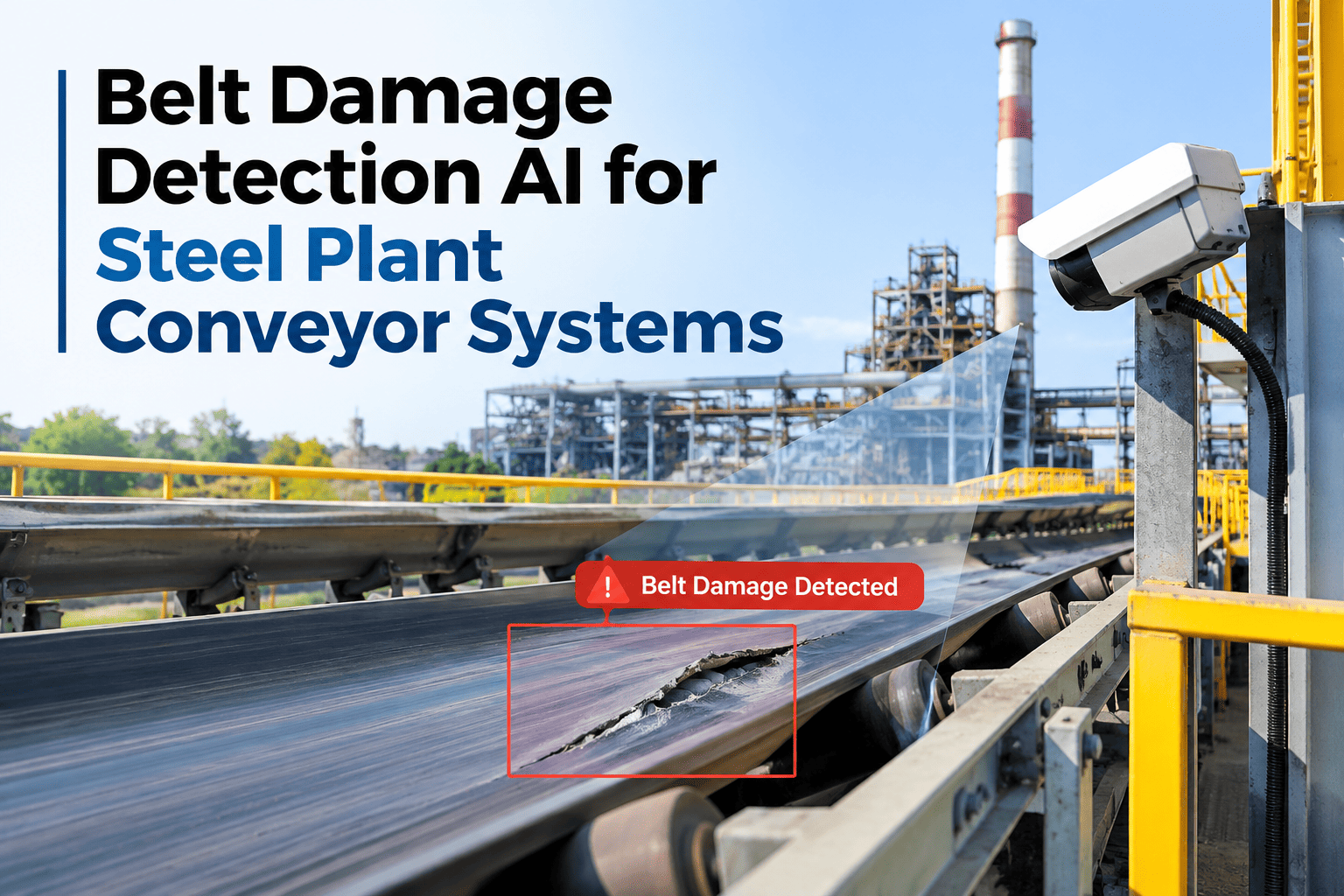
A steel cord conveyor belt failure is rarely a surprise to the belt itself — internal cord damage, longitudinal rips, and splice failures all develop before they become catastrophic, which is exactly why X-ray, magnetic flux leakage, and thermal scanning exist as belt monitoring technologies. iFactory, an on-premise AI platform with AI Vision Camera built in, combines these detection methods on raw material handling conveyors. Steel plant reliability teams who want this coverage on their own conveyor systems can request a demo with our team.
Belt Damage Detection AI · Steel Conveyor Systems, 2026
Internal Cord Damage Is Invisible to the Eye — Not to the Right Sensor
iFactory AI combines X-ray, magnetic flux leakage, and thermal imaging to catch belt tears, splice failures, and steel cord damage before a catastrophic rip.
X-ray
Internal cord structure, splice integrity
Magnetic flux
Steel cord condition, hidden internal defects
Thermal imaging
Distinguishes tear from wear patterns
Why catastrophic failure is preventable
Belt Degradation Shows a Pattern Before It Shows a Failure
Surface wear, cuts, longitudinal rips, delamination, and steel cord defects all progress through identifiable stages before resulting in a belt failure severe enough to stop the line — a 2026 review of conveyor belt diagnostics confirms this progression is well documented across sensing approaches (Rzeszowska, Błażej & Jurdziak, Sensors journal, 2026). The challenge isn't whether damage is detectable early, it's whether the right sensing technology is watching for it.
Matching the method to the damage type
No Single Sensing Technology Catches Everything
| Technology | Best at detecting | Limitation |
|---|
| X-ray scanning | Internal belt structure, cord position, splice integrity | Higher implementation cost and operational requirements |
| Magnetic flux leakage | Steel cord condition, internal defects invisible on the surface | Specific to steel-cord belts, not fabric-reinforced ones |
| Thermal imaging | Distinguishing tear conditions from normal wear patterns | Accuracy affected by dust, dirt, and belt degradation over time |
| Stereo vision / 3D imaging | Surface-level longitudinal and transverse tears in real time | Limited visibility into internal or steel-cord damage |
What a detected event triggers
Three Response Levels Based on Severity
Monitor
Minor surface wear logged and tracked for progression, no immediate action.
Schedule repair
A developing cut or splice concern flagged for the next planned maintenance window.
Automatic stop
A critical finding — a splice opening or belt slitting — triggers an automatic drive stop.
See What Belt Damage Detection Would Reveal on Your Conveyors
Share your current conveyor belt specifications and inspection history, and iFactory AI will walk through which detection methods fit your specific belts.
Which conveyors justify the investment
Length and Risk Determine Where This Pays Off Fastest
The economic case for continuous belt scanning strengthens with conveyor length and the consequence of failure — a long, steel-cord belt serving as a critical raw material lifeline between stockyard and plant justifies the investment far more clearly than a short, easily replaced fabric belt on a low-risk internal transfer.
From detection to prevention
Four Steps From a Flagged Pattern to a Prevented Failure
1
Continuous scanning in operation
The belt is scanned as it runs, without requiring a dedicated inspection stop.
2
Pattern classified
The finding is classified by type and severity against known damage signatures.
3
Response level triggered
Monitoring, scheduled repair, or automatic stop, based on the classified severity.
4
Repair confirmed and logged
The repaired section is tracked, and the belt's full condition history stays current.
Expert review
What a Conveyor Reliability Engineer Checks First
Belt damage detection earns its place when the automatic-stop threshold is calibrated tightly enough to prevent a catastrophic failure without triggering unnecessary stops for minor findings.
Verdict
Strong when the detection method actually matches the belt type — steel-cord belts need different coverage than fabric-reinforced ones.
Watch for
Thermal imaging accuracy degrading under heavy dust without anyone noticing the detection confidence has quietly dropped.
Do next
Identify your longest or highest-consequence conveyor belt and check what inspection method, if any, currently covers its internal condition.
Frequently asked questions
What Steel Plants Ask About Belt Damage Detection
Does belt damage really progress through detectable stages before failure?
Yes — a 2026 review of conveyor belt diagnostics confirms that surface wear, cuts, rips, delamination, and steel cord defects follow identifiable progression patterns well before resulting in catastrophic failure (Rzeszowska, Błażej & Jurdziak, Sensors journal, 2026).
Discuss detection coverage for your belts.
Is X-ray scanning necessary for every conveyor, or just steel-cord belts?
X-ray and magnetic flux leakage are most commonly justified on steel-cord belts, where internal cord damage is otherwise invisible — fabric belts are more commonly covered by surface-focused methods like stereo vision.
Ask support which method fits your belt type.
What causes thermal imaging to lose accuracy?
Does an automatic stop trigger for every detected finding?
No — response levels are typically tiered, with minor wear logged for monitoring, developing concerns scheduled for repair, and only critical findings like a splice opening triggering an automatic drive stop.
Ask support about setting response thresholds.
Which conveyors are the best candidates for continuous scanning investment?
Longer belts and those serving as a critical raw material lifeline, where a failure has the highest consequence, generally show the clearest economic case for continuous scanning technology.
Talk through prioritizing your conveyor fleet.
Catch the damage before the catastrophic rip
Combine Detection Methods to Cover Every Belt Damage Type
Book a demo to see how iFactory AI protects your raw material handling conveyors from preventable belt failure.