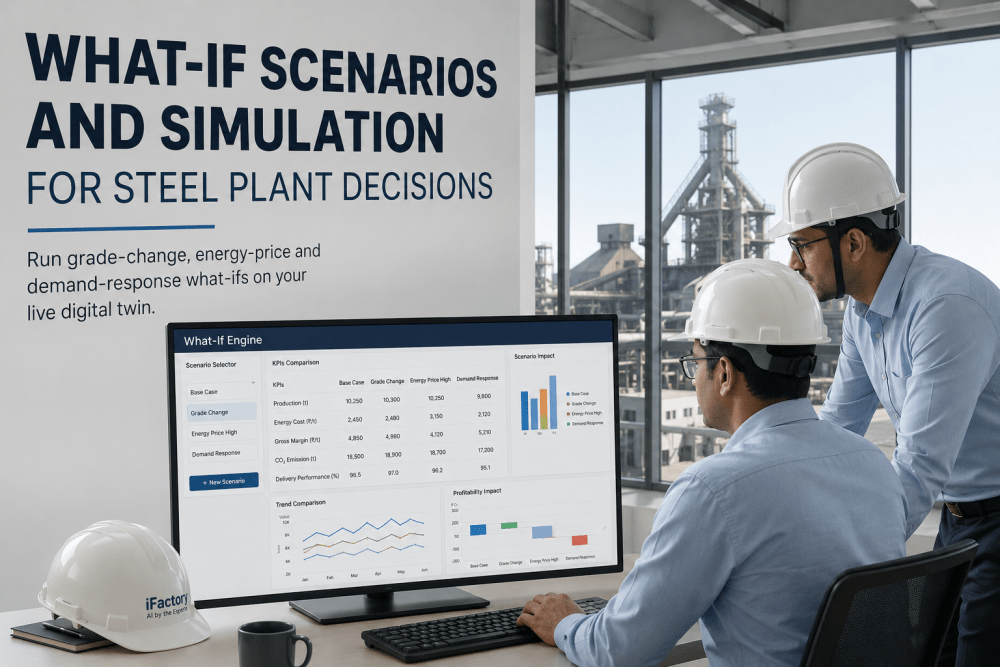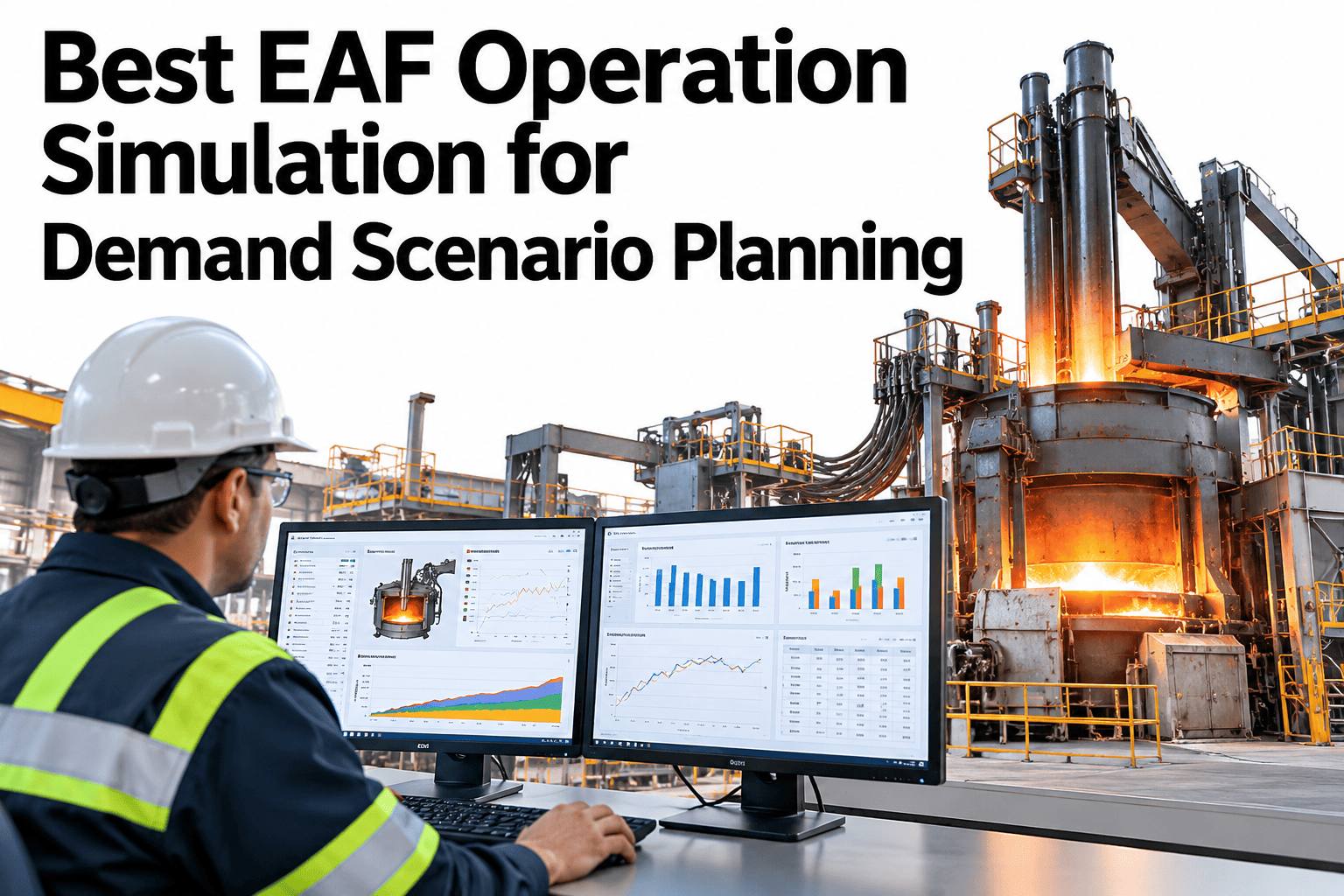
Every melt shop planner has faced the question of what would happen to demand if the second furnace started ten minutes earlier, or if a tap ran late, or if the grid asked for a curtailment halfway through a shift. Answering by gut feel is risky, and testing on the live plant is not an option. An EAF operation simulation lets you run those what-ifs on a model of your furnaces, ladle stations and caster schedule. It compares schedule permutations, contingencies and grid responses before anything changes on the floor. Planning teams can try a demand scenario on a simulated copy of their own melt shop schedule and see the result.
Test the Schedule on a Model Before the Grid Tests It on You
iFactory steel simulation runs schedule permutations, contingencies and grid response scenarios against your melt shop model.
From Melt Shop Data to a Chosen Schedule
Five steps take a scenario question to a decision with evidence.
Three Schedule Options, Three Demand Shapes
Small timing changes between furnaces can reshape the peak. Simulation shows the effect before anyone commits.
Schematic overlap of two furnaces. Real schedules include more equipment and constraints.
Three Kinds of Scenario Worth Running
Each answers a different planning question.
Schedule permutations
Alternative heat orders and start times across furnaces
Contingency modeling
Furnace outage, late tap, delayed scrap or caster stop
Grid-condition response
Curtailment, price spike or frequency event during a shift
Outputs Worth Comparing Between Scenarios
Compare scenarios on the same measures so the choice rests on evidence.
| Output | Why It Matters | How to Read It |
|---|---|---|
| Peak interval demand | Sets demand charge exposure | Lower is better |
| Heats completed | Shows production impact | Higher is better |
| Tap-to-tap time | Shows efficiency of the schedule | Stable and short is better |
| Caster continuity | Shows whether sequence is protected | No gaps is the goal |
| Energy cost estimate | Brings tariff into the choice | Lower is better |
Run Your Hardest Scheduling Question as a Simulation
Bring one demand scenario your team debates. We will model it and compare schedule options side by side.
Spreadsheet Planning vs Simulation
Spreadsheets add up hours. Simulation shows how furnaces interact in time.
What to Test First
Start with questions where the answer changes a decision.
Illustrative priority. Your own planning issues set the real order.
Contingency Cases to Model Before They Happen
Contingencies are cheap to rehearse in a model and expensive to meet unprepared.
A Practical Start With Simulation
Begin with one question and one furnace pair.
What Experienced Melt Shop Planners Look For in a Simulation
Frequently Asked Questions
How accurate must the simulation be to be useful?
It needs to reproduce recent heats closely enough that differences between scenarios are meaningful. Perfect accuracy is not required for comparison. Comparing the model's predicted peak with the actual peak for a few recent weeks gives a practical measure of trust. Check how well a model reproduces your last month of heats before relying on it.
Can the simulation include grid conditions?
Yes. Grid events such as curtailments, price spikes or frequency events can be added as scenario inputs. The model then shows how schedule options respond. Treat the result as planning guidance and confirm limits with operations before using it. Treat grid scenarios as tests of resilience as well as cost, since the aim is a schedule that holds up when conditions change.
Who builds and maintains the model?
Engineers usually build it with support, and planners run scenarios. Keeping rates, tap times and constraints current matters more than model complexity. A short quarterly review keeps the model aligned with how the plant actually runs. Document model assumptions on one page, so new team members can see what the model includes and what it leaves out.
How is this different from our scheduling system?
A scheduling system produces a plan. A simulation tests plans under uncertainty and stress. They work well together. The simulation can also take the planned schedule as an input and test how robust it is to delays and outages. See how the two connect in a short walkthrough with your current schedule.
What is a sensible first project?
Pick one decision with clear cost, such as furnace start offsets or response to a late tap. Run a few scenarios, compare outputs and agree what to change. A first project that shows a clear difference between two options builds support for wider use of simulation. Choose a first scenario with our team on a short call.
Know the Demand Impact of a Schedule Before You Run It
Bring your furnace schedule and one scenario question. We will build the model and show the options side by side.