Indian steel exporters who treated CBAM as a reporting exercise during the transitional period are now facing a different set of obligations as the definitive period takes hold. Declarant registration, authorized declarant status, and the verification requirements that come with the definitive phase each have their own application window and documentation standard, and missing one can hold up shipments rather than just trigger a late report. The timeline is not a single deadline; it is a sequence of registration and compliance steps that need to be worked through in order, with lead time built in for EU-side processing delays. Exporters mapping their own compliance calendar can see a CBAM registration timeline built around their own shipment schedule before a deadline is missed.
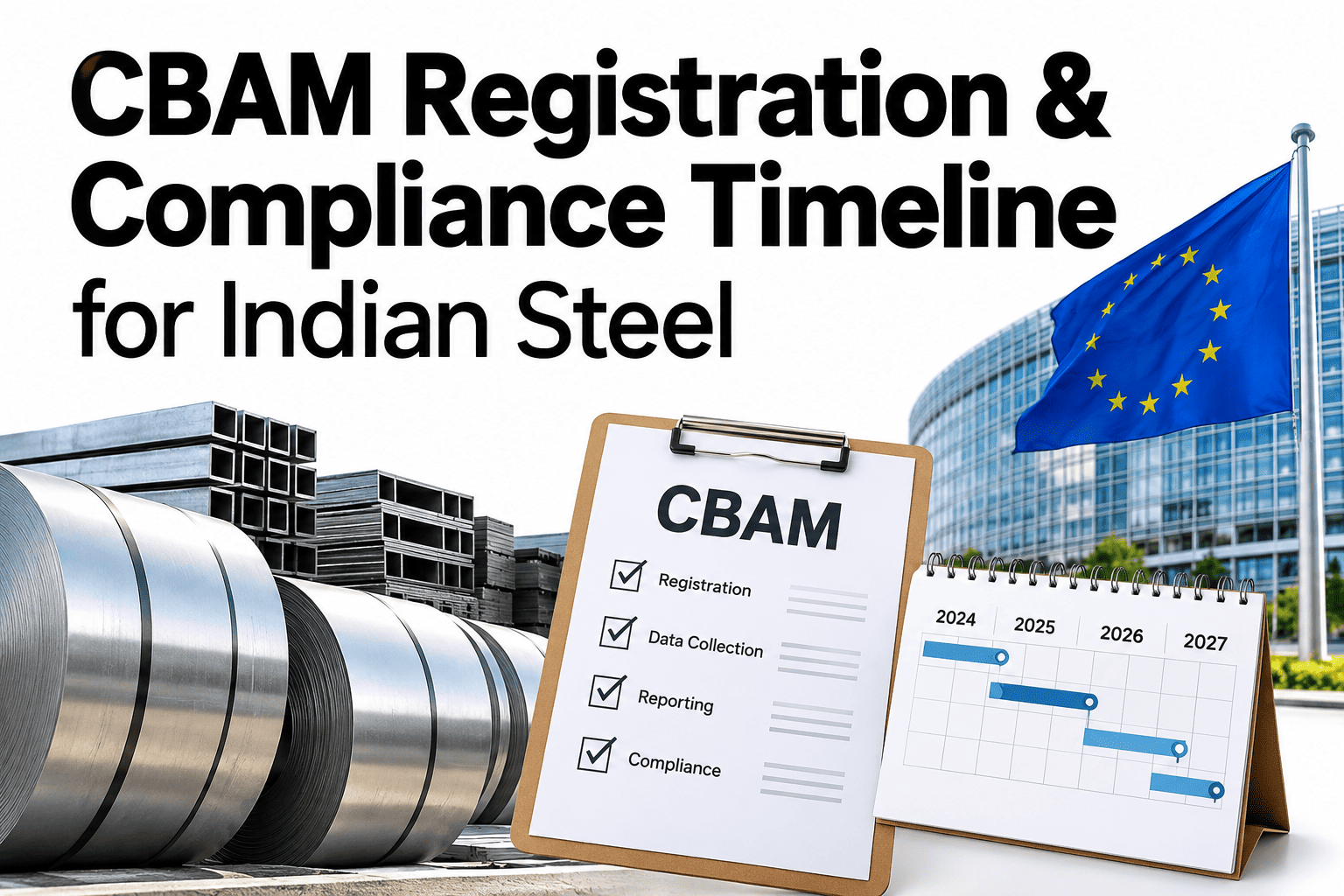
CBAM Registration & Compliance Timeline for Indian Steel
Declarant registration, authorized declarant application, and definitive-period compliance mapped to real deadlines.
Why Exporters Miss Steps in This Timeline
The definitive period introduces obligations that did not exist during the transitional phase, and three gaps show up repeatedly.
Authorized declarant status cannot be applied for until registration is complete, and both take processing time.
Verification requires evidence standards that transitional-period reporting never demanded.
EU-side processing delays mean applying close to a deadline often means missing it.
Treating this as a single compliance date rather than a sequence is the most common reason a shipment gets held up at the border.
Registration Steps, in Order
Each step depends on the one before it, so the order matters as much as the content of each application.
Check Your Own Shipment Schedule Against This Timeline
Book a 30-minute session and bring your export schedule. iFactory AI will map each registration step to a real deadline.
Transitional vs Definitive Period Requirements
The jump from transitional to definitive period changes what counts as acceptable evidence, not just what gets reported.
| Requirement | Transitional Period | Definitive Period |
|---|---|---|
| Declarant status | Not required | Authorized declarant status required |
| Emissions data | Default values often accepted | Verified actual data expected |
| Certificate purchase | Not required | CBAM certificates must be surrendered |
| Verification | Self-reported | Third-party verification required |
What iFactory AI Supports
The platform tracks where an exporter stands in the sequence and flags what needs attention next.
Status Tracking
Declarant and authorized declarant application status are tracked against official timelines.
Deadline Alerts
Upcoming registration and declaration deadlines are flagged with enough lead time to act.
Evidence Readiness Check
Emissions data is checked against verification standards before a declaration is submitted.
Shipment-Level Mapping
Each export shipment is mapped to the compliance obligations it triggers.
iFactory AI maps the full registration and compliance sequence to the exporter's own shipment schedule and emissions data pipeline.
Expert Review
The exporters who stay ahead of this timeline are the ones who treat authorized declarant status as a separate project from the emissions data pipeline, rather than assuming both will be ready at the same time. They rarely are, and the data pipeline usually takes longer.
EU-side processing delays are the most underestimated factor in this whole sequence. Building in extra lead time before each deadline, rather than targeting the deadline itself, is the difference between a smooth transition and a held shipment.
Frequently Asked Questions
Who needs to register as a CBAM declarant?
Any importer bringing CBAM-covered goods, including steel, into the EU needs to register, which in practice often means the EU-based importer rather than the Indian exporter directly. Coordinating with that importer early is essential since their registration status affects how shipments clear. Ask about your specific import relationship in a working session.
How long does authorized declarant status typically take to process?
Processing time varies by EU member state authority and application completeness, and can run into months rather than weeks. Submitting early, with documentation prepared to the expected standard, is the main way to avoid delay. Contact support for current processing time estimates.
What evidence does third-party verification actually require?
Verification generally requires traceable, auditable embedded emissions data tied to the specific production route and facility, not a plant-wide estimate. Building this evidence trail before it is needed is far easier than reconstructing it after a verifier asks for it. See a sample evidence package in a live session.
What happens if a declaration is submitted without full verification?
An incomplete or unverifiable declaration risks rejection, which can delay customs clearance for the shipment it covers. This is why building the emissions data pipeline well ahead of the first definitive-period declaration matters more than the declaration itself. Ask support about recovering from a rejected declaration.
Can this timeline be tracked across multiple plants and shipments at once?
Yes, a group exporting from several plants can track declarant status and deadlines across all of them in one view, which matters since each plant's data readiness can be at a different stage. Book a session on multi-plant tracking to see how it is organized.
Turn a Single Deadline Into a Sequence You Can Actually Track
iFactory AI maps declarant registration, authorized status and verification readiness to your own shipment schedule. Book a walkthrough.