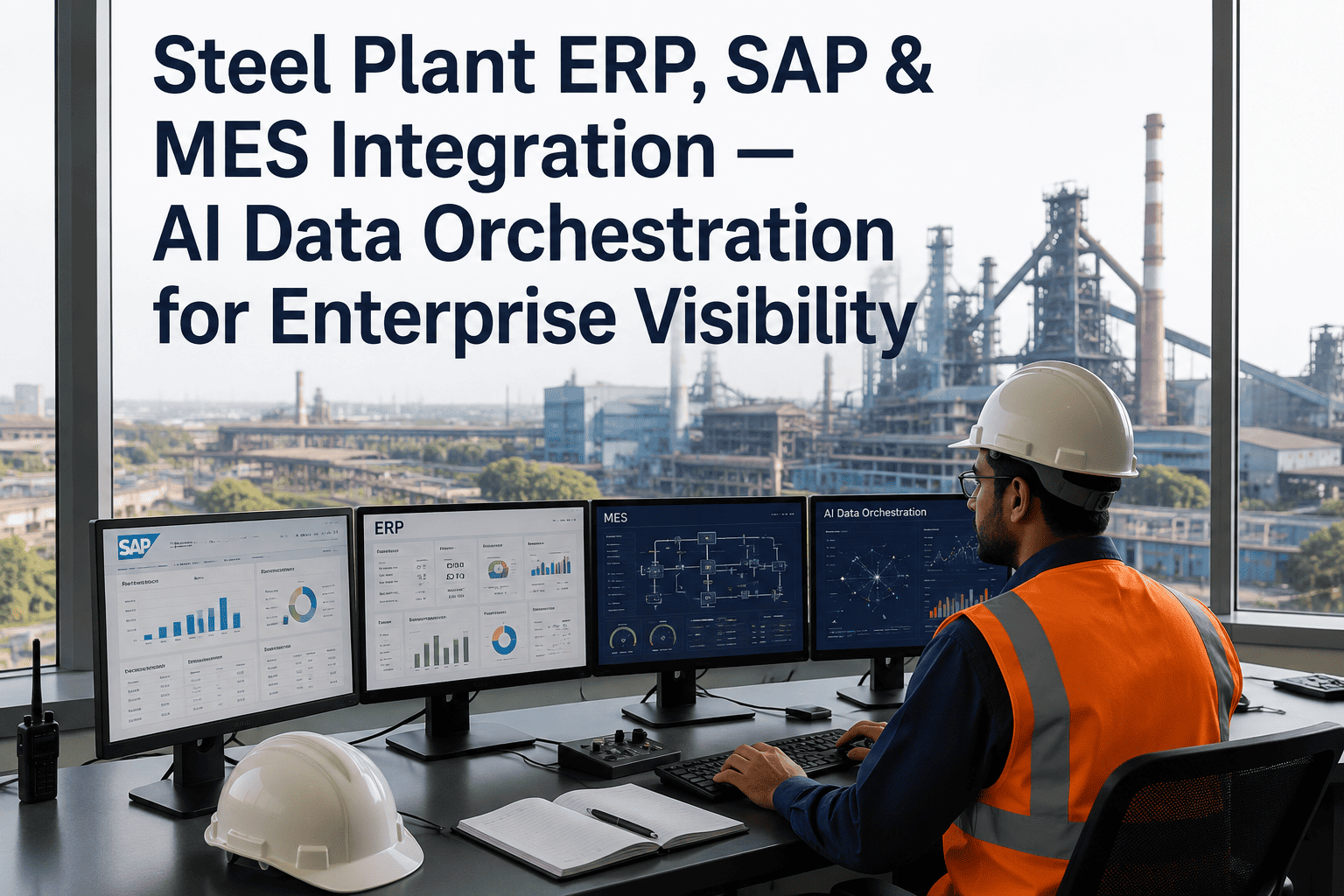
A maintenance technician closes a work order in the CMMS. Somewhere else, a purchasing clerk manually re-enters the parts consumed on that job into the ERP so inventory reflects reality. Somewhere else again, a production planner checks a separate MES report to see whether the repaired equipment is actually back online before committing it to the next production run. Three systems, three manual steps, and three separate opportunities for the numbers to drift apart. Steel producers ready to close those gaps can Book a Demo to see how CMMS, ERP, and MES integration eliminates the manual reconciliation between maintenance, materials, and production.
Three Systems Built for Three Different Jobs
CMMS, ERP, and MES systems were each designed to solve a specific operational problem, and that specialization is exactly why they rarely integrate cleanly by default. A CMMS tracks maintenance work orders, equipment history, and technician labor against specific assets. An ERP tracks materials, purchasing, inventory levels, and financial cost across the entire business, not just maintenance. An MES tracks production execution — what is being made, on which line, at what rate, meeting what quality specification. Each system has its own data model built around its own primary use case, and without deliberate integration work, the same physical event — a bearing replacement on a specific motor, for example — gets recorded three separate times in three incompatible formats, with no automatic mechanism keeping those three records consistent with each other.
Work Order Synchronization: Where the Chain Starts
A maintenance work order created in the CMMS is the starting point for a chain of downstream consequences across the other two systems, and how well that starting point synchronizes with ERP and MES determines how much manual effort the rest of the chain requires. When a work order specifies parts required, that requirement should flow automatically into the ERP to check inventory availability and, if needed, trigger a purchase requisition, rather than requiring a maintenance planner to separately look up parts in a completely different system and manually initiate procurement. Similarly, when a work order affects a piece of equipment currently scheduled for production, that constraint should be visible to production planning through the MES rather than requiring a phone call or a separate status check to confirm whether a machine is actually available.
Parts Requirement to Inventory Check
Work order parts requirements automatically check ERP inventory availability, flagging shortages and triggering procurement without requiring a separate manual lookup in a different system.
Equipment Status to Production Visibility
Work order status changes update equipment availability visible to MES production scheduling, letting planners see maintenance impact on capacity without a manual status check.
Labor and Cost Roll-Up
Technician labor hours and parts cost recorded against a work order flow automatically into ERP cost tracking, eliminating manual cost entry and improving job costing accuracy.
Material Consumption: The Discrepancy That Compounds Silently
Material consumption tracking is where the gap between CMMS and ERP shows up most persistently, because parts consumed on a maintenance job need to reduce ERP inventory accurately for procurement planning to work, but technicians recording parts usage in the CMMS are focused on documenting the repair, not on ensuring perfect inventory synchronization with a separate system. Small discrepancies from missed entries, incorrect part numbers, or timing differences between when a part is physically used and when it is recorded compound over months into inventory records that no longer reflect physical reality, leading to both unnecessary emergency procurement when the system shows stock that has actually been consumed, and excess inventory tied up in parts the system shows as depleted but that are actually still on the shelf.
| Consumption Tracking Approach | Manual Cross-System Entry | Integrated Automatic Sync |
|---|---|---|
| Inventory accuracy | Degrades over time from missed entries | Reflects actual consumption in real time |
| Reorder point triggering | Delayed or based on stale data | Triggers automatically from accurate stock levels |
| Job costing accuracy | Approximate, dependent on manual diligence | Precise, tied directly to actual parts used |
| Staff time required | Significant, recurring data entry burden | Minimal, limited to exception handling |
Cost Tracking Across Maintenance and Production
Understanding the true cost of maintenance requires combining data that typically lives in different systems — labor cost tracked in the CMMS or a connected time system, parts cost tracked in the ERP, and the production impact of downtime tracked in the MES — and without integration, calculating a genuine total cost of a specific failure or a specific piece of equipment's maintenance history requires a manual, time-consuming pull from all three sources every time the question comes up. Integrated systems make this total cost calculation available continuously rather than as a special one-off analysis, letting maintenance and finance teams see the real cost of unreliability on specific assets without waiting for someone to manually compile it.
This integrated cost visibility changes how maintenance investment decisions get made. A piece of equipment that looks inexpensive to maintain when only labor and parts cost are considered can look very different once the production downtime cost associated with its failures is factored in consistently, and that fuller picture often shifts capital replacement or major overhaul decisions that a maintenance-only cost view would never have surfaced, since the true economic case for replacing an aging but nominally inexpensive-to-maintain asset frequently rests on the production disruption it causes rather than on its direct repair bill alone. Finance teams also benefit from this integration, since maintenance cost allocated accurately against specific production lines or product families gives a more precise picture of true product cost than an aggregated maintenance budget that cannot be broken down by contributing cause.
Designing the Integration: Sequencing the Connections
Connecting three enterprise systems at once is a significant undertaking, and plants that succeed tend to sequence the integration deliberately rather than attempting a simultaneous three-way connection from the start. Starting with the CMMS-to-ERP connection for parts and cost synchronization typically delivers the fastest, most tangible return, since inventory accuracy and cost visibility improvements are easy for both maintenance and finance teams to see and appreciate. The CMMS-to-MES connection for equipment status and production impact visibility often follows as a second phase, once the foundational data model and integration approach have been proven on the first connection.
Establish Shared Equipment and Part Identifiers
Standardize how equipment and parts are identified across all three systems so records can be matched reliably regardless of which system originated the data.
Connect CMMS and ERP for Parts and Cost
Synchronize parts consumption and labor cost data first, since this connection typically delivers the fastest, most visible improvement in inventory accuracy and job costing.
Connect CMMS and MES for Equipment Status
Extend the integration to give production planning real-time visibility into equipment availability affected by open maintenance work orders.
Build Unified Cost and Impact Reporting
Combine labor, parts, and downtime data across all three systems into reporting that gives maintenance and finance teams a genuine total cost view without manual compilation.
Change Management: Getting Three Departments to Trust One Integrated System
Technical integration between CMMS, ERP, and MES only delivers value if maintenance, purchasing, and production planning staff actually trust and use the synchronized data instead of falling back on their own department's historical workarounds and shadow spreadsheets built up over years of working with disconnected systems. Building this trust requires demonstrating early and consistently that the integrated data is accurate, which is why running the integration in parallel with existing manual processes for a validation period matters as much for organizational buy-in as for technical verification, since staff who have spent years compensating for disconnected systems are understandably slow to abandon their own workarounds until the new integrated data has proven itself reliable across enough real production scenarios.
Data Model Alignment: The Prerequisite Everyone Underestimates
Before any meaningful CMMS-ERP-MES integration can happen, the three systems need to agree on how they identify the same physical equipment, the same part, and the same production order, and this alignment work is consistently underestimated in project planning because it sounds like a simple administrative task rather than the substantial undertaking it actually is in practice. A piece of equipment that the CMMS identifies by an internal asset tag might be known in the ERP by a different equipment master record number, and referenced in the MES by yet another line or station identifier tied to the production process rather than the physical asset itself, with no obvious link between the three at first glance. Without a cross-reference table or a unified master data management approach that maps these different identifiers to the same underlying physical reality, any attempt at automated synchronization produces mismatched or orphaned records that require manual cleanup, defeating the purpose of the integration.
Plants that invest properly in this data model alignment before attempting the technical integration consistently report smoother, faster implementations than plants that try to solve identifier mismatches reactively as they surface during testing. This upfront investment typically involves a cross-functional data cleanup effort — pulling equipment lists from all three systems, reconciling them against a physical asset inventory, and establishing the master identifier scheme that all three systems will reference going forward, a process that benefits from involving representatives of each department rather than being delegated entirely to IT. While this work can feel like a detour from the actual integration project, skipping it almost always costs more time later in the form of failed synchronization attempts and manual data correction once the technical connections are already live, often at a point in the project when stakeholders have already been told the hard part is finished.
Handling Exceptions: What Happens When the Data Doesn't Match
Even a well-designed integration encounters exceptions — a part consumed in the CMMS that has no corresponding ERP record because it was never properly added to the parts master, a work order referencing equipment that has been retired in the ERP but not yet updated in the CMMS, a production order in the MES with no matching cost center in the ERP. How an integration architecture handles these exceptions matters as much as how it handles the happy path, since a system that silently drops mismatched records or, worse, forces an incorrect match to proceed, creates data quality problems that are often harder to detect and correct than the original disconnected manual process ever was.
The most reliable integration architectures flag exceptions explicitly for human review rather than attempting to guess at a resolution automatically, routing mismatched records to a queue that a designated data steward reviews and resolves on a regular cadence. This exception-handling discipline requires ongoing attention rather than a one-time setup, since new exceptions will continue to surface as equipment gets added or retired, new parts get introduced, and organizational changes affect how work is structured across the three systems. Plants that build this ongoing exception review into a defined role or responsibility, rather than leaving it as an ad hoc task nobody owns, sustain much higher data quality over the long run than plants that treat exception handling as a problem solved once during initial implementation and never revisit it as the underlying systems and organizational structure continue to evolve.
Frequently Asked Questions: CMMS-ERP-MES Integration
Which system connection should a plant prioritize first when integrating CMMS, ERP, and MES?
Most plants get the fastest, most visible return by connecting CMMS and ERP first for parts consumption and cost synchronization, since inventory accuracy improvements are easy for both maintenance and purchasing teams to see directly in their daily work, building momentum and organizational trust before tackling the more complex production-facing MES connection. Plants can Book a Demo to review their current system landscape and identify the right starting sequence for their specific environment.
Do CMMS, ERP, and MES vendors need to be from the same software provider for integration to work?
No — integration between these three system types is achievable regardless of whether they come from the same vendor or three completely different providers, since the integration typically happens through each system's own application programming interface or a middleware layer designed specifically to bridge different vendors' data models. Plants running a genuinely mixed vendor landscape across CMMS, ERP, and MES are common today, and the integration approach accounts for this reality rather than assuming a single-vendor environment.
How does the integration handle a work order that gets modified after parts have already been consumed and recorded?
A well-designed integration treats each parts consumption event as its own timestamped record rather than a single mutable total, so a work order modification after parts have been recorded creates an additional adjustment entry rather than silently overwriting the original consumption data, preserving an accurate audit trail across both the CMMS and ERP. This approach matters particularly for cost tracking accuracy, since finance teams need to trust that historical cost records reflect what actually happened at the time rather than being retroactively altered.
What level of ongoing maintenance does the integration itself require once it is deployed?
Like any enterprise system integration, the connections between CMMS, ERP, and MES need ongoing monitoring to catch and address issues introduced by updates to any of the three underlying systems, since a vendor update to any single system can change data structures or interfaces in ways that affect the integration if not accounted for. Contact iFactory Support for guidance on establishing an ongoing monitoring and maintenance process for your fully integrated environment, including how to structure alerting so vendor-driven changes are caught proactively rather than discovered after they have already disrupted a downstream report or reconciliation job.
Can this integration approach also incorporate energy or quality data alongside maintenance, materials, and production?
Yes — the same integration architecture connecting CMMS, ERP, and MES can extend to incorporate energy and quality data sources, giving a plant an even broader unified view once the foundational three-system integration and shared equipment identifiers are established. Plants often add these additional data sources as a later phase, once the core CMMS-ERP-MES connection has proven reliable and the organization has built confidence in the integrated approach, applying the same equipment identifier and governance discipline established during the original three-system rollout.
Measuring Whether the Integration Is Actually Delivering Value
Plants sometimes complete a CMMS-ERP-MES integration project and declare success based purely on the technical connections being live, without establishing clear metrics to confirm the integration is actually changing outcomes for the better. Tracking the reduction in manual reconciliation hours across maintenance, purchasing, and production planning teams gives a direct, easily measured signal of labor savings, while tracking the improvement in inventory accuracy on maintenance-critical spare parts confirms whether the parts consumption synchronization is actually working as intended rather than simply appearing to function in a technical demo.
A second important measure is how quickly cross-departmental questions get answered once the integration is live compared to the pre-integration baseline — for example, how long it takes a maintenance manager to get an accurate total cost figure for a specific piece of equipment's repair history, or how long it takes production planning to confirm whether a machine flagged for maintenance is actually back in service and ready to accept the next scheduled order. Plants that track this kind of decision-speed metric alongside the more obvious labor-hour and accuracy metrics get a fuller picture of whether the integration is delivering its intended organizational value, not just its technical function.