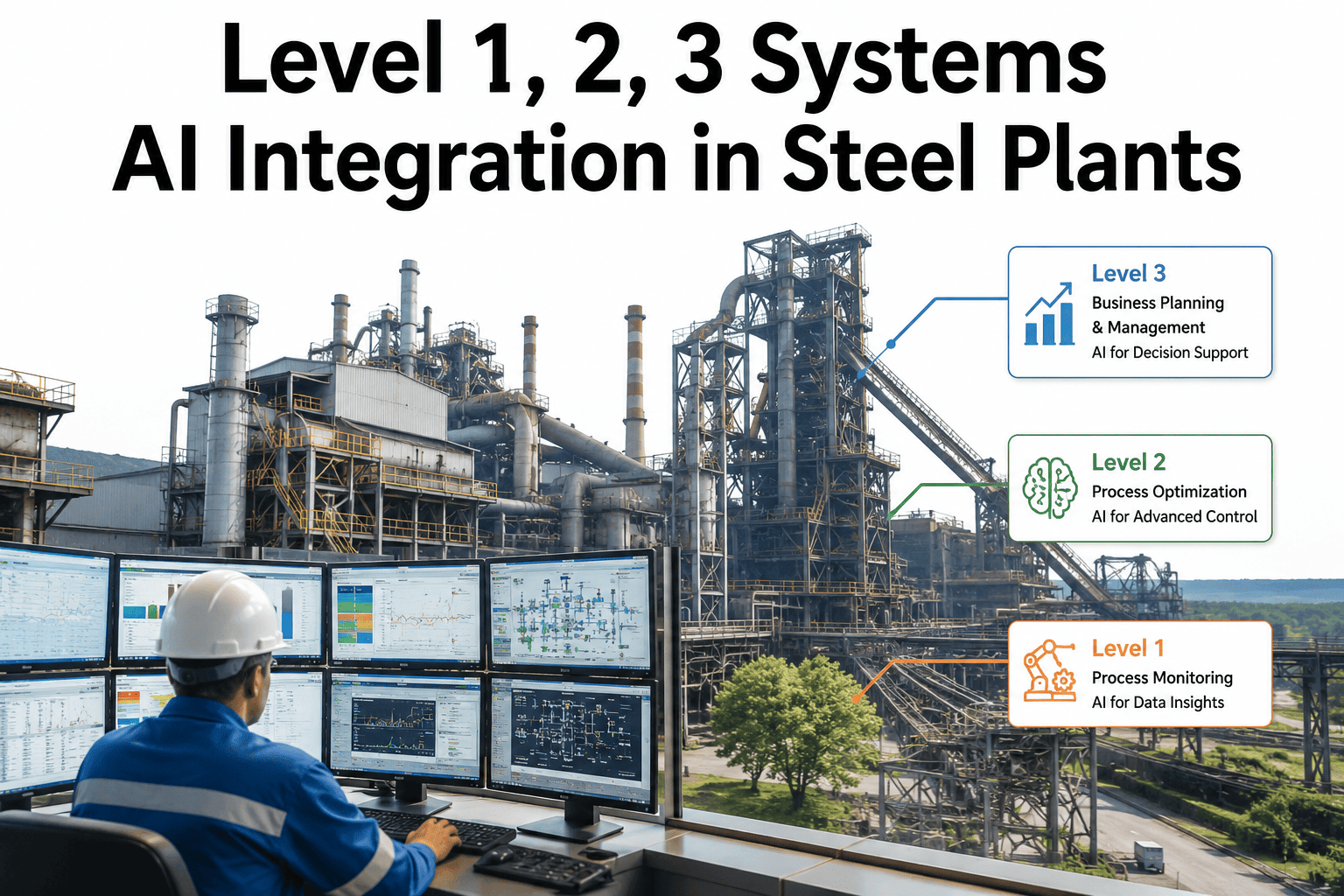
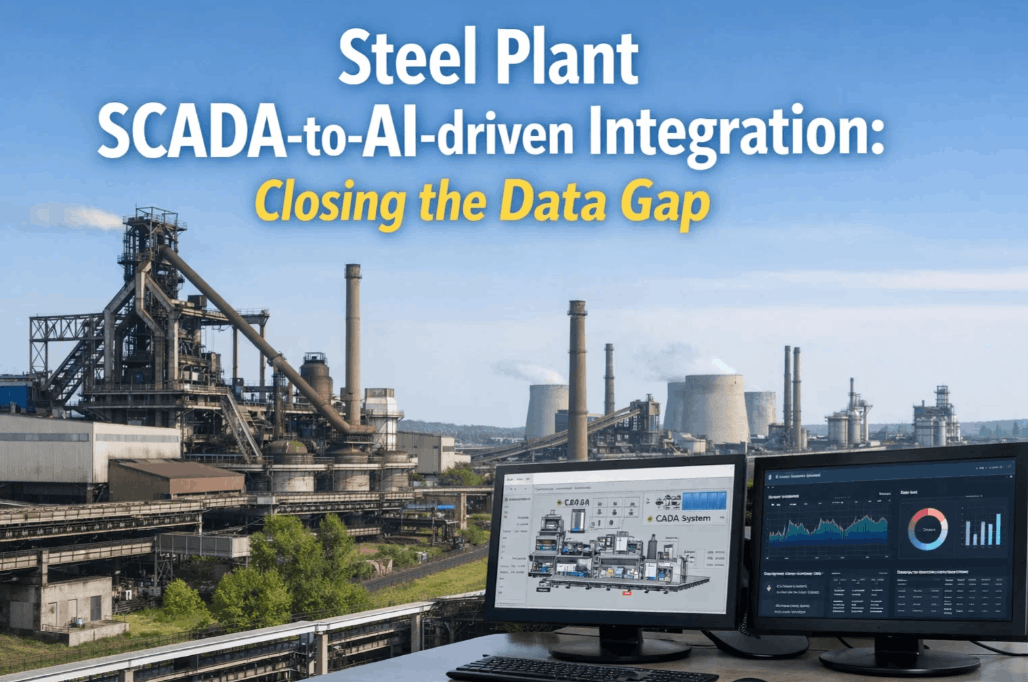
A steel plant runs on three distinct layers of automation that rarely speak the same language by default: Level 1 controllers driving individual PLCs and drives on the mill floor, Level 2 systems coordinating process control across a production line, and Level 3 systems like MES and ERP that turn floor activity into business decisions. When these three layers are not architected to exchange data cleanly, plant leadership ends up making decisions on delayed, manually reconciled numbers instead of a live picture of the operation. Steel producers ready to close that gap can Book a Demo to see how a properly layered integration architecture connects the floor to the business.
Why the Three Levels Exist and Why They Drift Apart
The layered automation model was never designed as an integration afterthought — it exists because each level solves a fundamentally different problem on a different timescale. Level 1 controllers respond to physical process conditions in milliseconds, driving motors, valves, and drives based on direct sensor feedback. Level 2 systems coordinate those individual control loops into a coherent process across a rolling mill, casting line, or furnace, operating on a timescale of seconds to minutes. Level 3 systems operate on a much longer horizon, tracking orders, scheduling production, and calculating costs across shifts, days, and months. Because each level was historically built and purchased separately, often from different vendors at different points in a plant's history, the connections between them were frequently bolted on after the fact rather than designed in from the start, and that history is exactly why so many steel plants today are running with fragile, manually patched data bridges between layers that were never meant to be permanent, and that quietly accumulate more risk with every passing year they remain in place unaddressed.
Mapping the Three Levels: What Each Layer Actually Owns
Before designing an integration architecture, a plant needs absolute clarity on what data each level owns and what it needs from the layers above and below it, because integration projects that skip this mapping step tend to build brittle point-to-point connections that break the moment either system on either end of the connection changes. Level 1 owns real-time equipment status, sensor readings, and control setpoints. Level 2 owns process-level coordination — sequencing, recipe execution, and quality-critical process parameters aggregated across the individual control loops beneath it. Level 3 owns business context — what order is being produced, what the cost target is, what the customer specification requires — that Level 1 and Level 2 systems have no native visibility into on their own.
Business and MES Layer
Order management, production scheduling, quality specification, and cost tracking. Consumes aggregated production and quality data from Level 2, and pushes order and specification data down to guide production.
Process Control Layer
Coordinates individual control loops into a coherent line-level process, executes recipes, and aggregates real-time data into production and quality summaries for Level 3 consumption.
Automation and Control Layer
PLCs, drives, and field devices executing direct control based on sensor feedback, responding in milliseconds to physical process conditions on the mill floor.
The Middleware Layer: Where Most Integration Architectures Succeed or Fail
The technical connection between Level 1, Level 2, and Level 3 rarely happens through direct point-to-point links in a well-designed architecture — instead, a middleware or integration layer sits between the levels, translating protocols, buffering data during outages, and enforcing a consistent data model that both sides can rely on regardless of what specific PLC brand or MES vendor sits on either end. Plants that skip this middleware layer in favor of direct point-to-point connections often find themselves locked into a fragile architecture where upgrading any single system on either end risks breaking every connection built directly against its specific interface, turning what should be a routine software update into a multi-week integration project.
| Architecture Pattern | Point-to-Point Integration | Middleware-Based Integration |
|---|---|---|
| Resilience to system upgrades | Fragile — direct dependency on both endpoints | Resilient — middleware absorbs interface changes |
| Data buffering during outages | Typically none — data loss during downtime | Built-in queuing preserves data continuity |
| Adding a new system to the architecture | Requires a new custom connection per system | New system connects once to the middleware layer |
| Protocol standardization | Each connection handles translation independently | Centralized translation and data modeling |
Common Failure Points in Level 1-2-3 Integration Projects
Integration projects connecting automation and business layers fail in recognizable, repeating patterns, and understanding these failure modes in advance saves plants from repeating mistakes that are well documented across the industry. The most common failure is treating integration as a one-time project with a fixed end date rather than an ongoing architectural discipline, which leaves the connection unmaintained the moment the implementation team moves on to the next initiative and any subsequent system change on either side goes unaddressed until something breaks. A second common failure is building the integration around whatever data happens to be easiest to extract rather than the data the business layer actually needs to make decisions, producing a technically functional connection that nobody in production planning or quality actually finds useful.
Treating Integration as a One-Time Project
Without ongoing ownership, connections degrade silently as either system changes, and nobody notices until reports start showing stale or missing data weeks later.
Extracting Convenient Data Instead of Needed Data
Building the integration around easily accessible tags rather than the specific metrics production planning and quality teams actually need produces a technically working but practically useless connection.
No Data Model Standardization
Without a consistent naming and structure convention across systems, the same physical asset can appear under different identifiers at each level, breaking any attempt at cross-system correlation.
A Phased Approach to Building the Integration Architecture
Steel plants that successfully modernize their Level 1-2-3 integration architecture treat it as a phased, prioritized effort rather than an all-at-once replacement of every existing connection, since attempting a complete architectural overhaul in one initiative introduces both excessive risk and a long delay before any value is realized. Starting with the highest-value, most painful manual reconciliation point — often the connection between production output data and order fulfillment tracking — builds organizational confidence and demonstrates value quickly, creating momentum for the broader architectural investment that follows.
Map Current State Data Flows
Document every existing connection between Level 1, Level 2, and Level 3 systems, including manual reconciliation points, to establish a clear baseline before designing the target architecture.
Define the Target Data Model
Standardize asset identifiers, naming conventions, and data structures across all three levels so information can be correlated consistently regardless of source system.
Deploy the Middleware Layer
Implement a protocol-agnostic integration layer that translates and buffers data between systems, starting with the highest-value connection identified in the current state mapping.
Validate and Expand
Confirm data accuracy and reliability on the pilot connection before extending the same architecture pattern to additional data flows across the plant.
Establish Ongoing Ownership
Assign clear responsibility for monitoring integration health and updating connections as either endpoint system evolves, preventing the silent degradation common in unmaintained architectures.
The Business Case: What Reliable Integration Actually Delivers
Steel plant leadership evaluating investment in Level 1-2-3 integration architecture typically wants a concrete answer to what the investment actually returns, and the clearest returns show up in two places: the labor hours currently spent on manual reconciliation, and the decision quality improvement that comes from having current rather than day-old data. A production planner working from data that is a full day behind the actual state of the mill floor is making scheduling decisions on stale information, and the resulting inefficiency — machines idle waiting for material that manual tracking showed as available, or orders committed against capacity that was already consumed — compounds across every planning cycle in ways that are difficult to see individually but add up to a meaningful drag on overall plant throughput.
The less visible but equally real return comes from what becomes possible once the architecture exists, beyond simply automating what was previously done manually. Real-time correlation between equipment condition data at Level 1 and production outcomes tracked at Level 3 — connecting a specific quality deviation to a specific process parameter drift, for example — becomes practical only once the underlying data flows reliably between layers. Plants that build this integration architecture well position themselves to layer increasingly sophisticated analytics on top of it, while plants that continue relying on manual reconciliation remain stuck analyzing whatever fragments of data someone happened to compile into a spreadsheet that week.
Data Governance: The Discipline That Keeps Integration Trustworthy
Building the technical connection between Level 1, Level 2, and Level 3 systems solves only part of the integration challenge — the harder, more persistent challenge is establishing the governance discipline that keeps the data flowing through that connection trustworthy over time. Without clear ownership of the data model, individual teams tend to make local changes to tag naming, unit conventions, or data structures to solve an immediate problem, and those local changes silently break downstream consumers that were built assuming the original structure. A governance process that requires any change to a shared data element to be reviewed carefully against its downstream dependencies prevents this kind of silent breakage, though building that discipline requires genuine organizational commitment rather than just a documented policy that gets bypassed under production pressure when deadlines loom.
Effective governance also means establishing a single source of truth for each category of data rather than allowing the same information to be tracked independently in multiple systems with no reconciliation between them. A steel plant that tracks production output separately in its Level 2 process historian and its Level 3 MES, with no defined relationship between the two, will inevitably see the numbers drift apart over time as each system accumulates its own rounding differences, timing offsets, or data entry corrections. Designating one system as authoritative for each data category, with all other systems treating that source as the reference rather than maintaining a parallel independent record, eliminates this drift and gives the organization a single number everyone can trust when the same metric comes up in a planning meeting or a customer conversation.
Scaling the Architecture Across Multiple Production Lines and Sites
A Level 1-2-3 integration architecture proven on a single production line or pilot area needs deliberate planning to scale effectively across a full steel plant with multiple lines, and even more planning to extend across multiple plant sites within the same organization. The core architectural pattern — a middleware layer, a standardized data model, and clear ownership — remains the same at scale, but the specific configuration details multiply quickly, since each production line typically has its own mix of automation vendors, historical system versions, and local naming conventions that need to be reconciled against the shared standard rather than assumed to match automatically.
Plants that scale successfully tend to build a repeatable onboarding playbook from their pilot deployment rather than treating each new line as a custom integration project from scratch. This playbook captures the specific steps for mapping a new line's Level 1 and Level 2 systems against the established data model, configuring the middleware connection, and validating data accuracy before the new line's data flows into shared Level 3 reporting alongside the lines already integrated. Multi-site organizations that invest in this playbook approach consistently onboard new locations faster and with fewer data quality surprises than organizations that rebuild their integration approach independently at each site, and the playbook itself becomes a valuable asset in negotiations with automation vendors, since it clarifies exactly what connectivity and data access requirements any new equipment purchase needs to satisfy.
Frequently Asked Questions: Level 1-2-3 System Integration
Which Level 1-3 connection should a plant prioritize first if resources are limited?
Most plants get the fastest return by prioritizing the connection with the heaviest manual reconciliation burden, since that connection typically both frees up the most staff time and delivers the most immediately visible improvement in data currency that plant leadership can point to as proof the investment is working. Production-to-order fulfillment tracking is a common starting point because it directly affects customer commitments and scheduling accuracy. Plants can Book a Demo to review their own current-state data flows and identify the highest-priority starting connection, including a walkthrough of how similar plants have sequenced their own phased rollouts based on where the manual reconciliation burden was greatest.
Do older Level 1 automation systems need to be replaced to support a modern integration architecture?
No — a well-designed middleware layer is built to communicate with legacy PLCs and control systems through their existing protocols rather than requiring automation hardware replacement, since the translation and standardization work happens in the middleware layer itself rather than requiring the legacy system to natively support a modern data format. This means plants can modernize their integration architecture on a timeline independent of their automation hardware replacement cycle, which matters considerably given that many steel plants run Level 1 equipment with service lives measured in decades rather than years.
How does a plant maintain data quality once multiple systems are feeding into a shared architecture?
Data quality depends heavily on the standardized data model established during the architecture design phase, since inconsistent naming or structure across source systems is the most common cause of data quality problems in integrated environments, particularly when different vendors use entirely different conventions for identifying the same physical equipment or process parameter. Establishing validation rules within the middleware layer — flagging data that falls outside expected ranges or fails basic consistency checks before it reaches Level 3 reporting — catches many data quality issues before they propagate into business decisions.
Who should own the integration architecture on an ongoing basis after the initial project completes?
Ownership works best when it sits with a specific role or small team that has visibility across automation, IT, and production planning, since integration health issues often require coordination across all three functions to diagnose and resolve — a connection failure might originate from a PLC firmware update, a network configuration change, or a business system schema migration, and someone needs enough cross-functional visibility to trace the actual cause rather than each team assuming the problem lies elsewhere. Plants that leave integration ownership diffuse across departments without a clear point of accountability consistently see faster degradation of connection reliability than plants with a designated owner. Contact iFactory Support for guidance on structuring ongoing integration ownership for your plant.
Can a phased integration rollout coexist with existing manual reconciliation processes during the transition?
Yes — running the new automated connection in parallel with the existing manual process for several weeks is the recommended approach, giving the team a direct comparison to validate that the automated data matches what manual reconciliation was producing before fully retiring the manual step. This parallel period also surfaces edge cases or data quality issues in the automated connection that need to be resolved before the manual safety net is removed entirely, and it gives staff who will ultimately rely on the automated data a chance to build confidence in its accuracy through direct, side-by-side comparison rather than being asked to trust a new system based on assurance alone.