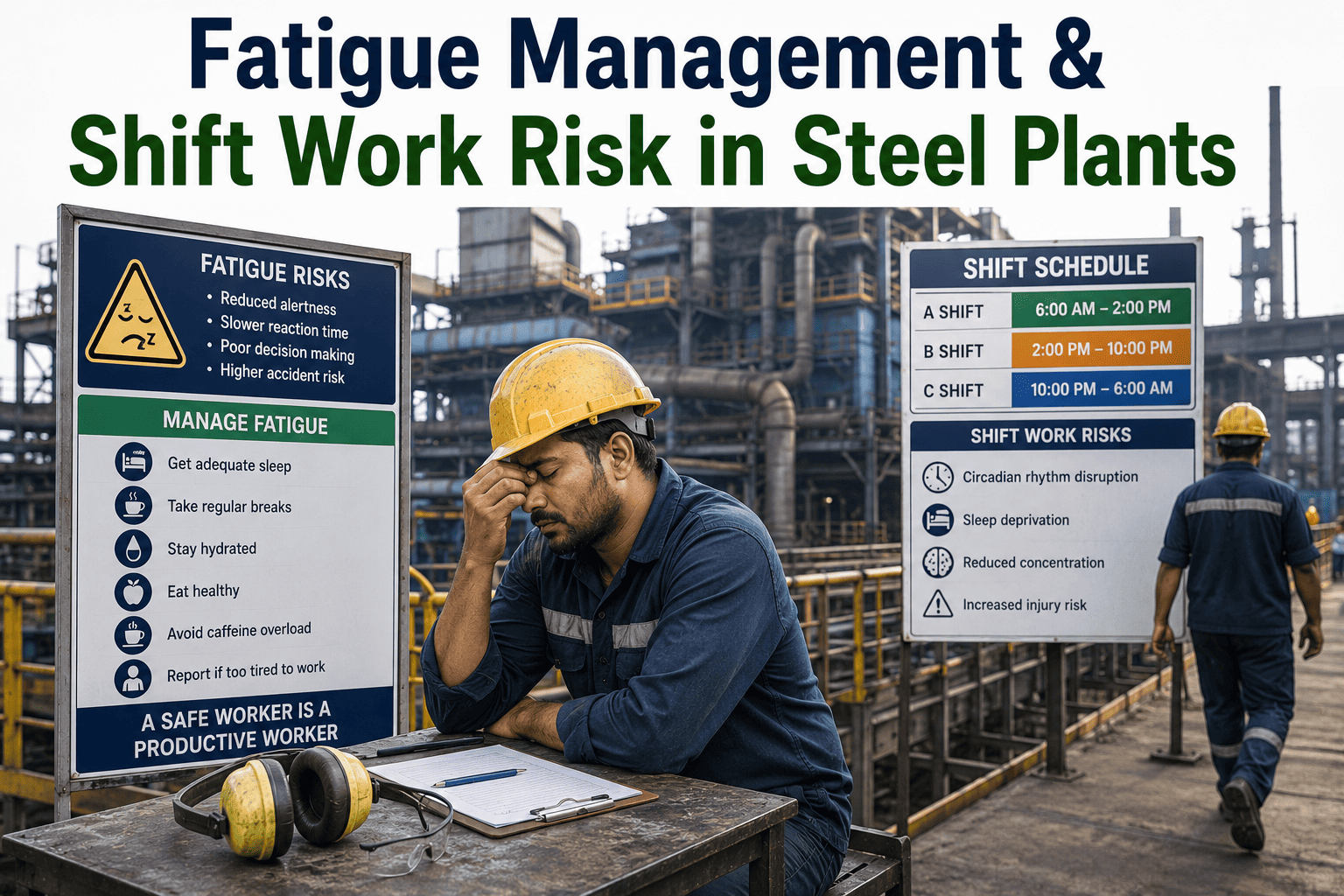
A steel plant does not stop at the end of a day shift, which means every scheduling decision made in an office eventually has to survive a 2 a.m. reality on the mill floor where reaction time, judgment, and attention have all quietly degraded from where they were twelve hours earlier. Fatigue-related impairment at the wrong hour of a rotating shift has been compared to functioning after measurable alcohol intoxication, yet most plants still build shift rotations around production coverage alone, with fatigue treated as something to manage after the schedule is already set rather than a variable built into the schedule itself. iFactory's AI builds shift rotations around fatigue science from the start, and you can book a demo to see it model your current rotation against a fatigue-optimized alternative.
Your Shift Schedule Was Built for Coverage — Not for the Hour Your Operators Are Actually Sharpest
iFactory's AI schedules 24/7 steel plant rotations within fatigue science, balancing production coverage against circadian alignment, recovery time, and cumulative fatigue load across every crew.
Why the Same Task Gets More Dangerous at the Same Hour, Every Rotation
Circadian rhythm is not a preference, it is a biological schedule your body follows regardless of what shift you are assigned. Rotating shifts, especially those that rotate backward from night to afternoon to morning, force the body to repeatedly fight that internal clock, and the cognitive cost of that fight shows up as slower reaction time, weaker attention, and degraded judgment during exactly the hours a steel plant still needs full alertness at a furnace or a rolling mill.
The frustrating part for operations leaders is that this cost is largely invisible in a standard production report. A crew that hits its output target on a night shift can still be operating at meaningfully reduced cognitive capacity the entire time, with the gap only surfacing later as a near-miss, a quality defect, or a slower response to an abnormal reading that a rested operator would have caught immediately. Scheduling around fatigue science is not about being cautious for its own sake. It is about accounting for a real, measurable performance variable that a coverage-only schedule simply ignores.
Four Fatigue Factors the Scheduling Model Weighs for Every Crew
A fatigue-aware schedule cannot look at headcount and shift coverage alone. It has to weigh how each individual rotation pattern, rest interval, and consecutive shift count compounds fatigue risk across the crew, which is precisely the kind of multi-variable balancing a manual scheduler cannot do consistently across dozens of workers and multiple rotating crews. A human scheduler working from a spreadsheet is realistically tracking one or two of these variables at a time, usually coverage and overtime cost, simply because holding four interacting fatigue variables in mind for every worker on every shift is not something a manual process can sustain week after week.
Forward-rotating patterns, moving from morning to afternoon to night, align better with the body's natural circadian drift than backward rotation, and the model favors forward rotation wherever coverage requirements allow it.
Cumulative fatigue builds across consecutive night shifts even when each individual shift is fully rested going in, so the model caps consecutive night assignments per crew member rather than only enforcing a single mandatory rest day.
The interval between the end of one shift type and the start of the next is weighed against known recovery science, flagging turnarounds too short for meaningful sleep before the next shift begins.
High-attention tasks such as crane operation or furnace monitoring are weighted more heavily during historically higher-risk hours, so the model avoids stacking your most fatigue-sensitive roles into the highest-risk window.
Forward Rotation vs Backward Rotation — What the Difference Actually Costs
Many legacy shift patterns rotate backward, from night to afternoon to morning, because it was administratively simpler to build decades ago, not because it was better for the people working it. Those patterns have often stayed in place for years simply because nobody had a practical way to redesign them without breaking coverage somewhere else in the plant. The comparison below shows what changes when a schedule shifts to a forward-rotating, fatigue-aware pattern within the exact same coverage constraints.
See Your Current Rotation Scored for Fatigue Risk
Bring your existing shift pattern and see it modeled against a fatigue-optimized alternative in the same coverage constraints.
Fatigue Does Not Show Up on a Cost Report the Way Overtime Does
Overtime spend is easy to track because it appears on a payroll line every pay period. Fatigue cost is much harder to see because it is distributed across dozens of small events, a slightly slower response here, a missed step there, a quality defect traced back three shifts later to a specific crew on a specific rotation, none of which get coded as a fatigue incident in most reporting systems. That invisibility is exactly what allows a coverage-only schedule to look fine on paper for years while quietly generating a stream of preventable cost.
It also tends to compound with the very overtime pattern plants are already trying to control. When the same reliable operators get called in repeatedly to cover gaps, their fatigue exposure increases at the same time their overtime pay increases, meaning the plant is often paying a premium rate for a worker who is operating at reduced cognitive capacity during exactly the shift being covered. Breaking that cycle requires a scheduling model that treats fatigue and overtime as connected variables rather than two separate reports reviewed by two different teams.
Every Generated Schedule Is Checked Against Your Rules Before It Reaches a Supervisor
Fatigue rules only protect anyone if they are actually enforced on every published schedule, not treated as a reference document a scheduler consults occasionally. A written policy that lives in a binder does nothing for the crew member assigned three consecutive night shifts by a well-meaning supervisor who simply did not have the policy open at the moment the schedule was built. The checklist below reflects what the AI verifies automatically before a rotation is finalized, so the rule is enforced in the schedule itself rather than relying on someone to remember it.
What Plants Report After Moving to Fatigue-Aware Scheduling
These figures reflect outcomes tracked after steel and heavy industry plants replaced coverage-only shift scheduling with AI-driven, fatigue-optimized rotation planning.
From Coverage-Only Rotation to Fatigue-Aware Scheduling
Redesigning a shift rotation sounds like it should take months of negotiation and disruption, but most plants get a working, fatigue-optimized schedule in front of their team within a few weeks by starting with the crews carrying the highest fatigue exposure first. The four steps below outline the typical path from a current, coverage-only rotation to one built around fatigue science.
Import Your Current Rotation
Existing shift patterns, crew rosters, and coverage requirements are loaded and mapped into the scheduling model.
Set Your Compliance Rules
Labor law limits, union provisions, and internal fatigue policy thresholds are configured as hard constraints the model must respect.
Generate and Compare Rotations
The model produces a fatigue-optimized rotation and shows it side by side against your current schedule for direct comparison.
Publish and Monitor
Once live, the schedule is continuously checked against fatigue and near-miss data to refine future rotations.
Questions Operations Leaders Ask About Fatigue-Aware Scheduling
A Schedule That Covers Every Shift Is Not the Same as a Schedule That Keeps Every Shift Safe
Coverage and safety look like the same problem from a staffing spreadsheet, but they are not the same problem at all. A rotation that fills every slot on the board can still be quietly stacking fatigue risk onto the same crews night after night, and that risk does not show up in a headcount report. It shows up later, in near-miss logs clustered around shift changeover, in reaction times that were a fraction of a second too slow, and in incidents that get investigated as isolated events when the real pattern was visible in the schedule the whole time.
iFactory's AI treats fatigue as a scheduling input from day one, weighing rotation direction, recovery time, and cumulative shift load against your actual coverage requirements instead of bolting fatigue policy onto a schedule that was never built with it in mind. The result is a rotation that still covers every hour your plant runs, built in a way that gives your crews a fairer fight against their own circadian rhythm.
None of this requires accepting a tradeoff between safety and output. The plants seeing the strongest results are not the ones that cut coverage to reduce fatigue risk. They are the ones that redesigned the order and interval of the same shifts they already needed to run, and let a model that can actually hold every fatigue variable at once do the balancing that a manual spreadsheet was never built to do.
Build Your Next Rotation Around Fatigue Science, Not Just Coverage
iFactory's AI schedules your 24/7 crews within fatigue and circadian science while still meeting every coverage requirement. Book a demo and compare it to your current rotation.