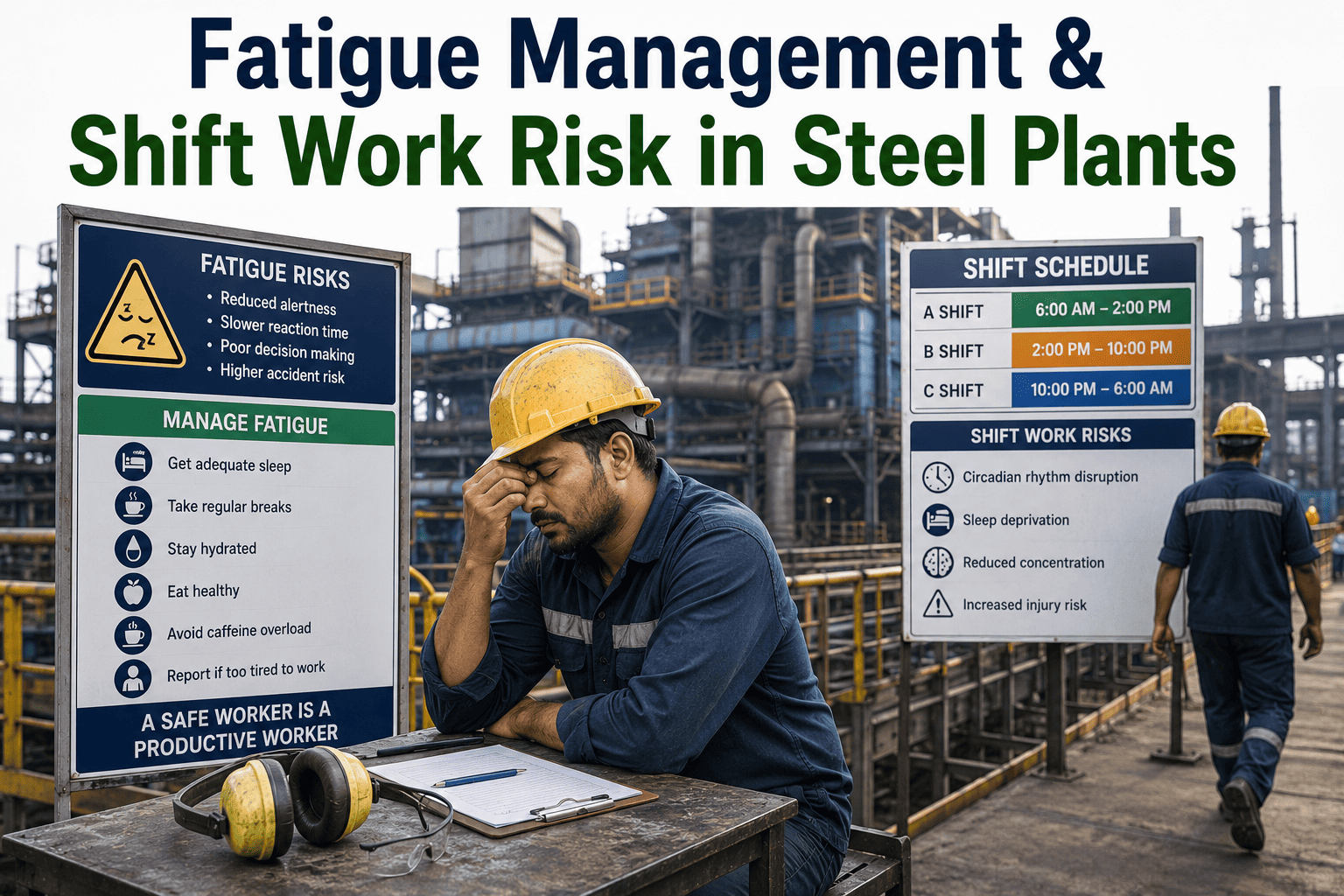
Every steel plant runs shifts because the furnace never stops, and every scheduler eventually has to answer the same uncomfortable question — how much fatigue is the roster quietly building into the crew running the night turn. The answer rarely shows up as a single dramatic collapse. It shows up as a slower reaction to a pressure alarm, a missed step in a lockout sequence, a hand placed a half-second too late near a moving line. Fatigue behaves like a hazard with no visible source, which is exactly why it survives in schedules that look compliant on paper. iFactory turns fatigue from a guess into a measured, managed variable across shift design, rest tracking, and real-time risk scoring.
Safety Analytics · Fatigue & Shift Risk
The Shift Pattern Is a Safety Control, Not Just a Staffing Plan
Rotating and night shifts carry a measurably higher injury rate than day shifts, and the gap widens with every extra hour on the roster. iFactory tracks shift design, rest periods, and fatigue indicators together so scheduling decisions are made with the same rigor as any other safety control.
The Shift Risk Curve
Injury Risk Climbs With Every Step Away From a Standard Day Shift
OSHA's own worker fatigue guidance, built on peer-reviewed injury research, lays out a consistent pattern: risk rises predictably as shifts move later, get longer, or stack on top of insufficient recovery time. The bars below use that baseline to show how much ground a night shift or a twelve-hour roster gives up compared to a standard eight-hour day shift before any other hazard is even considered.
Baseline
Day shift, 8 hours
The Sleep-Debt Line
Injury Rate by Hours of Sleep Before the Shift
Fatigue research tracking annualized injury rates against reported sleep duration found a sharp, near-linear relationship below seven hours of sleep — the exact zone many rotating shift workers live in for days at a stretch after a night-shift transition. This is the data that makes rest-period enforcement, not just shift-length limits, a meaningful lever for injury reduction.
From Roster to Risk Score
A Compliant Schedule Can Still Be an Exhausted Crew
iFactory scores every shift roster against rest-period, cumulative-hours, and circadian factors in real time, flagging the assignments that meet policy on paper but stack fatigue risk onto specific workers.
Four Compounding Factors
What Actually Builds Fatigue Risk Into a Roster
Fatigue is rarely caused by one bad shift — it accumulates across a pattern of decisions made independently by different people at different times, none of whom can see the cumulative effect the way a system tracking the whole roster can. A supervisor approving one extra overtime shift, a scheduler filling a last-minute gap with a quick turnaround, and a worker picking up a swap to cover a colleague all look like reasonable individual decisions. Stacked together across a single week, they can push one person into a fatigue zone nobody specifically chose to create.
Circadian Misalignment
Night and rotating shifts force work against the body's natural sleep-wake rhythm, and iron and steel industry research links night shift work to significantly higher odds of occupational injury compared to day shift work.
Shortened Recovery Windows
Quick-return schedules that leave less than eleven hours between shift end and shift start compress the sleep window below what most workers need, building a debt that does not fully clear on the next day off.
Extended and Stacked Overtime
Manufacturing workers logging more than 64 hours in the prior week show a substantially elevated injury risk, and overtime approved shift-by-shift rarely gets checked against the worker's cumulative hours for the week.
Consecutive Night Runs
Each additional consecutive night shift compounds sleep debt further, and alertness on the fourth or fifth consecutive night is measurably lower than on the first, even when total hours worked stay within policy.
How the System Works
Turning Fatigue From a Feeling Into a Managed Metric
A fatigue management system does not replace the scheduler — it gives the scheduler visibility into cumulative risk that a spreadsheet of shift start and end times cannot show on its own. The goal is not to remove human judgment from scheduling but to make sure that judgment is informed by the same cumulative picture every time, rather than depending on whichever scheduler happens to remember a worker's last few weeks of shifts.
01
Roster Ingestion
Shift schedules are pulled in automatically from the existing workforce management system, including planned overtime and shift-swap requests.
02
Fatigue Scoring
Each assignment is scored against rest period, consecutive nights, cumulative weekly hours, and shift-length factors using a validated fatigue risk model.
03
High-Risk Flagging
Assignments crossing the risk threshold are flagged to the scheduler before the roster is published, with the specific driver of the risk score shown alongside the flag.
04
Task Assignment Adjustment
High-fatigue-risk workers can be automatically excluded from being assigned to high-consequence tasks such as crane operation or confined space entry for that shift.
05
Trend Reporting
Site leadership sees fatigue score trends by crew, shift pattern, and department, surfacing which rosters are structurally building in risk over time.
Standards and Guidance
Where Fatigue Management Fits the Regulatory Picture
Fatigue does not have a single dedicated OSHA standard the way lockout or confined space entry do, but it is addressed through general duty obligations and referenced guidance that auditors and insurers increasingly expect sites to demonstrate they are managing.
OSHA General Duty Clause
Section 5(a)(1) of the OSH Act
Requires employers to provide a workplace free of recognized hazards likely to cause serious harm. OSHA's own published fatigue guidance treats extended and irregular shifts as a recognized hazard under this clause.
ISO 45001
Occupational Health and Safety Management
Requires hazard identification that includes work organization and psychosocial factors, under which fatigue from shift design is increasingly documented in certified management systems.
ACGIH TLV Guidance
Threshold Limit Values for Work Schedules
Provides recommended limits on extended and unusual work schedules referenced by many industrial fatigue risk management programs as a benchmark for shift design.
Where This Matters Most
Operations Running Continuous Shift Coverage
Fatigue management delivers the clearest value in operations that cannot pause for a day shift-only schedule, where rotating and night coverage is a structural requirement rather than an occasional exception.
Integrated Steel and EAF Plants
Continuous casting and furnace operations run 24/7 shift coverage where a fatigue-driven lapse near molten metal carries severe consequence.
Rolling and Finishing Mills
High-speed line operation demands sustained attention, and fatigue-related slowed reaction time directly increases pinch-point and entanglement risk.
Heavy Manufacturing and Process Plants
Continuous process operations with rotating crews share the same structural fatigue exposure as steel plants and benefit from the same scoring approach.
Logistics and Warehousing Night Operations
Overnight dispatch and receiving operations combine night-shift circadian risk with equipment operation, a combination fatigue scoring is built to flag.
Common Questions
Frequently Asked Questions
Does fatigue scoring rely on wearable devices or self-reported worker data?
The core fatigue score is calculated from schedule data already available in the workforce management system — shift start and end times, rest periods, consecutive shifts, and cumulative hours — so no wearable is required to get a working score for every worker on the roster. Sites that want a more granular picture can layer in optional self-reported alertness checks or wearable sleep data, but this is an enhancement rather than a requirement to start managing fatigue risk at the scheduling level.
Will fatigue scoring restrict how many overtime hours a worker is allowed to take?
The system does not set overtime policy — it makes the cumulative effect of overtime approvals visible before a schedule is published, so the people who do set policy can see when an approval pattern is building toward a high-risk week for a specific worker. Many sites use the flag as a prompt for a supervisor conversation or task reassignment rather than an automatic block, though hard limits can be configured for specific high-consequence roles if that fits your safety program.
How does the system decide which tasks are too high-risk for a fatigued worker to perform?
Task risk tiers are configured during setup based on your site's own hazard classification — typically aligning with tasks that already require a permit, such as confined space entry, crane operation, or energy isolation. When a worker's fatigue score crosses the configured threshold, the system flags conflicts with those specific task assignments rather than applying a blanket restriction across all duties for the shift.
Can this integrate with our existing shift scheduling and workforce management software?
Yes — the fatigue model is designed to ingest schedule data from common workforce management and time-and-attendance platforms rather than replace them, calculating risk scores on top of the roster you already build.
Reach out to support with your current scheduling platform and integration requirements can be scoped directly against it.
How quickly can a site see fatigue risk trends after rollout begins?
Once schedule data is connected, fatigue scores populate for the current and upcoming rosters immediately, and meaningful trend patterns by crew and shift type typically become visible within the first two to four weeks as enough shift cycles accumulate in the data.
Book a demo to see the scoring model applied against a sample of your actual shift patterns.
Manage the Hazard You Cannot See on the Floor
Build Fatigue Risk Into the Schedule, Not Into the Injury Report
iFactory scores every shift roster for fatigue risk in real time, giving schedulers the visibility to catch exhausted assignments before they become incidents.



-for-steel-plants-digital-compliance-framework.png)