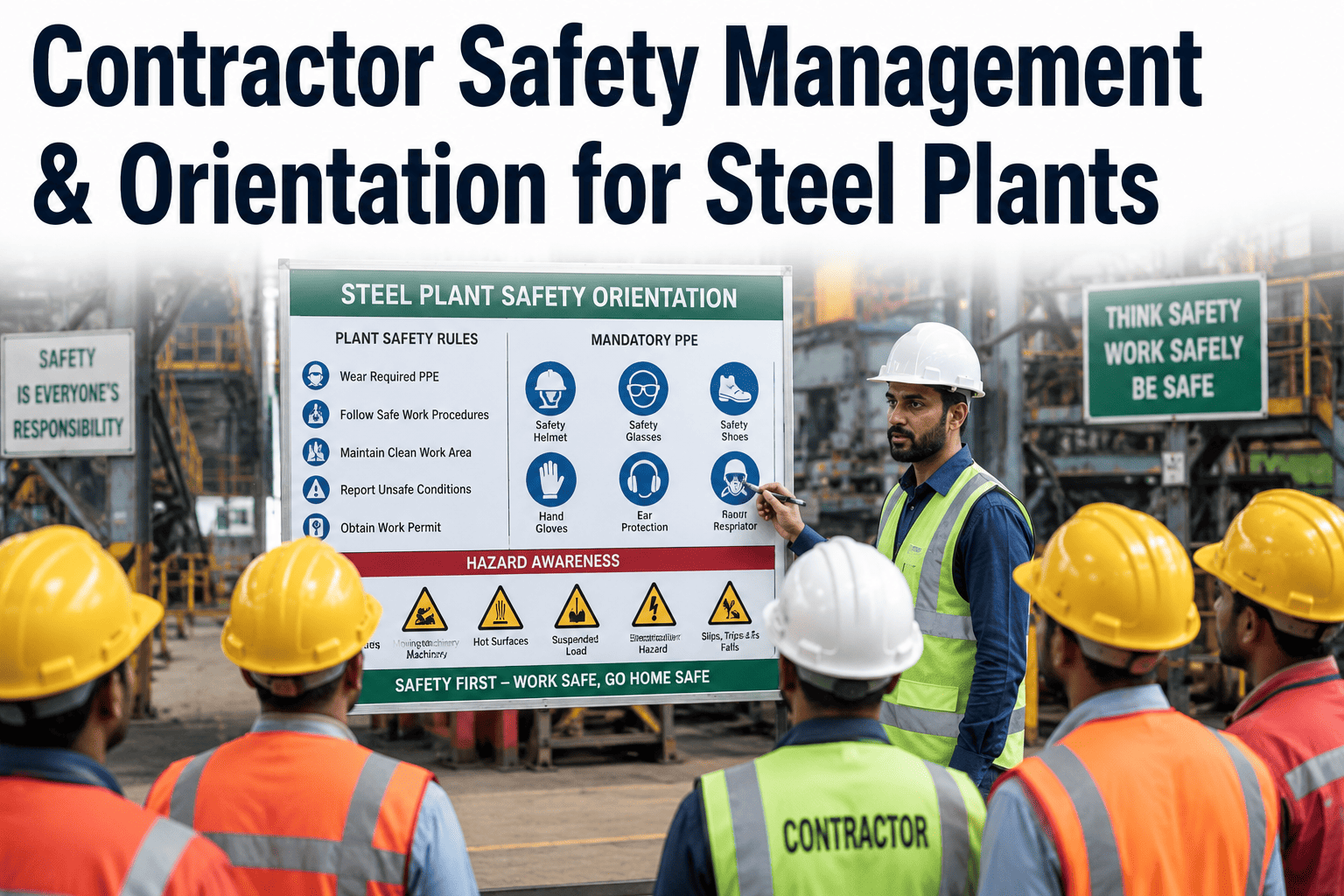
Contractors account for 38% of fatalities in the primary metals sector even though they represent a much smaller share of total site-hours than the direct workforce — and that gap is not a contractor competency problem, it's a management system problem. A steel plant is not a generic industrial worksite: overhead crane movements, molten metal transfers, confined space entries, and hot mill operations create hazards that a contractor who works construction sites the rest of the month has never been trained to recognize. iFactory helps steel plants close that gap before a contractor ever steps on site, not after an incident forces the question.
Your Contractors Are Dying at 3x the Rate of Your Own Workforce. That Gap Has a System Behind It.
Contractor safety in a steel plant runs on four levers: who you let on site, how you prepare them for hazards specific to your plant, whether they're inside your permit system or working around it, and whether you're still watching once the relationship gets comfortable.
Four Levers, and What Happens When Each One Fails Quietly
None of these failures announce themselves. A weak pre-qualification process doesn't produce an alarm — it produces a contractor with an unknown incident history who looks fine on paper. A generic orientation doesn't fail loudly — it just leaves a worker unprepared the first time they walk near a hot metal transfer route. Each gap sits invisible until the day it isn't.
What makes these four levers particularly dangerous in combination is that a strong showing on one can mask a genuine weakness on another. A contractor with an excellent TRIR who receives only a generic orientation still enters unfamiliar hazard zones without the specific knowledge that record alone doesn't provide. A plant with rigorous permit integration but no ongoing performance monitoring has no way of knowing whether a contractor's safety posture is holding steady or eroding two years into the relationship. Treating the four levers as a single connected system, rather than four separate checkboxes, is what actually closes the gap.
Pre-Qualification Gap
Contractors selected on bid price alone arrive with unverified incident histories and safety programs that were never tested against a steel plant's actual hazard profile.
Orientation Failure
A generic video covering fire exits and PPE doesn't prepare anyone for overhead crane exclusion zones, molten metal routes, or the plant's own permit requirements.
Permit-to-Work Gaps
A simplified, parallel permit process for contractors — separate from the one plant employees use — is the leading source of OSHA multi-employer citations at steel plants.
Performance Blindness
Safety records collected once at pre-qualification and never revisited mean a contractor's incident rate can triple by year three without the plant ever noticing.
Why the Controlling Employer Can't Look Away From a Contractor's Safety Record
OSHA's multi-employer citation policy is the regulatory fact that makes this a business necessity rather than an administrative preference. A steel plant acting as the controlling employer on a multi-employer site can be cited for failing to exercise reasonable oversight — even when only contractor workers were exposed and the contractor's own supervisors created the hazard. The plant's defense rests entirely on documented evidence that it required compliance, inspected for violations, and corrected what it found.
| Employer Role | OSHA Definition | Exposure at a Steel Plant |
|---|---|---|
| Creating Employer | Created the hazardous condition | Often the contractor performing the work |
| Exposing Employer | Whose workers are exposed to the hazard | Can be either party depending on scope |
| Correcting Employer | Responsible for correcting the hazard | Often the plant, if it controls the equipment |
| Controlling Employer | General supervisory authority over the site | The plant, in nearly every steel mill scenario |
A contractor safety program with documented pre-qualification, orientation, and permit oversight is the factual record that supports the controlling employer defense. Without that record, there is no defense once OSHA applies the multi-employer policy.
Pre-Qualification: Setting the Floor Before a Contractor Ever Bids
Pre-qualification exists to establish a minimum safety performance floor, not to collect paperwork. A system that approves any contractor who submits an OSHA 300 log is an administrative process with no protective function. The stronger approach combines a quantitative performance screen with a qualitative review of whether the contractor's safety programs actually function in practice.
Third-party prequalification platforms have become the practical standard for plants managing a large active contractor population, since collecting and independently verifying documentation from dozens or hundreds of individual contractors is not administratively viable through manual review alone. These platforms standardize the intake questionnaire, verify submitted documentation against source records, and maintain ongoing compliance tracking — freeing the plant's own safety team to focus on the qualitative program-function review that a platform alone can't perform.
TRIR and EMR Against BLS Benchmarks
Three-year average Total Recordable Incident Rate and workers' compensation Experience Modification Rate compared against the BLS benchmark for the contractor's specific trade — not an absolute number, since acceptable rates vary sharply by NAICS code.
Program Function, Not Just Program Existence
Evidence of implementation — training records, procedure forms, incident investigation examples — separates a functioning safety management system from a generic written program submitted to check a box.
Performance Changes, So the Screen Must Repeat
TRIR and DART data, insurance certificates, and EMR all get refreshed annually, with contractors falling below threshold placed on a performance improvement plan rather than automatically retained.
Work category matters as much as the contractor's overall record. High-hazard categories — confined space entry, crane rigging, refractory demolition, electrical maintenance — warrant a tighter threshold than general maintenance, since the consequence of a failure in those categories is disproportionately severe.
Two-Tier Orientation: General Site Rules, Then the Hazards of the Specific Area
A single orientation trying to cover both general site rules and every possible work-area hazard ends up doing neither well. The stronger structure splits orientation into two distinct tiers, each with a different scope, a different audience, and a different person responsible for delivering it.
Delivered to every contractor worker before any site access is granted
Covers crane exclusion zones, hot metal routes, the permit system overview, emergency procedures, and site-minimum PPE
Instructor-led, with a documented comprehension check, not a passive video and signature
Delivered before first entry to a specific work area, by the supervisor who actually knows that zone
Covers area-specific hazards, the permits required for the planned scope, and area emergency shutdown procedures
Documented with an area-specific form tied to the worker's access record
Site access should be contingent on a current orientation record, not on a supervisor's assumption that a returning contractor remembers what they were told a year ago. Workers without a valid record inside the past twelve months should be automatically blocked from access until re-orientation is complete.
A 20-Minute Video and a Quiz Is a Documentation Event, Not an Orientation
iFactory links orientation completion directly to site access control, so an expired record blocks entry automatically rather than depending on someone remembering to check.
One Permit System, Not a Simplified Parallel One
The permit-to-work system authorizes and closes out the highest-hazard work on a steel plant floor, and it's also the system most frequently implicated in OSHA multi-employer citations — either because a contractor bypassed the requirement entirely, or because a simplified contractor version skipped the steps that make the real system protective.
The temptation to create a lighter contractor process usually comes from a reasonable-sounding place — contractors are on tight schedules, and the full plant permit process can feel like friction that a trusted, experienced contractor shouldn't need. That reasoning misses the actual purpose of the system. The permit process exists because the hazards it controls are capable of killing people, and a contractor's schedule pressure is never a valid reason to skip a step designed to prevent exactly that outcome.
Parallel Contractor System
Contractor supervisor issues the permit with no plant involvement, verifies their own lockout, and self-certifies closeout — leaving the plant with no visibility into what's actually happening.
Integrated Plant System
A plant area supervisor issues the permit after joint hazard review, plant-applied lockout with contractor personal locks added, and plant verification before energy is restored.
The difference isn't bureaucratic. It's the difference between hazards controlled at the system level and hazards controlled only by whatever judgment an individual contractor supervisor happens to apply under schedule pressure that day.
Performance Monitoring: Treating Contractor Data With the Same Rigor as Employee Data
Pre-qualification sets the floor at the start of a relationship. It says nothing about whether that floor is holding two years in. Mature contractor safety programs track performance continuously rather than filing it away once approval is granted.
The consequences attached to this monitoring have to be real to matter. A performance improvement plan issued and then never followed up on sends a worse signal than no plan at all — it tells the contractor that the consequences of falling below threshold aren't actually enforced. Disqualification, when a contractor fails to meet improvement targets or has a serious incident, should be documented clearly enough to prevent that same contractor from quietly reappearing under a different legal entity at a later date.
Incident and Near-Miss Rate Review
Contractor recordables and near misses reviewed against site employee rates and the contractor's own baseline — a contractor reporting zero near misses across thousands of hours is a reporting-culture problem, not a safety success.
Unannounced Permit Compliance Audits
Random field verification that contractor workers are following permit conditions in practice, not just on the paperwork filed at issuance.
Formal Safety Performance Review
A structured meeting with contractor safety leadership covering incident trends, near-miss quality, and the status of any open corrective actions.
Stop-work events deserve particular attention in this rhythm. Three or more stop-work events in any ninety-day period for the same hazard category should trigger immediate performance review, and a contractor who disputes or resists a stop-work action is a categorical disqualifying signal regardless of how clean their overall record looks.
A Composite Scenario: The Contractor Whose Record Looked Fine on Paper
A composite integrated steel mill had pre-qualified a mechanical maintenance contractor three years earlier with strong initial TRIR and EMR figures. The contractor's file was never formally revisited beyond an annual paperwork renewal, and no one on the plant side was tracking incident trends against the contractor's own baseline over time.
A routine audit ahead of a major shutdown pulled the contractor's actual incident history for the full three-year window rather than just the most recent renewal snapshot, and found recordable incidents had climbed steadily each year — the contractor's current TRIR sat well above twice its original pre-qualification figure, a level that would have triggered disqualification from high-hazard work categories had it been caught at any point along the way. The mill placed the contractor on an immediate performance improvement plan with defined targets, restricted them from high-hazard work categories until the plan showed sustained improvement, and adopted a standing rule that annual renewal reviews compare the full historical trend, not just the most recent year in isolation.
Assumptions That Undermine a Contractor Safety Program
A contractor who passed pre-qualification once remains a known quantity for the life of the relationship.
Safety performance and program quality change over time, sometimes sharply, and only continuous monitoring — not a one-time gate — catches the drift before it becomes an incident.
A simplified contractor permit process is a reasonable accommodation for schedule pressure.
A parallel, simplified permit system is the leading source of OSHA multi-employer citations, precisely because it removes the plant-side verification steps that make the real system protective.
A contractor with zero reported near misses over a long stretch of site-hours is demonstrating strong safety performance.
Zero near-miss reports across meaningful site-hours is far more often a signal of reporting-culture failure than an absence of hazardous conditions.
A Checklist for Reviewing a Contractor Safety Program
Pre-qualification screens on program function, not just submitted paperwork
Requiring evidence of implementation — training records, procedure forms, incident investigation examples — filters out generic programs that look complete but were never tested.
Orientation is split into general and work-area-specific tiers
A single generic orientation can't cover both site-wide rules and the specific hazards of every work area equally well.
Contractors operate inside the plant's own permit system, not a parallel one
Full integration removes the verification gap that a simplified contractor-only process leaves open.
Performance data is reviewed against historical trend, not just the latest snapshot
A single annual renewal figure can look acceptable in isolation while masking a multi-year climb that only a trend view reveals.
Frequently Asked Questions
Can a steel plant be cited by OSHA for a contractor's violation even when plant employees weren't involved?
Yes — under OSHA's multi-employer citation policy, a plant acting as the controlling employer can be cited for failing to exercise reasonable oversight of site safety conditions, even when only contractor workers were exposed and the contractor's own supervisors created the hazard. Visit support to review how documented program evidence supports the controlling-employer defense.
What TRIR threshold is appropriate for contractor pre-qualification at a steel plant?
The right threshold should be expressed relative to the BLS industry benchmark for the contractor's specific trade rather than as an absolute number, since acceptable rates vary meaningfully by NAICS code — a tighter multiple applies to high-hazard categories like confined space entry or crane rigging than to general maintenance work.
How long should a general site orientation run at a steel plant with significant hot metal and crane operations?
A general orientation shorter than roughly ninety minutes to two hours generally can't credibly cover crane hazards, permit system overview, molten metal exclusion zones, emergency procedures, and PPE requirements with genuine comprehension rather than passive exposure. Book a demo to see how orientation tracking ties into site access control.
Should contractors apply their own lockout/tagout procedures or the plant's?
When contractors work on equipment covered by the plant's own LOTO procedures, the plant's procedure governs — the plant's authorized isolator applies primary lockout, and each contractor worker adds a personal lock, rather than a contractor applying an unfamiliar generic procedure to equipment they haven't been specifically trained on.
How often should contractor safety performance be formally reviewed after initial approval?
A monthly incident and near-miss rate review, ongoing unannounced permit compliance audits, and a quarterly formal review meeting with contractor safety leadership together give a plant continuous visibility rather than relying solely on an annual re-qualification snapshot. Contact support to structure a monitoring cadence for a specific contractor population.
Manage Contractor Risk Before Work Begins, Not After an Incident
iFactory centralizes contractor pre-qualification, two-tier orientation tracking, permit-to-work integration, and ongoing performance monitoring in one platform built for steel plant hazard density.





-for-steel-plants-digital-compliance-framework.png)