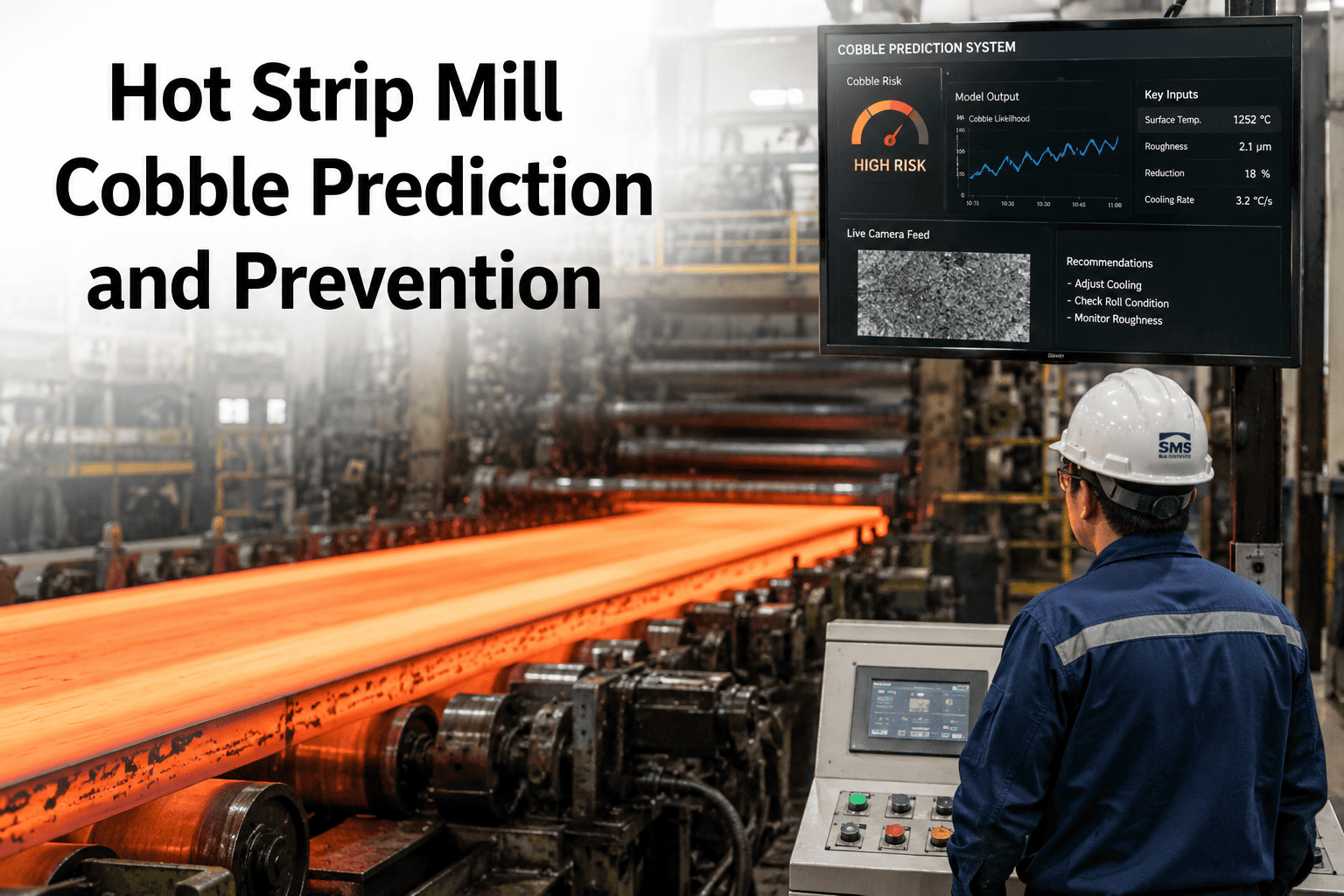
A cobble on a hot strip mill happens fast — a strip buckles, folds over itself, or snakes off the pass line, and within seconds a coil that was worth tens of thousands of dollars becomes scrap tangled around a mill stand. The direct cost of a single cobble typically runs $50,000 to $300,000 once material loss, roll damage, and cleanup are counted, and the mill sits down for one to six hours while the tangle is cleared and equipment is inspected for damage. HSM process engineers have relied on operator experience and post-event root cause analysis to manage this risk for decades — reactive by necessity, because nobody had a reliable way to see a cobble coming. AI cobble prediction changes that by monitoring mill stand parameters across every pass in real time, flagging rising risk before the strip actually fails. You can book a demo to see this risk model running against live mill stand data.
What a Cobble Actually Costs — Beyond the Obvious Scrap
The headline number on a cobble is the lost material, but that's rarely the largest cost. Roll damage from a tangled strip wrapping around a work roll can force an unplanned roll change, adding hours to the recovery beyond the initial cleanup. Downstream schedule disruption pushes every subsequent coil back, which can cascade into missed shipment commitments if the cobble happens late in a shift. And every cobble carries a safety dimension — clearing a tangled mill stand is inherently hazardous work, which is exactly why prevention matters as much for crew safety as for cost.
There is also a less visible cost that rarely appears in a formal incident report but shows up clearly in a mill's annual performance numbers: the conservative operating margins that crews adopt after a bad cobble event. It is a completely reasonable human response — after a costly incident, operators and process engineers naturally pull back on speed, tension targets, or pass aggressiveness to reduce risk of a repeat. That caution protects against another cobble, but it also leaves throughput and yield on the table for weeks or months afterward. A mill running scared is not running at its actual capability, and that gap between cautious operation and confident operation is itself a real cost that continuous risk monitoring helps recover, because operators can trust the system to flag developing risk rather than relying purely on instinct after a bad memory.
The frustrating part, from a process engineering standpoint, is that cobbles are rarely truly random events. Post-incident root cause analysis on most cobbles reveals a pattern — a tension deviation that built up over several passes, a temperature drop that changed flow stress right before the incident, a roll gap asymmetry that had been trending for a shift. The data that would have predicted the event was almost always available. The problem has never been a lack of data; it's been the absence of a system watching all of it continuously and correlating it into a single risk signal.
Head End, Tail End, and Neck Cobbles — Why Location Changes the Cause
Not all cobbles share a root cause, and where along the strip a cobble occurs is often the single biggest clue to what triggered it. HSM process engineers who separate cobble analysis by location — head, tail, or mid-strip neck — consistently identify patterns that a single aggregated "cobble rate" metric obscures entirely. Treating all cobbles as one undifferentiated category is a bit like treating every equipment failure the same way regardless of which component failed — technically true that something broke, but useless for actually preventing the next occurrence.
The Mill Stand Parameters an AI Model Actually Watches
A cobble prediction model earns its accuracy from the breadth and resolution of the mill stand data it monitors continuously, pass by pass. Isolated parameter monitoring — watching tension alone, or roll force alone — misses the interactions between variables that most often precede an actual cobble event. Book a demo to see which parameters matter most on your specific stand configuration.
Reactive Root Cause Analysis vs. Real-Time Risk Prediction
Traditional cobble management is fundamentally reactive — an event happens, the mill goes down, and an investigation reconstructs what went wrong after the fact. That analysis is valuable for preventing repeat occurrences of the exact same failure mode, but it does nothing for the cobble that's forming right now, in real time, from a slightly different combination of contributing factors. The fundamental limitation of reactive analysis is that it only ever teaches a mill about the specific failure modes it has already experienced — it has no mechanism for catching a novel combination of contributing factors that hasn't previously resulted in a full cobble event, even if that combination is drifting toward one right now.
| Capability | Reactive Root Cause Analysis | Manual Parameter Watching | AI Real-Time Prediction |
|---|---|---|---|
| Timing of insight | After the cobble has occurred | Depends on operator attention span | Continuous, before failure |
| Parameters correlated simultaneously | Reconstructed manually post-event | One or two at a time, typically | All mill stand parameters, continuously |
| Detects developing risk across passes | No — single-event focused | Limited by operator recall | Yes — trend-aware across the campaign |
| Prevents the specific event in progress | Not possible | Only if noticed in time | Alert generated before failure threshold |
| Typical cobble rate reduction | Baseline | 10–15% with disciplined process | 35–55% reported by early adopters |
How Risk Signals Escalate From Normal to Critical
The value of a prediction model is not a single alarm threshold — it's a graduated risk signal that gives process engineers time to intervene before conditions reach a point where a cobble is nearly unavoidable. Book a demo to see how these thresholds are tuned to your specific stand configuration and product mix.
What Cobble Reduction Is Actually Worth to an HSM Operation
The financial case for cobble prediction rarely needs much elaboration once a mill has experienced even a handful of significant cobble events in a year. The combination of direct cost, downtime, and cascading schedule disruption makes even a modest reduction in cobble frequency one of the highest-ROI investments available to an HSM operation. A mill running three to five significant cobbles a year at an average of $120,000 in direct cost alone is looking at $360,000–$600,000 in annual exposure before downtime and schedule disruption are even factored in — a figure that makes even a partial reduction in frequency deliver a fast payback on monitoring infrastructure.
Deploying Cobble Prediction on an Existing HSM — What It Involves
Cobble prediction is designed to layer on top of existing mill stand instrumentation and process control systems rather than replace them. Most HSM operations already generate the underlying tension, roll force, temperature, and speed data the model needs — the gap has been correlation and continuous monitoring, not data availability. This is precisely why deployment timelines tend to be shorter than process engineers initially expect: the hardest part of most industrial AI projects is getting good sensor data in the first place, and HSM operations largely cleared that hurdle years ago when they instrumented their mill stands for automation and process control.